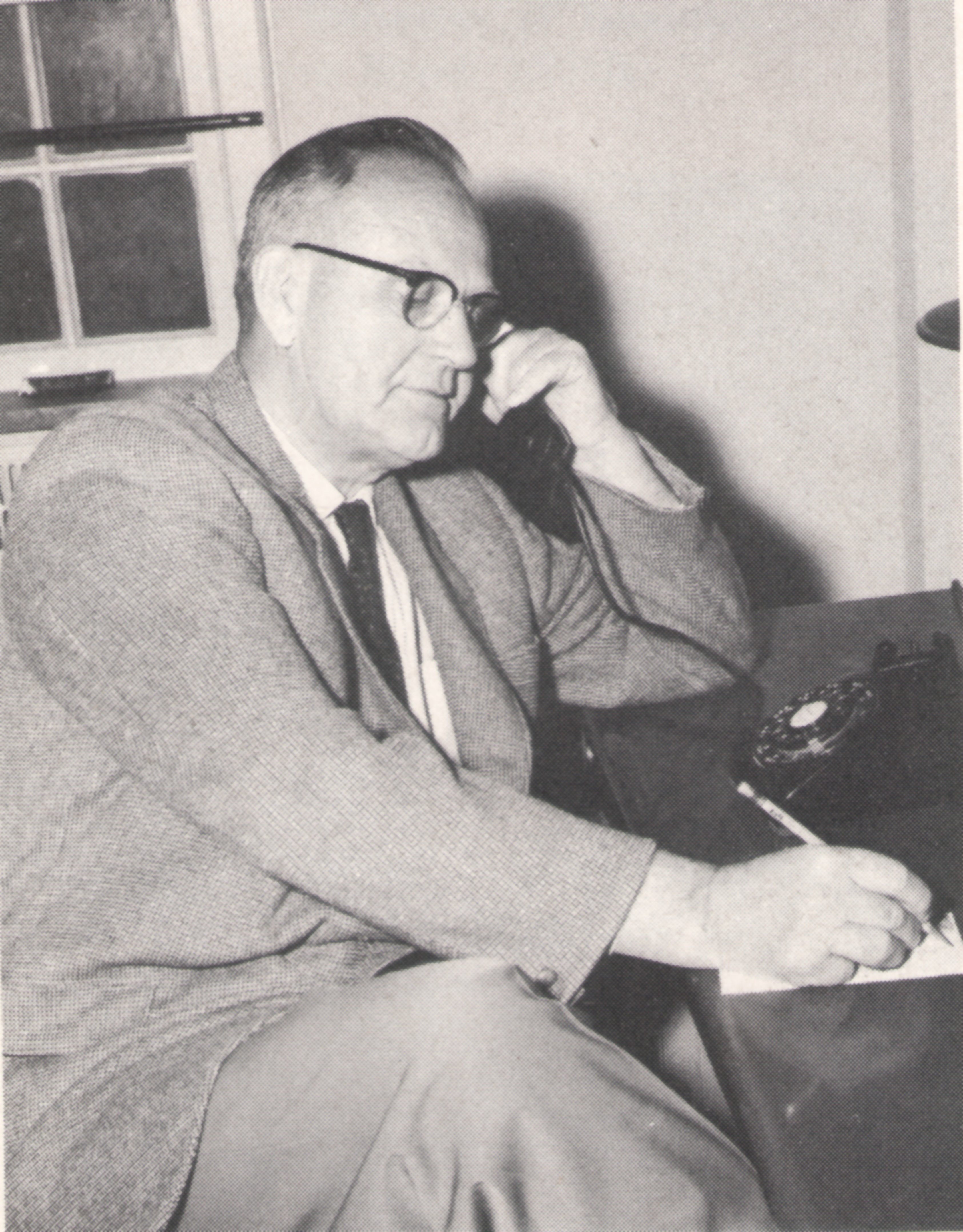
3. Playing eighteen holes with someone is a good way to take his or her measure. The game has a way of magnifying character flaws—whininess, explosiveness, dishonesty, lack of charity, self-delusion—that may be less detectable in off-course situations. You can know a guy for twenty years and not realize he’s an asshole until you’ve played a round of golf with him. The much-derided male custom of cultivating business relationships on golf courses actually has demonstrable value. Would you really want to invest your life’s savings with somebody who had just toed his ball into a better lie when he thought you weren’t looking?
Author Archives: David Owen
Tom Watson, Seventh Grader
Tom Watson and I had the same seventh-grade math teacher. Watson is six years older than I am, but we attended the same school, in Kansas City. It was called Pembroke-Country Day then and is called Pembroke Hill now. It was boys-only in our day; it began to go co-ed when I was a senior.
My father had had the same math teacher, too, many years before. In my father’s day, the math teacher’s nickname was Tarz, short for Tarzan, because he was built like Johnny Weissmuller; by the time Watson and I had him, his nickname was Wheezer. He looked like Lyndon Johnson, with tremendous gravity-stretched jowls and ear lobes. Age must have lengthened his scrotum, too, because he was always careful to lift his testicles out of the way before sitting in a chair or leaning back against the front of his desk. Sometimes, my friends and I, as we took our seats for math, would pretend to lift our testicles out of the way, too.
Wheezer supervised one of my study halls. One day, an eighth-grader hid a running tape recorder inside a locker in the back of the room, and every five or ten minutes the tape would scream, “WHEEEEEEE-ZER!” There would be pandemonium; then, gradually, everyone would settle down; then it would happen again.
When Watson was in high school, in the mid-sixties, he was the captain of the golf team, of course, but he was also an outstanding shooting guard on a very good basketball team, and he was the quarterback (and leading rusher) on the football team, which won a conference championship. He would put his golf clubs away every August, when two-a-day football practices began, and he wouldn’t touch them again until February, when basketball season was over—a mentally and physically healthy approach to sports that athletic prodigies don’t follow anymore.
I never saw Watson play golf, but I did cheer for him at basketball and football games. Then, in 1967, he went off to Stanford without a scholarship, figuring he’d end up in the insurance business.
Watson was the subject of one of my first magazine articles, a profile for Esquire, which ran in 1982. I had to revise the ending over the summer, as it went to press, because he suddenly won the U.S. Open, at Pebble Beach, after making his famous chip-in birdie on the seventeenth. And then, in July, after the issue could no longer be updated, he won the British Open, too.
These photographs are from Pembroke-Country Day’s yearbook for 1967, when Watson was a senior and I was in sixth grade. I’m pretty sure I was in the bleachers at the football game below, because my friends and I didn’t miss many. Watson is at the far left.
Winter (Such as it Was) is Over
Six of us played at Tunxis Plantation this morning, and two of us wore shorts. The grounds crew had just finished mowing the greens for the first time in 2012, and the grass became noticeably greener as we played. By the time we putted out on the eighteenth, at a little after 11:00, even shorts felt sort of suffocating.
Our superintendent played with us. He said that he attends a meeting at Tunxis in late March every year, and that in the past the course has always been closed and, usually, either covered with snow or frozen. That won’t be the case this year. The parking lot was filling as we drove away (to the barbecue place down the road), and the thermometer in my car read 67 degrees.
Masters Countdown: First Hole

Augusta National's first green in the early 1930s, when it was still the tenth. The bunker was later removed and a different bunker was added, closer to the green. The putting-surface contours haven't changed much, however.
In Augusta National’s early years, a small creek ran across the first fairway, at the bottom of the hill, less than a hundred yards from the tee. The carry over the ditch was so short that few players even noticed the hazard, but a member named Clarence J. Schoo—who ran a boxboard manufacturing company in Springfield, Massachusetts, and was a close friend of the club’s chairman and co-founder, Clifford Roberts—drove into it so often that it came to be known as Schooie’s Gulch. After topping yet another drive into the creek one day, Schoo said to Roberts, “I wish you’d fill in that damn ditch.” Roberts did fill in the ditch, during the summer of 1951—and sent the bill to Schoo.
That, at any rate, is how the story is usually told. The real reason for eliminating the ditch was that the club wanted to replace its old press tent with a Quonset hut, on a site to the right of the first fairway, and the ditch was in the way of the planned foundation. The ditch also constituted a maintenance headache that Roberts wanted to eliminate. Schoo, who later became a vice president of the club, did gladly pay for part of the alteration, but he almost certainly wasn’t surprised when he opened his bill.
Schoo was such a poor golfer that when he one day made a natural birdie Roberts decreed that he should be paid the same cash pot that was ordinarily given to golfers who made holes-in-one, on the theory that Schooie was never going to come any closer. Another time, while playing the seventh hole in a foursome that also included Roberts and former President Dwight Eisenhower, Schoo hit a dreadful drive that traveled just a few yards, into a clump of pampas grass to the left of the tee. Schoo said, “Well, in all the years I’ve been playing here, that’s the first time I’ve done that.” That summer, the grounds crew cut back the pampas grass and found several balls with his name imprinted on them. On another occasion, Schoo declared with exasperation that he must be the worst golfer in the club. His caddie, who had been around long enough to hear stories but not long enough to recognize individual members, said, “No, sir. The worst golfer in this club is Mr. Schoo.”
Want a $12,000 Bulletproof Golf Shirt?
On my first day in Colombia, two women in an old Toyota drove me to an industrial park on the outskirts of Bogota. There, in a building that from the outside looked like a warehouse, the man I’d come to interview—early forties, black hair, not tall—shot me in the abdomen with a .38-calibre revolver. I felt a thump in the gut, then nothing. The man was Miguel Caballero. He’s the founder and chief executive of a company that makes “specialized personal protection,” and when he shot me I was wearing one of his products, a black suede jacket with lightweight bulletproof panels in the lining. The company, which is called Miguel Caballero, makes fashion-oriented body armor, and sells it mainly to executives, celebrities, political figures, and others who have security concerns but don’t want to dress like members of a SWAT team. Popular items include a three-button blazer, a V-necked wool sweater, a Nehru vest (for customers in the subcontinent and, conceivably, for anxious idolizers of Sammy Davis, Jr.), and a polo shirt, which, because of its extra bulk, may usefully promote a compact golf swing. Caballero also makes bulletproof camouflaged hunting clothes,to protect hunters from misdirected shots fired by their companions—an eventuality that he referred to as “a Dick Cheney accident.”
Before shooting me, Caballero hollered across the main manufacturing area to warn the several dozen workers there—most of them women sitting at sewing machines-to put on ear protection. They complied without apparent curiosity. Carolina Ballesteros, who is the company’s design director and Caballero’s fiancée, told me that being shot by her boyfriend is “very normal”: he has more than two hundred employees and has shot most of them (including Ballesteros) at least once, a practice that encourages team loyalty and close attention to quality control. Caballero, nevertheless, is aware of the dramatic possibilities, especially when the target is a visiting journalist. After removing his revolver from its case, he held out an open box of Colombian military ammunition, and—saying, “We respect the human rights”—invited me to select my bullet. He positioned me at a slight angle to himself, near a tabletop shrine to the Virgin Mary. (“This is a Catholic country,” he’d explained earlier, when he noticed me looking at the shrine.) He told me that he was going to count to three, and that when he began counting I should take a big breath and hold it. He asked me to point to my belly button, then held the pistol’s barrel a few inches from my descending colon and closed his eyes, as if praying or collecting his thoughts, while one of his suppliers took photographs with my camera. The jacket felt a bit heavy, but pleasantly so—like a dentist’s X-ray apron. After firing, Caballero lifted my shirt to check my abdomen for bruising, and found none. Then he used a pair of long-nosed pliers to extract the bullet from inside the suede. It was flattened and rounded like a mushroom cap, and it was still hot.
I wrote about Caballero and his company in The New Yorker. He has a retail boutique at Harrods, in London, where some of the golf shirts sell for the equivalent of about twelve thousand dollars.There’s no further mention of golf in my article, but bulletproof technology is pretty interesting. Below is a brief video of me being shot. The video was made by Caballero’s public-relations assistant, on her iPhone:
Sunday Golf in Brooklyn
There are a dozen public courses in New York City, and they stay open all winter, as long as the ground is snow-free—as it usually is, thanks to the urban heat island effect and the proximity of the Atlantic Ocean. On Sunday, as Rory McIlroy was moving to the top of the world ranking, six members of my regular Sunday Morning Group and I drove to Brooklyn for a round at Marine Park. (Several of our favorite city courses have enticingly warm-sounding names: Marine Park, Pelham Bay, Dyker Beach.)
Marine Park is situated a few miles from J.F.K. International and a few hundred yards from Floyd Bennett Field, which was the city’s first official airport. (When Howard Hughes set a record by flying around the world in ninety-one hours, in 1938, his trip began and ended at Floyd Bennett. The old runway area is now a somewhat dystopian-looking public park and a New York Police Department helicopter base.) The golf course covers a little over two hundred acres inside the elbow formed by Flatbush Avenue and the Belt Parkway. It was designed by Robert Trent Jones and was completed in 1963—just in time for the World’s Fair, which was held virtually next door, in Queens, the following year. The holes have a genuinely linksy feel: few trees, subtly undulating topography, exasperating wind off Jamaica Bay (another warm-sounding name). There’s more broken glass in the bunkers than you’d find at Troon or Carnoustie, and the views from some of the fairways include more barges and giant dump trucks. But the greens on Sunday were fast and terrific, even though nobody had mowed them in months.
In 2007, New York City accused the company that was operating Marine Park of having ties to organized crime, and revoked its lease. The new lessee is investing millions in the course, and has renovated the club house and added a driving range. We saw huge piles of topsoil alongside a number of the fairways—raw material for improvements to come. The guy manning the cash register in the golf shop, who was also the starter, told us that the days when old car parts and toilet seats would sometimes pop up through the turf are gone.
When we’d finished our round (after playing the last few holes as a sevensome, since there were slowpokes ahead of us and no one behind), we caravaned to Pipin’s Pub, in Bay Ridge. We’ eaten lunch there before—on New Year’s Day 2008, after playing a cold, wet round at Dyker Beach—and ever since then we’d been meaning to go back, partly because almost the entire first page of the menu is devoted to various kinds of cheeseburger. The day’s winners threw all their winnings into the lunch pot, as we almost always do during the off-season, and we ended up leaving a huge tip because with seven people the arithmetic was just impossible.
Tiger, Continued
In 2006, when I was working on the Men’s Vogue article about Tiger Woods that I mentioned yesterday, Woods showed me around the men’s grillroom in the clubhouse at Isleworth, the gated golf community where he lived. He pointed out its many man-friendly amenities, among them a pool table, a Ping-Pong table, numerous pinball machines and videogames, a true-rolling artificial putting green, a miniature basketball court, and a long row of leather easy chairs, which were lined up in front of a flat-screen TV that was hanging above a fireplace. “There are a lot of divorces here,” he said, and we both laughed.
Ha! Who knew? He was probably already fouling his nest, as my late father would have put it, but his public self-immolation was still a few years away. If there’s anyone other than Woods himself who might gain by meditating on his troubles, it’s parents who—inspired by his remarkable life, perhaps—entertain serious athletic ambitions for their own children. Ask any pushy sports dad whether he’d be happy for his son or daughter to achieve superstardom, and he’d undoubtedly say yes. But striving for supremacy, in any endeavor, is a morally treacherous proposition. Great athletes become great in part by learning to coldly exploit the weaknesses of others, and by treating their own desires as global priorities. What we usually refer to as an athlete’s “sacrifices”—the pre-dawn wake-up calls, the endless, lonely hours in the gym or on the driving range—are really acts of narcissism, carried to a sweaty extreme. One of Woods’s many appealing characteristics, pre-scandal, was that he seemed at least moderately concerned about the world beyond his own accomplishments. The mess he made of his family is a useful reminder that being a good person, no matter how many advantages you seem to have, is as difficult as it looks, especially if you’re in a position to take your sexual fantasies live—a temptation that famous athletes often seem to resist about as successfully as rock stars.
Nevertheless, as I wrote yesterday, I enjoyed hanging around with him—and I would guess that virtually all the other people present on those days did, too. He arrived by himself, in his own car, without an entourage, and he cheerfully did everything he was asked to do. A woman who worked for one of his corporate sponsors told me that he never complained, much less threw a celebrity tantrum. In Los Angeles, he spent much of the day shooting motion-capture footage for a video game. He had to lie still as two technicians from Electronic Arts, the video game’s publisher, affixed eighty-eight BB-size motion-capture reflectors, called markers, to his face, neck, and upper chest, and as they worked he chatted with them amiably. Then he spent almost two hours sitting in what looked like a dentist’s chair inside a pod-like enclosure, which was as brightly illuminated as an operating room, and had to keep his head motionless while saying things like “A bear bit me in the forest today” and “I never jump quickly off a truck”—sentences that contain phonemes which can be digitally reshuffled into custom dialogue.
Another of his professional commitments that day was to spend half an hour conversing with Edward Barry-Walsh, a seventeen-year-old English boy (and four-handicap at Sunningdale), who, as a result of winning a contest sponsored by Electronic Arts, was going to be included as a character in the game. Woods sat next to him on a couch, put his feet up on the coffee table, and gave no indication whatsoever that he was keeping track of the time. Barry-Walsh had written a number of questions on a sheet of paper. He seemed nervous at first, but Woods set him at ease and after a while he put the list away.
When Barry-Walsh couldn’t think of anything else to ask, Woods posed for photographs with him and his parents, discussed the proper technique for hitting lob shots over living-room furniture, and looked ahead to the day when Barry-Walsh would be “out there kicking my butt.” Later, Barry-Walsh told me that the experience had far exceeded his expectations, and marveled, “He’s just such a down-to-earth bloke.” Not even close, we learned later.
Four and a half years after their conversation, Barry-Walsh made the cut and finished tied for forty-third in the 2010 Castle Dargan Irish Masters, a European mini-tour event. But, unless he subsequently enjoyed triumphs that Google knows nothing about, that was the zenith of his professional golf career—maybe not the unluckiest thing that could happen to a talented young man.

Bunker Dogs
This afternoon, I took a walk on my home golf course with my dog, Henry the Dog. I let him off the leash, and he spent most of the walk running far ahead. On the sixth hole, he surprised himself, after racing across the green, by going airborne over the lip of a bunker. He landed halfway across the sand, like an Olympic long-jumper, then spent five minutes repeating the jump and running in tight circles, pausing occasionally to dig a hole.
Then he stopped to catch his breath and study what he had done, and we headed back toward the parking lot. I’ll rake that bunker in the spring.
Henry reminded me of another happy dog I walked a golf course with, on the island of South Uist, in far northwestern Scotland, in 2007. That dog almost disappeared down a rabbit hole:
My Close Personal Friend Tiger Woods
In late 2005 and early 2006, on assignment for Men’s Vogue in Los Angeles and Orlando, I got to spend some time hanging around with Tiger Woods. (Woods wanted Vogue to pay attention to his clothing lines and so had agreed to be interviewed at some length by a print reporter, something he ordinarily hates and rarely does.) He buffaloed me on at least one issue—he described his marriage as one of the proudest achievements of his life—but I liked him a lot, and I enjoyed being with him, and I found him much more interesting to talk to than, for example, any of the handful of Major League Baseball players I had to interview, many years ago, on an assignment for the short-lived magazine Inside Sports. (Imagine the most annoying jock in your high school class permanently frozen at his moment of maximum annoyingness.) Woods gets close to zero credit for being forthcoming, but, actually, over the years he has intelligently explained a huge amount about what goes on in his mind as he competes—more than any other great athlete I can think of.
He has also been surprisingly nonchalant about the potential peril of getting out of the bed in the morning. He loves roller coasters. He races down double-black-diamond slopes despite not knowing all that much about skiing. He has taught himself to hold his breath underwater for four minutes, and he has dived to a hundred feet without scuba tanks. He has gone bungee jumping in New Zealand. And he drives his car too fast, in my middle-aged opinion. Also, of course, those cocktail waitresses.
In Florida, the idea was that Woods would put on a Prada suit and zip around Lake Butler on a jet ski while the photographer chased him in a power boat. But there was a problem. The sky had darkened steadily through the morning, and the wind had picked up to thirty miles an hour, and the National Weather Service had issued a small-craft advisory. The owner of the power boat said the water was so choppy that if he ventured onto the lake he might not be able to return to the same dock. Canceling the shoot would be the prudent thing to do, everyone agreed—except Woods. “It’s not that rough,” he said, like a ten-year-old making a case for visiting Disney World in a thunderstorm.
Woods eventually prevailed on the weather issue. After a few minutes on the water, though, he circled back toward the dock, and I and all the other people on shore assumed that the ugly conditions had brought him to his senses. But then he shouted, “How fast is this thing supposed to go?” It turned that he hadn’t been able to crank the jet ski to anything like its top speed, 60 m.p.h., and he couldn’t figure out what might be wrong. A neighbor of the jet ski’s owner removed several handfuls of weeds from under the hull, and Woods happily took off again, at full throttle.
Thirty minutes later he was back on land, very pleased. As he changed out of his wet clothes, he said, “Watch this,” and poured a half-cup of water from one of his Cole Haan oxfords
With a great deal of trepidation, I’m going to open this blog to comments. But I can always change my mind. Real names, please.
The Invisible Fence
Late last season, a regular golf buddy of mine explained why he hadn’t shown up the previous Sunday: “I was stuck behind the Invisible Fence.” His wife doesn’t make him wear a shock collar, but almost. When she sees him tiptoeing toward the door and smells sunscreen, she gives him a zap.
Another friend had to beg off one weekend because his family was holding a reunion. “I’ve got an idea,” I said. “We’ll call Sunday’s round a tournament, and we’ll dedicate it to the memory of your father [who had been an avid player]. That way you’ll have to play.” We ended up not, but only because he didn’t think it would work.