Traveling to Golf by Air, Land, and Sea

machrihanish

I don’t like to fly on the same plane with soccer teams, Cub Scout dens, Shriner lodges, or similar groups, because it’s too easy to imagine the headline the following day: “Plane Carrying All Members of Small Order of Spanish Nuns Goes Down in North Atlantic.” So I felt more than slightly anxious when, a few minutes before our scheduled departure, two dozen members of a Scottish cheerleading team, who had had to run to make their connection, boarded our plane. I learned later that the team was from the Blast Cheer & Dance Academy, in Glasgow, and that they had just won an international title of some kind at a big competition in Virginia Beach, Virginia. 
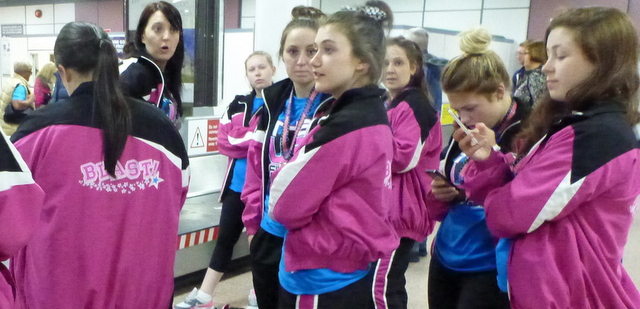
blast

Miraculously, the flight went smoothly, and on Saturday morning at 7:30 eleven friends and I landed in Scotland, ready to play golf. We were met at the airport by a bus from Celtic Golf, which planned our trip.
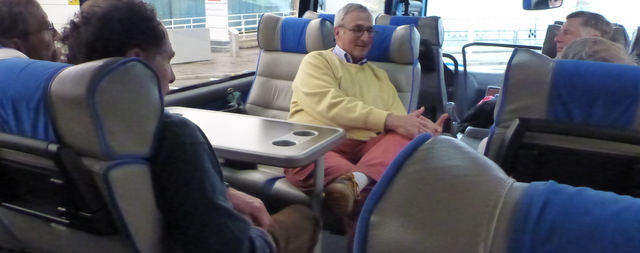
on the bus

Our bus driver’s name was Dave, and that’s also the name of a quarter of the people on our trip. The only kind of people we have more of is lawyers. When the lawyers reply-all to golf-trip emails, the boilerplate disclaimers at the bottom pile up like litter against a parking-lot fence.
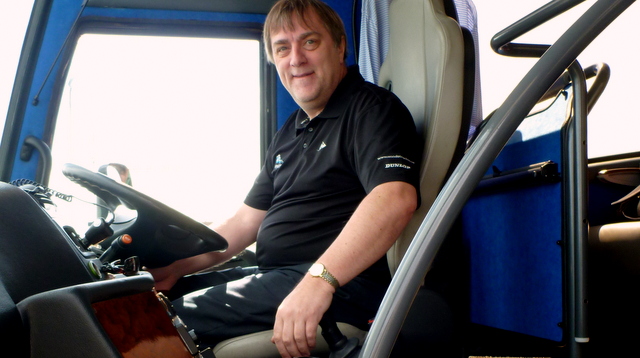
Dave

That first day, straight from the airport, we played two rounds, one at Western Gailes and one at Dundonald, which is next door. Everybody loved Western Gailes and was basically OK with Dundonald, which is owned by the people who own Loch Lomond. The picture below is from Western Gailes, and two of the people in it are named Dave.
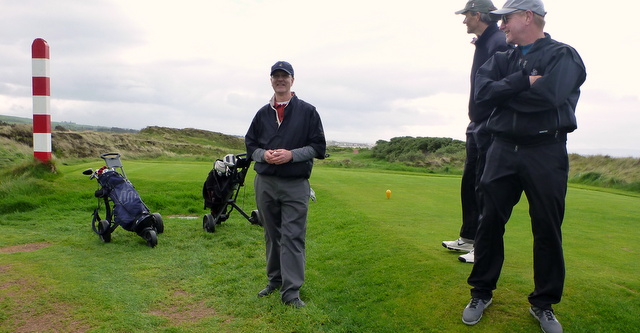
western gailes

Dave the driver had told us to be ready to roll at 10:30 the next morning. I didn’t see Peter A. as we were loading our stuff onto the bus, so at 10:35 I called his room from the front desk of our hotel. He picked up after about twelve rings, and said, Yeah, yeah, I’m on my way—and five minutes later we left. That afternoon, he told me that he had actually been asleep when the phone rang, and that he had set a personal record for getting dressed, packing a suitcase, and vacating a hotel room.

bus

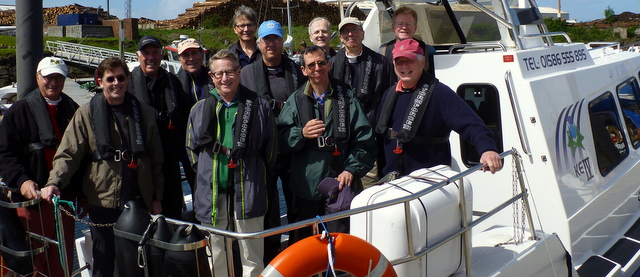
That morning, the bus took us not to a golf course but to Troon Harbor, where we boarded a chartered twelve-passenger motorboat, owned by a company called Kintyre Express. The boat took us to Campbeltown, the home of Machrihanish Golf Club, on the Kintyre Peninsula. 
P1120258

Machrihanish is hard to get to by car; going by boat knocks a couple of hours off the trip. Nice scenery, too.

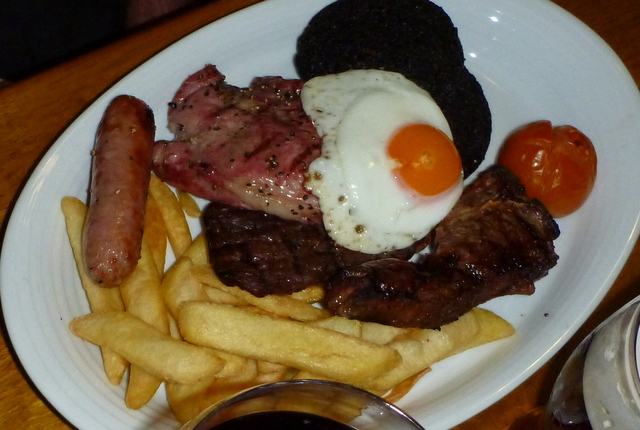
lighthouseMachrihanish has been on my golf dream list for a long time. I’ll have more to say about it later. After three days there, we had to get back on our boat, and move on to our next destination, so that we could play more golf, but somewhere else. I’ll have more to say about that soon, too. In the meantime, here’s what Tony and David M. had for dinner our first night in Campbeltown:
mixed grill

Reader’s Trip Report: Pinehurst, North Carolina
photo 1

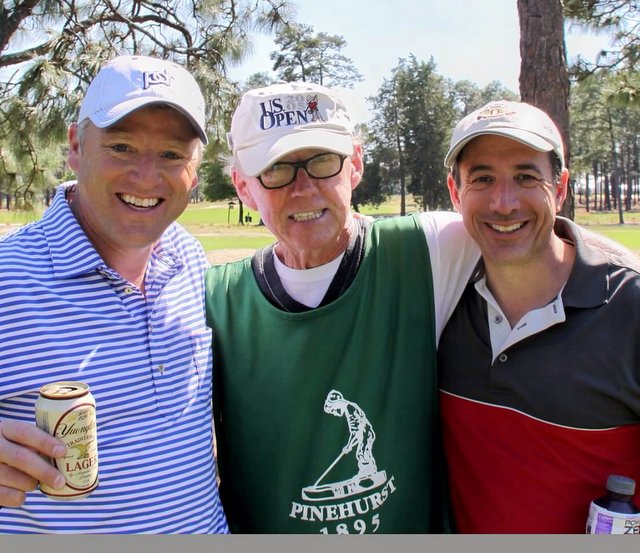
This year’s U.S. Open and the U.S. Women’s Open will be held at Pinehurst during consecutive weeks, beginning on June 12 (for the men) and June 19 (for the women). The U.S.G.A. has never tried that before, although my club has done it successfully with the men’s and women’s member-guests. Adam Sachs, a reader in Kansas City, recently traveled to Pinehurst with three friends to check things out.

Sachs 9

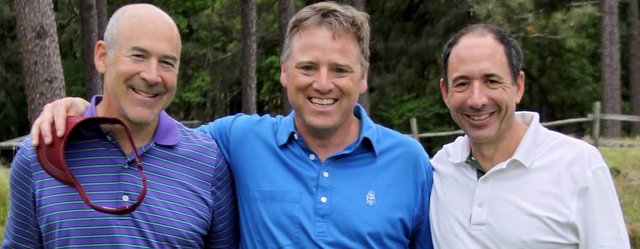
Sachs is the guy in the middle in the photo above. The guy on the left is Steve Swartzman, and the guy on the right is Chip Fleischer, whose fiftieth birthday was their excuse for taking the trip. They all went to high school together. We haven’t met Glenn Jordan, the fourth member of the group, yet, but you get the idea.

Pinehurst flag

From Sachs’s report:
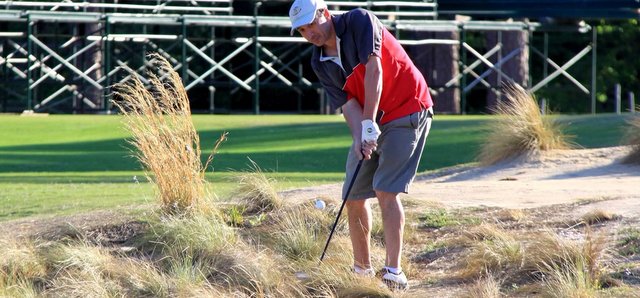
Ben Crenshaw and Bill Coore happily brought Pinehurst No. 2 back to its sandy Donald Ross roots in 2011. As for its altogether vexing, convex-shaped greens, our caddies Eddie Mac and Jamie liked to say, “Mr. Ross likes you to visit, but he doesn’t want you to stay too long.” The restored waste areas now define the course as much as the greens. We had top-notch caddies, a sun-drenched afternoon, and nary a gust of wind, so scoring conditions were ripe. I’d like to tell you we all managed to stay in the nineties. But I can’t.

No 2

Pinehurst No. 2 is definitely bucket-list material, but from now on my destination courses in the area will be Pine Needles and Mid Pines, just five miles down the road. Pine Needles has hosted three U.S. Women’s Opens in the past twenty years, yet the clubhouse personnel were low-key and friendly; the practice area was conveniently close to the first tee; and the golf course was full of rolling hills and (of course) pine needles. Our hands-down favorite course of the trip was Mid Pines: 

mid pines

I myself haven’t been to Pinehurst in about ten years, and I want to go back. And here, finally, in the photo below, is Jordan, the fourth man. He’s standing with Swartzman, even though the guy he went to college with is Fleischer. Jordan is a sportswriter for the Portland (Maine) Press-Herald.

chip (1)

Sachs also forwarded me an email from Swartzman, whose post-trip reflections support my theory that men get to know each other mainly through parallel play:
As I told Adam in the car (to Adam’s relief, driven by someone other than me) on the way home, I’m not sure what I’ll say when Evelina asks me what we talked about all weekend.  She’ll want to know what everyone’s doing and how old their kids are, and she’ll ask about everyone’s health, summer plans, sex lives, etc. Of course, we didn’t talk about any of that. Should I tell her about Chip and Adam almost choking at the thought that a waitress had farted after delivering our food (when in fact it was me)? Or about how serious everyone was about taking home a large glass boot? The great thing about gatherings like this is how little we talk about our lives, our cares and concerns, or the future.
I couldn’t agree more. They’ll be plenty of time for all that other crap in the grave. Meanwhile, check out these urinals:

urinals midpines

Medical Breakthrough: I Operate Successfully on my Laser Rangefinder

Grackle and tool

Laser rangefinders are sophisticated optical instruments, and should be handled as carefully as cameras. That means no dropping, no freezing, and no storing all summer in the trunk of your car. I was careless with my first one and, when it stopped picking up targets over 100 yards, I mailed it back to Bushnell to be realigned. It was too far gone to be repaired economically, so they sold me a refurbished unit instead—a better deal than buying a new one.

pinseeker-d

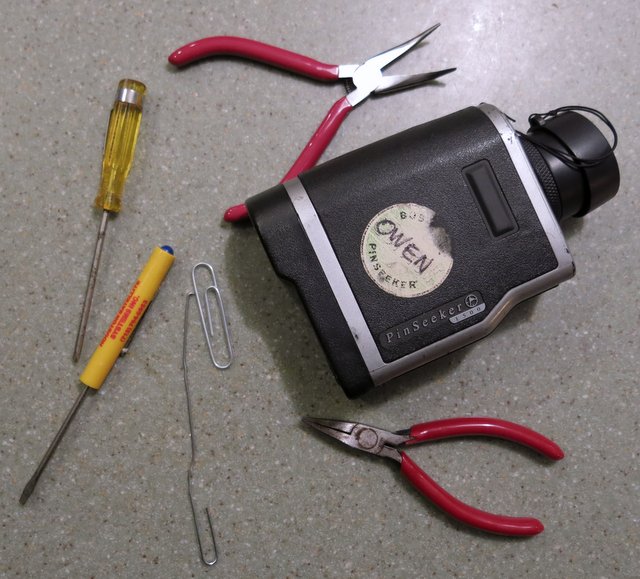
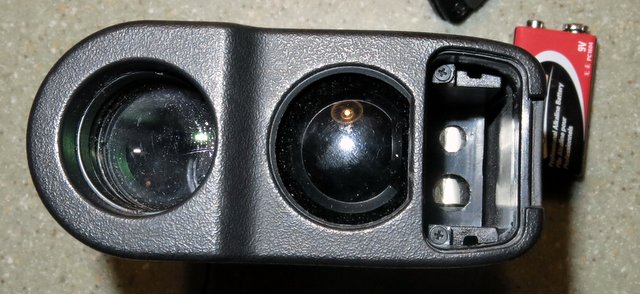
That was three years ago. Recently, the refurbished unit failed to power up, even after I’d changed the battery. (This is an ancient model, which runs on an old-fashioned 9-volt alkaline battery rather than a fancy lithium-ion battery like the one in my garage-door opener.) After a little ignorant trial-and-error, I discovered that I could make it work again, intermittently, by pressing my thumb really hard on the battery door. That made me realize that the problem was probably just that the battery was no longer making good contact with the whatever. To repair it, I did what grackles and bonobos do in National Geographic documentaries: I fashioned a tool from the materials at hand:

operating theater

I straightened a jumbo paperclip and used a small pair of pliers to make a hook at one end:

paperclip tool

Then I stuck the hook into the battery compartment and used it to tug on the metal contacts at the bottom, so that they would stick out more. And it worked!

battery compartment

The only bad thing is that, before going into surgery, I had 95% persuaded myself that my only rational option was to buy a brand-new rangefinder — ideally, the most expensive one available. I can’t justify that now, even to myself, although with luck my refurbished-and-repaired unit will break again before the end of the season.

Awwwww. Have I Told You About My Compression Shirts?

thundershirt

In the April issue of Golf Digest, I have an article about high-technology golf clothing. Among the garments I mention are compression shirts, of which I now own three: one made by Under Armour and two made by a company called IntelliSkin. (When I discovered I didn’t mind the tightness of my first IntelliSkin shirt, I bought a second one that was one size tighter.) Stretchy clothes that squeeze your body are said to have numerous athletic benefits, including improving your posture, making you cooler, making you warmer, helping your muscles recover faster after exertion, and enabling you (in the case of IntelliSkin) to become a “Full Time Human.” Harry Vardon once said that every golfer should play in a jacket and suspenders, to keep the swing compact, and my compression shirts feel something like that.

thunderdog

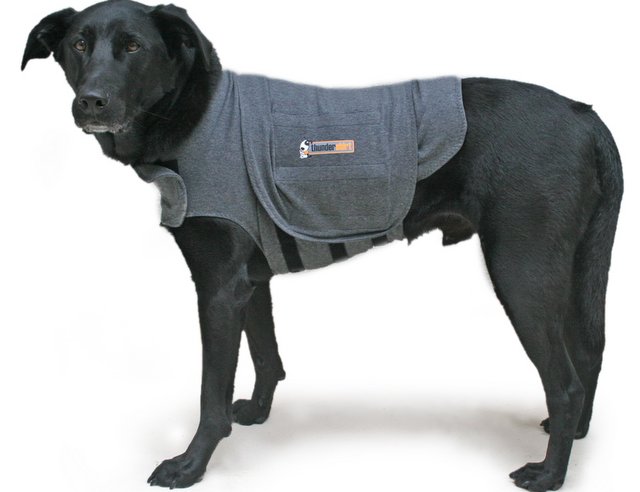
I wonder also whether they might not reduce the risk of gagging over three-foot putts, in the same way that a gently compressive vest called the ThunderShirt is said to relieve anxieties in nervous dogs and cats. A couple of years ago, my wife, out of curiosity, bought a blanket from a company called Peace Weighted Products. Weighted blankets are used in various kinds of therapy, but they are just about the greatest thing in the world to take a calm, yip-free nap under.

weighted blanket chart

Still, wearing super-tight clothing requires a certain firmness of purpose, even if no one else can see it. In theory, a compression garment should make you look thinner, but the first time I glimpsed myself in a mirror in profile I thought, I really need to start ordering salads instead of fries with my bacon cheeseburgers. You also have to deal with what my sister identified—while wearing upper and lower Spanx “shapewear” at the wedding of her middle son—as the critical interface between your love handles and your muffin top. (Shapewear used to be known as girdles. Spanx also makes shapewear for men—including, I’ve been told, Butch Harmon.)

spanx

During the past few months, I’ve developed something in my right shoulder which I have Web-diagnosed as mild rotator-cuff tendinosis. One of the things you’re supposed to do for it is to stop slumping your shoulders like an old lady. My IntelliSkin shirts make good posture semi-automatic, by helping to un-slouch me and keeping me that way once I’ve gotten myself started. The only challenge is peeling the things off without dislocating the joint I’m trying to mend.

John Cook is an IntelliSkin “ambassador.” He talks about the shirts in the video below. (The slightly scary-looking guy in the red hat is the company’s founder.)

What Marathoners and Golfers Have in Common (Unfortunately)

singh

Nat Ehrlich, a reader in Ann Arbor, Michigan, is a retired university professor whose main academic interests are human-performance psychology and statistics. In 1974, he spent an interesting year as the director of research at the Michigan Center for Forensic Psychiatry. In 2013, he conducted a research study, for Michigan State University, which demonstrated that “we elect our Presidents more on the basis of how they come across as people—most important, how honest they seem—rather than what ideology they espouse.”

Ehrlich took up golf in 1961, and he was the golf coach at the University of Michigan-Flint in 1971 and 1972. He’s a regular at Radrick Farms, the University of Michigan’s golf course and one of Pete Dye’s earliest designs (photo below). “My goal is to shoot my age,” he told me recently. “My best effort so far is age-plus-six: a 74 when I was sixty-eight, and a 78 last year, when I was seventy-two.”)

050310_RADRICK FARMS 1-1 LON

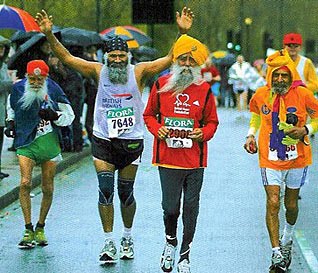
Recently, Ehrlich subjected golf and golfers to some penetrating retired-guy statistical analysis, with interesting results. He told me: “I looked up world-record holders in the 100 meters, the mile, and the marathon, by ten-year age groups, and found very similar curves for increase in time to run each event. Then I plotted a similar curve for golf, and came up with age-ranked par figures.” (See the chart below.) What those numbers in the bottom row mean, essentially, is that as we get older we need to adjust our expectations downward (or upward, depending on how you look at it)—probably true in everything we do.

Ehrlich par chart

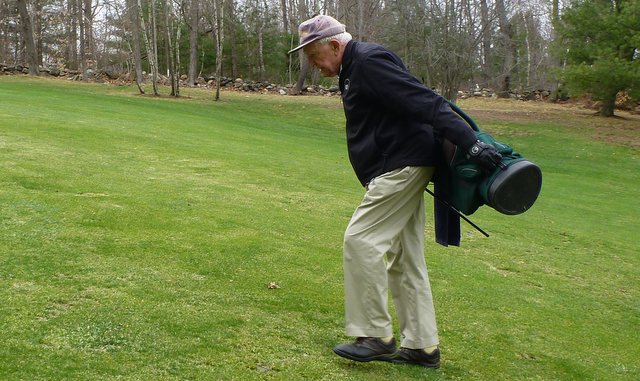
Even though scores rise with age, enjoyment doesn’t have to fall. Slade, who is in his eighties, is one of the oldest members of the Sunday Morning Group, but he still walks and carries his bag:

P1120061

We screw him and other high-handicappers by limiting to fourteen the number of strokes that anyone can receive—and no strokes on par 3s. But he still shows up, and thank goodness for that. The only S.M.G. guys who use carts are guys who really can’t get around our course on foot anymore—unlike these two, who don’t necessarily look old enough to have drivers’ licenses:

youngsters

But they don’t play with us.

Surprising Golf Accessory: “Grandpa, is that a cloth Kleenex?”

One of my wife’s nieces visited us for Easter, and I reminded her that when she was 11 she saw her grandfather using a handkerchief and asked, with astonishment, “Is that a cloth Kleenex?” A couple of years ago, I myself became a cloth-Kleenex-user, especially while playing golf, and especially during allergy season—which for me is pretty much every season. As a result, I’ve stopped blowing my nose on my golf towel and wiping it on my rain gloves, among other behavior upgrades

handkerchief

Recently, I found some inexpensive cotton handkerchiefs that I really like. They’re called Umo Lorenzo (of all things), and on Amazon you can buy them for twelve dollars a dozen, including shipping. I try to remember to put at least one in my pocket before I leave for the golf course, and I keep a few more in my golf bag, in case I forget. The other day, I accidentally dropped one near a green, and Tim picked it up, very carefully, by pinching just the tiniest end of one corner, and gave it back to me.

umo

The handkerchiefs in my golf bag I keep in a small food-storage container made by a company called Lock & Lock. I learned about Lock & Lock containers a few years ago from a guy I used to play bridge with, and my wife and I now have two or three dozen, in many sizes. They’re so watertight and airtight that geocachers use them to geocache stuff in. (If anyone ever accuses you of playing a dumb game, tell them about geocaching.) I keep three handkerchiefs in an eleven-ounce one; two range-finder batteries, two camera batteries, and a glasses screwdriver in a six-ounce one; and some Band-Aids, a jar of Advil, a tiny thing of Purell, and a microfiber glasses-cleaning cloth in another 6-ounce one. The containers are heavier than Zip-Lock bags, but not a lot heavier—the smaller ones weigh just 2.3 ounces each, empty—and they last forever.

boxes

Three Air-Travel Stories Tangentially Related to Golf

New Yorker Owen

I had an article in last week’s New Yorker about fancy airplane seats.  Here’s something about air travel I’ll bet you didn’t know: the rule of thumb for in-flight entertainment systems is “$1,000 an inch”—meaning that the small screen in the back of each economy seat can cost an airline $10,000, plus a few thousand for its handheld controller.

Jetblue directv

On June 18, 2006, I flew to Las Vegas on JetBlue with my wife and our two kids, and the flight was great because I got to watch almost the entire final round of the U.S. Open, at Winged Foot, on the screen in the back of the seat in front of me. The broadcast broke up as we were landing. Phil Mickelson had just hit a terrible drive into trouble on the left on the final hole, but he had a one-stroke lead and was about to win his third major in a row—good for him! I thought nothing more about it until the next morning, when I turned on ESPN. They were talking about Geoff Ogilvy and his victory at the U.S. Open, and at first I thought that the tournament I’d watched on the plane must have been a recording of the Open from some other year. Eventually, though, I learned what had happened.

Mickelson winged foot

Two weeks ago, I traveled to Calgary to give a talk (not about golf), and as a result I didn’t get to watch any of the first three rounds of the Masters, even on the plane. I went out to dinner with some of the people who had sponsored the conference I spoke at, and the husband of one of them, a lawyer, told a story about an airplane trip he took in the late 1960s, when he was about twenty.

Here’s the story: This lawyer fellow (whom I’ll refer to as Fellow) goes with a friend of his to the Toronto airport, where Friend (ditto) is catching a cheap charter flight to London. There’s construction going on at the airport, and the gate area is a mess, and everyone is sort of milling around. Fellow stands with the other non-passengers, waiting to wave farewell, but at some point Friend says, “Come on—let’s see how far you can get.” Fellow says, “No, no, I’ll get in trouble.” They go back and forth like that, but Friend eventually talks him into it, and, when the passengers are taken onto the tarmac to board a shuttle to take them to the plane, Fellow goes with them.

On the shuttle, Fellow says, “I don’t have anything!” and Friend says, “Here, take this,” and gives him his ticket envelope (while keeping the ticket). When Fellow gets to the plane, he sort of waves the envelope at the stewardess in the doorway and says “22C,” and boards the plane. He has no ticket and no passport and no luggage, and he’s wearing shorts. He sits down in 22C, and Friend slips into one of the restrooms and closes but does not lock the door.

The stewardesses count the passengers. The plane takes off. There are one or two empty seats on the plane, and Friend comes out of the bathroom and sits down. The plane lands at Gatwick, and all the passengers get off. There is enough confusion at the airport that Fellow is able to slip through customs, perhaps aided by the fact that he is maybe the only person in England who is wearing shorts. He calls his mother, back in Canada, and asks her to mail him his passport and some money. She sends him $100. He figures he’ll get a job of some kind, but mostly he just hangs out in pubs with Friend.

After about a month, Fellow gets some part-time work helping a guy who handles travel for University of Toronto students studying in England. One day, the guy hands him the unused return portion of a round-trip ticket that belonged to some student, and says, “Here. You owe me.” (This was in the era when half a round-trip ticket was often cheaper than a one-way ticket, and airlines didn’t penalize you for using it.)

The ticket has someone else’s name on it, but Fellow successfully uses it, along with his actual passport, to fly back to Toronto. When he lands, has just 50 cents—enough to take a bus only partway to the city, so he figures he’ll go as far as he can and then walk. While he’s waiting for the bus, he looks down and sees two bus tickets lying on the ground. He goes to the place he worked before he went to England, to get his last paycheck, which he had never collected. While he’s doing that, the boss comes out asks him what he’s doing, and re-hires him, and he goes to work the next day.

Easter Sunday Golf Handicap Bonus

P1120086

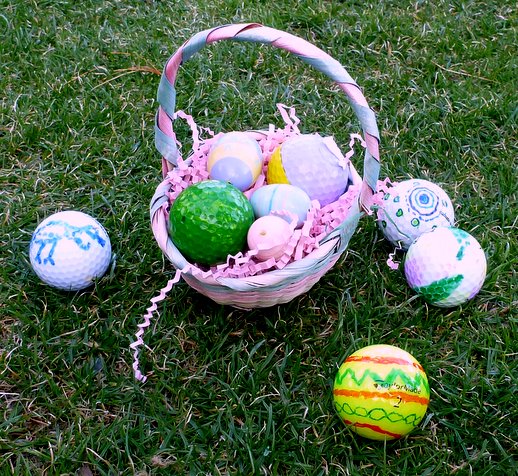
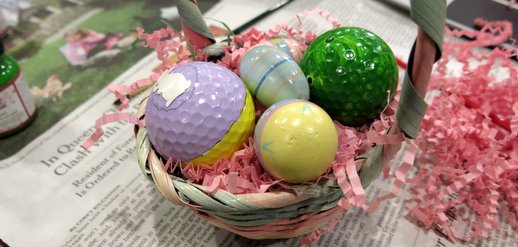
April 20 was an important day for people in the egg and pastel-dye industries. To celebrate, the Sunday Morning Group gave one extra handicap stroke to every player who teed off with an appropriately decorated golf ball. Last-minute scrawls with a Sharpie didn’t count; to qualify, a ball had to be something you wouldn’t be ashamed to show the Easter Bunny.

IMG_1438

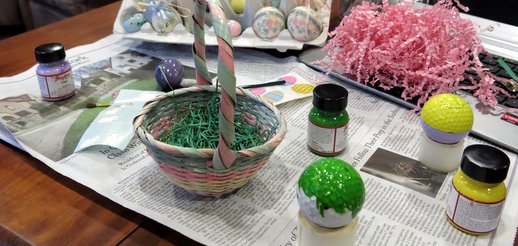
I did my decorating the night before, with something called Angelus Acrylic Leather Paint. It isn’t formulated for golf balls, probably, but it was the only thing I could find in the basement that was in the right colors. The two balls I painted were still tacky in the morning, twelve hours later, and the bunny stickers were coming up at the edges. I think the bunnies cost me some yardage on my opening drive—on our sixth hole, a par 5—but the wet paint helped me on my third shot, from a greenside bunker, because sand got embedded in the paint and kept the ball from rolling off the green. 

IMG_1452

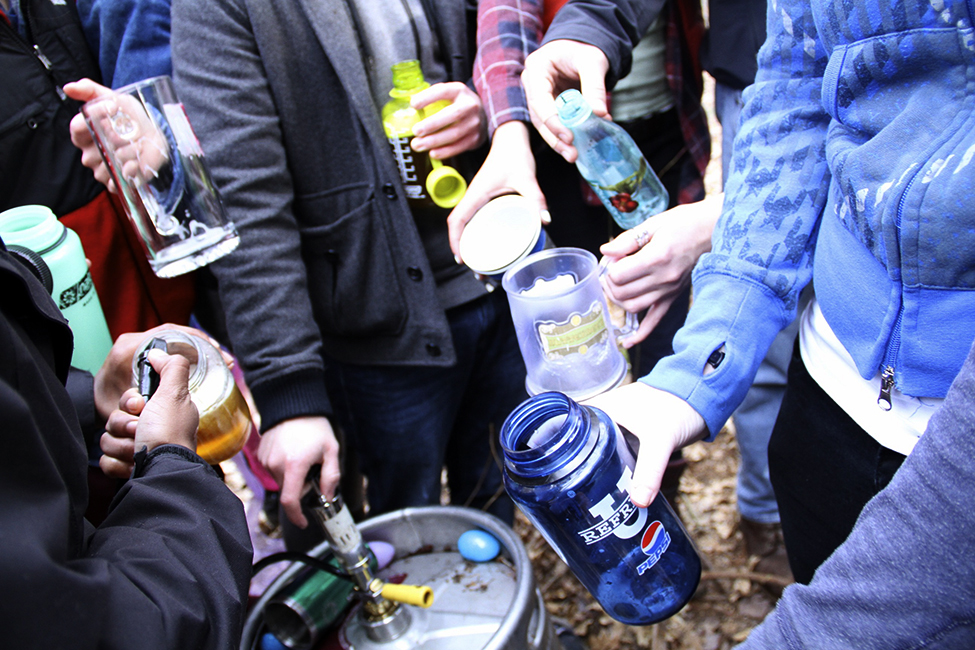
Five guys, out of nine, showed up with decorated balls. Mike A. played with his ball the whole round. Fritz lost his in the woods on the fifth. Ben slept through the golf but came for lunch (without a ball). He said that the college he went to, Hampshire, holds an annual Easter Keg Hunt, and when I got home I found a picture online:
Easter Keg

We may have to try that next year.

IMG_1455

Last Year’s Golf Water: Is It Safe to Drink?

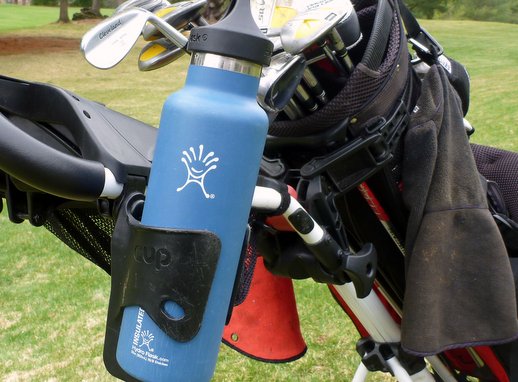
Mounting created BloggifLast summer, I played in a tournament called the Danbury Amateur, along with several other guys from my club. We got two rounds at Richter Park, a semi-free lunch each day, and a really nice insulated water bottle, which I used for the rest of the golf season. 

P1120069

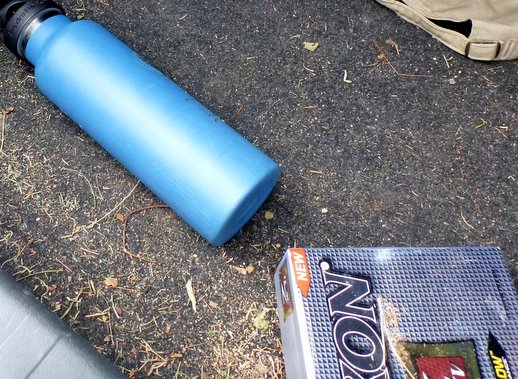
I forgot about the water bottle during the winter, though, and for several months it rolled around in the trunk of my car, along with a golf-ball box containing six or seven loose golf balls. The water bottle and the ball box made quite a racket when I cornered hard, etc., but as soon as I had parked my car in my garage they stopped rolling around and I forgot about them.

P1120073

This spring, I put my golf clubs back in the trunk, and brought the water bottle inside my house, to refill it. When I opened it, I noticed that there was a little bit of water still in it, from last year, and suddenly I wondered whether anything bad would happen to me if I drank the leftover golf water instead of pouring it out.

Was this a dumb idea? I don’t know. Check back in a few days and see if I’m still here.

Mean Weather and the Value of a Shank-in-One

This is what the ninth green looked like on the morning of April 16. Unfair!

This is what the ninth green looked like on the morning of April 16. Unfair!

On the day after Income Tax Day, the weather in the Northeast turned vindictive, and my golf course—which had been back in operation for less than a week—disappeared under two inches of snow and ice. I had to travel that day, so I couldn’t have played anyway, but I still felt bullied. 

IMG_1272

The weather is going to have to win my trust back one day at a time, beginning this afternoon (assuming I can finish a couple of things I’m supposed to be working on). Still, I have less reason to be upset than Mike Reilly, a reader and a member of the World’s Second-Best Golf Club, whose first trip to the Masters, on practice-round Monday, was rained out after two hours. “Their rain-out policy is ‘better luck next year,” he wrote from a motel room in Augusta (the club offered refunds). “I understand why it is that way, but that was a long way to drive to watch eight guys tee off No. 1.”

Masters practice round rain

While the weather was misbehaving, several of my friends conducted an email debate about the Sunday Morning Group’s hole-in-one policy, which Hacker (real name) implemented a couple of years ago. We collect fifteen dollars a man on Sundays, and three of those dollars go into the S.M.G. Slush Fund, with which we pay for things like community service, international relief efforts, and bottle openers. The Slush Fund also underwrites the S.M.G. hole-in-one prize, which is five hundred dollars if the hole-in-one occurs during our regular Sunday game, and two hundred and fifty dollars if it occurs during a sanctioned S.M.G. event on a different day or time. (A sanctioned event is any round of golf that the whole group knows about in advance, including the Monday, Tuesday, Wednesday, Thursday, Friday, and Saturday versions of our regular Sunday game.)

20121118_130803-001

No one has ever won the $500 prize, and only Reese has won the two-hundred-and-fifty-dollar prize (which he spent on drinks for everyone—see photo above). That means that, by now, the hole-in-one prize is probably over-endowed, at least in theory. David W. asked whether a hole-in-one on our ninth hole (a short par 4, which long hitters occasionally reach from the tee) would count. The answer to that one was yes, of course. Then Fritz asked about holing out on No. 2 (a par 4) with your tee shot on No. 7 (a par 3). The second green is slightly closer to the seventh tee than the seventh green is, although the shot is probably tougher, because there are pine trees in the way. Addison said he thought the shot ought to count as long as it was a genuine shank. In other words, you can’t just aim for it. Further study.

P1070560

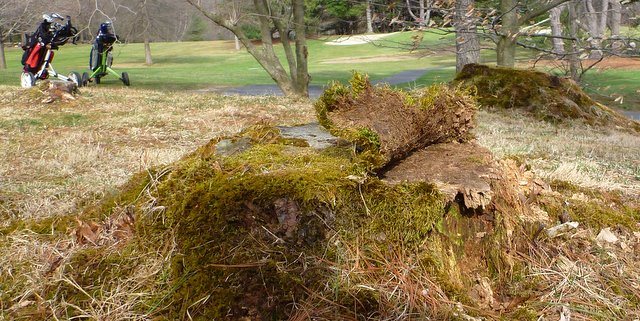
Meanwhile, the wind on Monday was so strong that it peeled the moss right off a stump:

P1120052

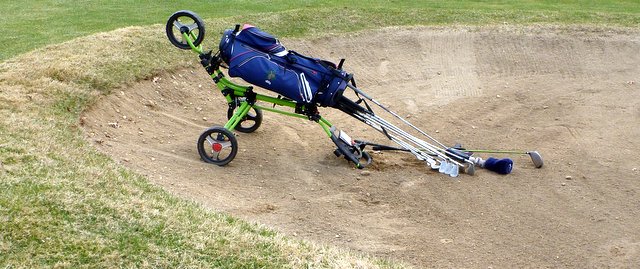
It also sent Hacker’s pushcart rolling into a bunker and tipped it over. (Maybe there should be a prize for that, too.)

P1120058