Horton Smith, Titanic Thompson, Bobby Jones, Alfred Bourne, and Me

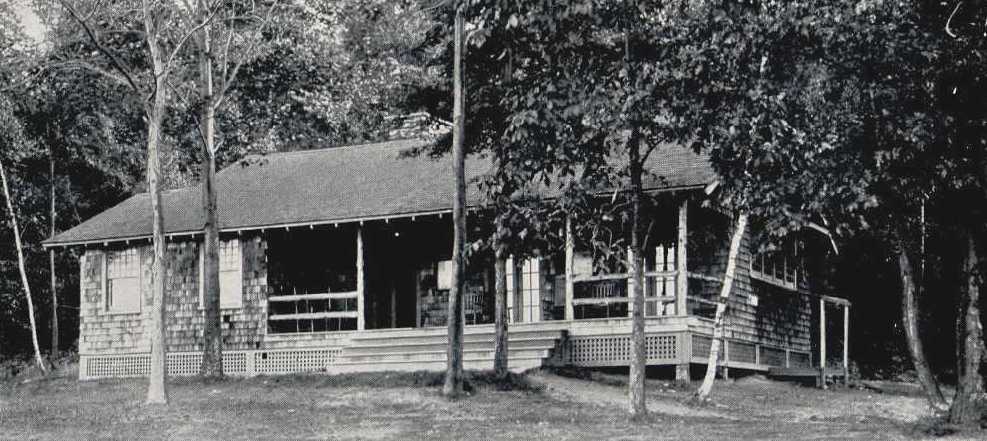
My golf club’s clubhouse as Horton Smith and Titanic Thompson knew it. It looks about the same today, although the trees and the porch have grown.

Horton Smith won the first Masters, in 1934, and he won again in 1936. Two and a half years after that, he got married in the little Connecticut town where I live, ninety miles north of New York City. The bride was Barbara Bourne, whose parents owned a 40-room weekend house here. The legendary golf hustler Titanic Thompson attended the wedding and, during a golf outing at our nine-hole club, gave a ten-dollar tip to his caddie, a local kid who, once he’d become an old man, sometimes played golf with me. (The regular rate in 1938 was 35 cents a loop, 60 cents for two bags.)

Barbara Bourne and Horton Smith (far left), along with lots of Bournes.

Barbara’s late grandfather, Frederick Gilbert Bourne, known as “Commodore,” had been a president of the Singer Sewing Machine Company. He owned a 110-room summer place on Long Island, a 28-room castle on the St. Lawrence Seaway, in the Thousand Islands, and the entire first floor of the Dakota apartment building, in New York.

Horton Smith’s late grandfather-in-law, “Commodore” Frederick Gilbert Bourne, 1851-1919.

Barbara’s father was Alfred Severin Bourne, who, in addition to being the 1934 men’s champion of my club, was a founding member of Augusta National. He served on the five-man Organization Committee, and was a vice-president until his death. Without him, the first Masters might never have been held.

Barbara Bourne and her father, Alfred Severin Bourne, in the late 1920s or early 1930s.

The Bournes spent winters in Augusta, which was popular as a resort destination partly because it was just about as far south as a New Yorker could travel overnight by train and still play golf on arrival. Alfred belonged to Augusta Country Club, and his playing partners there occasionally included Bobby Jones.

Kenneth Bourne (son of Alfred) and Bobby Jones, probably at Augusta Country Club.

In 1931, as Jones and Clifford Roberts were trying to get Augusta National going, next door, Bourne wrote them a check for $25,000—a quarter of the sum that Roberts figured they’d need to build their course. Bourne apologized that he couldn’t be more generous, and told them that if they’d come to him before the Crash he’d have underwritten the entire project. (Bourne missed the first three days of the first Masters because he was competing in—and winning—an amateur event in Aiken, South Carolina, twenty miles from Augusta.)

Alfred Bourne (center) and various playthings, Thousand Islands, 1930s.

Alfred Bourne died in 1956. His weekend house in my town is now the main building of a boarding school; not surprisingly, it’s called Bourne Hall. Each year for the past six or seven, the school and my club have held a tournament, called the Bourne Cup, in which eight or ten of the school’s alumni (some of whom are also members of my club) are almost always soundly defeated by eight or ten members of my club (some of whom are also alumni of the school).

Bourne cap, from Bourne Cup.

This year, the school’s team included a member of the class of 1951, named Dave. He told me that when he was a boy he spent several summers caddying at the club, and often caddied for Alfred Bourne. He said he once asked Bourne if it would be all right for him to use a fielder’s mitt to shag Bourne’s practice balls. (Dave loved baseball but lacked opportunities to hone his technique.) Bourne said that would be fine, and they made a game of it. Bourne was a generous tipper, Dave told me (although he squandered most of his  earnings, a nickel at a time, in the club’s Coke machine).

My club’s caddie corps in 1925, sitting on the front steps of the clubhouse. Note the neckties on the ten year olds. The gloomy-looking (and tie-less) grownup at right is the head pro. The wee lad in knee socks, two seats to his left, is his eventual successor.

A senior member of my club, whose name is Dick, also caddied for Bourne. He told me that he would warm up by hitting exactly thirty practice balls, which Dick would scoop up in a leather bag while keeping an eye out for players teeing off on the sixth hole. (The club’s driving range in those days was just the right side of the sixth fairway.) After counting the thirtieth shot, Dick would run back to Bourne, who would play the first hole, chip to the eight green, play the ninth hole, make the same circuit again, and go home.

Dick, who used to caddie for Alfred Bourne,at our town invitational tournament, October, 2008.

The day before this year’s Bourne Cup, I had the immense good fortune to play a round at Garden City Golf Club, also known as Garden City Men’s, where the U.S. Open was held in 1902. Before we teed off, I wandered around the clubhouse (where jackets are mandatory but shirts are not), and gazed at all the cool stuff. And among many other extremely interesting things I learned that the winner of the Garden City club championship in 1921 was Alfred Severin Bourne. I forgot to take a picture of the plaque with his name on it, but I remembered, later, to take a picture of a similar plaque, back home:

Early champions at my club: two Bournes and several missing years.
Want to Buy a Building Lot at Augusta National?

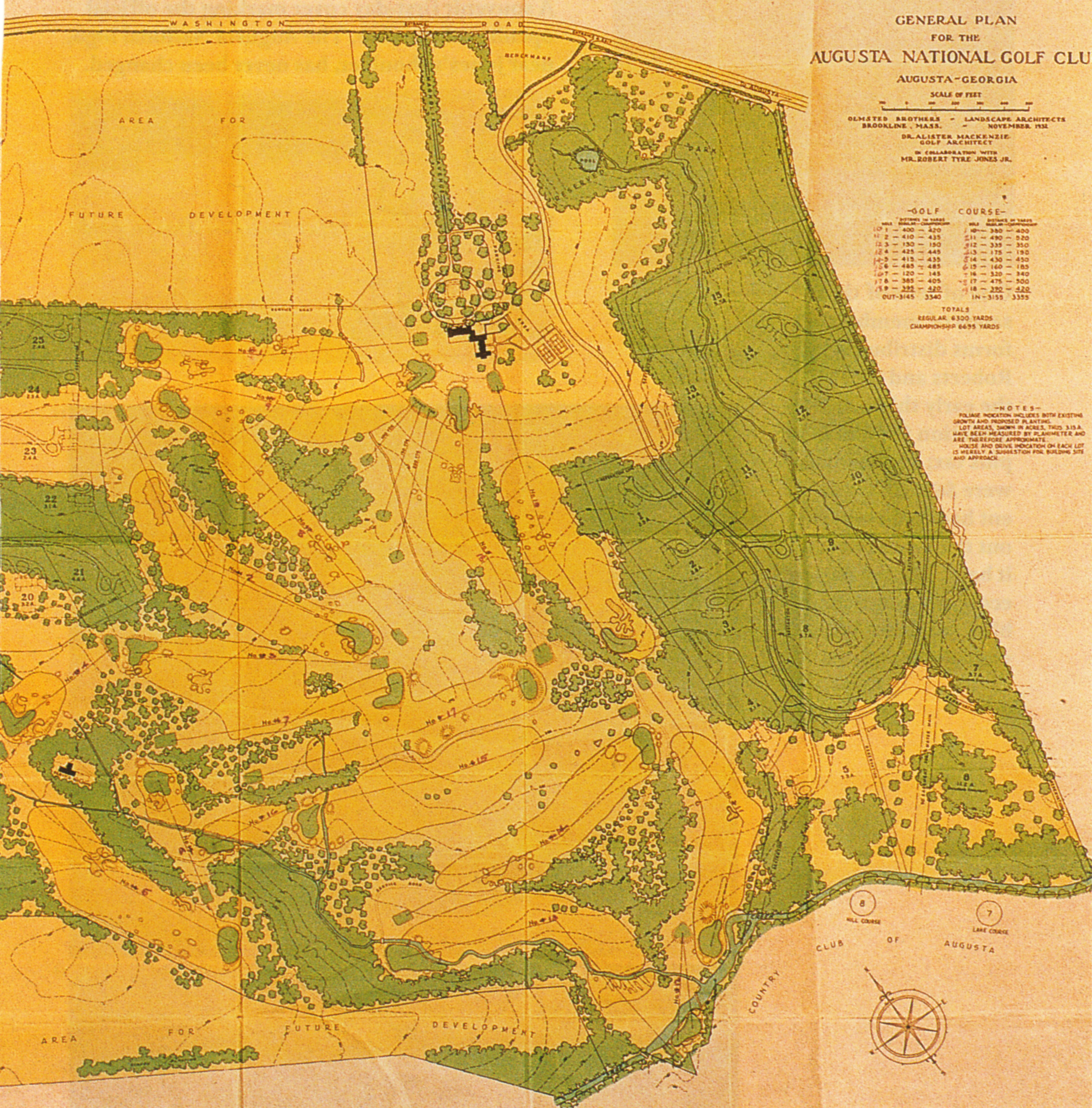
Olmsted Brothers' 1932 Augusta National real-estate development plan. If your eyes are good enough, note the tennis courts and the brand-new clubhouse—none of which were built. Also note the small practice area, between the ninth and eighteenth holes.

Augusta National Golf Club suffered severe financial problems during its first two decades, which coincided with the Great Depression and the Second World War. Its lenders actually foreclosed in 1935, just eight months after Gene Sarazen had seemingly secured the future of both the club and the Masters by hitting “the shot heard round the world.” (I explore those difficulties at some length in The Making of the Masters.)

One of the club’s best hopes for raising money in the early years was to sell building lots overlooking the course. Roughly a third of the club’s property was reserved for that purpose, and the lots were delineated and numbered on several early maps, including the plan reproduced above. For the most part, the lots occupied areas west of the second fairway and east of the tenth and eleventh. (Note to Laurentius: The spot where Rory McIlroy’s yanked tee shot on the tenth hole ended up during the final round of the 2011 Masters was near the edge of Lot No. 1.)

The club’s development plan, which was created by the landscape architecture firm Olmsted Brothers, called for two dozen building sites, and additional acreage was reserved for more. Most of the lots were between three and five acres; the largest, No. 6, was twelve acres. The club actively tried to sell those lots or others for more than twenty years. Boundary lines were cleared, access roads were built, lots were numbered with signs that faced the roads, and a major, continuing effort was made to stir up sales—all without success. In the early 1930s, W. Montgomery Harison, an early member, bought three adjoining lots just beyond the first green, but he was the only taker. He built a huge brick mansion, which stood until 1977, and the elder of his two sons built a much smaller house next door. (Harison’s younger son, Phil, was the tournament’s official starter for more than sixty years. He died 2008, at the age of 82. His own son is a member now.)

W. Montgomery Harison's house overlooking Augusta National's first green, during the Masters in 1941. (The photographer was standing near the ninth green and looking up the first fairway.) The house was torn down in 1977.

After the war, the club briefly considered leasing or renting the remaining lots, at annual charges ranging from $250 to $500 a year. When no enthusiasm for that idea was evident, the club gave up on the original subdivision and for four or five years pursued a more modest development plan in a different location. This new subdivision—which was to be called De Soto Trail—was situated just east of the area now occupied by the par 3 course. It consisted of twenty-four lots, most of them about a half-acre, and was targeted not at club members but at local middle-income families. To avoid the expense of building an access road and installing utilities, the club in 1949 offered the entire parcel to Augusta real-estate agents. There were no bids. The club then tried without success to sell the lots individually. Late in 1952, a developer offered $18,000 for fifteen acres. Roberts viewed that figure as too low, and the club eventually abandoned the entire idea.

Today, golf fans and even club members are almost always amazed to learn that Augusta National, in more than twenty years of conscientious effort, could turn up only one buyer interested in building a house near what today may be most fabled golf course in the world. If the same lots were offered for sale today, the bids would undoubtedly be astronomical. The failure of the real-estate projects underscores the immensity of the challenge that Clifford Roberts and Bobby Jones, Augusta National’s founders, faced in nearly every area of the club’s operation. As late as the early 1950s, Roberts couldn’t get local real-estate developers to return his calls.

It was only in the mid-1950s—when the tournament was securely established, and both the club and the country were on better financial footing—that Roberts began to view all development ideas as a mistake. A local club member named Julian Roberts (no relation) eventually bought Harison’s property and later sold it back to the club. One of Clifford Roberts’s last acts before taking his life, in 1977, was to walk to the first tee with the help of a waiter so that he could look up the fairway and assure himself that the house had been torn down.


Why Golf Tournaments Last Four Days

Seventy-two-hole golf tournaments at the time of the first Masters, in 1934, were invariably scheduled for three days, with a thirty-six-hole final on Saturday—an accommodation to the nation’s blue laws. It was Bobby Jones who thought of expanding the schedule. “My idea in stringing out the medal play over four days,” he wrote in a letter to Clifford Roberts, the club’s chairman and co-founder, not long before the tournament, “was to give time for special events to be sandwiched in between.” These events included an optional alternate-shot match, an approach-and-putt contest (to be held on the practice putting green), an iron contest (to be held in the old practice area, which can still be seen between the ninth and eighteenth fairways), and a driving contest.

Roberts liked the four-round idea—one of many golf innovations introduced at the Masters—in part because it eliminated what he believed to be a disadvantage for players who were “unable to do their best scoring if forced to play thirty-six holes in one day.” He also liked the fact that the schedule would enable the club to sell four days’ worth of tournament-round tickets instead of just three. (Tournament-round tickets sold for $2.20, including tax; practice round tickets were $1.10; series tickets, good for all week, were $5.50.) Roberts had initially wanted the driving contest and other special events to be scheduled alongside the practice rounds—on Sunday, Monday, Tuesday, and Wednesday—partly because he hoped they would increase practice-round ticket sales, and partly because he thought a long schedule of activities might make the tournament seem more substantial to local hoteliers and merchants, whose support would be needed both that year and in the future.

Incidentally, Roberts loved the special events, and he helped to create many of them. One year, he arranged an exhibition for local children, who were given free practice-round tickets; he scheduled the exhibition late in the afternoon so that it wouldn’t conflict with school. Another year, he devised a competition in which the pros took turns trying to repeat Sarazen’s double-eagle shot from the fifteenth fairway. (None succeeded.) For the 1942 Masters, he wanted to hold a complex “ringer score contest” in which the seven tournament champions would compete against the rest of the field during the four practice rounds. The contest was never held, but not for lack of support from the chairman. (Among other things, he wrote, the competition would “give the newspaper boys something to write about” during the first half of the week.) According to one spectator from that era, “The contests were fun, because the pros were always so relaxed and having such a good time.”

Those early special events were the precursors of the Par 3 Contest—another Roberts innovation. The first was held in 1960 (and won by Sam Snead) after enthusiastic lobbying by Roberts. “I am really rather bullish on the idea of making use of the Par-3 course as a distinctive pre-tournament event,” he had written the year before. “If so, it can be quite a feather in the cap of the Masters Tournament.  I say this because no other club holding a tournament could duplicate what I am proposing we do at Augusta. So far as I know, no other club has a Par-3 layout and, even if they do, I am sure they don’t have anything to compare with ours.” The event has always drawn a huge and enthusiastic crowd. It is also popular with the players and their children—even though no winner of the Par 3 Contest has ever gone on to win the Masters. Yesterday’s event was shortened by rain and lightning. Padraig Harrington and Jonathan Byrd were leading, at 5 under, when it was called.

Masters Countdown: Fifth Hole

Augusta National's fifth green in 1935.

The fifth hole is the centerpiece of what has sometimes been called Augusta National’s other Amen Corner. It’s ranked by more than a few players as the second best par-four on the course (after the tenth), and television cameras don’t do justice to its dramatic topography. Alister MacKenzie, who designed the course, felt that the fifth was descended in spirit from the Road Hole—the much feared seventeenth hole on the Old Course at St. Andrews. The main similarity may be in the difficulty of the approach shot, since balls that land short invariably stay short, while balls that are hit long occasionally disappear for good in the trees and shrubbery beyond the green. The perils of the green make Jack Nicklaus’s achievement during the 1996 Masters seem all the more astonishing: he eagled the fifth twice, in consecutive rounds.

The pair of large, steep bunkers on the left side of the fairway are a characteristic MacKenzie hazard. (Equally characteristically, Bobby Jones initially felt that the bunkers were superfluous, and they were not added until after the course had opened.) As originally positioned, they were more of a visual hazard than an actual one, since even in the early years players didn’t have much trouble driving over them or playing safely to the right. (The bunkers often aided less skilled players, by stopping pulled or hooked drives that might otherwise have run down the steep hill and out of play—as Wendell Miller, the contractor, predicted they would, in May, 1933, while making an unsuccessful attempt to interest Jones in adding the bunkers then.) MacKenzie, throughout his career as an architect, made frequent use of course features that were essentially optical illusions: seemingly narrow fairways that were ampler than they appeared from the tee; seemingly ample fairways on which the ideal landing areas were narrow and precise; large greens that seemed to provide huge targets but were contoured so that reasonably simple putts could be earned only with brilliant approaches—and bunkers that looked threatening from a distance but were easy to carry. He felt that easily avoided fairway bunkers were good for a player’s self-confidence and sense of achievement.

By 2002, the bunkers had long since ceased to serve even as visual hazards for the vast majority of Masters competitors. Under the direction of Tom Fazio, the tournament tees were moved back, the fairway was reconfigured, and the bunkers were reshaped, deepened, and moved closer to the green. The carry over the farther bunker from the Masters tees is now more than 315 yards, uphill, and both bunkers are so deep that reaching the green from either one is impossible, or nearly so. Each bunker has an almost vertical forward face, on which a thin layer of sand is held in place by a fabric liner, which also prevents balls from becoming embedded.

The fifth fairway caused problems for many years. Buried stones continually worked their way to the surface, where they were a threat to golf swings and mower blades. Finally, in 1962, the club resurfaced the fairway (and also the seventh) with new topsoil. When the job was complete, Clifford Roberts, the club’s co-founder and chairman, devised a characteristically simple method of testing the results: he asked Phil Wahl, the club’s manager, to drive a golf cart up and down the fairway at full speed and report back on the smoothness of the ride.

Masters Countdown: Second Hole

Augusta National's second green in 1935, when it had just one bunker.

During Augusta National’s early years, in the 1930s, the second hole had a vast, ragged bunker in the fairway, not far from the tee. A more subdued version of that bunker survived into the mid-sixties, when Clifford Roberts, the club’s chairman and co-founder, replaced it with a smaller bunker farther down the fairway and to the right. “The players all complained when Roberts put it in,” Gene Sarazen, who suggested the change, told me in the late 1990s. “But it didn’t mean a thing when you complained to Roberts. He had his own mind made up.” Among the players who complained was Ben Hogan, whose fade made the sand a genuine annoyance. Sam Snead told me, “Hogan said the bunker should have been placed on the other side, so you couldn’t cut the corner.” But the left side of the fairway was already well guarded, as it is today, by a grove of pines and a deep ravine with a creek at the bottom of it—one of the few spots on the course where a player can hit a truly unrecoverable drive. Gardner Dickinson once suggested that the tournament’s airline office—a Roberts innovation, which enables players and tournament spectators to make last-minute changes in their travel plans without leaving the property—should be moved into the ravine, on the theory that any player unfortunate enough to hit his tee shot down there might as well book a flight and go home. In recent years, the carry from the tournament tee to the fairway bunker has been stretched to more than 300 yards, but some players are able to hit their drives right past it. And hardly anybody employs Hogan’s second-hole strategy: intentionally hitting his second shot into a greenside bunker and trying to get up and down for birdie from there.

The second green in 1948: two greenside bunkers with a broad gap between them.

Masters Countdown: First Hole

Augusta National's first green in the early 1930s, when it was still the tenth. The bunker was later removed and a different bunker was added, closer to the green. The putting-surface contours haven't changed much, however.

In Augusta National’s early years, a small creek ran across the first fairway, at the bottom of the hill, less than a hundred yards from the tee. The carry over the ditch was so short that few players even noticed the hazard, but a member named Clarence J. Schoo—who ran a boxboard manufacturing company in Springfield, Massachusetts, and was a close friend of the club’s chairman and co-founder, Clifford Roberts—drove into it so often that it came to be known as Schooie’s Gulch. After topping yet another drive into the creek one day, Schoo said to Roberts, “I wish you’d fill in that damn ditch.” Roberts did fill in the ditch, during the summer of 1951—and sent the bill to Schoo.

That, at any rate, is how the story is usually told. The real reason for eliminating the ditch was that the club wanted to replace its old press tent with a Quonset hut, on a site to the right of the first fairway, and the ditch was in the way of the planned foundation. The ditch also constituted a maintenance headache that Roberts wanted to eliminate. Schoo, who later became a vice president of the club, did gladly pay for part of the alteration, but he almost certainly wasn’t surprised when he opened his bill.

Schoo was such a poor golfer that when he one day made a natural birdie Roberts decreed that he should be paid the same cash pot that was ordinarily given to golfers who made holes-in-one, on the theory that Schooie was never going to come any closer. Another time, while playing the seventh hole in a foursome that also included Roberts and former President Dwight Eisenhower, Schoo hit a dreadful drive that traveled just a few yards, into a clump of pampas grass to the left of the tee. Schoo said, “Well, in all the years I’ve been playing here, that’s the first time I’ve done that.” That summer, the grounds crew cut back the pampas grass and found several balls with his name imprinted on them. On another occasion, Schoo declared with exasperation that he must be the worst golfer in the club. His caddie, who had been around long enough to hear stories but not long enough to recognize individual members, said, “No, sir. The worst golfer in this club is Mr. Schoo.”

Alister MacKenzie

Alister MacKenzie and his wife, Hilda, on the fifteenth green at Cypress Point.

Obsessive students of golf architecture should file away the latest revision of a comprehensive chronology of the life of Alister MacKenzie, the designer of Augusta National, Cypress Point, Royal Melbourne, and a number of other courses worth scheming to play. The chronology is the work of Neil Crafter and the AM Research Team, in Adelaide, Australia, and it contains contributions from many people (including, in a very small way, me). Crafter, in a cover note, writes, “Sean Tully in San Francisco and Bob Beck in Santa Cruz have been most diligent in researching Mackenzie’s time in the USA, and Bob has unearthed records from Cypress Point that show when Mackenzie stayed overnight in the clubhouse and even what he ate for his meals! It is staggering that 80 or more years on we can get down to this level of detail about the life of Alister Mackenzie.” Even if you feel you already know everything you need to know about MacKenzie’s diet, the chronology contains many interesting facts.

Incidentally, the images above and below also appear in my book The Making of the Masters, which is now selling on Amazon for practically nothingBelow is MacKenzie’s original watercolor sketch of the routing of Augusta National. In it, the holes are numbered as they are today. MacKenzie later switched the nines; the club, after the first Masters, switched them back, because the current first nine thawed first on frosty mornings. Note the 90-yard 19th hole, near the clubhouse, squeezed between the 9th and 18th greens. MacKenzie explained the idea in a letter to Clifford Roberts, the club’s founding chairman: “Bobby Jones and some of the other directors thought it might be interesting to have a real 19th hole so that the loser could have the opportunity of getting his money back by playing double or quits. This 19th Hole will be an attractive plateau green, narrow at one end where the flag will usually be placed but wide at the other end so as to give a safety route to the player who has not the courage or the skill to pitch to the narrow end of the green.” The club, in those days, didn’t have the money to build it, and Jones and Roberts, in any event, worried that it would block the view of anyone in the clubhouse who was trying to watch whatever was happening on the 18th. Cool idea, though.