Why Fathers Should Boycott Father’s Day

Father and daughter, New York Hospital, June 29, 1984.

We were standing around drinking beer on Friday evening at my brother’s member-guest fifteen years ago when one of the participants suddenly moaned, “Oh, [very bad word], I’ve got to go to my wife’s [extremely bad word] birthday party.” Nasty rub of the green, there. What are the odds of marrying someone who was born on the exact date of the steak-and-calcutta stag dinner? (My own wife’s birthday occurs in the fall somewhere. No problem!)

At my brother’s member-guest a couple of years later, I noticed that one of the regulars was missing. “His wife wouldn’t let him play,” someone explained, “because it’s Father’s Day.”

Let that one sink in for a moment.

I’d always hated Father’s Day without knowing why; suddenly, I knew why: Father’s Day has nothing to do with fathers. It’s just a passive-aggressive reprise of the day that inspired it; it’s Mother’s Day, Part Two. You would think, in theory, that Father’s Day would be the one Sunday of the year when a married man could get away with playing just as much golf and drinking just as much beer and smoking just as many cigars as he wanted to. But it doesn’t work that way.

“Oh, you can’t play golf in the morning,” your wife says, smiling cruelly, “because the children are going to make you a nice Father’s Day breakfast. And you can’t play at lunchtime, because the children want to give you the presents they made for you at school. And you can’t play in the afternoon, because your mother and I have planned a lovely Father’s Day dinner for you and your dad.” Which means, of course, that your father can’t play, either.

Appropriate Father’s Day activity, three sons and their father, 2011 Member-Guest.

Mother’s Day, paradoxically, has a higher Golfability Index than Father’s Day does, because your wife isn’t in charge of making the plans. You can buy her some jewelry, or you can make a dinner reservation for the two of you—say, at ten p.m., after the course has safely closed—or you can blow the whole thing off (she isn’t your mother, after all) and endure her scorn for a week or two. If your kids are determined to serve her breakfast in bed, you can put a box of cereal on the kitchen counter before you leave for the club.

The only solution to the problem of Father’s Day is to move it out of prime golf season. Will that require an act of Congress? I don’t know, but here’s what I propose: henceforth, Father’s Day shall fall on the first rainy or snowy Monday in November. Like Passover, it shall begin at sundown. And it shall be ignored, or celebrated over the telephone, if you happen to be in Myrtle Beach with your pals.

Father and daughter, St. John’s Episcopal Church, September 17, 2011.

Sports Psychologists Are Wrong About This


Member-Guest 2010: “Smooth stroke. Back of the cup.”

I had a side-hill three-footer in a team match, in which a partner and I were playing two guys from our enemy club. I studied my little slider while one of the other guys failed to chip in. My putt was slick, but I felt confident. I could see the line as clearly as if it were painted on the grass.

When it was my turn, my partner—who had been in his pocket since hitting both his drive and his provisional drive out of bounds—suddenly spoke. “Take your time,” he said.

Now, there’s a golf injunction I hate. I had been doing little for the past fifteen minutes except waiting for other people to play themselves out of the hole. How much more time was I supposed to take? I ignored my partner and got comfortable over my ball. One long, last look at my target, and—he spoke again.

“Back of the cup,” he said. “Smooth stroke.”

He had me now. Was I missing something? I backed away and reexamined my line. Maybe the putt did break less than I’d been thinking. I picked a different blade of grass to aim for, and stroked the ball a little harder.

It dipped below the rim but didn’t fall.

The conventional wisdom among sports psychologists is that chat between partners should always be positive. The human brain can’t process negative instructions, they say. Tell a golfer to avoid that bunker over there and he’ll think of nothing but sand. Therefore, you say “Back of the cup,” not “Don’t jab it, you loser.”

I disagree. When a partner turns gravely supportive, I can’t help wondering what he’s worried about. Invariably, I come up with a list.

A better strategy, I think, is to confront golf anxieties squarely. Recently, some buddies and I tested this hypothesis. Our foursome was playing three other foursomes, and our pro, Fran, had a crucial putt.

“Hey, Fran,” I said. “Don’t screw up.”

He laughed. Then he drained it.

On the next hole, as I was teeing up my ball, Tony said, “Keep it out of the woods, for a change, O. K.?” Boom—straight up the middle. And long.

When your partner tells you to make a good swing, he is indirectly expressing his uneasiness about your ability to play golf; when your partner tells you not to screw up, he is using a joke to acknowledge the pressure you’re feeling and, in effect, forgiving you in advance for letting down the side, if that’s how things turn out.

On the final green, I was able to return the favor to Tony. “We need this one,” I said, “How about not blowing it?”

He took his time, made a smooth stroke, and nailed the back of the cup.

More About Foursomes: Muirfield, Troon, Prestwick, and Kümmel

The golfer's liqueur.

In 2009, I played a round at Muirfield, in eastern Scotland, where the Open Championship will be held in 2013. Alastair Brown, the secretary, described it to me (over lunch) as “a lunching club with a golf course attached to it.” A member, he said, once described an ideal day at Muirfield as “two-and-a-half, two-and-a-half, two-and-a-half”: a two-and-a-half-hour 18-hole foursomes match in the morning, followed by a two-and-a-half-hour lunch, followed by a two-and-a-half-hour 18-hole foursomes match in the afternoon.

In the United States, foursomes is usually known as Scotch foursomes or alternate shot, and it’s often a prelude to divorce; at Muirfield, it’s the signature game. Hitting just half the shots gets the non-lunch portions of the day over faster, and ensures that someone always has a hand free to hold the kümmel, a clear, anise-and-fennel-flavored beverage, which is sometimes called the golfer’s liqueur. “The way the club’s members play golf is the antithesis of championship golf,” Brown told me—and he meant that as praise. Muirfield has its own foursomes handicapping system, named after C. J. Y. Dallmeyer, a club captain in the 1950s, who invented it: if you go three-up in a match, you give strokes to your opponents until you’re back to one-up. Dallmeyer also initiated a heavily lunch-oriented New Year’s Day tournament, called the Captain’s Frolic.

Foursomes is also a historically significant game at Royal Troon and Prestwick, two other courses on the Open Rota, on Scotland’s west coast. Every year, members of the two clubs play a cross-country foursomes match over both courses, which abut each other. Half the field starts on the first tee at Prestwick, and half starts on the first tee at Troon. Everyone plays to the eighteenth green on the other course, breaks for lunch, and then plays all the way back. The two members I played with at Troon told me that, usually, a team scores better if it starts at Prestwick, because a typical Prestwick lunch includes so much alcohol that golfers who make the turn there sometimes have trouble finding their way home.

Before lunch, Royal Troon, May, 2009. I'm standing on the tee of the famous Postage Stamp. That's the green by my right arm.

Muirfield has an undeserved reputation for hostility to outsiders. It’s true that visitors are limited to specific tee times on Tuesdays and Thursdays, but the club actually welcomes thousands of unaccompanied non-members every year, and you can make reservations online. You have to wear a jacket and tie in the dining room, but the atmosphere is seductively informal, and even visitors are encouraged to linger. No table has fewer than six chairs, an arrangement that forces groups of golfers to mix, and the food is served cafeteria-style. Diners who don’t live in fear of their cardiologists sometimes bypass lunch itself and move straight from the bar to the dessert table, where the specialties include rhubarb crumble, sticky toffee pudding, and ice cream from S. Luca of Musselburgh, a locally famous dairy.

Muirfield’s locker room has modern, car-wash-caliber showers, like the ones at Merion and Pine Valley, but the other amenities are distinctly old-school, among them a pair of wooden dressing tables, each furnished with a shaving mirror, a nail file on a chain, and a single hairbrush and comb (and no beaker of blue Barbicide). And the members’ locker room at Prestwick is even cooler. Ninety of the lockers there date back to 1877. They look like Queequeg’s coffin.

Foursomes: the Joy of Hitting Half the Shots


Colleen & Joe, mixed foursomes, 2010.

The great British golf correspondent Henry Longhurst once recounted (with disapproval) an old joke about a golfer who was “alternately playing and kicking his ball” because he was “practicing for the mixed foursomes.” Longhurst loved foursomes—in which two golfers take turns playing the same ball, a game that in this country is better known as “Scotch foursomes” or “alternate shot”—and he especially loved mixed foursomes, in which each team consists of a man and a woman. I don’t know many golfers who would agree. But I do understand what he meant.

The first time I played nine holes in 36 strokes, I did it in a Memorial Day mixed-foursome event, as the partner of the wife of a friend of mine. We didn’t look like a promising team. Her handicap was 45 or 50, and we had never played together before, and my swing hadn’t fully thawed from a long, snowy winter. We teed off with no expectation of doing well. After three or four holes, though, I realized that we had made only pars. When my partner hit a bad shot, I somehow followed it with a great one, and when I left a 20-foot putt five feet short, she somehow stuffed it in the hole. We double-bogeyed the sixth, a par-four, despite having been 12 feet from the cup in two, but we closed with a chip-in birdie on the ninth. We won both gross and net by a shocking number of shots.

How had we managed to play so much better as a team than either of us was then capable of playing alone? The answer, I think, is that foursomes can fool you into playing golf the way great competitors do instinctively. When you stand over a bunker shot in a foursomes match, your arms don’t tense up with embarrassment and regret, because it wasn’t your slice that put you in the sand. And when you line up a six-foot putt, you don’t panic, because you know the come-backer, if there is one, won’t be your responsibility. In foursomes, you can only be a hero. The problems you are asked to solve are not problems that you yourself created, and if you make a mess someone else has to clean it up. You focus only on the task at hand—just as Bob Rotella says you should.

(None of this applies to married couples, who bicker like tennis players. Best advice: play with a stranger.)

You Should Play With Your Pro

Fran and Doug, first tee, May, 2012.

Two years ago, my golf club introduced Play With the Pro, which allows members to sign up, at no charge, to play nine or eighteen holes with Fran, our head professional. The program has two purposes. The first is to get Fran onto the golf course. Like many people who loved golf so much when they were kids that they decided to make a career of it, Fran hardly ever got to play, and his main exposure to the game was sitting in a chair on the practice tee, watching people with terrible swings hit terrible shots.

The second purpose is to give members opportunities to spend quality time with their head professional. We can sign up in the golf shop, and we can do it alone, with friends, with members of our family, whatever. Playing with Fran is a good way for new members to learn that they aren’t supposed to drive golf carts into bunkers, and it’s a good way for long-time members to sneak in a free playing lesson. (The club pays Fran his lesson rate for his time, so he doesn’t lose income that he could have earned by teaching.)

At a club I used to belong to, playing lots of golf with members was part of the head pro’s job description, and the program was so popular that the sign-up sheet for the entire season usually filled up the day it was posted. At many other clubs, though, golf committees view a pro who’s playing golf as a pro who’s slacking off. They want him in the golf shop, handing out scorecards and hawking balls and telling guests where the men’s room is. Hey—get over it!

At our club, we encourage our superintendent, Gary, to play a lot, too. He usually plays with the gang in our regular game on Sunday morning, after coming to work before dawn to cut the greens, and because he doesn’t mind bad weather he plays with us all winter, too. And every October we take Fran and Gary with us on our annual end-of-season golf trip to Atlantic City, during which we only play golf and eat crappy food, and nobody ever goes to a casino (except, occasionally, a couple of the young guys). It’s fun for Gary and Fran, and it’s fun for us. And that’s the whole point, right?

Gary at Goodwin Park, during the winter that wasn't, February, 2012.

The Greatest Golf Movie Ever Made

No, it's not Caddyshack.

I recently watched, for the twentieth or thirtieth time, the greatest golf movie ever made. Not Caddyshack, although I’m a fan. And not Tin Cup, in which Kevin Costner swings like a chicken and tucks his sweater into his pants. And not Follow the Sun, in which Glenn Ford makes you believe that Ernest Borgnine (for example) would have made a better Ben Hogan. And definitely not Bagger Vance, which I’ve seen only scattered fragments of, without sound, while accidentally looking up from the book I was reading on an airplane, but still couldn’t wait for it to be over.

No, the all-time No. 1 golf movie was made in 1942 by Michael Curtiz. It’s set in Morocco, and it stars Humphrey Bogart and Claude Rains. Ingrid Bergman is in it, too. It’s called Casablanca. Have you seen it?

Casablanca isn’t only about golf. There’s a long boring part at the beginning in which the Nazis make a lot of trouble, and various people sing various songs in Bogart’s nightclub, and Bogart apparently has some sort of love affair with Bergman—although you never actually see them doing anything except talking to each other with their faces a quarter-inch apart. This boring stretch lasts for about an hour and a half. I usually let my wife watch it by herself, while I make popcorn or take the dogs for a walk.

The golf part comes near the end. Bogart and Bergman and a wimpy-looking foreign guy, who appears to be wearing lipstick, turn up at a foggy airport one night, and for a moment you think that Bergman is going to dump the lipstick guy and marry Bogart. That’s the suspense. Bergman is good-looking, despite the hat, but you can tell that as soon as the wedding is over she’s going to start demanding lifestyle changes, and the first thing to go will be the nightclub. Then she’ll say, “Oh, Rick, do we really need to live in Africa?” Then they’ll have four kids in a hurry, and that will be that.

But Bogart sees the trap a mile away. He makes Bergman think he’s going along with her scheme, but at the last second he tricks her into getting on the plane. “You’re taking the fall,” Bogart says to the lipstick guy. (I’m paraphrasing now.) Then the plane heads down the runway—whew!—and Bogart and Rains escape into the fog, so that they can spend the rest of the Second World War drinking gin and playing golf. I tell you, that movie makes me cry every time.

The Ladies of Ballyliffin Were Victorious

Ballyliffin Golf Club, Ireland, April, 2012.

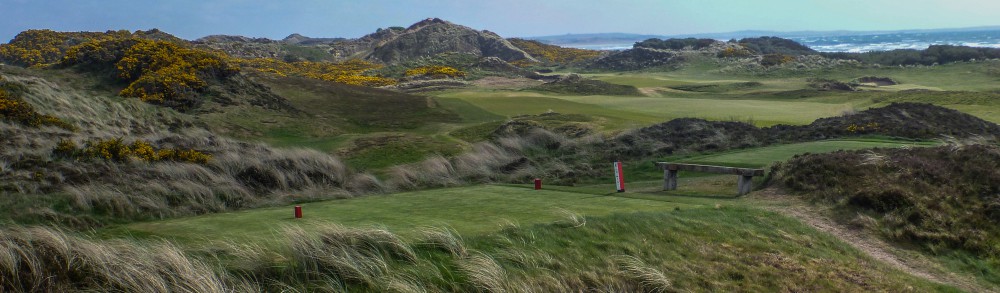
Six friends of mine and I arrived in Belfast, Northern Ireland, late Saturday morning. We played Portstewart that afternoon with Kevin Markham—who has played every eighteen-hole course in Ireland and written an extremely useful guide to them all, called Hooked—and the next day we played two rounds at Royal Portrush, where the Irish Open will be held in June. Then we drove to Ballyliffin, where we played both the new course (which is called the Glashedy, after a big rock off the coast) and the old course (which is called the Old Course). So far, all four courses we’ve played on this trip are our favorite.

We shared the the Old Course with the ladies of Ballyliffin, who were playing a match against the ladies of Narin & Portnoo (where we’re headed tomorrow, after two rounds at Portsalon). The ladies turned down our offer to caddie for them, and/but they were victorious anyway, and they let us hang around with them in the clubhouse afterward, while they celebrated. Ballyliffin is just about the friendliest place we’ve ever been, except for all the other places we’ve been in Ireland. And this morning, when we got up, both courses—which I could see from the window of my hotel room, at the Strand—were covered in fog. That’s the clubhouse on the right, in the photo below.

The links of Ballyliffin, from the Strand Hotel, April 24, 2012.

The Capital of Left-Handed Golf (No, Bubba, It’s Not Augusta, GA)

Clubhouse, Kingussie Golf Club, Scotland.

In 1992, when I was new to the game, I took my first golf trip to Scotland. You can probably guess at least part of the itinerary. I played at Turnberry, Gleneagles, St. Andrews, Carnoustie, and Dornoch, and I finished at Tain, an Old Tom Morris course at the inland end of Dornoch Firth. That last round went by so fast that it left me with most of a day to fill, so I asked my playing partners, who were Tain regulars, if they could recommend a course on the long road to the airport—any course at all. They suggested Kingussie, just off the A9, about a third of the way between Dornoch and Glasgow, in what is now Cairngorms National Park. So that’s where I went.

My expectations were neither high nor low; I just wanted one more chance to swing my clubs. But during the decade and a half since then I’ve probably thought about Kingussie as often as Carnoustie. You could never hold a British Open there—among other reasons, the course is almost 2,000 yards too short—and golf-tour operators almost never send American travelers to play it. Nevertheless, it stuck in my mind. The course (which was expanded and redesigned by Harry Vardon in 1908) is set in and around the elevated valley of the River Gynack, in the rocky hills above the village. The first hole is a long, semi-blind par-three, and the sixth is a short par-4 that plays past the ruin of an old shieling, or shepherd’s hut, and the fourteenth, called the Dyke, runs along an old stone wall. It was a memorable finish to a memorable trip.

The Shepherd's Hut, Sixth Hole, Kingussie.

I returned to Kingussie in 2007 and played with three Scots, two of whom were on holiday from the Orkneys, a cluster of small islands north of the Scottish mainland. When we had finished, we had a drink with a group of regulars sitting at two picnic tables outside the clubhouse. One of them told me, “Kingussie has more left-handed and cross-handed players than any other golf club in the world”—a consequence, he said, of the town’s intense devotion to shinty, a bruising Highlands stick game that is similar to the Irish sport hurling (from which it evolved) and to field hockey, and in which there is apparently a tactical advantage to playing from the wrong side of the ball. No, no, another member insisted: there are more left-handed golfers in Newtonmore, Kingussie’s principal shinty rival, three miles to the west. The conversation then veered into a discussion of Newtonmore’s golf course, which my new friends unanimously dismissed as too flat to bother with.

One of my new friends from the Orkneys.

That evening (after a second eighteen), I drove over to Newtonmore and watched a youth shiny practice, the only form of the game available locally that evening. I stood with a group of shinty moms in a parking lot filled with Scottish minivans, and saw that grade-school shinty players, unlike the adult shinty players in the stories I had heard at the picnic table at Kingussie, wear helmets and still have their teeth.

Shinty practice, Newtonmore, Scotland, 2007.

You Could Win This Contest!

Over the weekend, I tied for fourth in the Mega Millions lottery. That is to say, I finished ahead of all the suckers who bought tickets (except for the three who get to split $640 million). I’m still kind of overwhelmed by the whole thing. I hope I don’t squander my windfall on something dumb!

In the meantime, here’s a contest you could actually win. It’s sponsored by Sun Mountain, the company that makes the golf pushcart I use. A month ago, in a post called Pimp My Ride, I described some enhancements I’d made to my cart, including the addition of a Lego shim, which prevents my laser rangefinder from interfering with the door of the cart’s storage compartment, and a Lego divider, which prevents my extensive collection of scorecard pencils from falling into the place where I keep my rangefinder (see photo below). Sun Mountain was so utterly blown away by what I had done that they decided to give people who aren’t me a chance to win some cool stuff for doing the same kind of thing.

Do you own a pushcart that you have customized in some way? If you do, you should follow the contest’s instructions, and submit photos and a description to Sun Mountain, by way of the company’s Facebook page. You have until April 15, 2012.

Masters Countdown: Third Hole

Augusta National's third green, 1935.

Augusta National’s third hole has probably undergone fewer changes than any other hole on the course. Its principal feature today, as was true in the beginning, is a treacherously shaped green, which sits on a tilted natural plateau. Dropping off from the shallow left end of the green is a deep bunker from which pars can be difficult to save. The green is hard to hit and harder to hold, and approaches to it are complicated by the fact that the putting surface is invisible from the fairway.

In 1933, Clifford Roberts, the club’s co-founder and chairman, wrote a letter to Alister MacKenzie, who had designed the course, in which he suggested adding a deep cross bunker in the face of the plateau directly in front of the green. “It was my understanding,” Roberts wrote, “that the deep-face trap located in about the center would make this a definite drive and pitch hole; that is to say, a well struck pitch would be required in order to hold the green and the trap would make it impossible to play a run-up shot.” MacKenzie was vehement in vetoing that idea—which Roberts had admitted Jones didn’t support—and his response contains so much of his thinking about design that it is worth quoting at length:

I am delighted that Bob agrees that the [third] with the one trap is all right. This confirms my impression that Bob knows more about golf and its sound principles than any man I have ever come across.

My own opinion is that a cross bunker would convert it into an ordinary stereotyped hole and would nullify all the subtleties of the undulations of the approach to which we gave so much time and thought.

Consider the many problems which face a golfer approaching the hole. In the first place he can play safely to the right and rely on a long putt going dead to get his four. If he elects to go straight at the flag he must play a perfect pitch or else his ball would hit the bank and come back or run over the green. On the other hand if he tries to run up from the right his shot must be played perfectly as a half hearted run up shot will inevitably run into the bunker on the left, which appears to me to be absolutely perfect both in regard to its position and its construction.

At this hole the super golfer, like Bob, has a most fascinating problem, as to have a reasonable chance of three he will have to attack the hole from the left, where all the slopes help him towards the hole. It is here that the tee-shot bunker comes in as he must make up his mind to play round it with a pulled shot from right to left or a fade from left to right, or, when a strong wind is in his favour, to play over it.

If the approach to this hole is maintained as hard and as true as the green it will make the most perfect hole of its length in the world of golf and any additional bunker would ruin it.

It is holes of this description that keep up one’s interest in golf year after year, stimulate players to improve their game and prevent golf becoming stale.

Jones didn’t think as highly of the third hole as MacKenzie did; his favorite par-fours almost all required long-iron or fairway-wood approaches—shots at which he excelled. But MacKenzie’s conviction has been borne out over the years. Of all the architects who have worked on the course, none has yet made a persuasive case for a major revision. (The single original fairway bunker became a cluster of four fairway bunkers in 1983, but the impact on tee shots didn’t change.) The third hole remains the shortest par-four on the course, yet it was one of the few holes that consistently gave Tiger Woods trouble during his record victory in 1997. (On Friday, he hit a bullet-like drive to within fifteen yards of the green, yet made a bogey.) In fact, the experience of Woods and other long-hitting players suggests that one effective way to “Tiger-proof” a golf hole may be to shorten it.