Golf in the Rain—But Not the Presidents Cup

P1090651

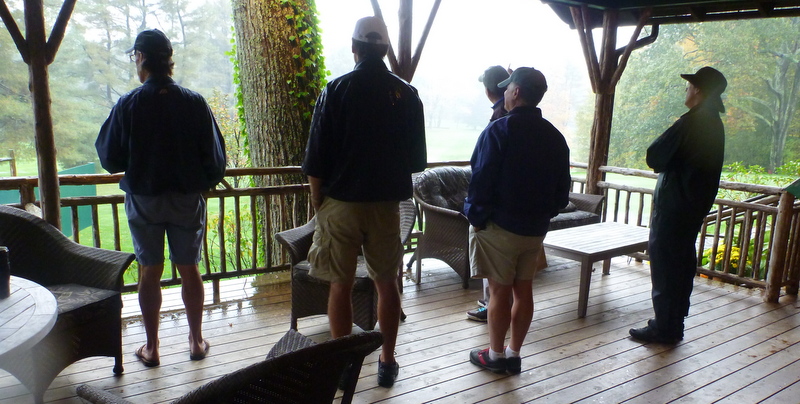
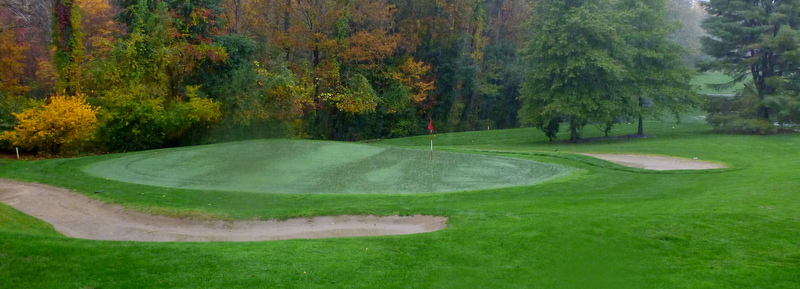
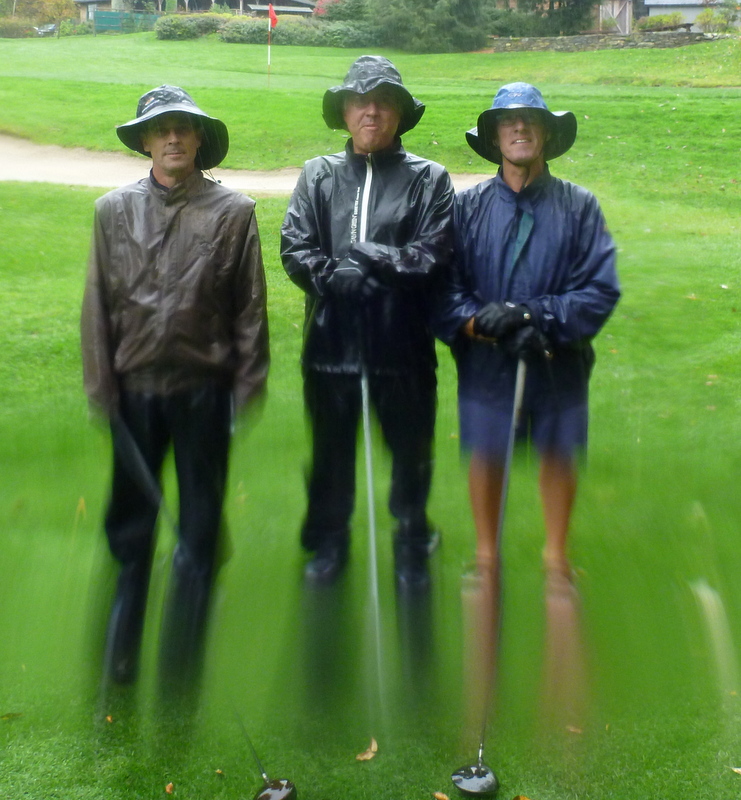
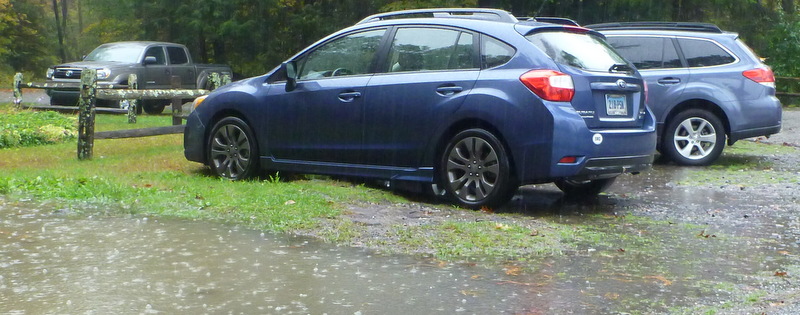
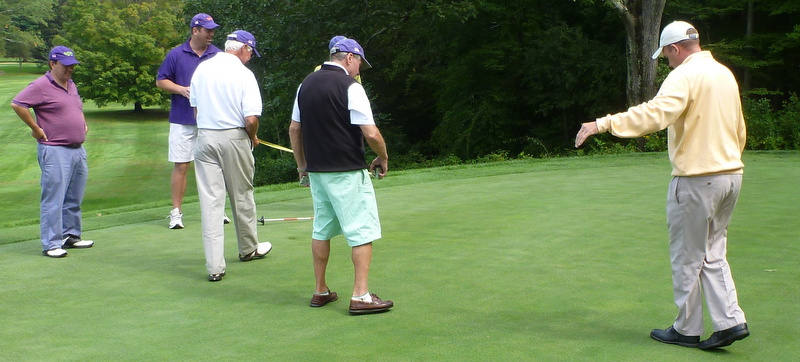
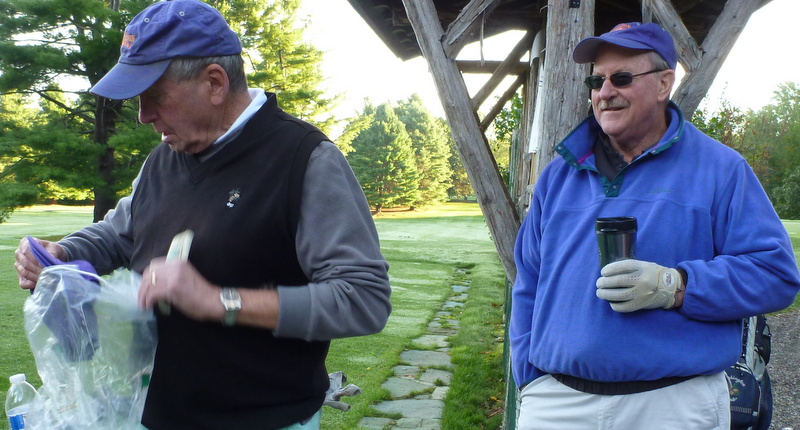
The rain that caused delays at the Presidents Cup reached my part of the world on Saturday night. It was still coming down on Sunday morning, when my friends and I assembled. We couldn’t tee off right away, because the greens were submerged.

P1090638

Barney went to get coffee, and we talked about going out to breakfast. After an hour, though, we said the hell with it and teed off. We had eight guys plus Peter P., who is still recovering from his car accident and so was playing in absentia.

P1090724

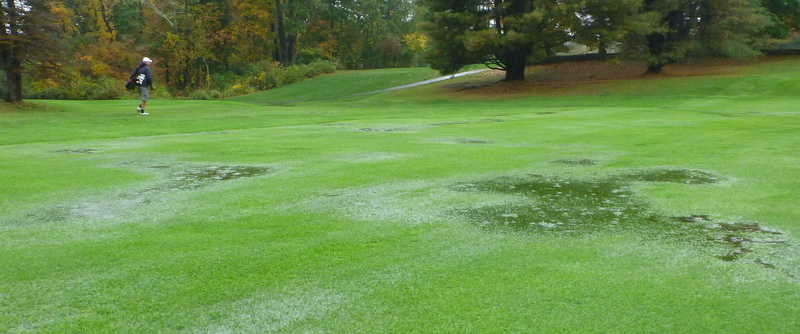
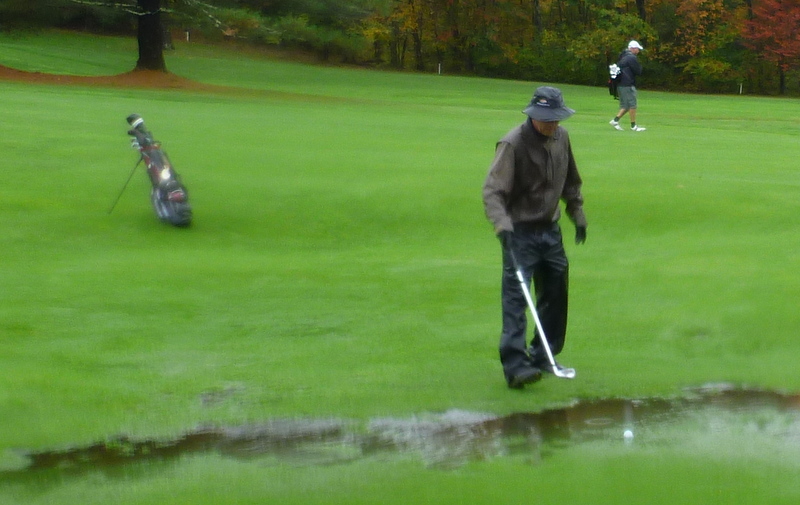
The course was wet, but it was playable, and when the rain let up a little bit most of the puddles disappeared.

P1090677

On a dry day, you can step across this creek:

P1090764

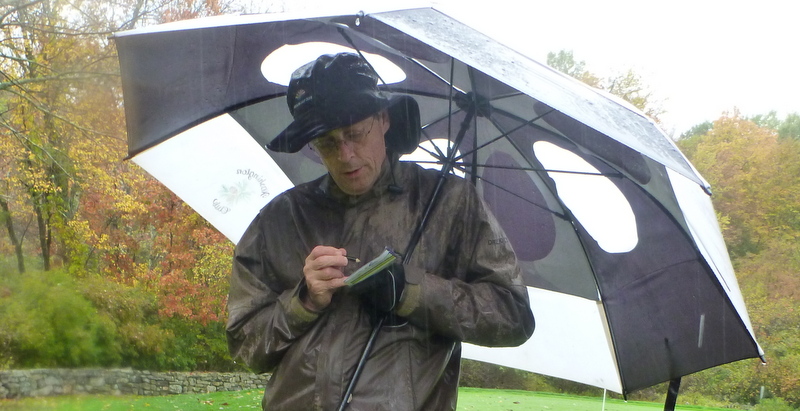
Keeping the scorecards dry was problematic:

P1090737So was keeping water off the lens of my camera:

P1090771

But playing was better than going home and doing chores, and in areas where the water was too deep you could take relief.

P1090788

The tee shot from on No. 13, which on Sundays we play from the tips, was even more intimidating than it usually is, but after thinking about it for a while Barney decided not to lay up.

P1090748

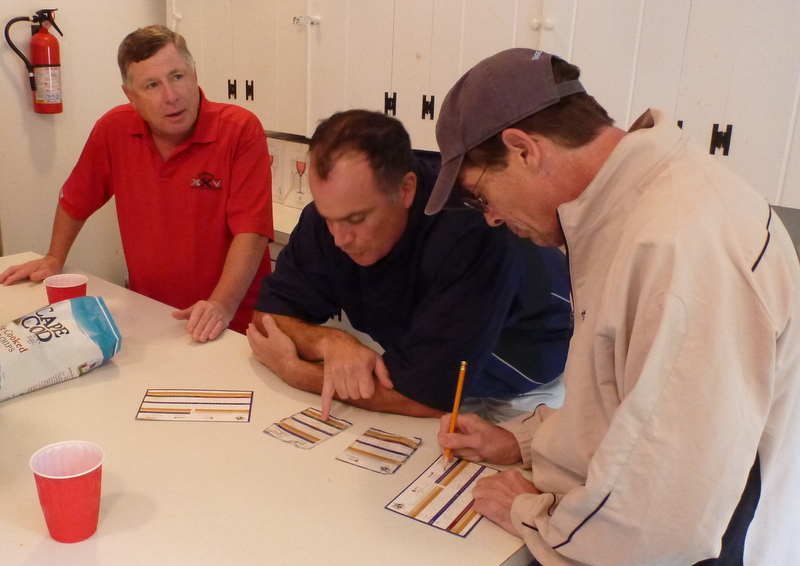
The round took just over three hours, and we all shot about what we usually shoot. Then we grilled cheeseburgers, as always. We ate them in the clubhouse kitchen rather than on the patio, though. That’s also where we did skins, after reconstructing the scorecards.

P1090811

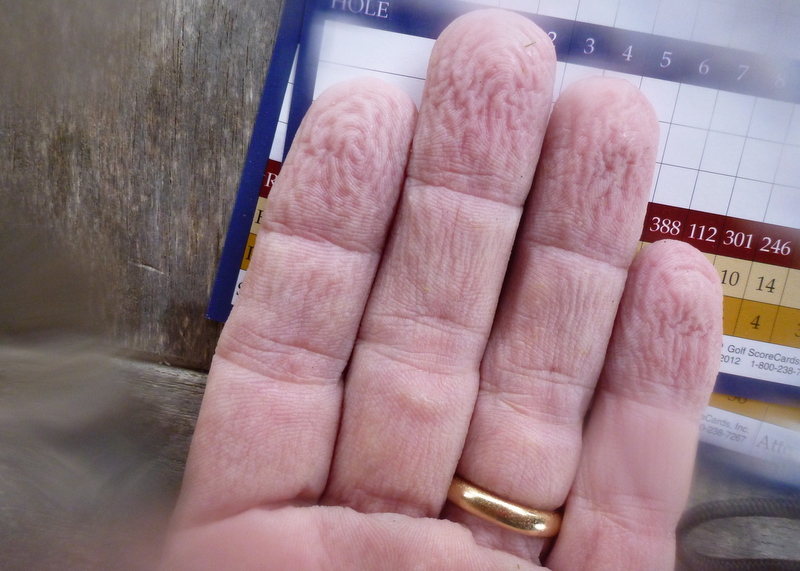
My team won, and I won two skins. My fingers looked the way my kids’ used to after their baths.

P1090803

Then it was time to go home.

P1090664

New Golf Playoff Format: Reverse Putt-Like-Pete

P1090240

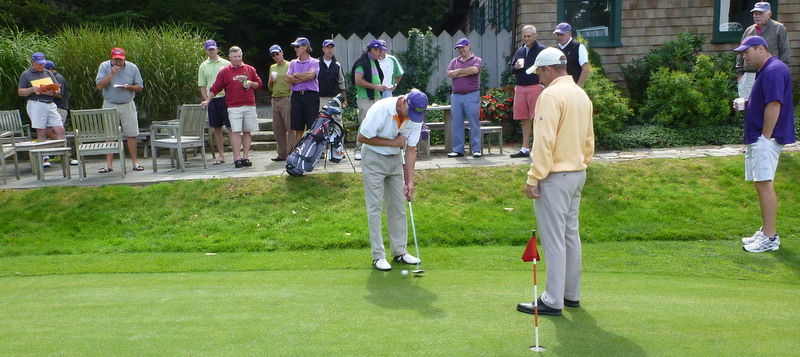
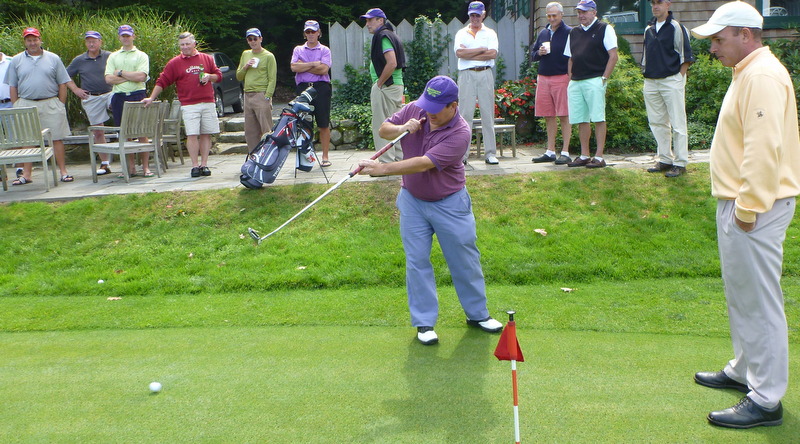
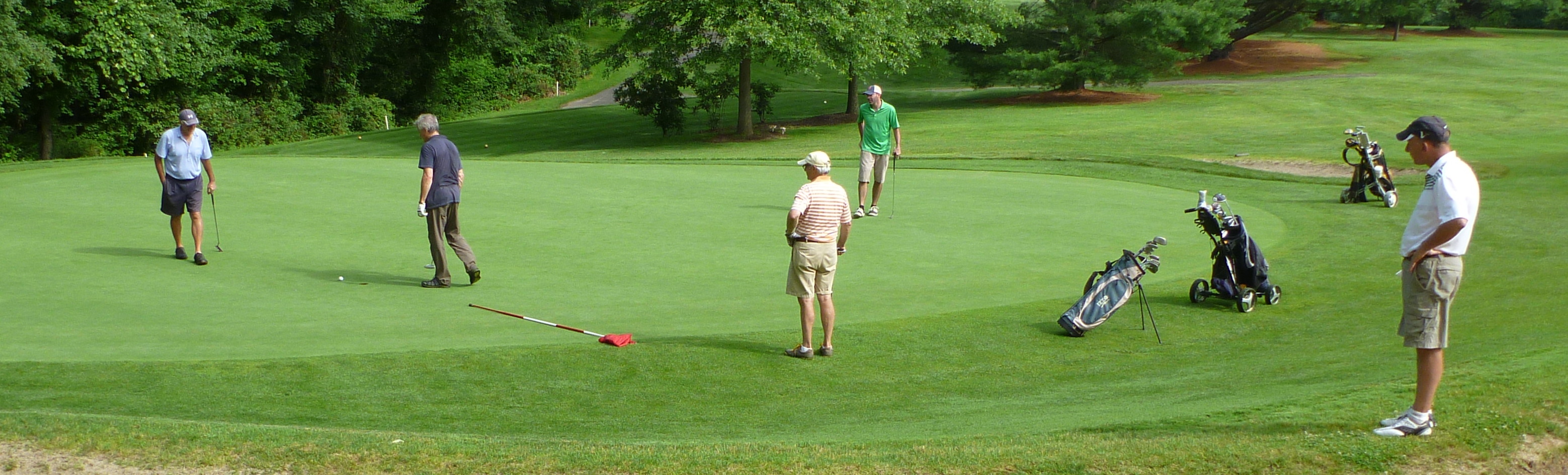
When the Sunday Morning Group’s regular game ends in a tie, we don’t divide the pot—a semi-corollary of Hacker (real name)’s rule that Money Never Flows Backward. We hold a playoff instead, and, over the years, we have invented many compelling formats. Last Sunday, we came up a new one, in honor of Peter P., who is in the hospital. Peter uses a long putter, so Corey, our pro, picked a similar one from the golf shop, and we made the eight playoff participants use it on a long putt on the practice green, closest to the hole wins. To make the competition more interesting, we made them use it wrong-way-around: righties had to putt lefty, and lefties had to putt righty. Furthermore, they had to strike the ball with the round thing on the back of the putter head, not the face. As always in our playoffs, the stymie rule was in effect. Here’s Chic, our new golf chairman, taking his turn:

P1090243

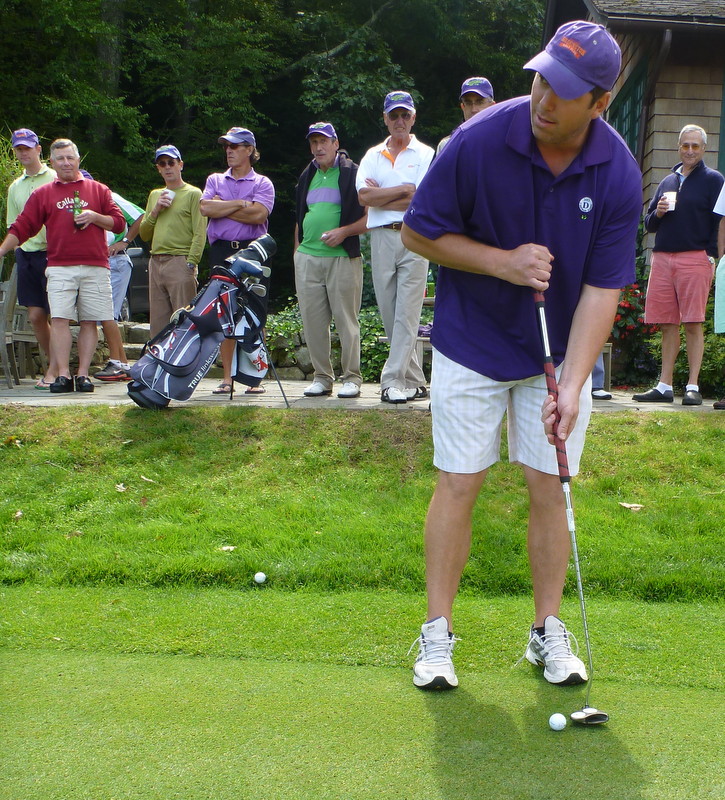
And here’s Rafael, who is from Mexico:

P1090247

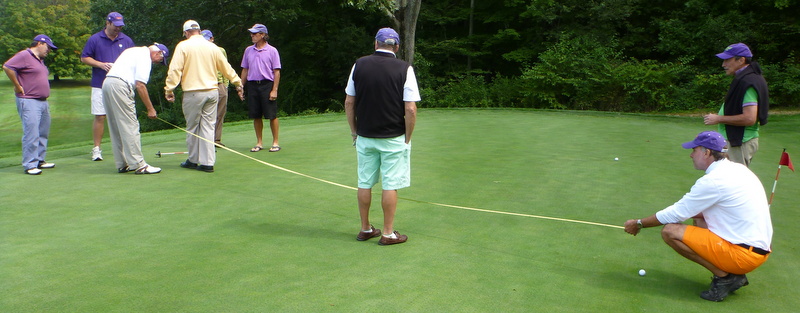
Putting backward off the round thing on the back of a long putter turned out to be harder than anyone had guessed, and only two balls—Rafael’s and Tim’s—ended up within twenty-five feet of the hole. We couldn’t tell whose ball was closer, so Corey paced them off. (By law, golf professionals wear shoes that are exactly twelve inches long.)

P1090255We still couldn’t tell, so Hacker got a measuring tape from the back of his car:

P1090259

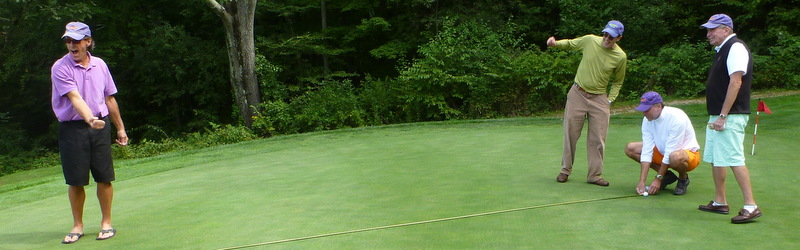
The winner, by half an inch, was Tim:

That's Tim,

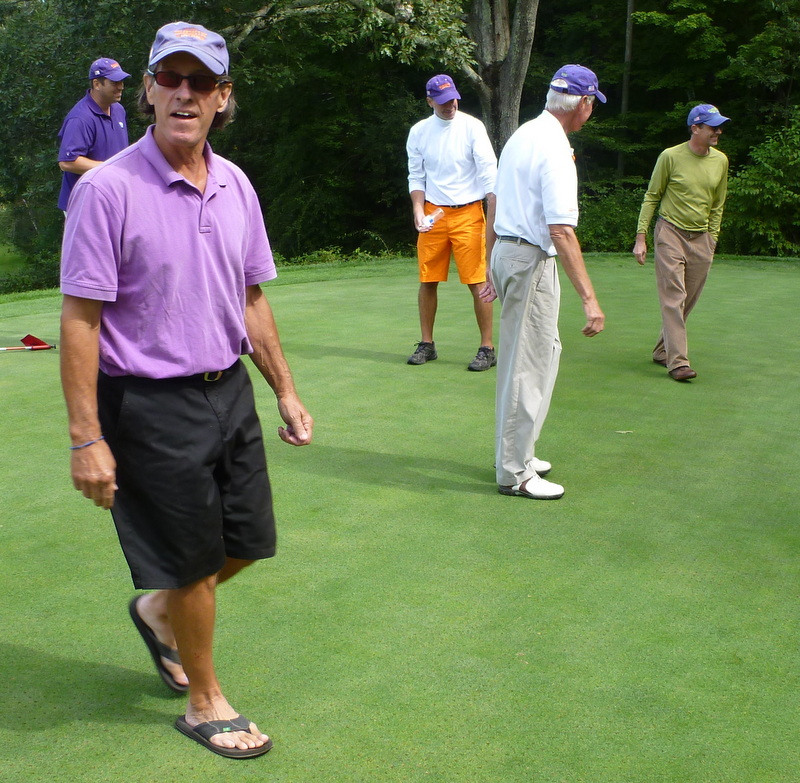
That’s Tim, in the green shirt, third from the right. Barney, left, was on his team. Fritz is holding the tape, and Hacker is supervising.

Then everybody went back to the patio for a couple more beers.

P1090265

Hat Day, Bumper Stickers, and Playing in Absentia

IMG_1131

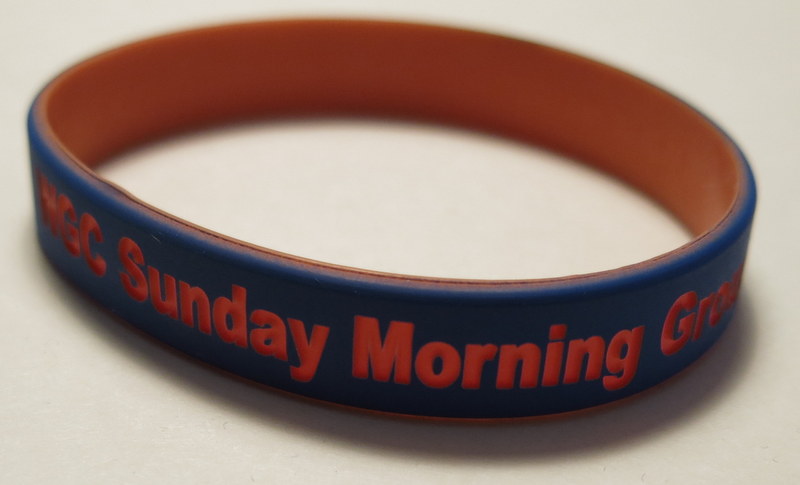
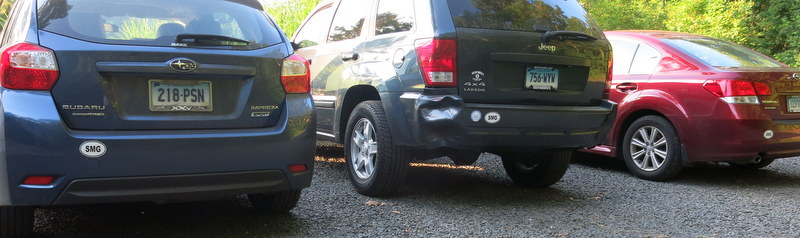
My Sunday Morning Group has a certain amount of branded merchandise, which is available for purchase by members only. Our wristbands (above) are free if you wear them, five dollars if you don’t. We also have European-style S.M.G. bumper-stickers, which cost two dollars but are currently not in stock. If you have one on your car (and also if you don’t), you can park in the Executive Parking Lot, between the clubhouse and the Dumpster.

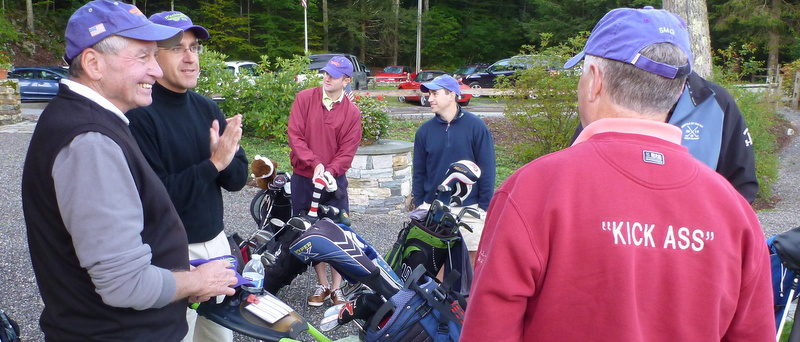
IMG_2062Most of all, we have hats. The original ones, which we designed ten or fifteen years ago, are purple and orange, a color combination we selected because we thought it would get on the nerves of some women who had recently complained about our drunken boorishness, and so forth. (When we wore our new hats on a field trip to a golf course in another town, an assistant in the golf shop asked, “Do you guys all work for Federal Express?”) The most recent hats are purple and fluorescent green. You can see both versions in the photo below:

Nick wanted us to have a POW/MIA emblem on our hats, but he settled for an American flag.

Nick (not pictured) thought we ought to have a POW/MIA emblem on our hats, but he settled for an American flag.

Some guys wear their S.M.G. hats fairly often, but most guys wear them only on Hat Day, when wearing them is mandatory. Hat Day takes place whenever Hacker (real name) says, usually once or twice a season. If you come to Hat Day without a hat, you have to buy a new one (for $19.99), rent a loaner (for $3.99), or buy a reconditioned one (for $9.99). The reconditioned hats are loaners that have been reconditioned by sitting in Hacker’s barn since whenever the last Hat Day was. On the most recent Hat Day, Hacker sold three of them.

Hacker (with the last three purple-and-greens) and Greg, Hat Day, 2013.

Hacker (with the last of the new purple-and-greens) and Greg, Hat Day, 2013.

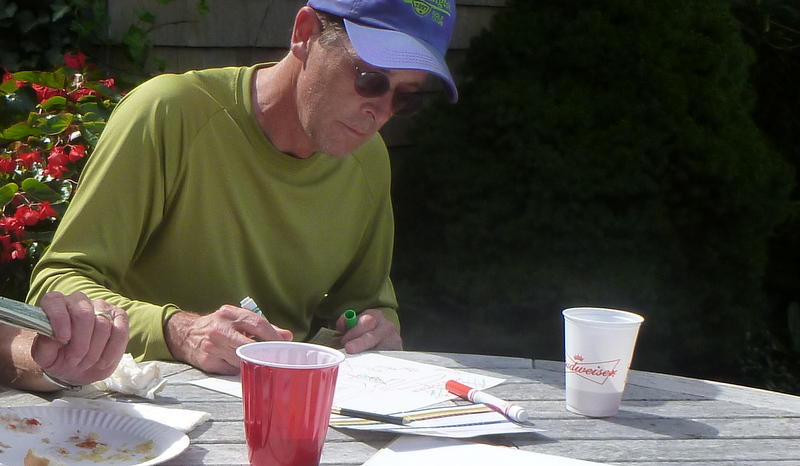
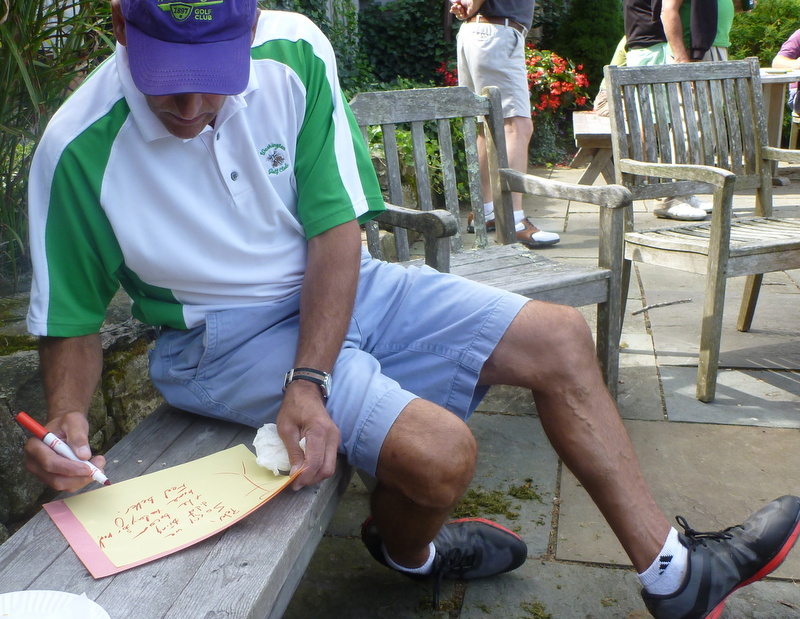
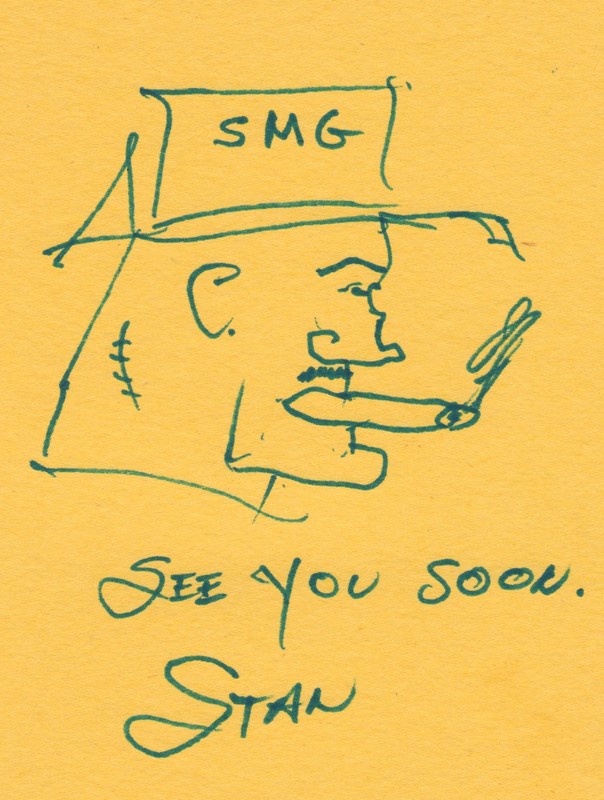
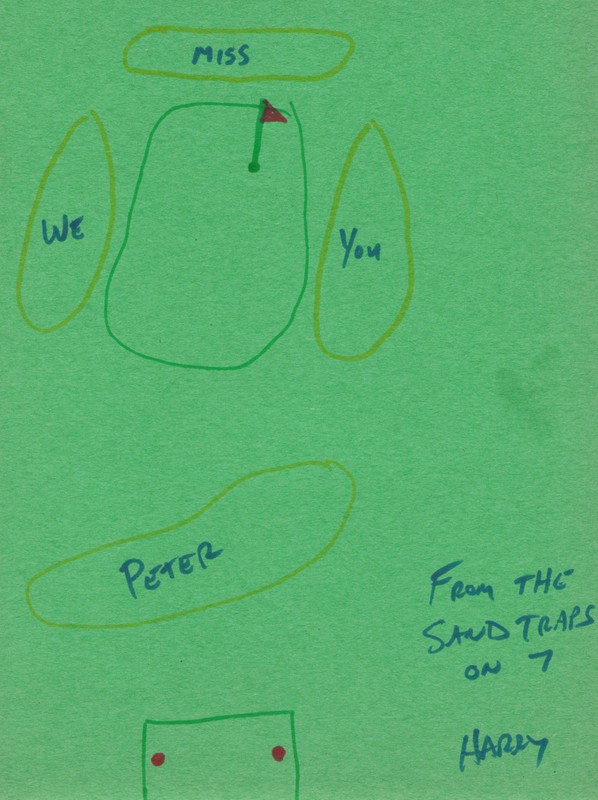
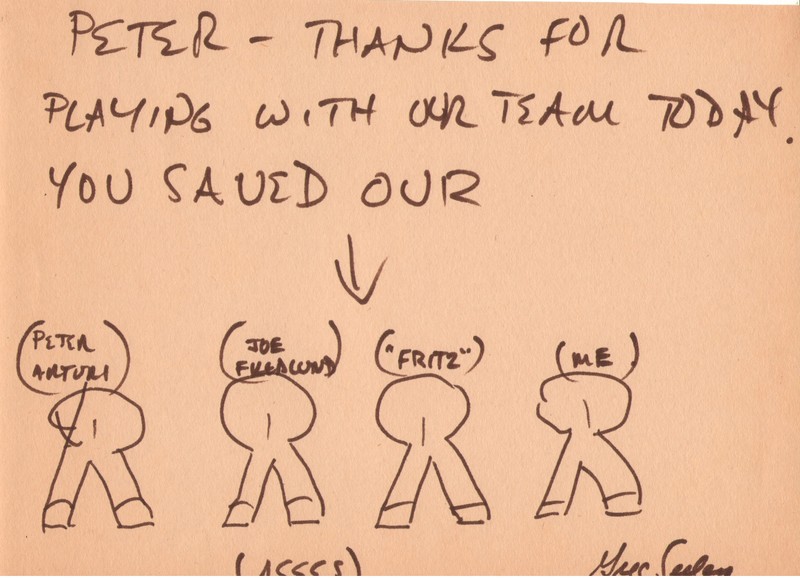
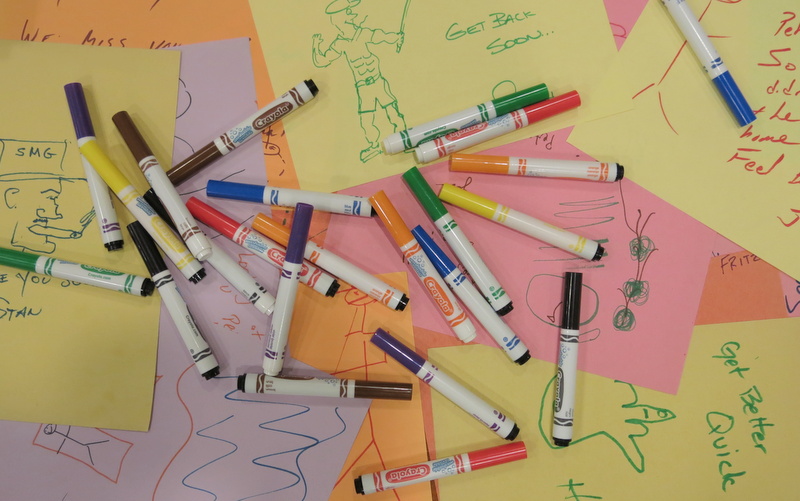
We had twenty-one guys that day, although only twenty were physically present. Peter P.—who had a horrific car accident shortly before Labor Day—was still in the hospital, but Hacker had figured out a way to let him play in absentia, by giving him a score of net par on every hole. We played two best balls, and Peter’s team needed his ball on seven holes, so he was more useful than quite a few of the guys who actually showed up. Peter also won a share of the Money Hole. During lunch, we used colored markers and construction paper to draw get-well pictures for him:

P1090220-002

P1090229

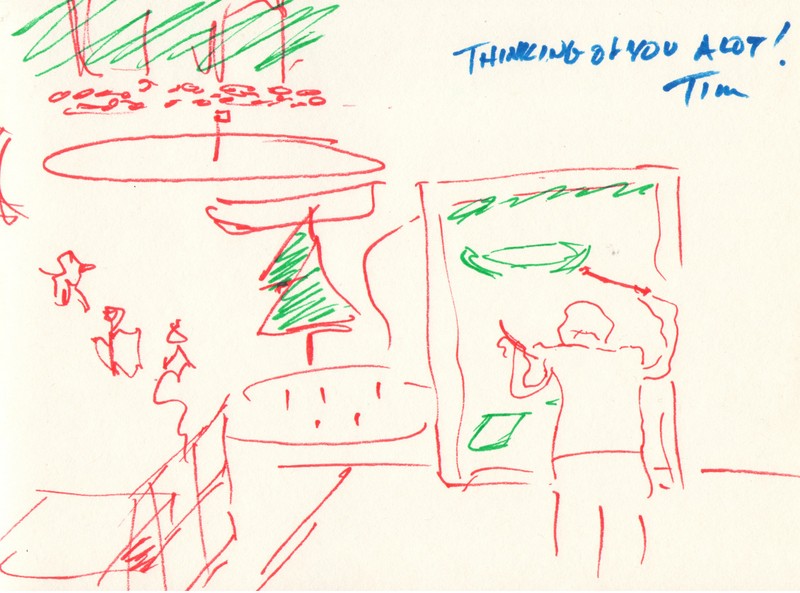
Here are some of the pictures:

Stan for Pete Harry for Pete-001 Greg for Pete

Tim for Pete

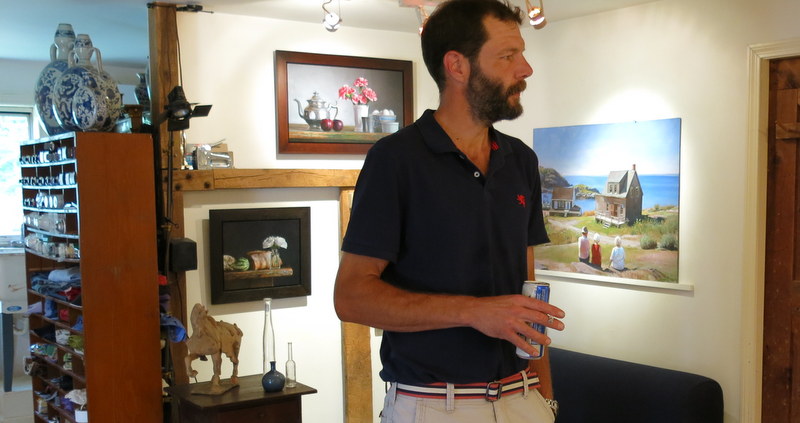
That last one, by Tim, shows Peter himself painting a picture of a golf hole. Peter doesn’t actually paint golf holes, but he is a painter. Just a couple of weeks before his accident, he held a reception in his studio, and a lot of us went—a rare opportunity to learn what someone we hang around with does when he’s not playing golf. Here’s Peter that evening, along with some of his paintings:

IMG_2691-002

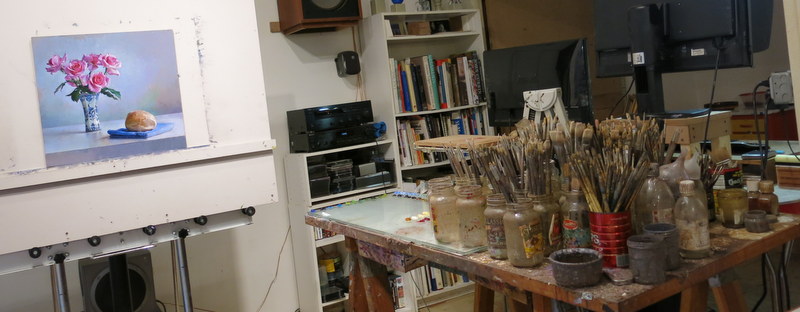
And here’s where he works:

IMG_2707And here’s another one of his pictures:

IMG_2699

We want him back soon, in person, and not only because he draws better than we do.

IMG_2739

Report From the 2013 Men’s Member-Guest, Part One

Peter P, Rob G., Fritz, Klinger, Chic, ringside at the putting contest.

Peter P, Rob G., Fritz, Klinger, Scribby, ringside at the putting contest.

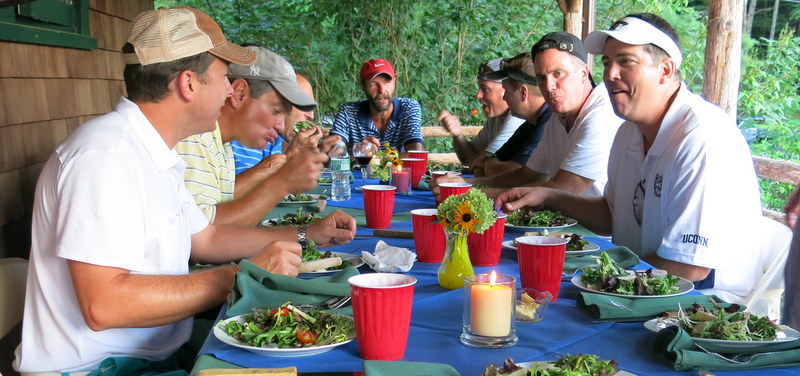
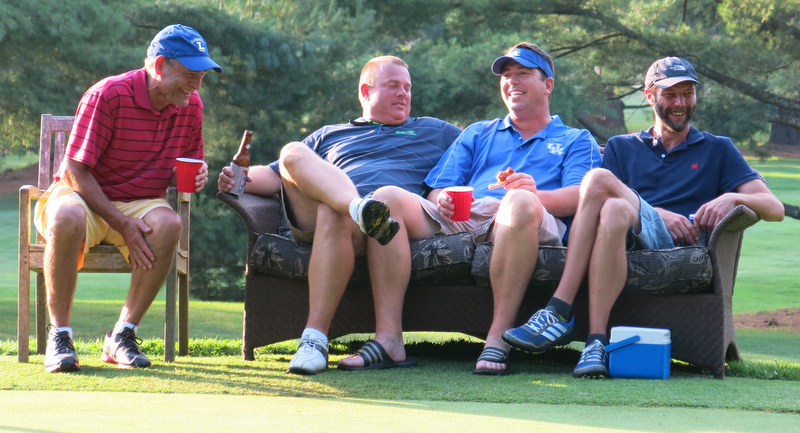
The men’s member-guest was the first weekend in August. Among the many highlights was the putting contest, for which qualifying began on Friday afternoon and concluded late Saturday morning, with a break for steaks on the clubhouse porch:

These guys are pretending to eat salad.

These guys are pretending to eat salad. Their steaks are still on the grill.

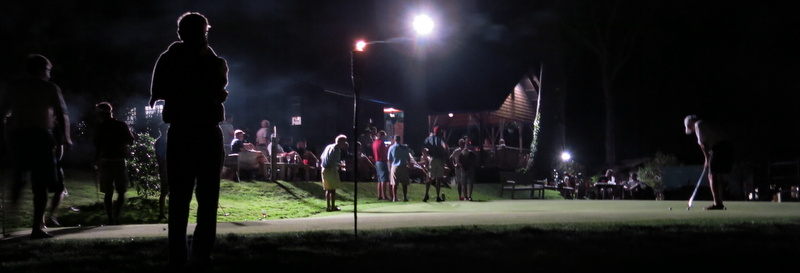
Some of the most stirring action took place after dark on Friday night, under lights provided by C.J. A qualifying round was two times around a four-hole course. Each each hole was a par-2.

IMG_2371

The green had been triple-cut and rolled, and all the holes were within a few feet of the fringe. If you putted a ball off the green, you had to pay a penalty stroke to move it back. The format was best-ball. In two days of trying, no pair went around in better than two under par.

IMG_2376

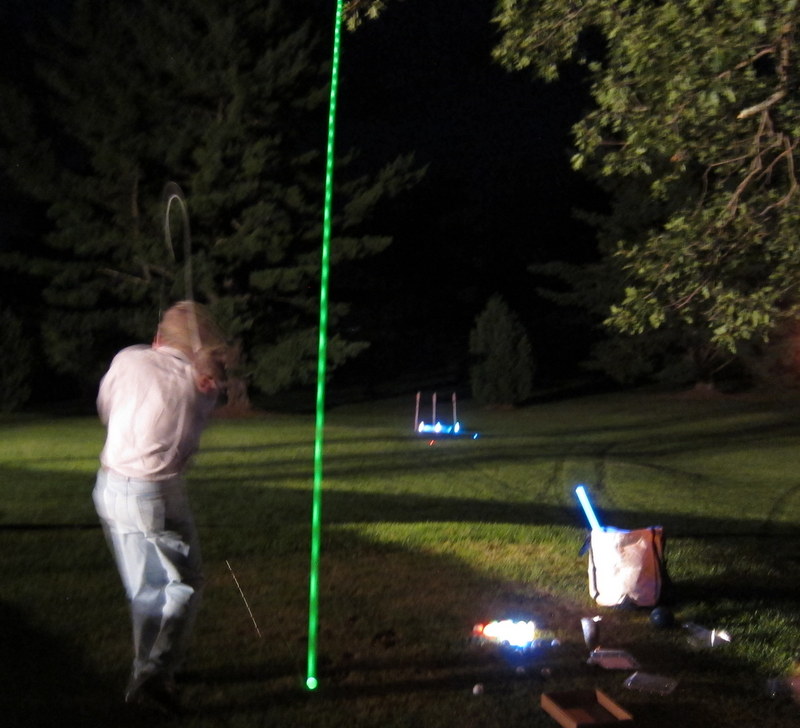
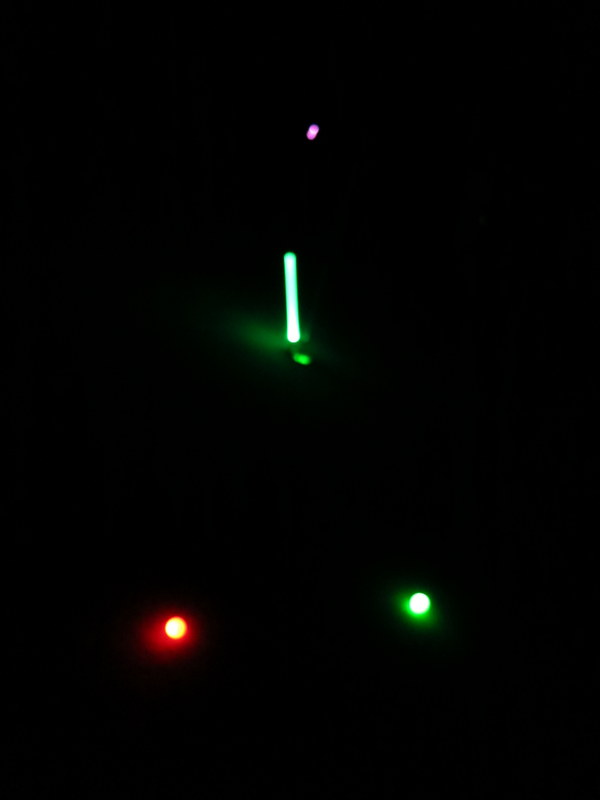
We also had an after-dark pitching contest, using Night Flyer balls. The target was a small kiddie swimming pool, which my wife bought for our dog but our dog, so far, doesn’t like. The kids in the golf shop had filled it with water and glow sticks, and they had marked it with Tiki Torches and flashing LED things that looked like tent stakes. You got three tries for five dollars, and if you made a ball stay in the pool from forty-five yards away you won half the pot. Doing that was harder than it sounds, because only one person managed to do it: Tim. But even the misses looked cool, and in some pictures my brother took they look like those tracking shots on TV.

IMG_2352

Night Flyer balls look like regular balls, but they light up when you clack them together or hit them with a club.

IMG_0170

Putting-contest tickets were ten dollars each. You paid for them at the cashier’s desk, which was also the pari-mutuel betting window for the regular golf matches. Michael U. handled the bets, using a computer program called Backnine Bookie. The program kept a running tally of the odds for every pair in the tournament. You could bet on yourself, and on other teams in any flight except your own flight—a rule we imposed to eliminate any temptation to tank matches. Michael used our handicap-card printer to print a ticket for each bet.

P1080058

To be continued.

Joe, Rob G., Chic, Peter P.

Joe, Rob G., Chic, Peter P.

Possible World Record for Ground Under Repair, and the Attack of the Red-winged Blackbird

Bob G., ground under repair, Glen Arbor Golf Club, Bedford Hills, New York, June, 2013.

Bob G., ground under repair, Glen Arbor Golf Club, Bedford Hills, New York, June, 2013.

Bob G., an honorary member of the Sunday Morning Group, treated my brother and me to a day of golf not long ago, and during our round we encountered what may be the world’s largest G.U.R. Part of one fairway had begun behaving in a puzzling manner, so the course maintenance crew decided to see what was down there. Here’s some of what they found:

P1070410

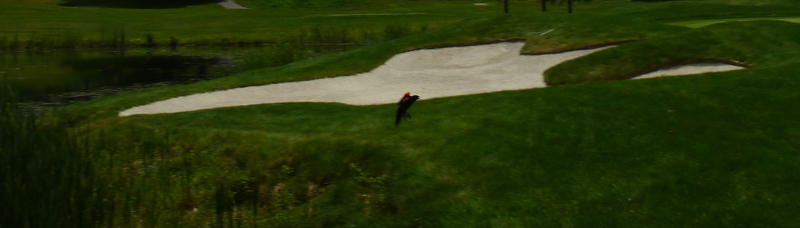
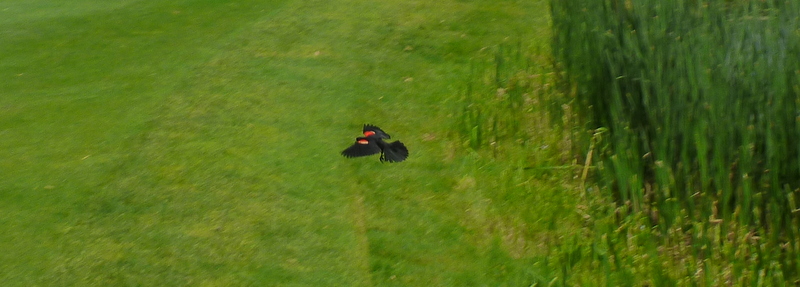
Later in the round, a red-winged blackbird let me know I’d gotten too close to its nest. It flew in circles around my head and yelled at me until I got to the green.

P1070416

P1070418

P1070417

P1070419

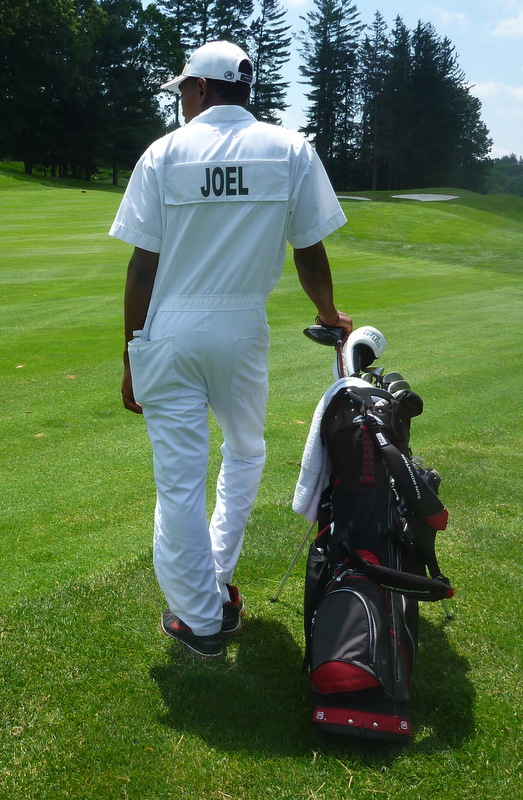
We had two terrific caddies that day. They wore white coveralls with their name on the back. It would solve a big problem for me if, from now on, everyone would wear their name on their back. Maybe wear it on their front, too:

Think how much easier remembering names would be if everyone would just do this.

Think how much easier remembering names would be if everyone dressed like this.

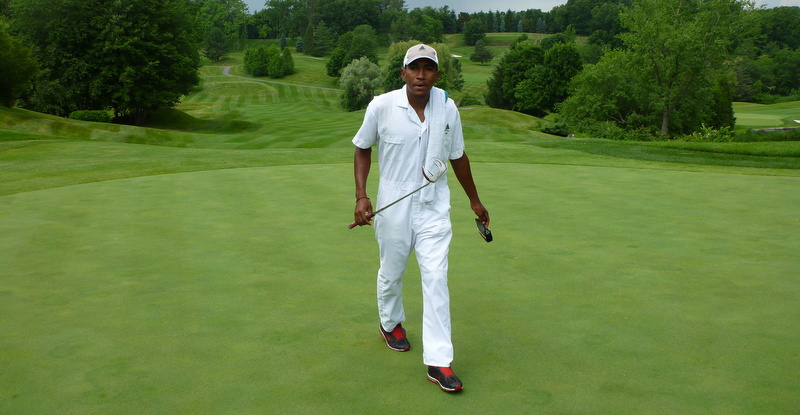
It started raining just as we were putting out on the eighteenth green, and almost immediately the lightning siren blew. That means we didn’t waste a single minute of the day.

Joel, on the eighteenth green. (See? I remembered his name.) You can sort of see the thunderstorm in the distance.

Joel, on the eighteenth green. (See? I remembered his name.) You can see some thunderstorm sky in the distance.

What’s In My Bag: Bruno Corbeil

No Baby Driver here. In fact, no driver at all.

No Baby Driver here. In fact, no driver at all.

Bruno Corbeil, a reader in Montreal, writes:

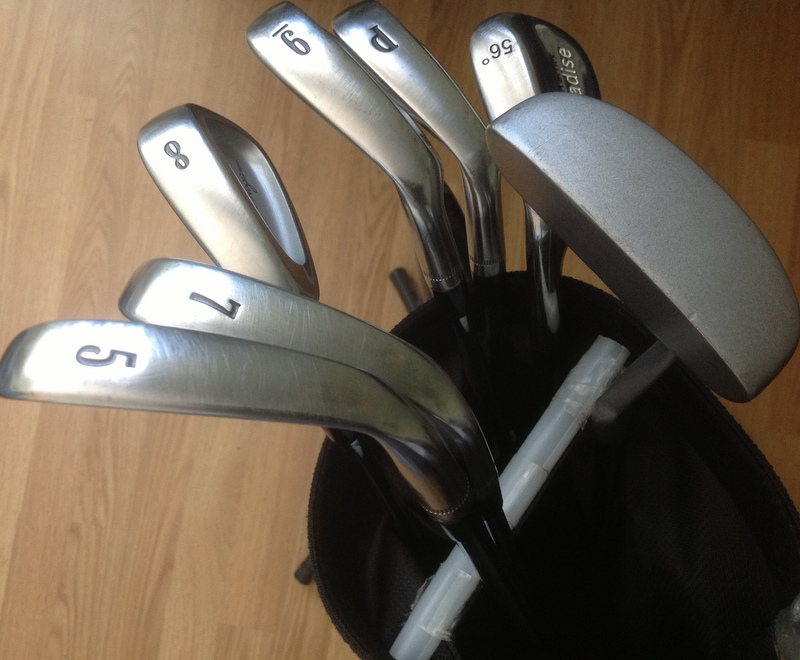
As I play mostly par-3 courses, with my kids, I carry a light Sunday bag with about seven clubs in it. I do it mostly because I don’t need a whole set, and also because I have grown to like carrying my bag.  I also hate playing the same course over and over again, so I have built a schedule that lets me play about six different ones in rotation, over the course of a season. This means that, depending on which course I’m playing, I need to decide which clubs I’ll bench for the week. I do have a whole set of irons (Ben Hogan BH-5), from pitching wedge through 3-iron. The sand wedge and my putter are both from Paradise. However, when I’m playing a small par-3 course, my usual set is S-5 and putter. Depending on the length of some holes and the weather, I’ll swap the 5-iron for a 4-iron or a 6-iron.  If I’m playing a course without bunkers, I might bench the sand wedge. I have tried some hybrid clubs but being more of an iron player than a wood player. My workhorse on regular-length courses has always been the 3-iron. Maybe a hybrid with a steel shaft might be a more pleasurable experience.

ATTDMLI2

Seven is a very reasonable number of clubs. My friend Tony once won our club championship with exactly that many, and Francis Ouimet won the 1913 U.S. Open, at The Country Club, in Brookline, Massachusetts, with just three more—and all of Ouimet’s had hickory shafts. In 1913, there was no rule limiting the number of clubs a player could carry, so Ouimet could have used twenty or thirty, as some players in those days did. Maybe he lightened his bag out of consideration for his caddie, Eddie Lowery, who was just ten years old.

Francis Ouimet (with horseshoe) and Eddie Lowery (with towel and seven-club golf bag), The Country Club, September 20, 1913.

Francis Ouimet (to the left of the horseshoe) and Eddie Lowery (with towel and seven-club golf bag), The Country Club, September 20, 1913.

Corbeil continues:

This summer, we went on a car tour of western Canada, and I took the opportunity to play golf in all the western provinces (Manitoba, Saskatchewan, Alberta and British Columbia).  Par-3 seemed the right choice as it didn’t not require much time to play, and would allow me to play with the kids and play after driving some 400 miles and still have somewhat of a game. That little Sunday bag—or those little Sunday bags, as the whole family has them—didn’t take up too much space in the car, and allowed us, if we chose wisely, to have our essential clubs to play the Par 3 golf courses.

Here’s a picture of Corbeil and his family on a par-3 course in Calgary:

100_1529

On a November weekend quite a few years ago, the Sunday Morning Group imposed a five-club limit on the day’s competition, as a novelty. I chose my putter, sand wedge, 8-iron, 6-iron, and 3-wood—a fairly typical line-up, it turned out. (This was before I’d become an almost total convert to hybrids.) Surprisingly, I shot about what I usually shoot, and so did everyone else. In fact, the score of the winning team that morning was two shots better than the score of the winning team the week before, when we had observed no limit on hand luggage more stringent than the U.S.G.A.’s. Still more unsettling, our course superintendent played along for a few holes with just an antique adjustable club, which he had set to 6-iron, and he would have won two skins if we hadn’t ungraciously disqualified him after the fact.

The day’s results lent a meditative air to the beer-swilling after the round. “Maybe we ought to play with five clubs all the time,” someone said—and the comment, unlike most post-round comments, was considered thoughtfully. Someone else pointed out that the scores during our club’s annual two-club tournament, which had been held a few weeks before, had been indistinguishable from regular scores—except for guy who had managed to post a new personal best.

Maybe the number of clubs we carry is less important than the selection. Five clubs may truly be all I need—as long as none of the five is the elusive Unhittable Club of the Day (U.C.D.), which moves unpredictably around my golf bag and was recently, for no known reason, my brand-new 60-degree wedge.

Sankaty Head Caddie Camp and Other Nantucket Wonders

Bruce Memorial Golf Course and Westchester County Airport, July 8, 2013.

Bruce Memorial Golf Course and Westchester County Airport, July 8, 2013.

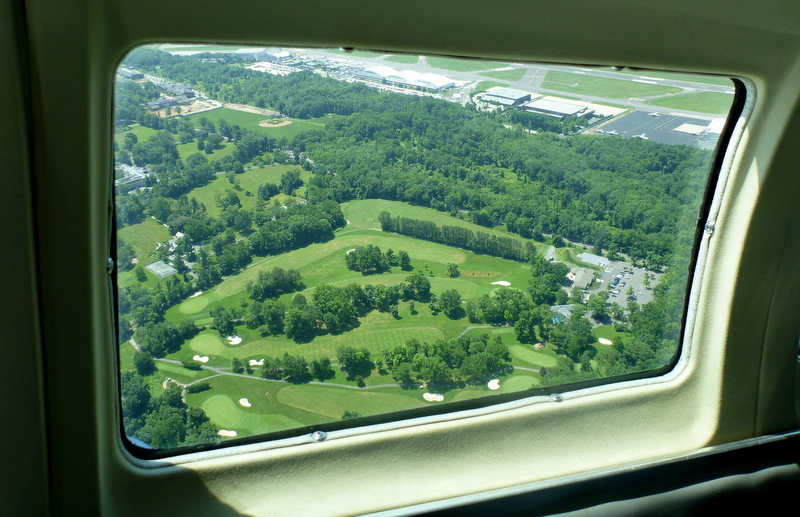
My wife and I flew to Nantucket earlier this week. In the air, we felt kind of rich, because we were the only passengers on the flight, but also kind of poor, because the plane was just a crappy Cape Air twin-engine Cessna eight-seater. I’d flown Cape Air before, on trips to and from Martha’s Vineyard, where my wife and I have spent summer vacations for many years. The weather during those flights was almost always terrible, and I spent most of each one gripping my seat and thinking, “We’re almost certainly going to die, but, if we don’t, this sure is faster than taking the ferry.” The weather this time was perfect, and from the plane I saw lots of golf courses, including the one in the photo above, a public course in Greenwich, Connecticut, right next to the airport. It was almost like visiting Google Earth!

This was our pilot. He never asked me to take the controls, but I studied them, just in case, when I wasn't scanning the ground for golf courses.

This was our pilot. He never asked me to take the controls, but I studied them, just in case, when I wasn’t scanning the ground for golf courses.

When we got to Nantucket, my wife took a nap, and Bob G.—an honorary member of the Sunday Morning Group, who had made our trip possible by arranging for me to give a talk in a local lecture series—took me on a tour of the island. Because our wives weren’t with us, our tour consisted solely of golf courses.
20130708_155350

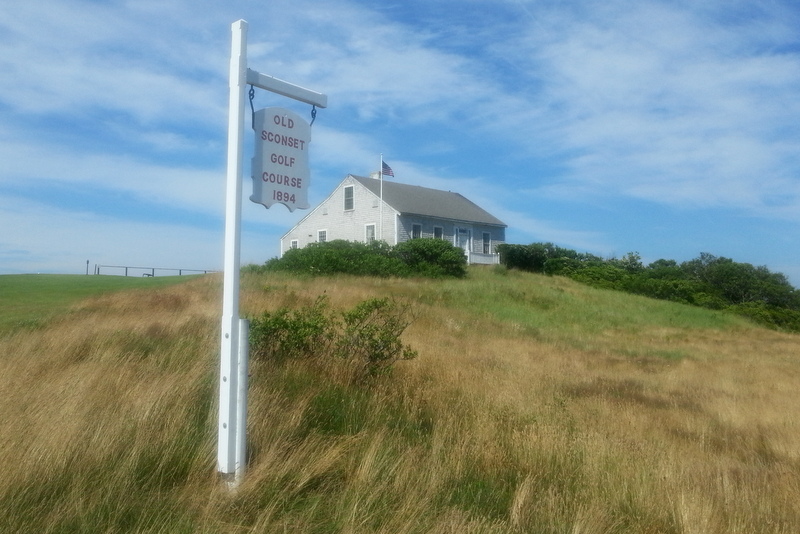
Old Sconset—the first stop on our tour—is known locally as Skinner’s, because Skinner was the middle name of one of the people who owned it for a while. (It’s now owned by the Nantucket Islands Land Bank.) You can read about the history of the course here.
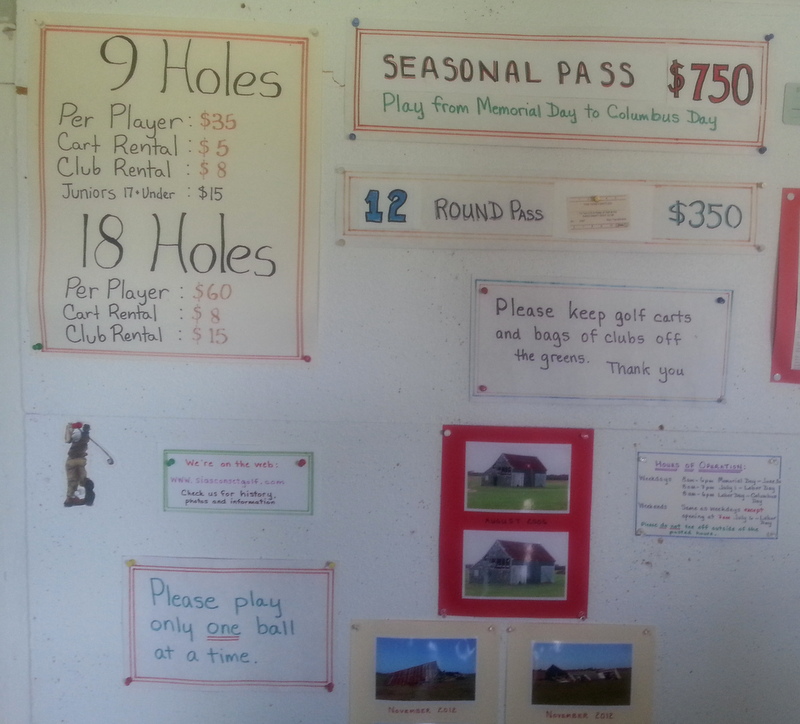
Inside the clubhouse, Old Sconset Golf Course.

Inside the clubhouse, Old Sconset Golf Course.

When Skinner’s is crowded, players reserve their place on the first tee by placing a ball in a sloping chute on top of the fence:

20130708_155507

The next day, Bob and I actually played golf, at Sankaty Head Golf Club, a course that’s been on my to-play list for a long time.

Sankaty Head lighthouse, which recently had to be moved farther from the cruel, cruel sea, and the somewhat less cruel fifth fairway.

Sankaty Head lighthouse, which recently had to be moved farther from the cruel, cruel sea, and the somewhat less cruel fifth fairway.

There’s lots of cool stuff in the Sankaty clubhouse, including the plaque in the photo below, which hangs on a wall in the men’s locker room. Note that each result is annotated with a description of the day’s weather:

P1070790

Maybe the very best thing about Sankaty is its caddie camp. Every summer, sixty boys spend two months living at the club and caddying for members. They have their own bunkhouses and dining hall, and there are organized games, trips into town, and other activities, in addition to lots of after-hours golf.
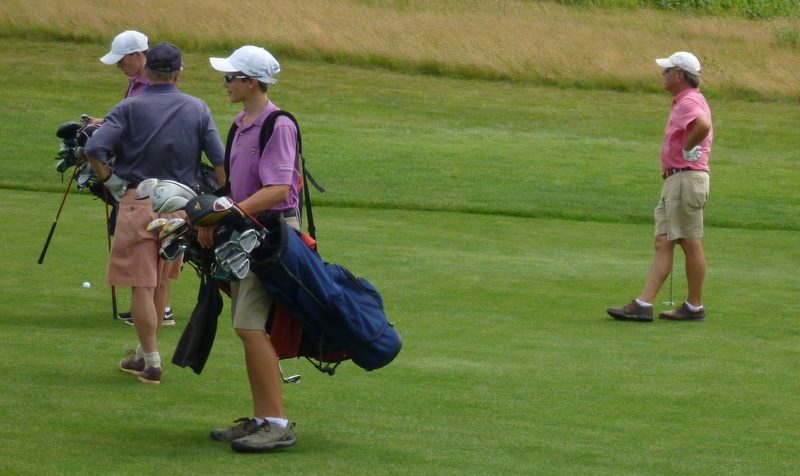
Tom, Bob G., Charlie, and Peter. The caddies get Garmin G.P.S. watches, hats with their name on them, and other stuff, and they make good money. Also, they are so polite that they make you almost reluctant to use bad words in their presence.

Tom, Bob G., Charlie, and Peter. The caddies get Garmin G.P.S. watches, hats with their name on them, and other stuff, and they make good money. Also, they are so polite that they make you almost reluctant to use bad words in their presence.

Here’s the camp, which is near the eleventh, twelfth, and thirteenth holes:
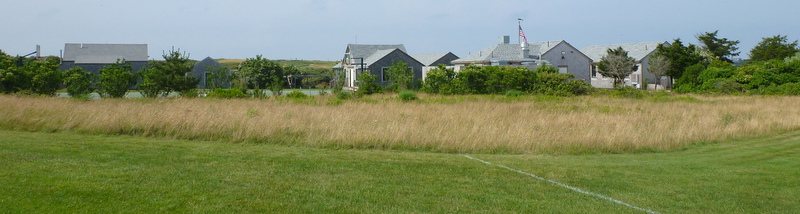
P1070784

And here are more caddies, on the driving range. I felt angry at myself for not knowing, when I was thirteen or fourteen, that spending a summer like this was possible:

P1070751

The next day, Bob and I played golf at Miacomet Golf Course, which, like Skinner’s, is public and is owned by the Land Bank. We played with Phil Truono, the director of golf.

Phil Truono, Miacomet Golf Course, Nantucket, July 10, 2013.

Phil Truono, Miacomet Golf Course, Nantucket, July 10, 2013.

Miacomet used to have just nine holes, but in 2003 the Land Bank added a second nine and renovated the whole thing. It’s a terrific golf course, and playing it is a relative bargain. People on Nantucket sometimes say that Sankaty Head is for millionaires and Nantucket Golf Club (where we didn’t play) is for billionaires. If that’s true, then I guess Miacomet is for thousandaires and Skinner’s is for hundredaires—so there’s something for everyone, as there always should be. (Non-golfers can look out for themselves.)
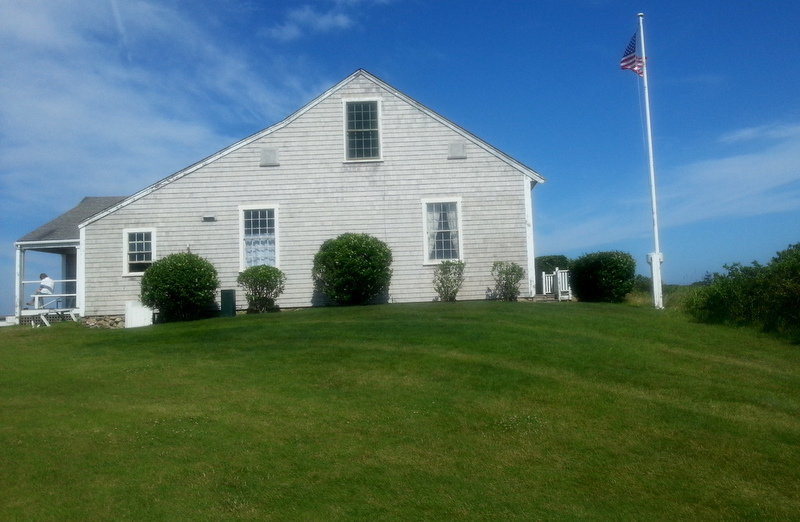

20130708_160201


Rain Gloves Are Also Sweat Gloves

Sweat-soaked rain gloves, July 7, 2013.

Sweat-soaked rain gloves, July 7, 2013.

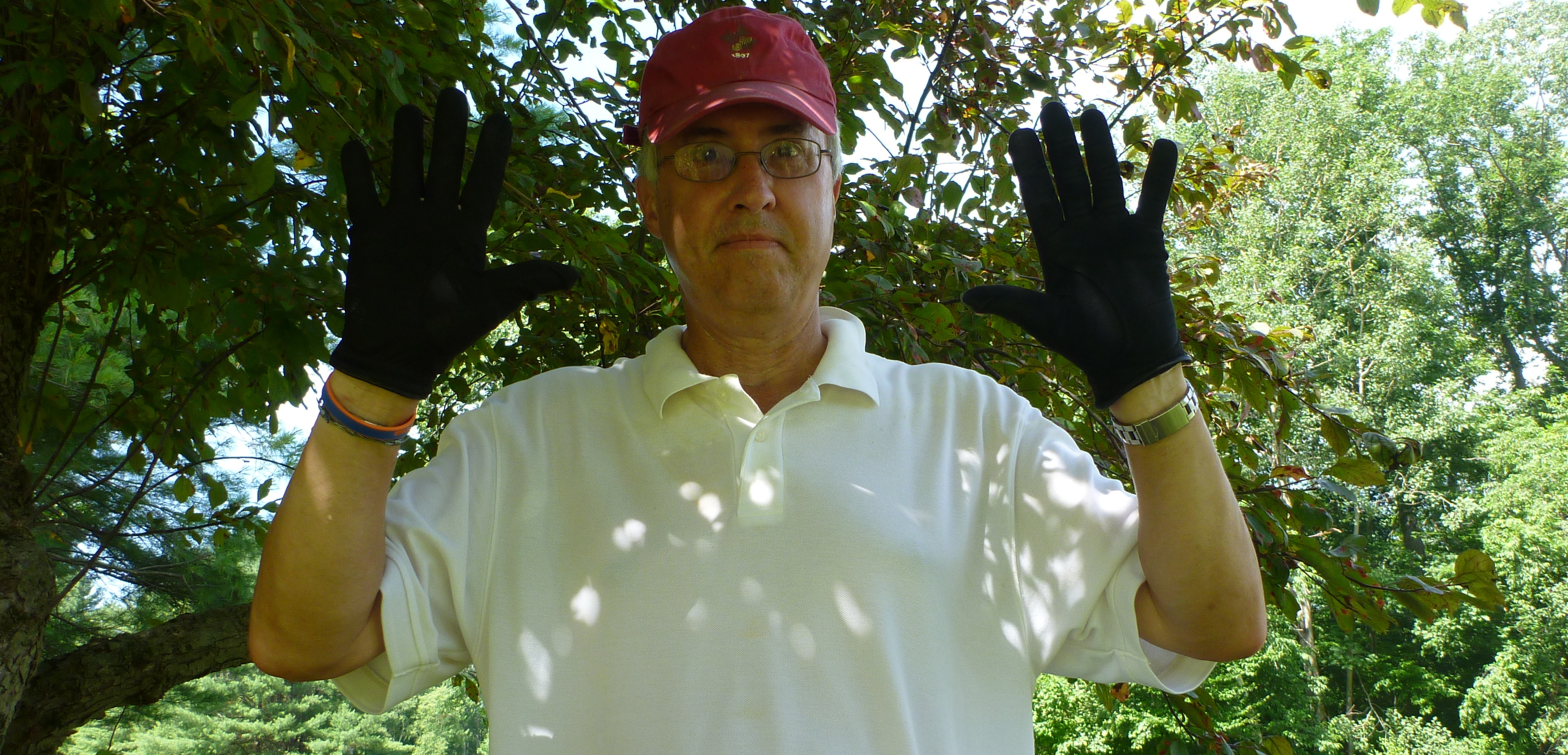
It’s been so hot and humid around here that we’ve had to make some adjustments. I’ve started wearing rain gloves even when it isn’t raining, because regular gloves feel slick and slimy when they’re soaked with perspiration. We’ve also tried bracketing the worst parts of the day by playing at the five-thirties: a Two-Hour Eighteen™ at 5:30 a.m. followed by a Two-Hour Eighteen™ twelve hours later, at 5:30 p.m. The course is empty and relatively cool both times, and you have room for a full workday in between, assuming you don’t fall asleep at your desk. And after the second eighteen you get home in plenty of time to ask, “Hey, what’s for dinner?”

Tony, Ian, Other Gene, Tim-o, Rex, eighteenth green, dawn patrol

Tony, Ian, Other Gene, Tim-o, Rex, eighteenth green, dawn patrol, July 3, 2013.

Kevin, Addison, evening session.

Kevin, Addison, evening session.

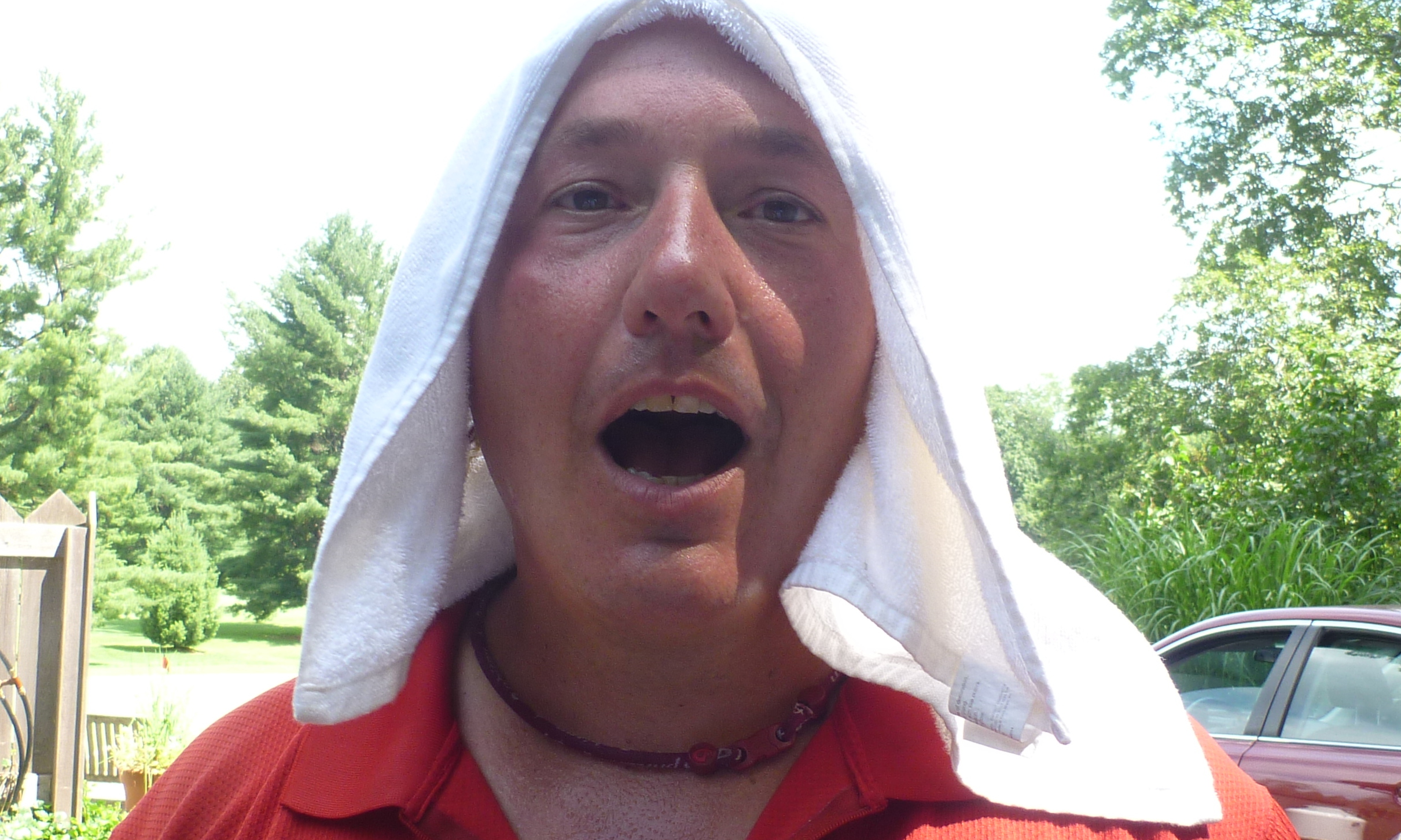
Sunday Morning Group met at the regular time—7:30—and the temperature was around 90 by the time we finished. Doug got so hot that he had to cover his head with a towel:

P1070679

Corey (our pro) wore shorts, and for the first time in living memory we ate lunch on the porch, to get out of the sun.

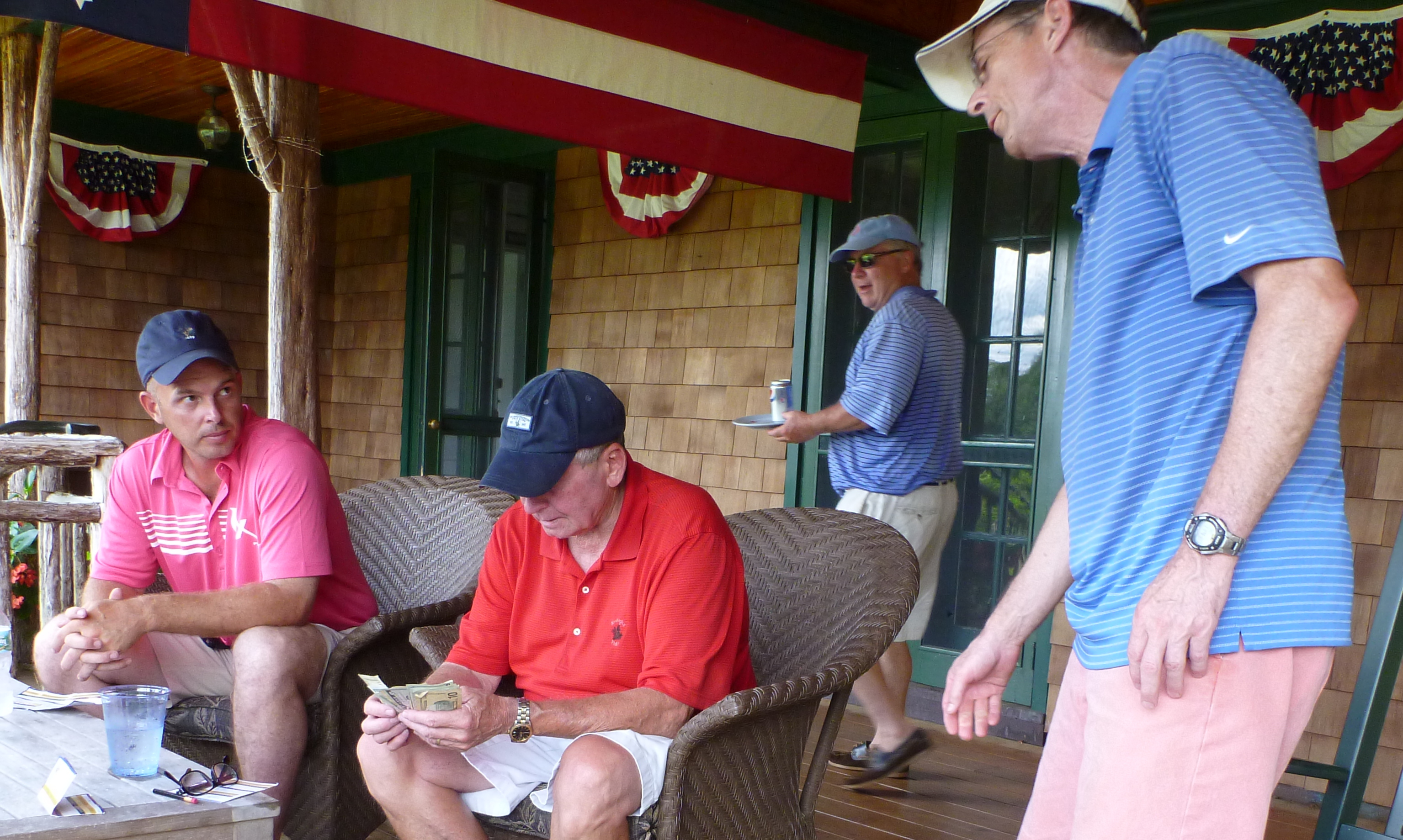
Settling up at lunch: Corey (our pro), Hacker (real name), Tom, Tim.

Settling up at lunch: Corey, Hacker (real name), Tom, Tim.

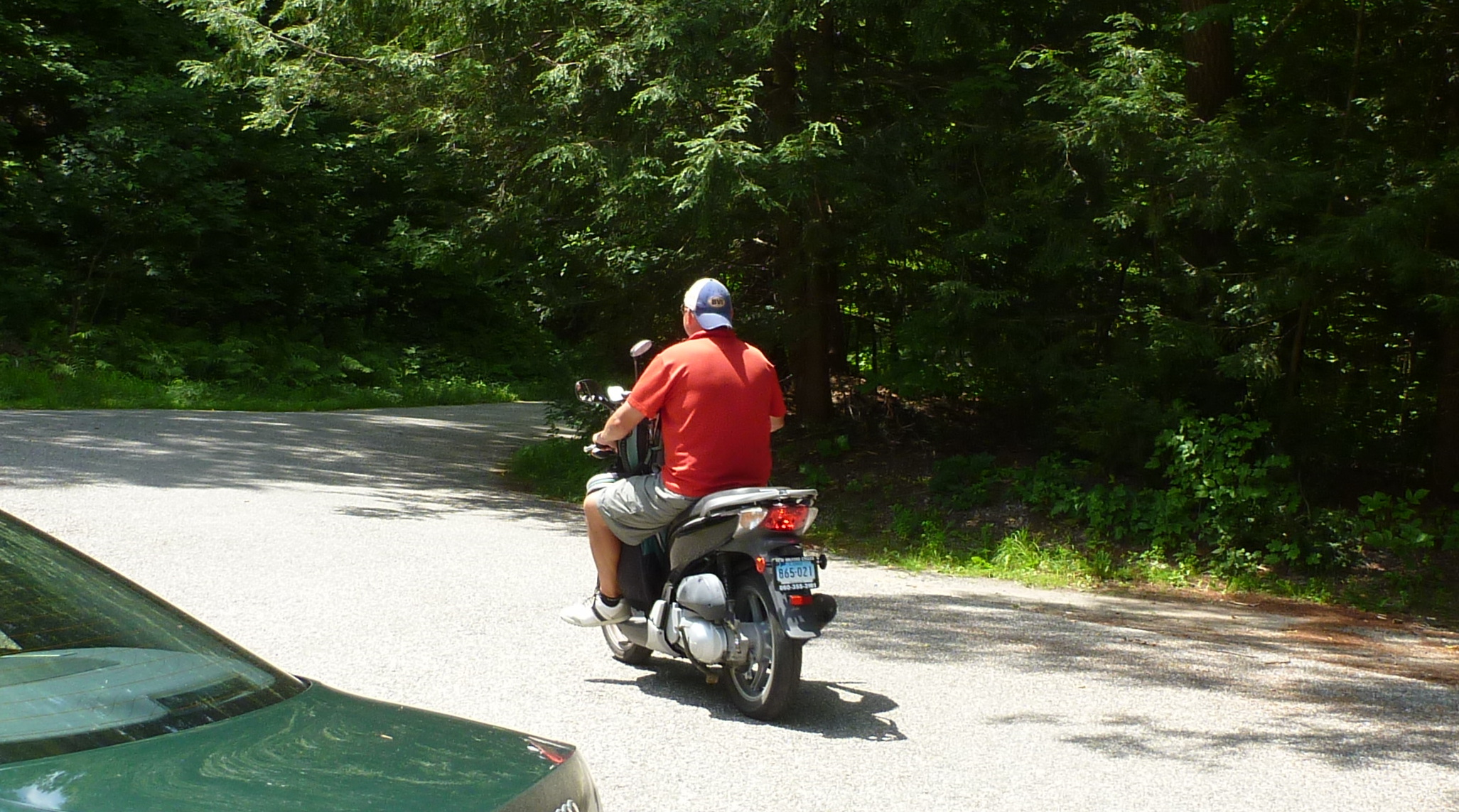
There were only three skins, and Tim got two of them. He was also on the winning team, so next week it will be his turn to bring lunch. Doug had a wife situation at home, so he left as soon as he had eaten. He doesn’t live very far from the course, so in decent weather he usually commutes by motor scooter:

P1070713 P1070715

That’s a dual-purpose helmet he’s wearing: turn it the other way and it’s a golf cap.

My Friends and I Like to Play With Glowing Balls

Young Nick, first tee, 9:45 p.m., July 5, 2013.

Young Nick, first tee, 9:45 p.m., July 5, 2013.

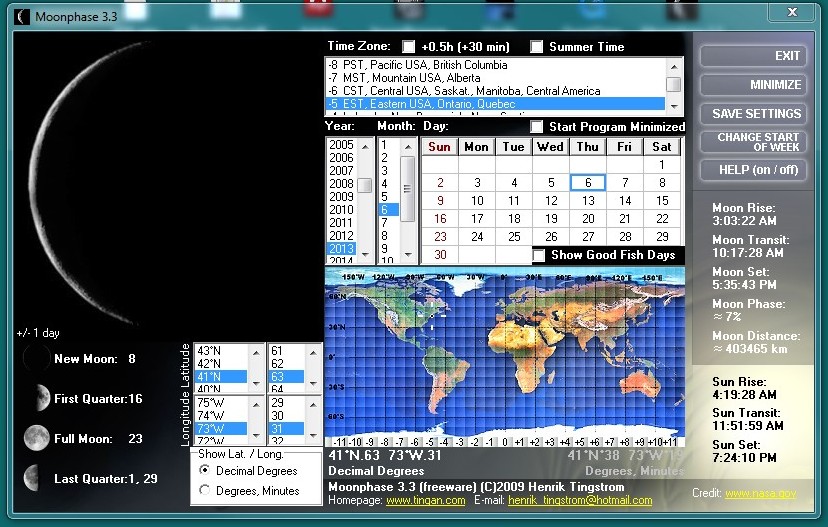
All golfers brood obsessively about the weather; my friends and I also track the phases of the moon. The reason is that we like to play at night, with glowing balls, and glowing balls look best against a truly black sky. The ideal time to play is an hour or two after sunset during a new moon, but other times of the month work, too, as long as the moon either hasn’t risen yet or has already gone down. I now monitor all that with a free program called Moonphase 3.3.

Moonphase

On Friday night, we met on the clubhouse porch at 7:00, for pizza from The Upper Crust, the official provisioner of the Sunday Morning Group.

Austin, John.

Austin, John, pizza, clubhouse porch.

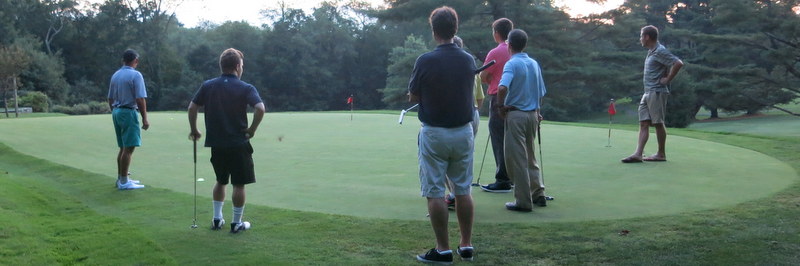
Then we played Putting for Dollars on the practice green while we waited for the sun to go away.

In all our putting contests, we use the stymie rule, which the rest of the golf world abandoned in the 1950s.  Closest to the pin wins, double points if the ball goes in. Luke (second from left) was the only competitor to actually sink a putt.

In all our putting contests, we use the stymie rule, which the rest of the golf world abandoned in the 1950s. Closest to the pin wins, double points if the ball goes in. Luke (second from left) was the only competitor to actually sink a putt.

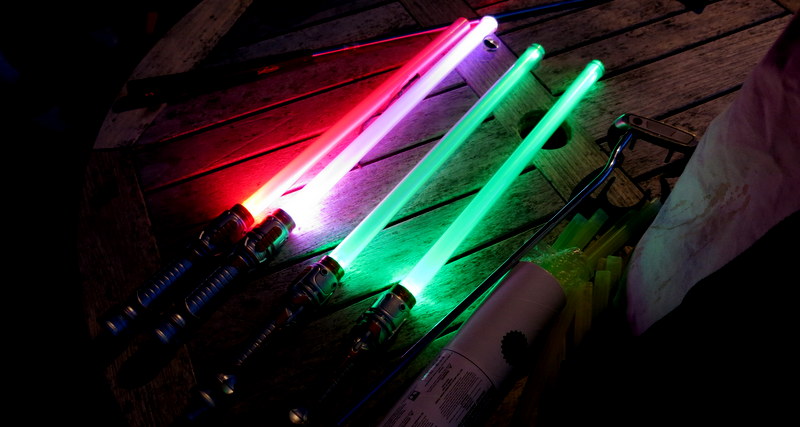
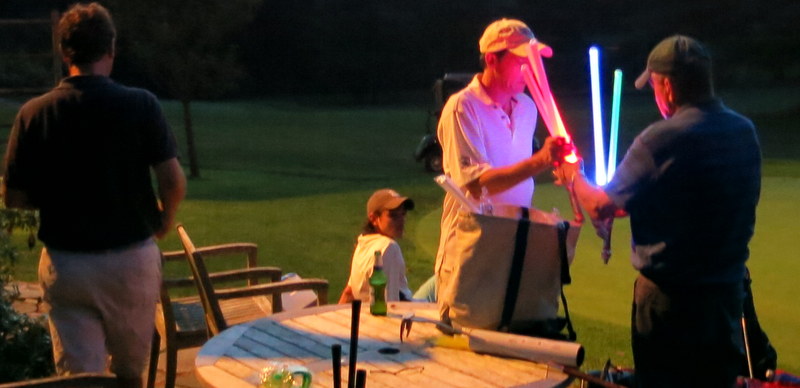
When the sky finally began to seem sort of promising, we turned on our flashing light sabers, to let them warm up.

IMG_2127

Then Hacker (real name) and Tim went out in a golf cart to place light sabers in the cups on the first second, seventh, eighth, and ninth greens, so that we’d be able to tell where the holes were. They also put glowing green rings in the bottoms of the cups.

Paul, Middle Nick, Tim, Hacker.

Paul, Middle Nick, Tim, Hacker.

Night golf has been a feature at my club for more than twenty years. For most of those years, we used translucent balls with glow-stick inserts. They were fun to play with, but they didn’t behave like real balls, and they didn’t fly anywhere near as far, and the glow sticks were sometimes hard to cram all the way in. Last year, we switched to Night Flyer balls ($70 a dozen, in six colors, at nightflyer.com). They’re self-illuminating—each one contains its own LED and battery, which isn’t replaceable but lasts for many rounds—and when they’re not lit up they’re visually indistinguishable from regular balls. You switch on the LED by hitting the ball or rapping it against anything hard, and it stays lit as long as you hit it again within eight or ten minutes, which is plenty of time to find it, even in the woods.

IMG_2152-002

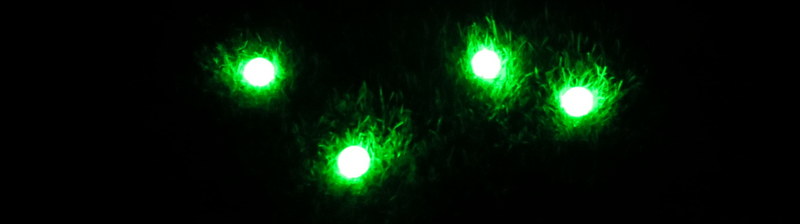
We had eleven guys. We played a scramble—each team with its own color—and we all played together. Hacker drove the beer cart. We teed up every shot, including chips, because divots are just about impossible to find at night. Here’s what the second green looked like when everyone was ready to putt:

IMG_2148-002

The red balls look the coolest, both in the air and on the ground.

IMG_2159

Austin made a brief video of someone missing a putt on the eighth green. Paul’s team had already clinched the title by then, so the miss didn’t matter.

Last year, I spoke with Pat Chapman, who is Night Flyer’s sales and marketing manager. She lives in New Hampshire but she grew up in New York, and when people give her a hard time she asks them, “Do you really want to mess with a girl from Brooklyn?” Largely as a result of her steady evangelism, night golf has rapidly grown in popularity all over the world. (“Not so much in France,” she said, “but France is France. What can I say?”) Scandinavians have been particularly enthusiastic, she added—perhaps because they spend so much of the year in the dark. She has organized full-scale night-golf events in many countries—for corporate outings, bachelor parties, wedding receptions, and other golf-appropriate occasions—and Night Flyer sells an almost comically extensive line of glowing accessories, including hole inserts, hazard stakes, tee-box markers, and black-stemmed margarita glasses. (That’s where we got the light sabers.)