Golf in Morocco: Silver Tongs for the King’s Cigarette

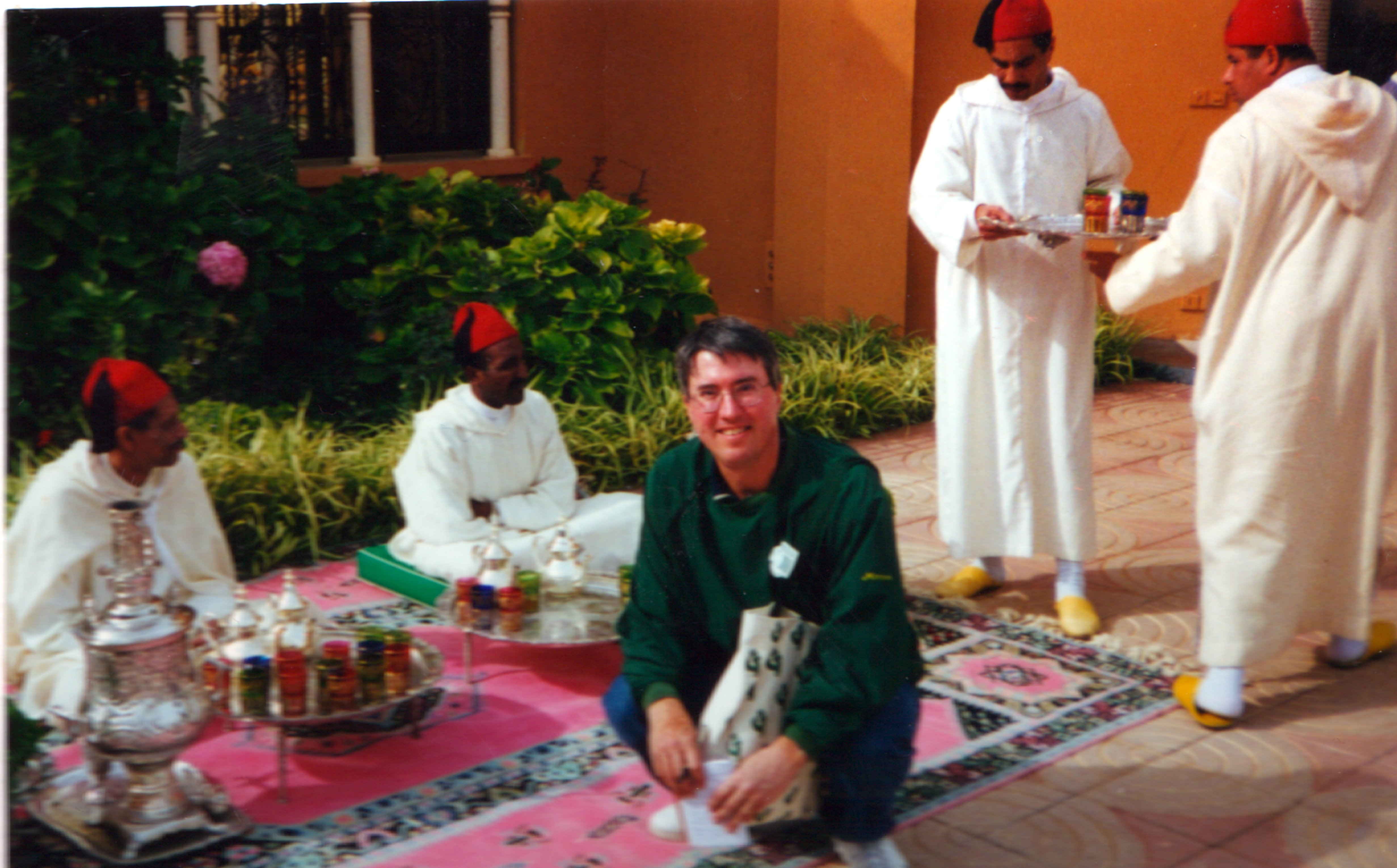
This past week, the European Tour was in Morocco, for the Hassan II Trophy. I attended that tournament in 2000, and I liked Morocco so much that, a few months later, I went back, with my wife and our two children. The Trophy didn’t become an official tour event until 2010, and when I was there it was played on a different course, but the broadcast of this year’s event brought back a lot of happy memories. Here I am having tea at the royal stables, in Bouznika:
dlomoroccotea2000

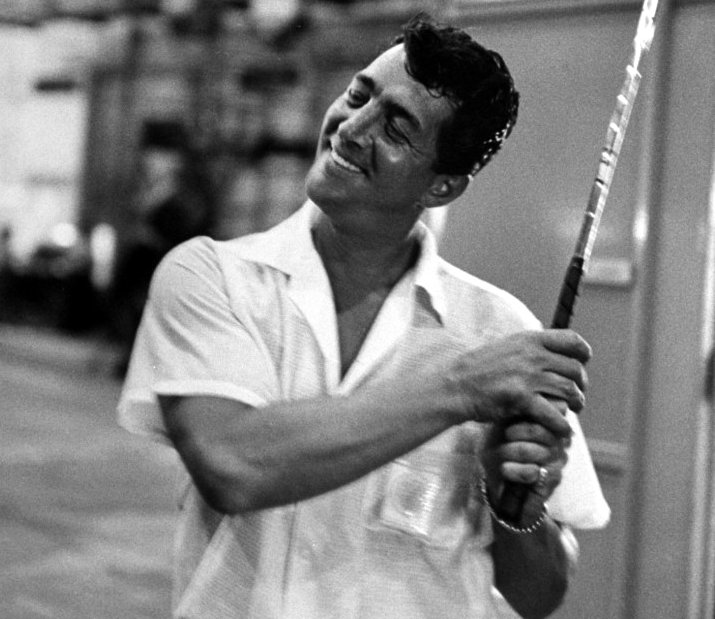
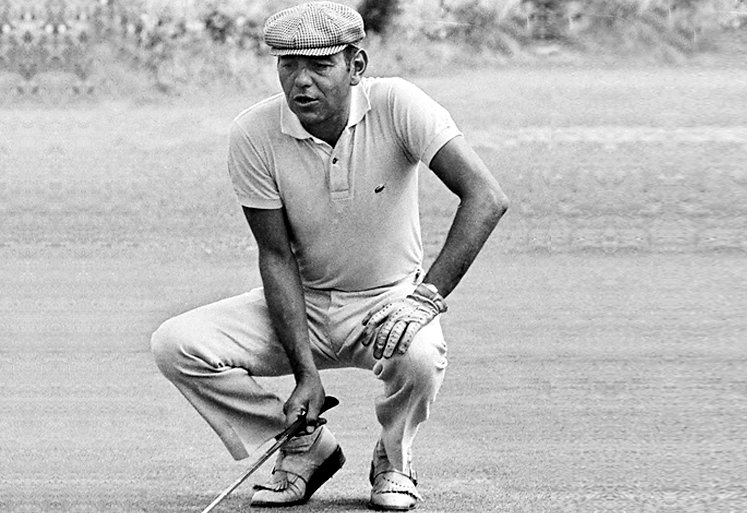
The tournament is named for (and was founded by) King Hassan II, who ruled Morocco from 1961 until his death, in 1999—the year before I visited. Hassan was a passionate golfer. He employed a squadron of caddies (one of whom was responsible for gripping the royal cigarette with a pair of silver tongs while the King swung his club), and shot mediocre scores that easily could have been worse (because kings are not obligated to play from bad lies or extricate themselves from bunkers). Hassan viewed golf not merely as a palliative to the tedium of absolute power but also as a potential bridge between his country and the United States—then, as now, the world’s most enticing source of exportable prosperity.
HasasanIIgolf-001

Hassan took up golf during the presidency of Dwight Eisenhower, whose widely chronicled enthusiasm had imbued the game with sort of hokey Free World allure—as did the contemporaneous rise of Arnold Palmer, who was golf’s first television star, and, a little later, the emergence of Jack Nicklaus, who turned pro the year of Hassan’s coronation.

morocco-lgflag (1)

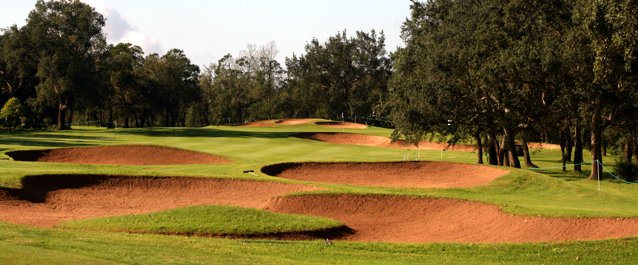
The King was not a natural player, however, and by the mid-1960s he was looking for an American instructor to help him bring his scores out of the triple digits. He settled on Claude Harmon, who had won the Masters in 1948 and was the head pro at Winged Foot. Harmon made numerous visits to Morocco in the late sixties and early seventies, in return for which the King gave him, among other things, jeweled daggers, rugs, swords, a cigar box stuffed with cash and a Lincoln Continental Mark III. Harmon eventually moved his family to Rabat. In the early seventies, his eldest son, Butch—later the teacher of Tiger Woods—served as the head pro at Royal Dar es Salaam Golf Club, where the Trophy was held in 2000.
Dar-Es-Salaam-Rabat

During the tournament’s formative years, Hassan II had concerns unrelated to golf. In 1971, his forty-second birthday party was crashed by more than a thousand rebellious soldiers; they killed nearly a hundred guests before the King, who had hidden in a bathroom during the worst of the shooting, effected a change of heart in one of the revolt’s commanders by looking him in the eye and reciting the first verse of the Koran. (The rebel knelt and kissed his sovereign’s hand.) The following year, the King’s plane was attacked in the air by four F-5 fighters from his own Air Force. One of the plane’s engines was destroyed, but it managed to land in Rabat—where the rebels continued to strafe it until the King grabbed his plane’s radio and shouted, “Stop firing! The tyrant is dead!” Both incidents were followed by the inevitable bureaucratic shufflings and summary executions. Then the King went back to working on his game.

To be continued.

reaganhassan


Masters Countdown: Augusta National’s Worst Golfer Ever?

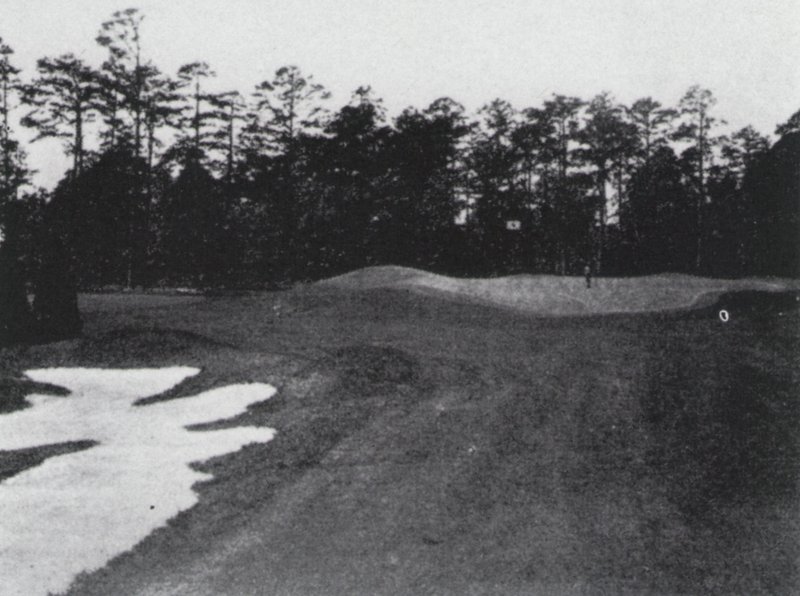
Here’s what Augusta National’s first green looked like during the first Masters, when the hole was still the tenth. That bunker was really more of a waste area. It was later removed, and a different bunker was added closer to the green:
ANGC-Hole-1

During the club’s early years, a small creek ran across the first fairway, at the bottom of the hill, less than a hundred yards from the tee. The carry over the ditch was so short that few players noticed, but a member named Clarence J. Schoo drove into it so often that it came to be known as Schooie’s Gulch. Schoo was the founder and president of a boxboard manufacturing company in Springfield, Massachusetts. The company doesn’t exist anymore, but Schoo’s name is preserved in the Schoo Science Center at Springfield College, of which he and his wife were benefactors.

schooiebox.jpg

At Augusta National one day, Schoo topped yet another drive into Schooie’s Gulch, and told Clifford Roberts, the club’s co-founder and chairman, “I wish you’d fill in that damn ditch.” Roberts did, during the summer of 1951—and sent the bill to Schoo. Or so the story goes. In truth, the ditch had always been a maintenance problem. Roberts also wanted to replace the club’s old Masters press tent, which really was a tent, with a Quonset hut. The new building was going to go to the right of the first fairway, near where the big scoreboard is today, and the ditch was in the way. The photo below shows the inside of the Quonset hut in the early 1950s. The sportswriters’ laptops look strange, but their beer cans and cigarettes are recognizable:

ANGC quonset.jpg

Schoo did pay for part of the alteration, but he did so gladly, and he almost certainly wasn’t surprised when he opened his bill. He and Roberts were close friends, He was also one of the most popular members, and he later served as one of the club’s vice presidents. Here’s a note that another popular member, former President Eisenhower, sent him after Schoo had missed Eisenhower’s birthday party:

Eisenhowerletter.jpg

Schoo was such a poor golfer that when he one day made a natural birdie Roberts decided that he should be paid the same cash pot that ordinarily went to a golfer who made a hole-in-one, on the theory that Schooie was never going to come closer. Another time, while Schoo was playing the seventh hole in a foursome that also included Roberts and Eisenhower,he hit a drive that traveled just a few yards, into a clump of pampas grass to the left of the tee. He said, “Well, in all the years I’ve been playing here, that’s the first time I’ve done that.” That summer, the grounds crew cut back the pampas grass and found many balls with his name imprinted on them. On another occasion, Schoo said with exasperation that he must be the worst golfer in the club. His caddie, who had been around long enough to hear stories but not long enough to recognize faces, said, “No, sir. The worst golfer in this club is Mr. Schoo.”

An Empirical Proof of Golf’s Superiority to Tennis

levering

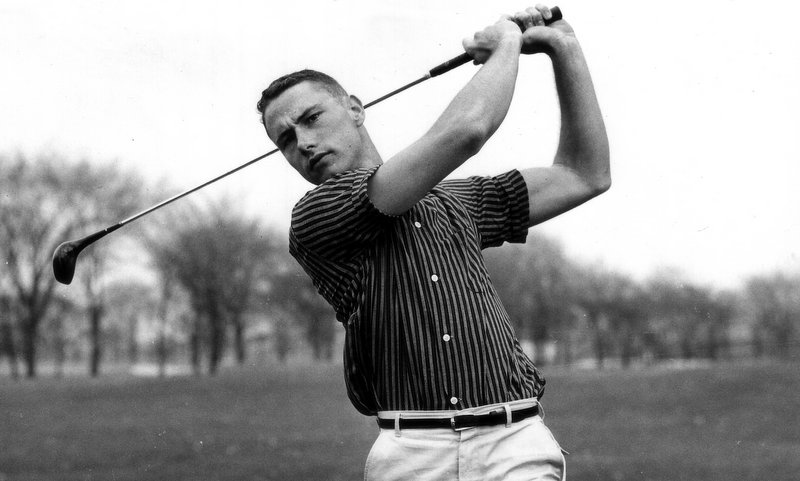
Gary Levering, a lawyer and real-estate developer in Houston, died last year. He played on the golf team at Northwestern from 1957 to 1961 (photo above, courtesy of Northwestern Athletics), and once he’d established himself in his career he reimbursed the university for his scholarship. He believed that golf was a more difficult sport than tennis. To prove it, he signed up for lessons at the Houston Racquet Club and won the club championship two years later: Q.E.D. He earned a perfect score on the test the U.S.G.A. uses to certify rules officials, and was known to friends as Dr. Golf. I learned about Levering from Keith Kimmick, a reader and a commercial-insurance executive. He heard Levering give a talk about bipolar disorder, from which he suffered, at River Oaks Country Club, and when the talk was over Kimmick asked what he could do to help.

Kimmick has served on the advisory board of the Depression and Bipolar Support Alliance of Greater Houston ever since. “Fortunately, I don’t suffer from this illness,” he told me recently, “but I admired Gary for stepping out to tell the world about himself. The D.B.S.A. provides free assistance for those that suffer from bipolar and depression through trained facilitators. I spend most of my time working a booth at various health functions throughout the city, spreading the word.”

Levering and Kimmick became golf buddies, too. Levering owned a house in Pebble Beach and was a member of Cypress Point Club, which always hovers near the top of Golf Digest’s 100 Greatest. During guest rounds there, Kimmick got to know Mike Reese, a longtime Cypress caddie. Reese died of a brain aneurysm in 2007, at the age of 49, and Kimmick wrote a tribute, of which this was part:

Casey Reamer, Cypress Point Club’s head pro, remembers Mike as a true perfectionist on the golf course. One day when Mike was caddying for him, Casey had accidentally left his Bushnell (electronic measuring device) in his golf bag. They are not permitted at Cypress Point Club, but Mike insisted that Casey test his yardages. On the 7th hole, Mike said he was 178 yards from the pin and the Bushnell indicated 179 yards. On the 8th hole, Mike said he was 134 yards and the Bushnell flashed 134 yards to the mark. On the 9th hole, Mike said he was 117 yards and the Bushnell indicated 116 yards. Casey responded to Mike that he was very impressed that he was right on target with the Bushnell once, and within a yard the other two times. Mike very professionally flipped the Bushnell over where the sticker read within one yard up to 1500 yards, and said, “I believe the Bushnell was off one yard on those other two holes.”
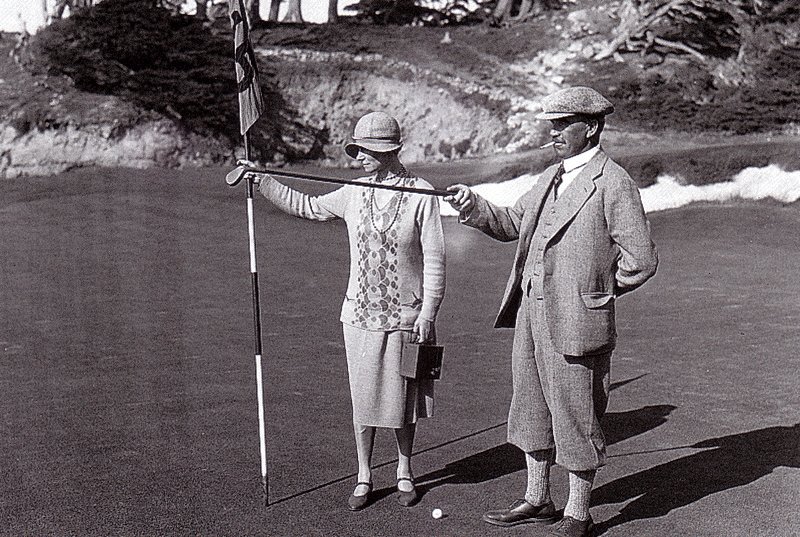
Kimmick and Reese shared a love for Cypress memorabilia. Kimmick’s collection is extensive, and he has shown me images of some of his favorite items. I’m going to write about one of them in a future post. (Not the photo below, which is part of my own Cypress collection. It’s of Alister MacKenzie and his wife, Hilda, on the fifteenth green when the course was new. That box in Hilda’s hand is a camera—and check out her shoes.
MacKenziesCPC

Amy Alcott, Walter Keller, Dean Martin, and Riviera

amyalcott

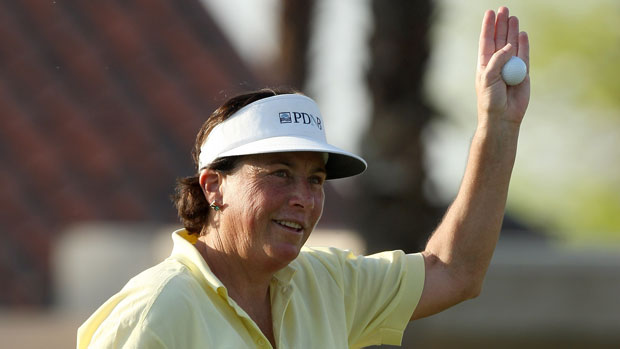
On Saturday, Jim Nantz interviewed the great Amy Alcott—who won twenty-nine LPGA Tour events, beginning in 1975, when she was nineteen—during the CBS broadcast of the Northern Trust Open (nee the Los Angeles Open), at Riviera. In 1995, on assignment at Riviera for Golf Digest, I met Walter Keller, who had been Alcott’s teacher. He told me that he first saw her on the practice tee at Riviera when she was a young girl. “I fell in love with the kid right there,” he said. “She hit a beautiful shot, and I said, ‘Hit another.’ She did. ‘Hit another.’ She did. I turned to her mother and said, ‘You are a blessed woman.’” Keller arranged for Alcott to become a member of the club—and here he is a little later, with Alcott and Tony Sills (another student of his) and a significant collection of junior trophies:

alcottkellersillstrophies.jpg

Keller, who died in 2003, at the age of ninety-five, said that Alcott had a difficult relationship with her father but that club members looked out for her. “She had twenty fathers here,” he said. “Dean Martin would see her on the driving range, swing by in his cart, and say, ‘Hey, Amy, let’s play nine holes.” One of many, many reasons to love Riviera.

Dinoandluckies

The Muny Life: Mayfair Country Club

Recently, I wrote about Mayfair Country Club, a muny in Sanford, Florida, and its interesting connection to Moe Norman. But wait! There’s more!
mayfairsignnew

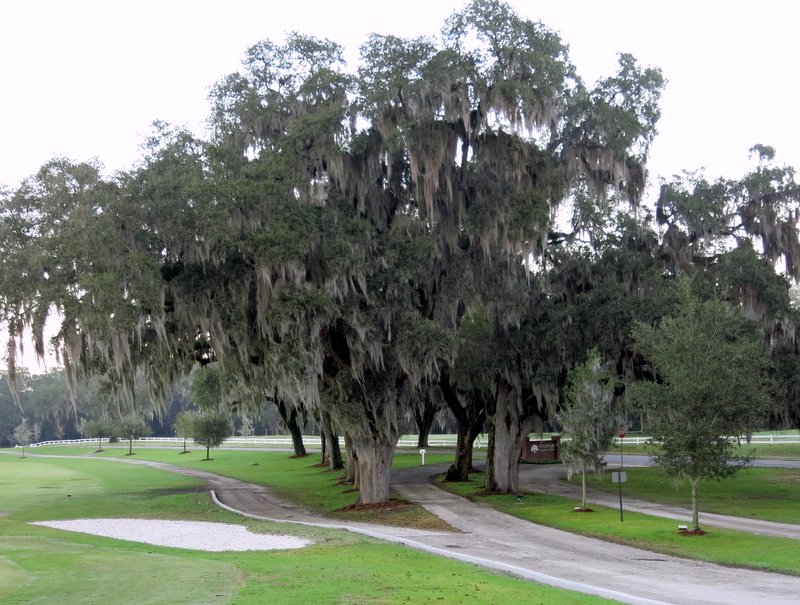
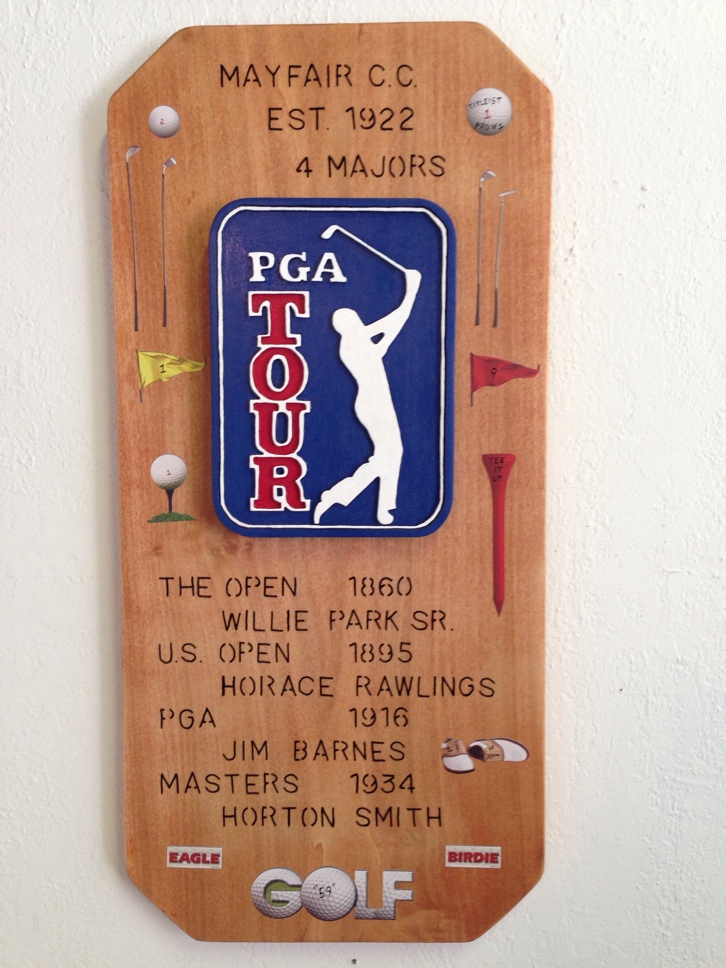
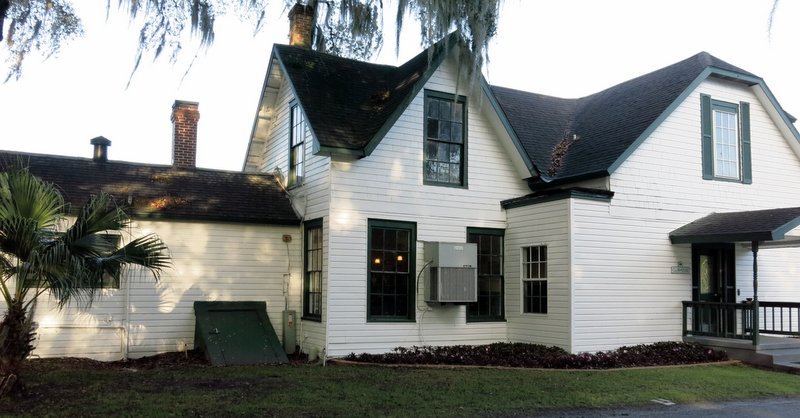
The driveway at Mayfair is flanked by enormous live oaks. They were planted in in 1847, when the property was part of a citrus plantation. The city of Sanford bought 152 acres in 1922 and created the Sanford Golf Club, which at first had just four holes.

liveoaks

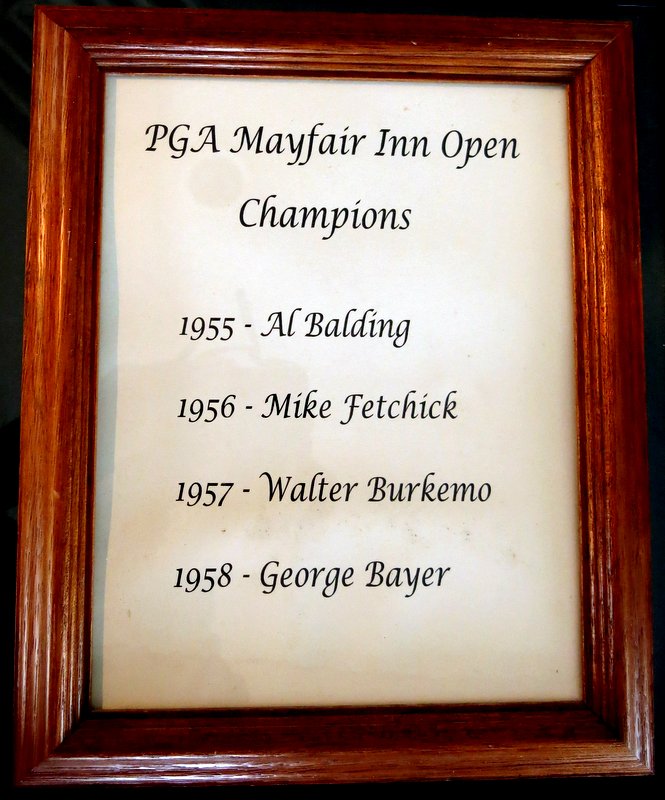
Later, the city leased the course to a variety of outside operators, among them the New York Giants baseball team. The Giants ran it from 1953-’61 and renamed it the Mayfair Country Club, after Sanford’s Mayfair Inn, which the team also owned. (The Giants used the inn as a dormitory for minor-leaguers, in addition to running it as a resort.) From 1955-’58, the club was the home of the Mayfair Inn Open—unofficially known as the New York Giants Open.
winnersign

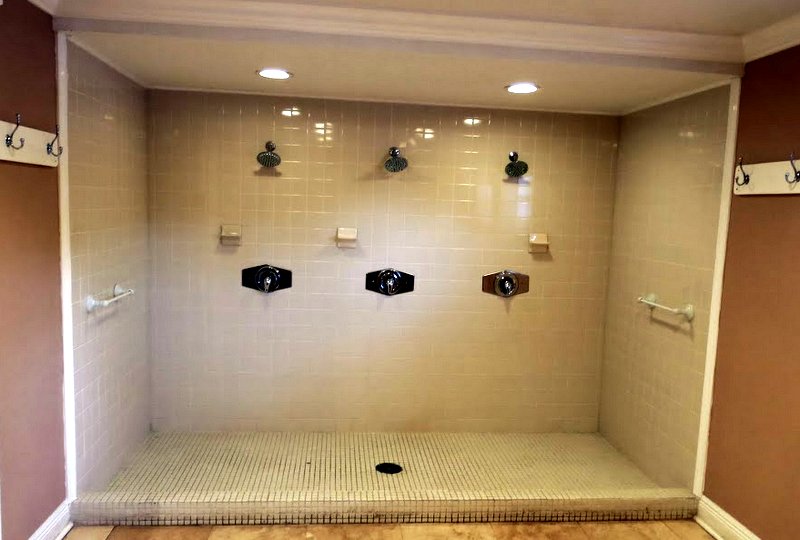
In 2009, a guest at a raucous graduation party shot and killed a young man standing at the bar in the clubhouse. (According to the guys I had lunch with, the shooting was an accident, in the sense that the shooter was trying to kill a different young man, who resembled the victim from behind.) But the murder was an anomaly, and Mayfair has survived an economic downturn that many other Florida courses haven’t. The city of Sanford and Integrity Golf have made major improvements to the course and the clubhouse, including these slightly unnerving showers:

MayfairShowers

I played in Mayfair’s regular Sunday-morning game, which has two components: a Stableford and skins. (One of the guys in the game referred to the club as St. Mayfair, because it’s where they all go on Sunday.)

mayfairguys

Jean-Pierre Ely, the club’s general manager, was in my group. He’s was born in Germany, and his grandmother knew Bernhard Langer’s parents. His family moved to the United States in 1998 after his mother won a green card in a lottery. He’s 28. His ambition is to play on the PGA Tour. That’s him on the right,with one of the club’s starters:

starterjp

There’s something cool about playing a golf hole that Ben Hogan had a definite opinion about (the fourth, a sinuous par 4, which he once described as one of the toughest bunker-free par 4s he’d ever played), and, later, buying a sleeve of balls in a golf shop that Sam Snead used to drive over while taking a shortcut to what was then the 10th green.

P1110931

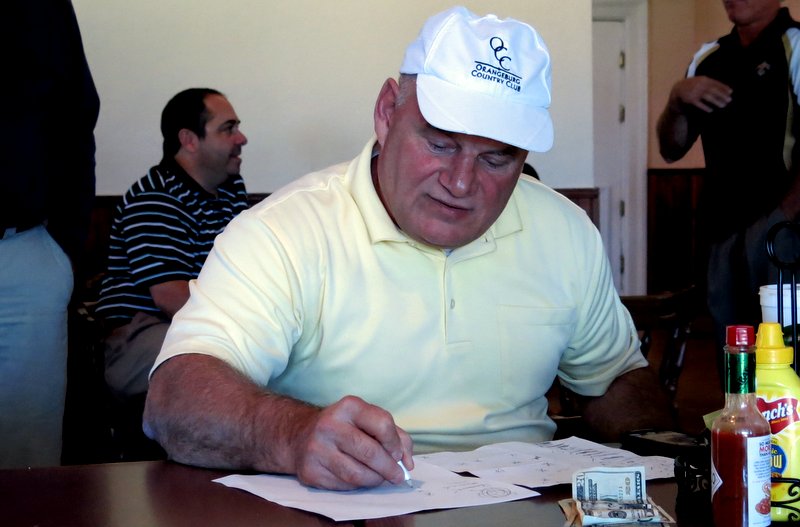
Ely won the Stableford, while the best that I could manage was to prevent someone else from winning a skin on the third, a short par 4. Sorting out the prizes took time, because for a while the pot appeared to be $10 light. Billy Griffin, a regular, scanned the crowd near the bar and said, “I can look at somebody and tell if he hasn’t paid.” The problem turned out to be that one participant had accidentally signed up twice. “In that case,” someone said, “you need to put in another ten.” I said something at some point, and Griffin said, “Hey, new guy. Sit down.” So I sat down. Here’s the group’s official record-keeper:

mayfairaccounting

John, one of the regulars, used to work for the tour player Mike Souchak. A friend of his told me, “John has 42 clubs in his bag. When he lifts the bag out of his truck, the truck rises.” John said, “I’m down to 16 or 18. But I’ve got a few beers in there, too.” Here’s a board that one of the regular groups at Mayfair uses to make up teams, or something:

cardboardsquare

Nice course! Nice club! I’d like to go back.

Ladies OrlandoP1110959IMG_0689Photo 1P1110939IMG0798IMG754

mayfairsignback.jpg

Moe Norman Slept Here (Richard Nixon Did Not)

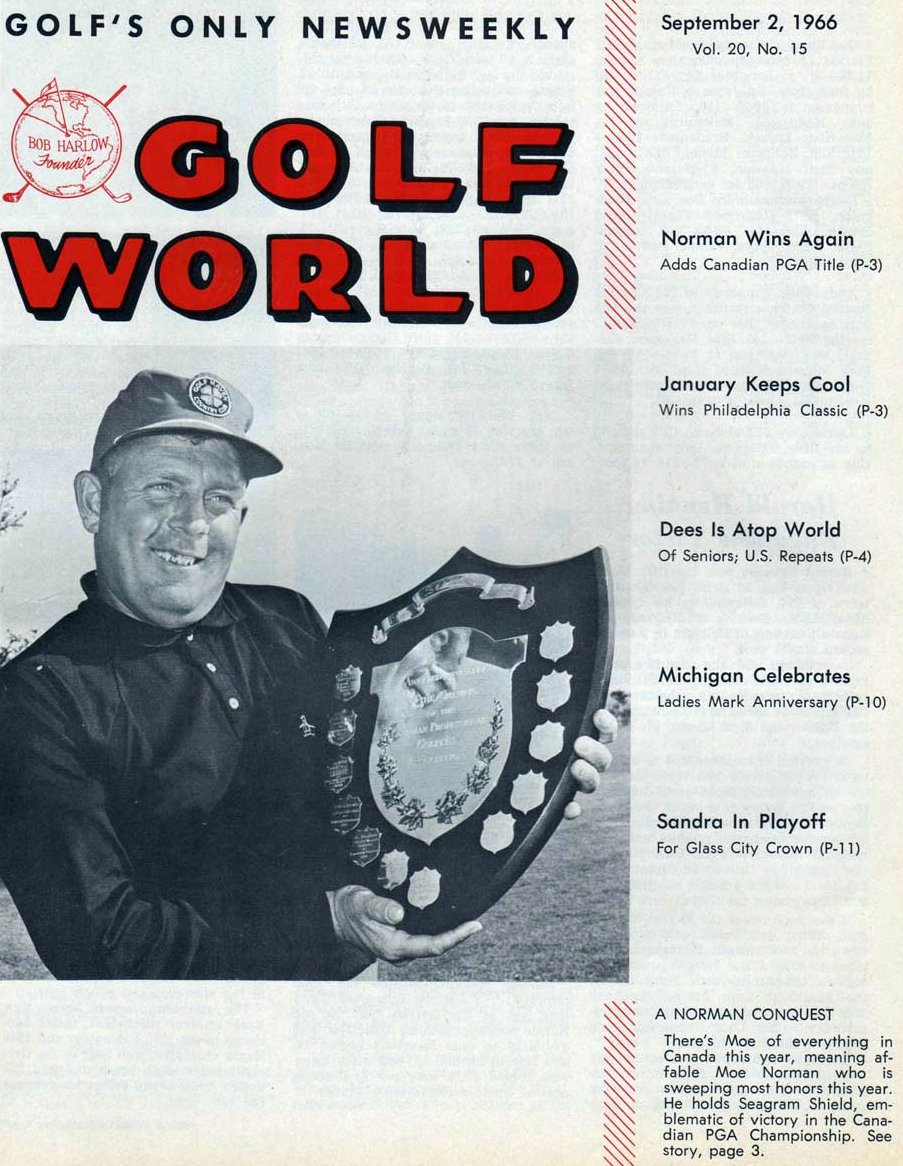
The Canadian golf legend Moe Norman had a wide stance, a short takeaway, a lumberjack motion, and a finish that made him look like he was dangling from a rope, yet many knowledgeable players, Tiger Woods among them, have ranked him with Ben Hogan as one of the greatest ball strikers of all time.

Moe Norman Golf World 9-2-66

Norman also almost certainly suffered from autism. He worked in a rubber-boot factory early in his career, and, although he won more than 50 amateur and professional titles in Canada, he felt like an outcast when he played in tour events in the United States (including the Masters, twice). His finances were precarious until the final decade of his life, when Wally Uihlein, of Titleist, learned of his distress and gave him the kind of retirement he deserved.

moenormanswing

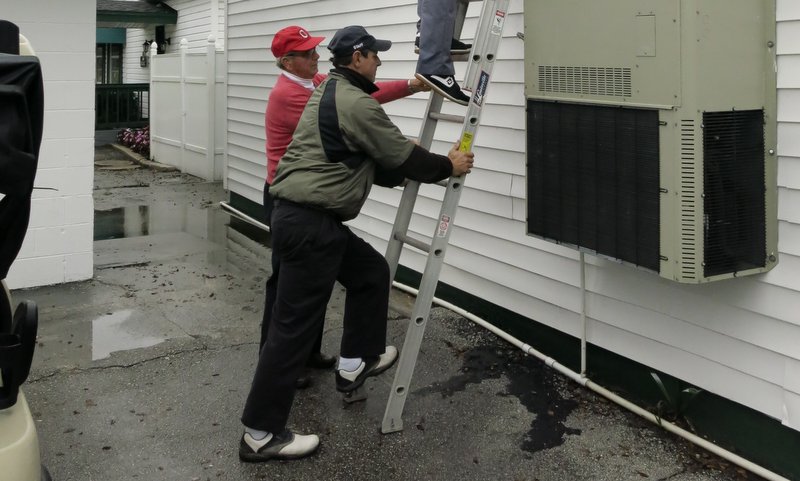
Norman spent his winters in Florida, and, until Uihlein stepped up, supported himself mainly by hustling and giving exhibitions. At one point, the pro at Mayfair Country Club, a muny in Sanford, let him stay, rent-free, in an apartment on the second floor of the clubhouse. I visited Mayfair last winter. The stairs to that apartment had been removed in a renovation, so in order to show me the place Mike Kenovich, the superintendent at the time, had to find a ladder.

moeladder

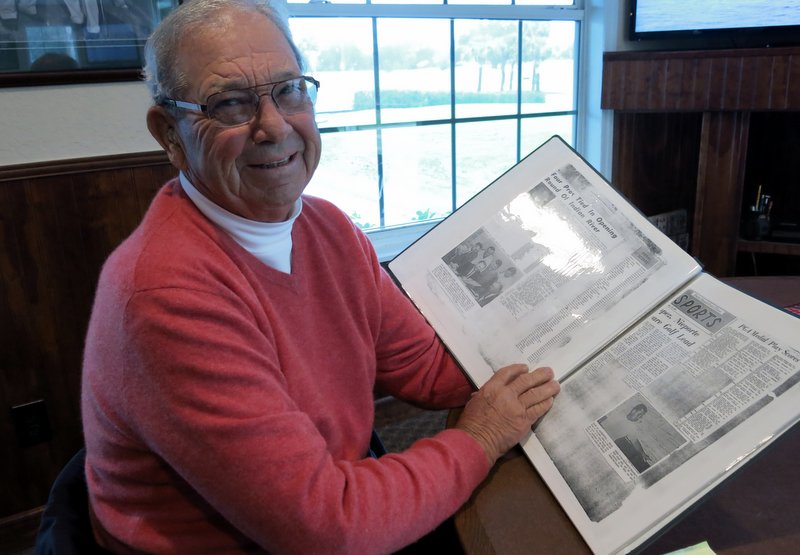
Then he and I and Jean-Pierre Ely, the general manager, climbed to the roof, while Bernie Haas—who competed with Norman in several tournaments in Florida in the 1960s and was inducted into the Northern Ohio PGA Hall of Fame in 1995—steadied the ladder by keeping a foot on the bottom rung. That’s Haas in the red hat in the photo above, and Kenovich starting to climb. And those are Ely’s feet disappearing up above. Here’s Haas in the club’s Oak House Restaurant, later, with one of his golf scrapbooks:

haasscrapbook

Haas was an assistant pro at Burning Tree, in Washington, D.C., in the late 1950s. One of his students there was Vice President Richard Nixon. Nixon’s boss played so much golf that Nixon figured he’d better learn, too, and because he had no friends he would invite Haas to play with him. “He wasn’t a very good golfer,” Haas said, respectfully. Nixon once told Clifford Roberts that he wouldn’t mind being a member of Augusta National, and Roberts, who didn’t like him any better than Eisenhower did, said, “I didn’t know you were that interested in golf.” And that was the end of that.
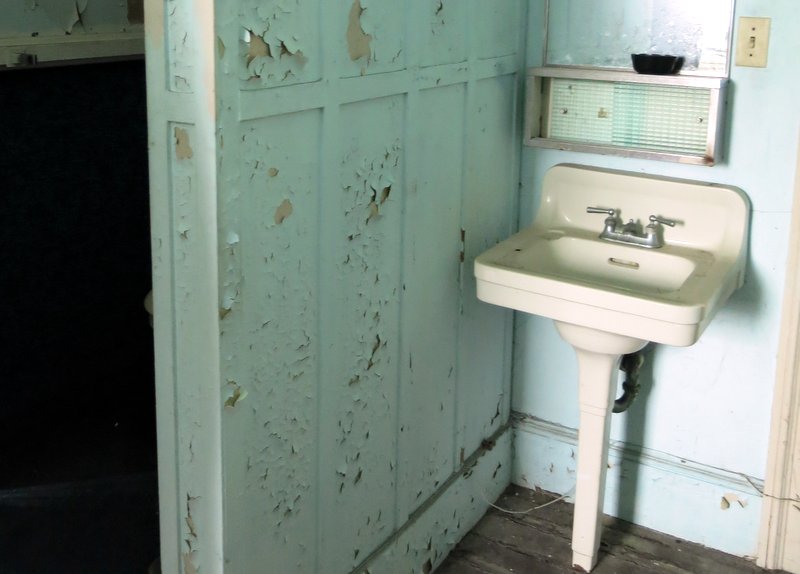
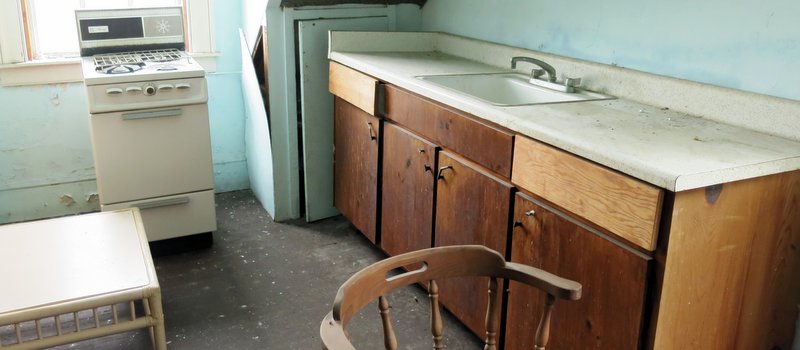
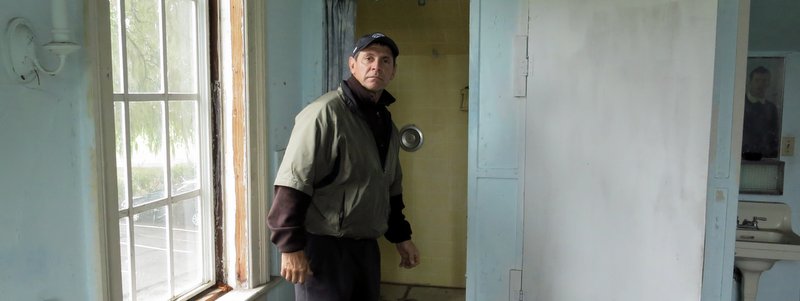
Anyway, here’s what’s left of the apartment where Norman stayed:
kenovichely
mayfairsink
mayfairkitch
mayfairshower
mayfairapt
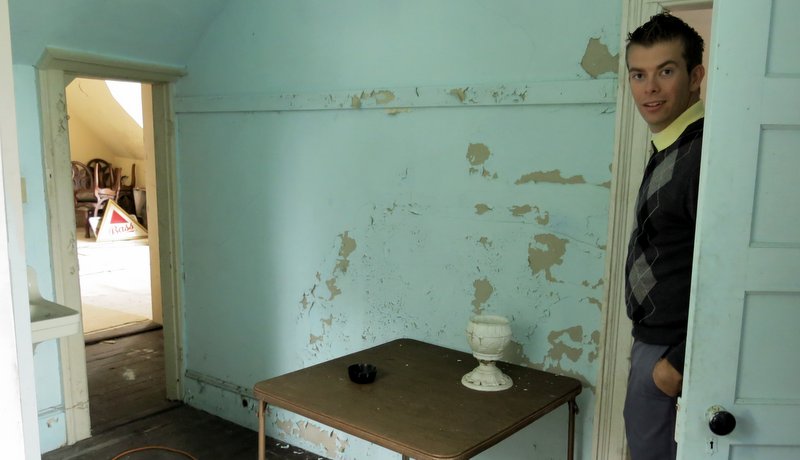
The walls were crumbling, but I could picture Norman, whom I spent some time with in the mid-1990s, standing at a window and waiting for the sun to come up so that he could tee off again.
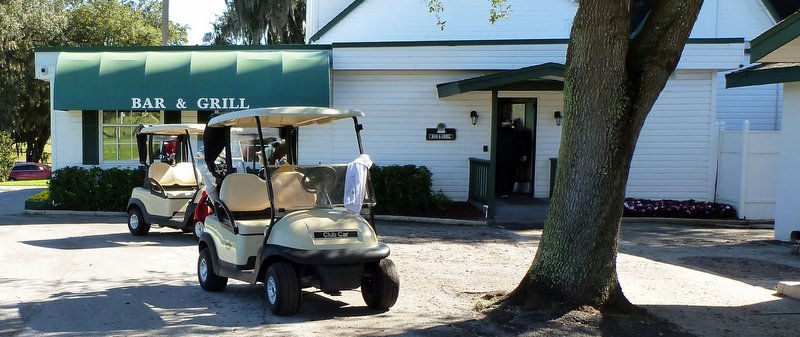
mayfairclubhouse
Mayfair has a long, interesting history. I’ll have more about that—and about Moe Norman—soon.

IMG_0661

IMG_0735

Back-Roads Scotland: Boat of Garten

P1020826

Eight years ago, I took what’s probably my favorite golf trip ever. I flew to Glasgow,
Scotland, without an itinerary, and spent a little over a week playing only golf courses I’d never heard of. My second stop was Boat of Garten.

P1020856

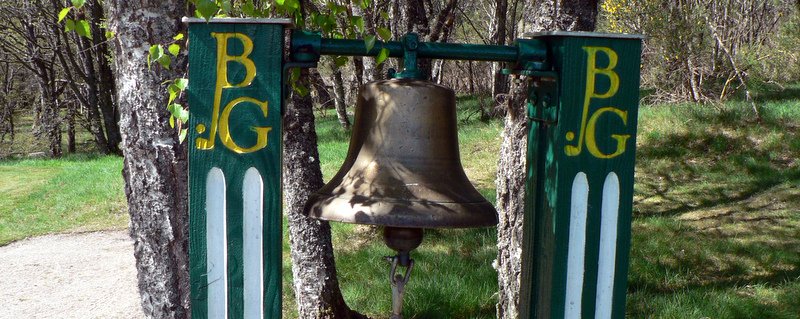
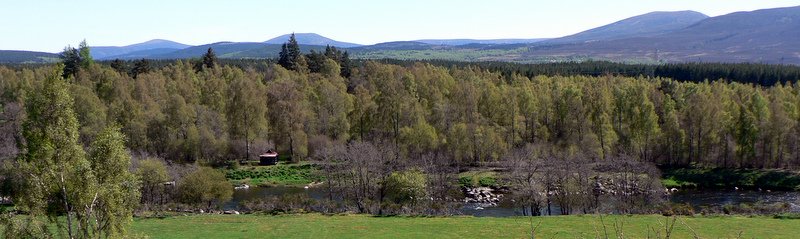
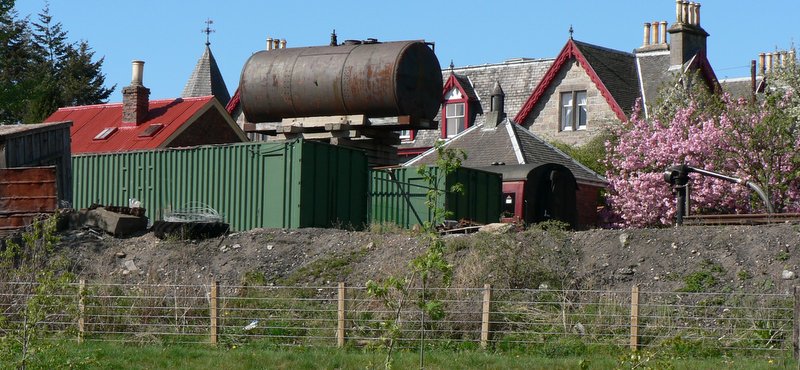
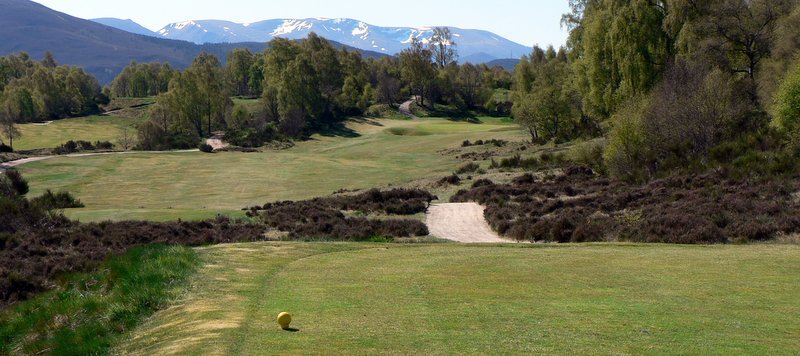
The village of Boat of Garten (population 700) was possibly named for a nearby river ferry, long since put out of business by a bridge. The region is a major summertime holiday destination for bird watchers, among others; Loch Garten, a nearby lake, is a national bird sanctuary. The golf course, which is known locally as “the Boat,” began as six holes in 1898, and was extended to 18 holes by James Braid a little over 30 years later. There are four clocks on the wall above the counter in the golf shop; they give the time in Boat of Garten, Pebble Beach, Augusta, and the United Arab Emirates. I paid £32 and, because no one else was around, teed off by myself. The Boat’s first hole runs past a station of the Strathspey Steam Railway:

P1020812

It’s a so-so par 3, but the second is terrific par 4, and many more terrific holes follow. Here’s the second, from the tee:

P1020816

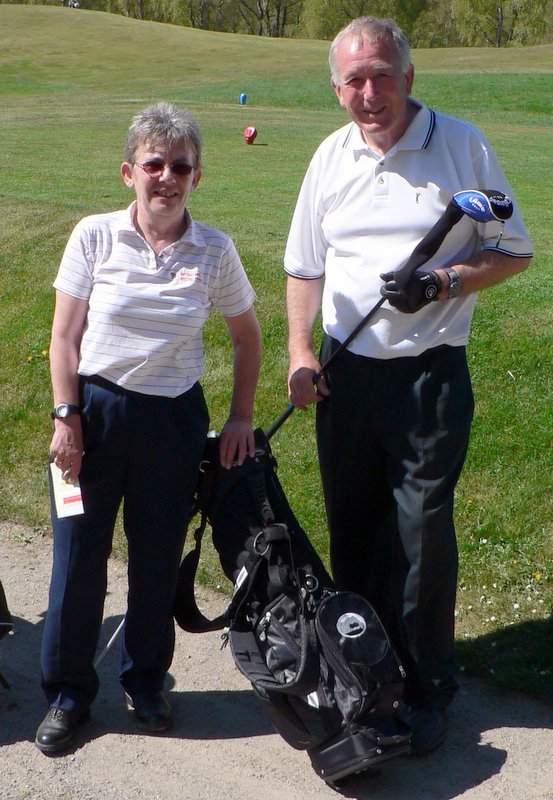
On the fourth, I caught up to Andy and Pat, a retired couple from Aberdeen, and played the rest of the way with them.

P1020827

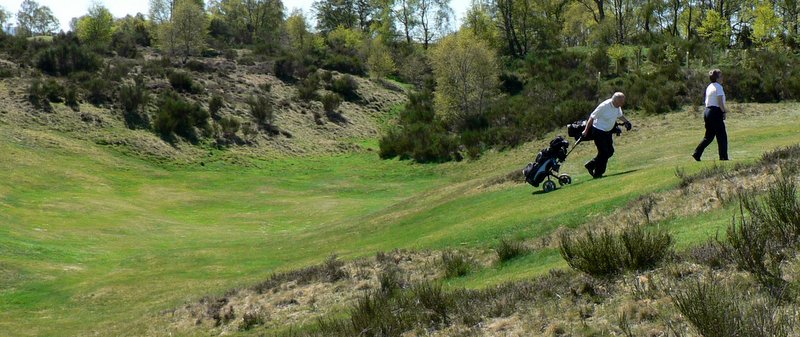
Andy had lured Pat to the course by assuring her that it was flat, and he did penance for this untruth by pulling her trolley up the steeper hills, of which there were many. (He had already lightened his own load by leaving eight of his golf clubs at home.) This hole is called Gully:

P1020860On the tenth, we got stuck behind a slow foursome, and Andy told me that an American group had once visited his home club, Stonehaven—a seaside, cliff-top course with spectacular views, 15 miles south of Aberdeen—and had played so slowly (five hours) that the club secretary asked them never to come back. I apologized for my countrymen, and didn’t point out that the golfers holding us up at that moment were Scottish.

P1020871

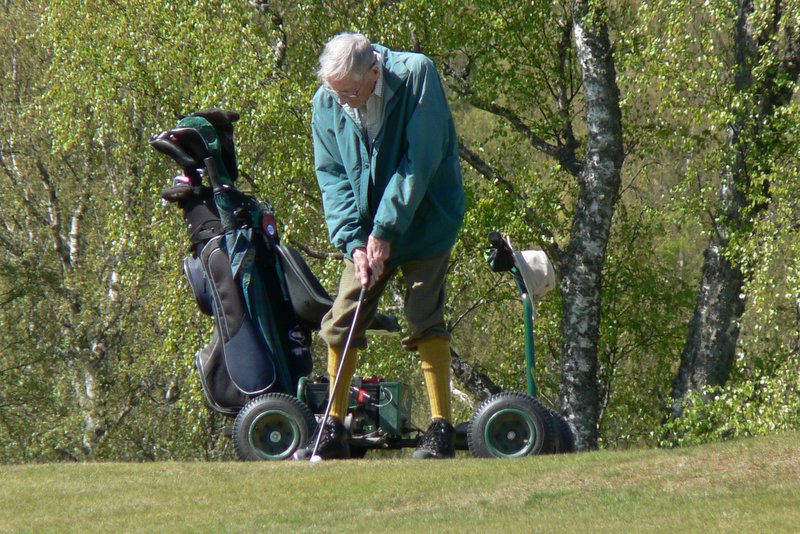
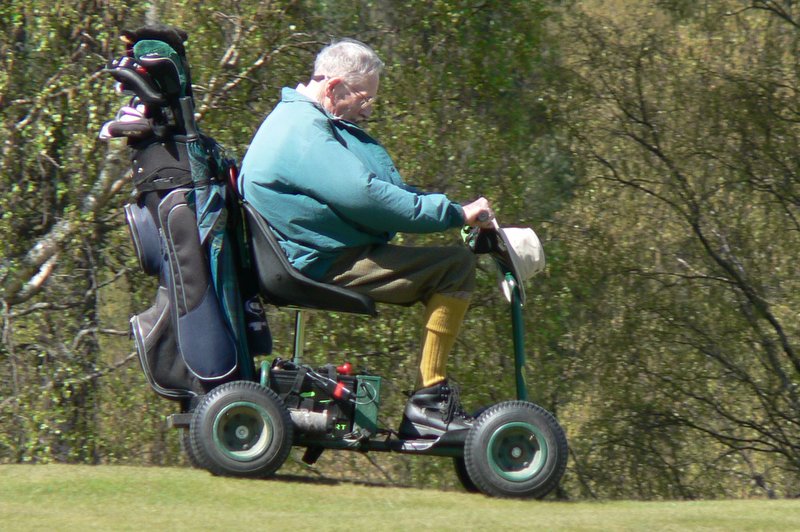
We waited on the next tee, too, and as we did an old man on a tiny, one-person motorized golf cart came up behind us. He was wearing a broad-brimmed hat, leather boots, a green jacket, brown plus-fours, and long yellow socks. “That may be Willie Auchterlonie himself,” Andy said. I asked him how long he’d been a member. “Fifteen years,” he said — a deeply disappointing answer, Andy and I agreed later.

P1020842

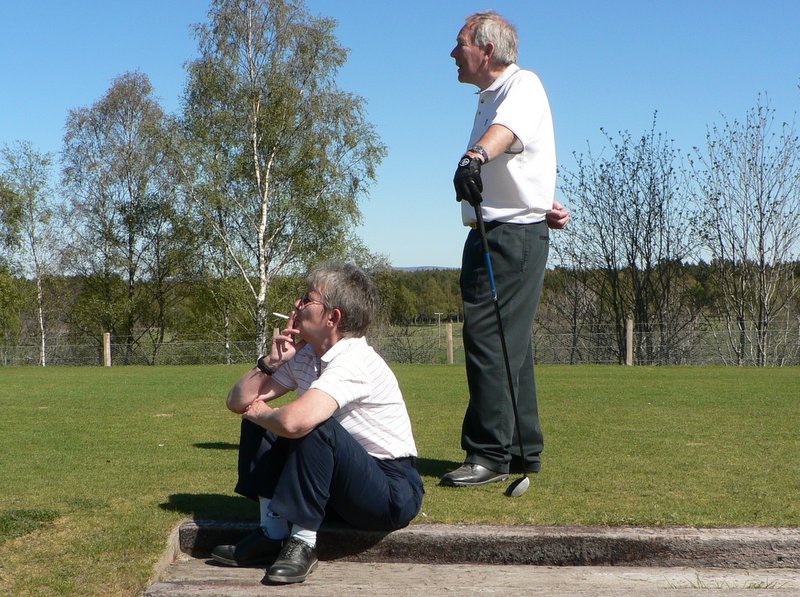
Andy and Pat were playing a match. Pat had a low, flat swing with a big lift at the top, but she hit the ball a long way. On one tee, she asked Andy what he was waiting for, then looked up the fairway at the group ahead, maybe 200 yards away, and said, “Oh—them?” and gave a great throaty smoker’s cackle. She was three down with three to go and won the last three holes with pars. Good pars, too.

P1020819001

P1020849

P1020865

P1020797

P1020832

P1020837

Did Donald Trump Copy His Hairstyle From Nature?

P1010611

We played Spyglass and Pebble last Sunday, at Maggie McFly’s. Here’s Mike B., holding the stick for me on the second green at Pebble:

mikepebble

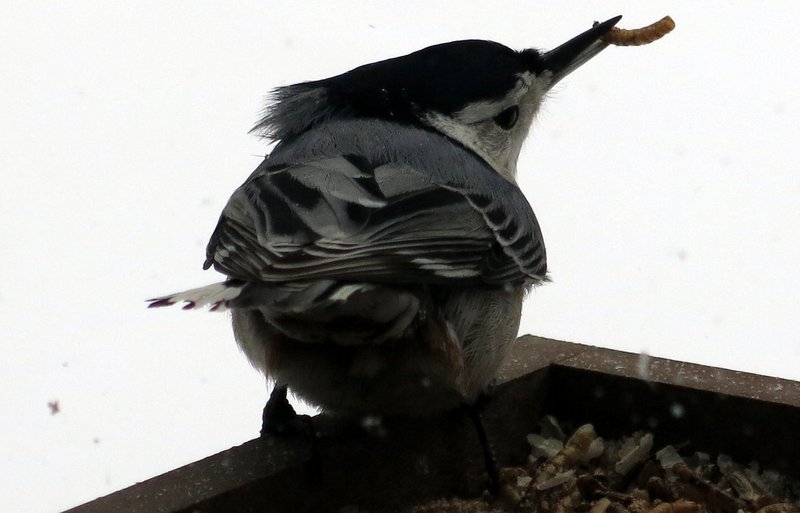
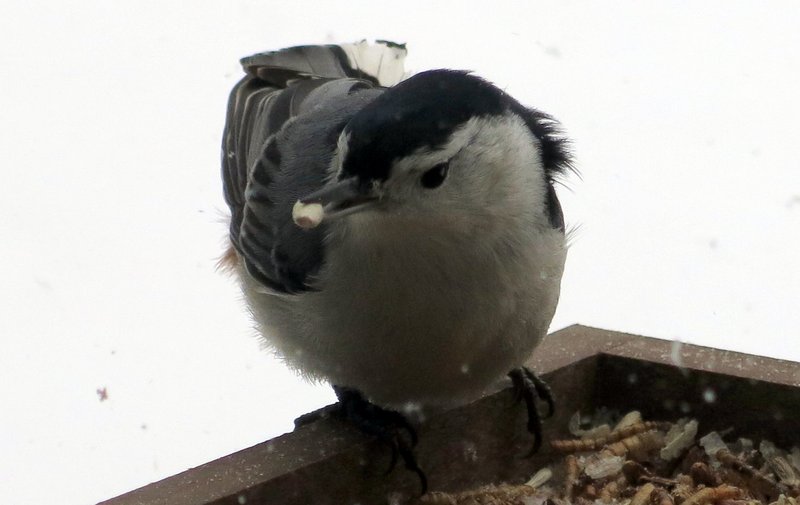
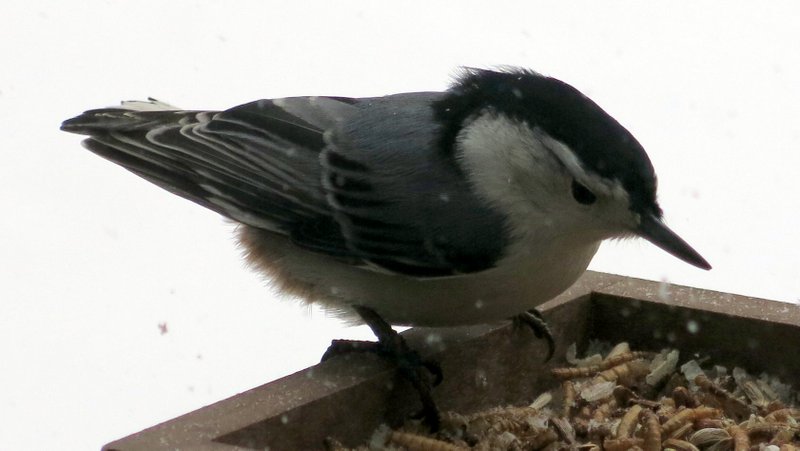
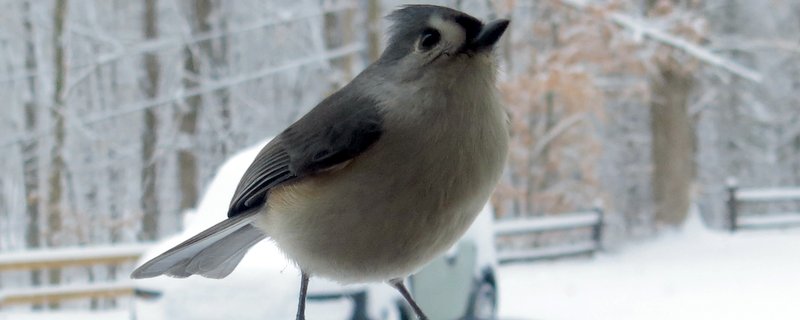
The weather had been so bad that playing anywhere but on the simulators wasn’t a possibility. Then the weather got worse. The snowstorm that the Weather Channel had such a cow about earlier this week turned out to be a dud in our part of New England, but we still got six or seven inches Then on Friday morning we got a few more. As a consequence, I’ve spent a lot of time staring at a bird feeder my wife gave me for one of the windows in my office —which our dog has also been interested in. Anyway, I think I’ve figured out where my close personal friend Donald Trump got his hairstyle: nuthatches.

nuthatch1

nuthatch3

nuthatch2

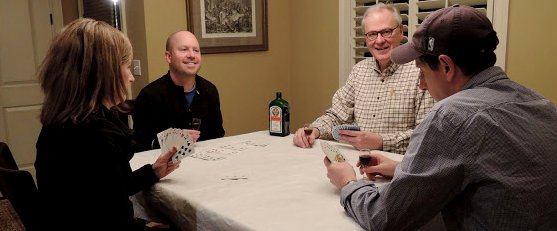
I mentioned in a recent post that Jägermeister’s official sponsorship of the Sunday Morning Group had had a measurable impact on sales because Other Gene’s wife had ordered some in a restaurant and a non-golf-playing bridge partner of mine in Mississippi was thinking about buying a bottle. I’d now like to update those results: my non-golf-playing bridge partner in Mississippi not only did buy a bottle; he also served it to three people he has been teaching to play bridge:

jagerbridge

“Each of the guys said he hadn’t drunk any since college,” my friend reported. “The one with the baseball cap said his first and only experience with it had been at a Cornell fraternity party he went to his freshman year. He drank so much that night that he ended up throwing up from a balcony at the front of the fraternity house, and a crowd gathered below to cheer him on. The other guy said his story was similar, but he didn’t tell it.” They’re grown-ups now, though, and I think I can safely put all four of them in the plus column, along with Other Gene’s wife.

Let’s check that bird feeder again:

henrybirdwindow

Is This Idea So Crazy That It Just Might Work?

Not long ago, I received a promotional email from a golf course my friends and I have often played during the winter, called Lyman Orchards. That got my hopes up—but the email wasn’t an announcement that the course had re-opened; it was an invitation to celebrate “National Pie Day” with “a Free 6-inch Pie.” And the pie wasn’t really even free, since you had to buy twenty-five dollars’ worth of other crap in order to get it. And then the weather turned almost vengeful: driving rain and sub-freezing temperatures. And then we got snow.

P1150435

I’ve been passing this golf-free period by working—or “working”—and, when I think of it, throwing birdseed onto the hill outside my back door. And one day I noticed something interesting: the birds, with all their frenzied wing-flapping and hopping-around as they pushed and shoved each other to get at the seed, had cleared almost all the snow from the area where I’d been feeding them:

snowgone

That made me wonder: could bird power be harnessed to keep golf courses open during the winter? Spread birdseed with crop-dusting planes, which can’t have anything better to do until spring, and let birds take it from there? Fairways and greens only, to keep costs down? I don’t know; I’m not an ornithologist. But let’s try it.

titmouse

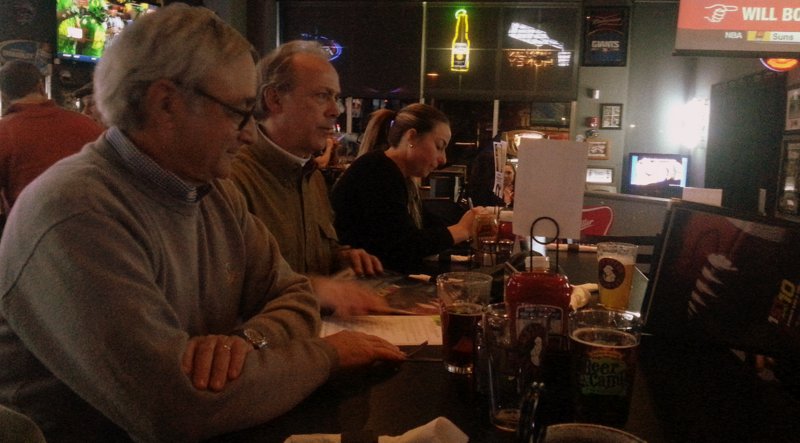
When my wife was in third grade, her Brownie leader didn’t believe her when she said there was a bird with “tit” in its name, but my wife was right, and the photo above is proof. Anyway, a couple of weeks ago, on a day when there was no functioning golf course within a hundred miles of where we live, the Sunday Morning Group went out to dinner, at a sports bar called 1st and 10.

20150109_183326

Hacker (real name) ordered something that isn’t on the menu anymore but that the chef will make for you if you know to ask for it:

hackerdog

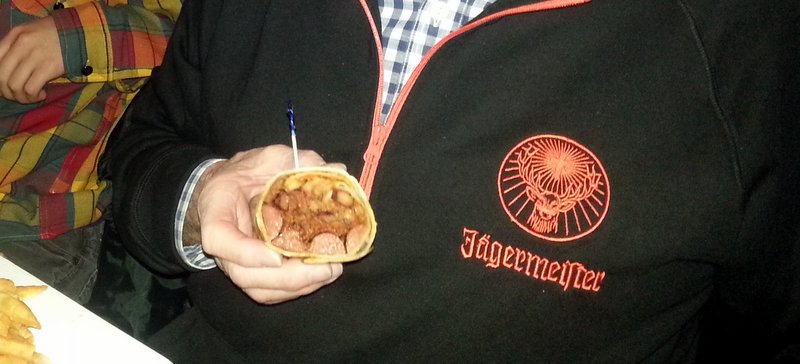
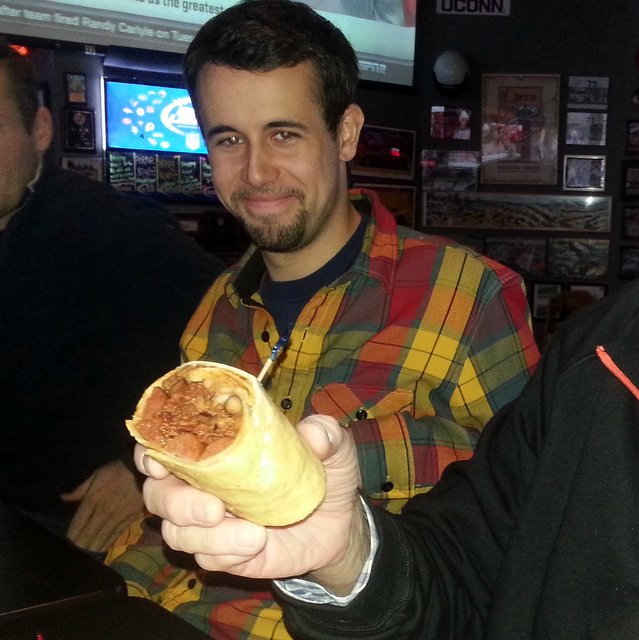
It’s two hot dogs split the long way and wrapped in a tortilla with chili, bacon, cheese, and some other stuff, then dipped in batter and deep-fried—and it comes with fries. I asked our waitress why it wasn’t still on the menu, and she said they took it off because no one but Hacker had ever ordered it.

addhacker

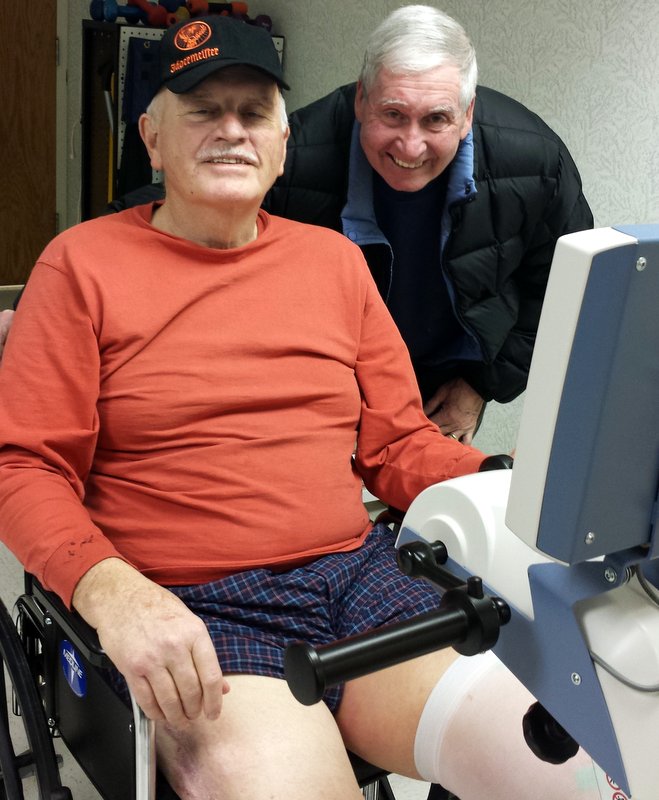
Quite a few guys showed up that night. One who didn’t was Stanley. The day before, he had reported, by email: “Had a golfer’s knee installed on Monday. Now rehabbing. Legs the same length.” Hacker visited him a couple of days later:

stansnewknee

Golfers who have knee replacements often figure they ought to get more handicap strokes. But shouldn’t they actually lose strokes, to make up for how much better they feel? When I suggested that to the group, Stanley disagreed. “I have no doubt that the U.S.G.A. will soon ban this device,” he wrote from the rehab center. “However, my knee was installed prior to the change and is therefore grandfathered.” We’ll see.

The other thing we’ve been doing this winter is working on our relationship with our first (and, so far, only) official sponsor: Jagermeister. Our sweatshirts are at the embroidery shop right now, because we’re having our names and some other stuff added to them. Even so, we’ve had a measurable impact on sales. A bridge partner of mine in Mississippi, who doesn’t play golf but does read my blog, wrote to say that he is seriously thinking about buying a bottle. And Other Gene’s wife, Diana, recently ordered some in a restaurant.

Just the beginning, my friend. Just the beginning.

jagerstuff.JPG


Beating the Snow, Plus Exclusive Footage of a Rare 86-stroke Penalty

forecastscreenshot

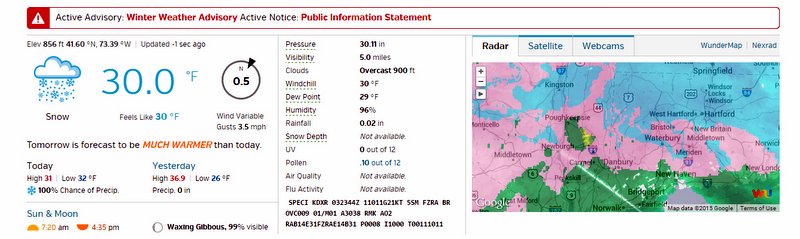
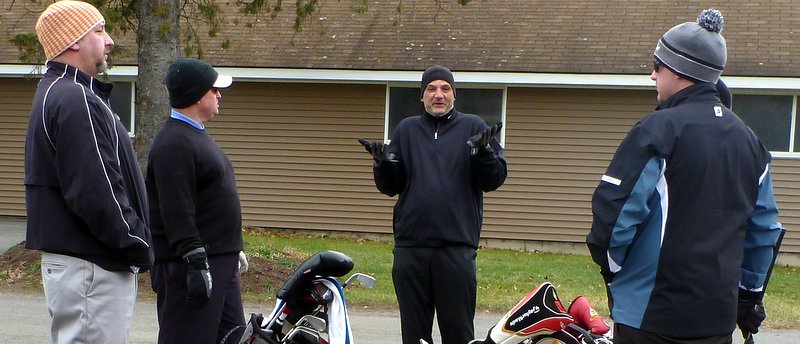
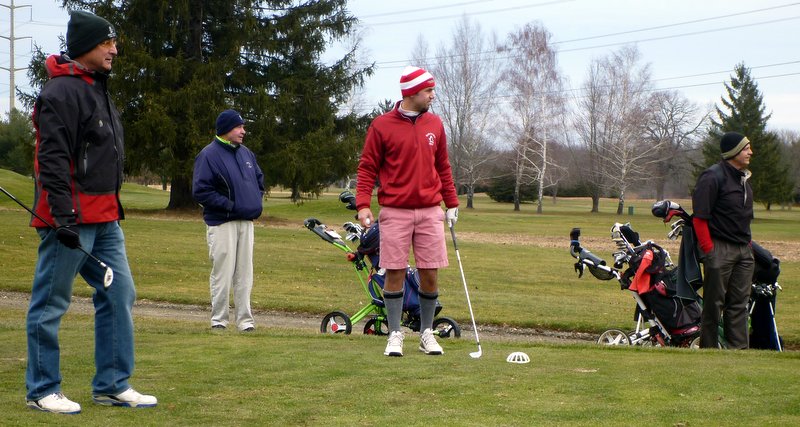
The forecast for Sunday was terrible, but the one for Saturday was pretty good—“snow and ice, then rain; fog”—so we shifted our Sunday game to Saturday. There were several guys standing around outside the golf shop at Candlewood Valley when we arrived: never a good sign:

P1150276

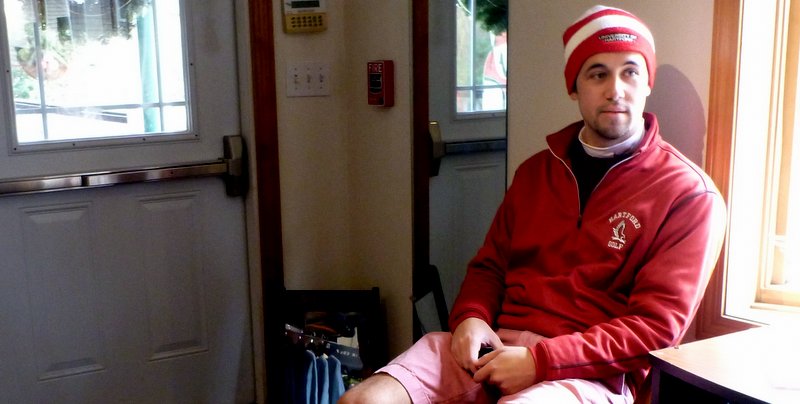
The problem was that the temperature was only a few degrees below freezing, and the superintendent was worried that the greens might not be frozen solid enough for him to ignore the frost. He went out to inspect the course, and we went out for breakfast, at a diner down the road. Then we came back and hung out in the golf shop, to await the superintendent’s verdict:P1150279-001

We also chatted up some of the other guys who were waiting. This guy, whose name is Greg, showed me a gadget called a PutterDart, which he sells and may have invented. It has lots of uses. There’s no PutterDart webpage, and Greg doesn’t seem to be on Facebook, but if you’re interested in learning more you can get in touch with him at PutterDart@aol.com.

P1150287

We got the all-clear, finally, at 10:00. Ed Slattery, the head pro, said we could play as a fivesome. He also let us start on the tenth hole, so we had plenty of empty golf course ahead of us.

P1150306

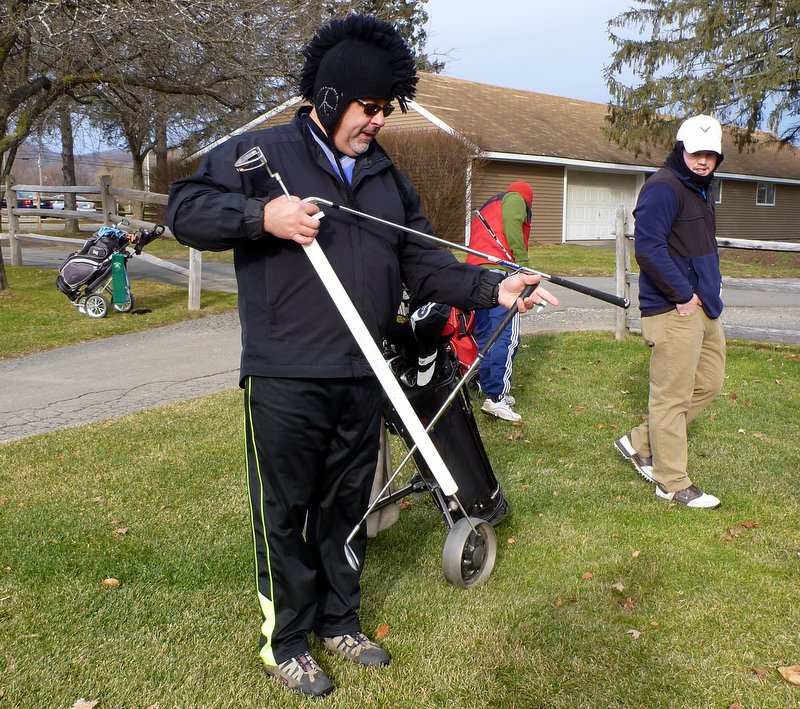
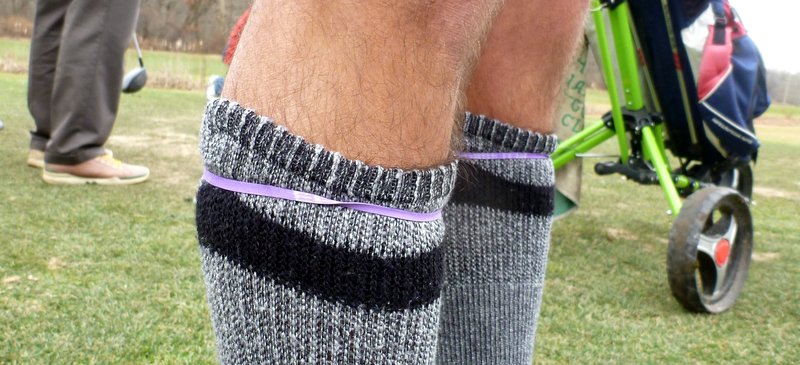
Addison was wearing shorts, so, in accordance with our winter rules, he got to be a 2 instead of a 0. But his socks were so tall that they functioned almost like pants, and to keep them from sliding down to his ankles he was holding them up with the rubber bands from two bunches of asparagus—which provided exactly the right amount of tension, he said. At some point, I guess, the Committee will have to rule on maximum sock height, as well as on artificial support.

P1150329

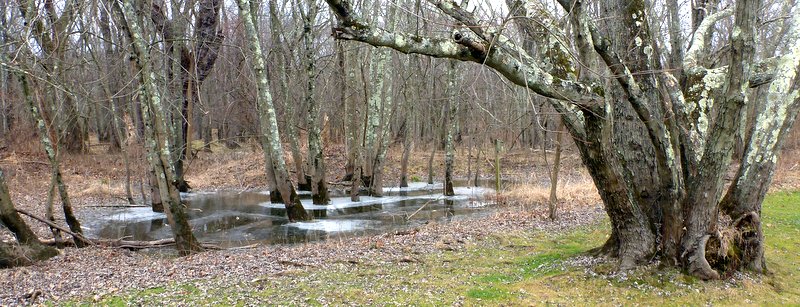
The Housatonic River, which runs through the course, was flowing, but the puddles and ponds were all frozen:

P1150320

On our ninth hole, Other Gene incurred a rare 86-stroke penalty, for repeatedly grounding his club after hitting his tee shot into a hazard:

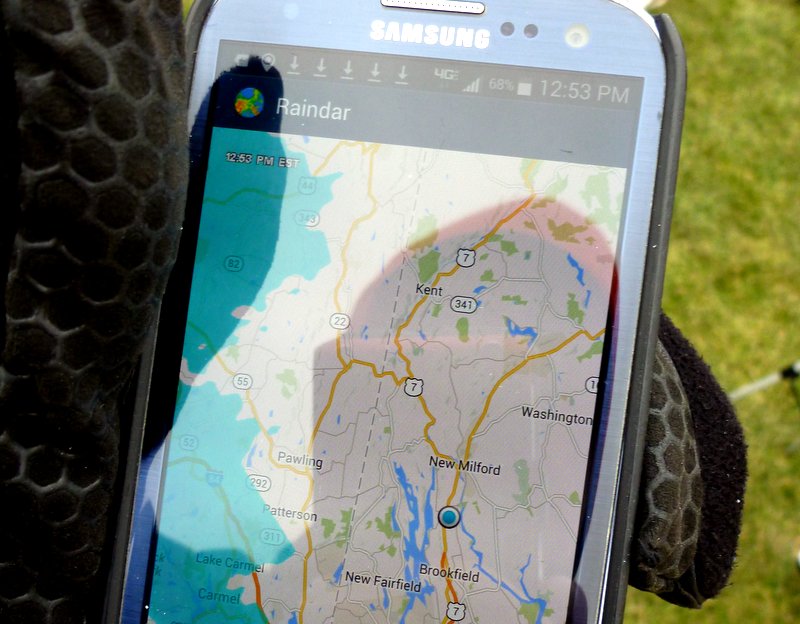
We kept a weather eye on the weather with Raindar, my favorite Android precipitation monitor:

P1150339

And, luckily, despite our one-hour frost delay, the snow didn’t reach us until we were making our way up the fairway on our seventeenth hole:P1150387

Even on our eighteenth, putting was still possible:

P1150405

P1150414

P1150415

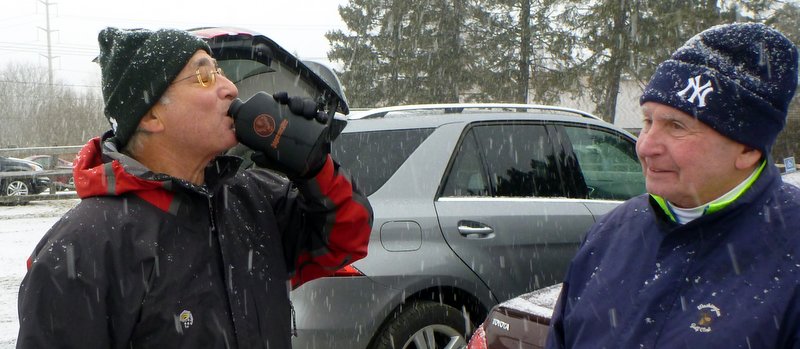
A final swig of Jagermeister, the official cold-weather intoxicant of the Sunday Morning Group, in the parking lot:

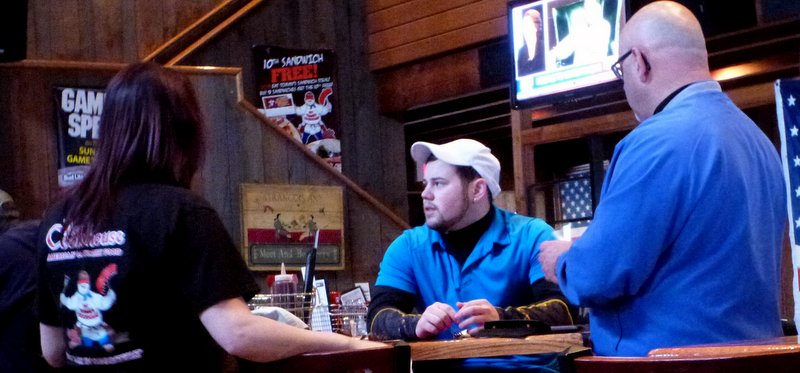
P1150439Then lunch at the Cookhouse —where, once again, we ran into the PutterDart guy. He was hard to recognize without that hat:

P1150457

P1150452