What’s In My Bag: Jack Chesnutt

Royal Birkdale, May 19, 2013.

Royal Birkdale, May 19, 2013.

Today, I played Royal Birkdale with Paul Jones, a young member and a terrific golfer, whose swing finish you see here:

P1060461Before we teed off, I bought my wife a sweater in the golf shop and decided not to buy myself an enameled ball marker. Then, during our round, I found an enameled ball marker that was even nicer than the one I had decided not to buy. The exact same thing (except for the part about my wife) happened to me a year ago, at Cruden Bay, in Scotland. The ball marker I found there turned out to be one of the luckiest I’ve ever owned, for about a month. Fingers crossed!

And that brings me to Jack Chesnutt, a reader in Colorado, who recently wrote:

I found the ball markers below (along with one from a course in Ireland I have since lost) on a fairway at Pacific Dunes in 2008. They did not seem to have been dropped accidentally from someone’s pocket. They were arranged in a small triangle with a well-worn repair tool in the middle. The last act of a frustrated golfer after watching one more drive arc toward the rocks and surf? Or maybe a little memorial to a departed golfing buddy? The view from that point in the fairway was wonderful.
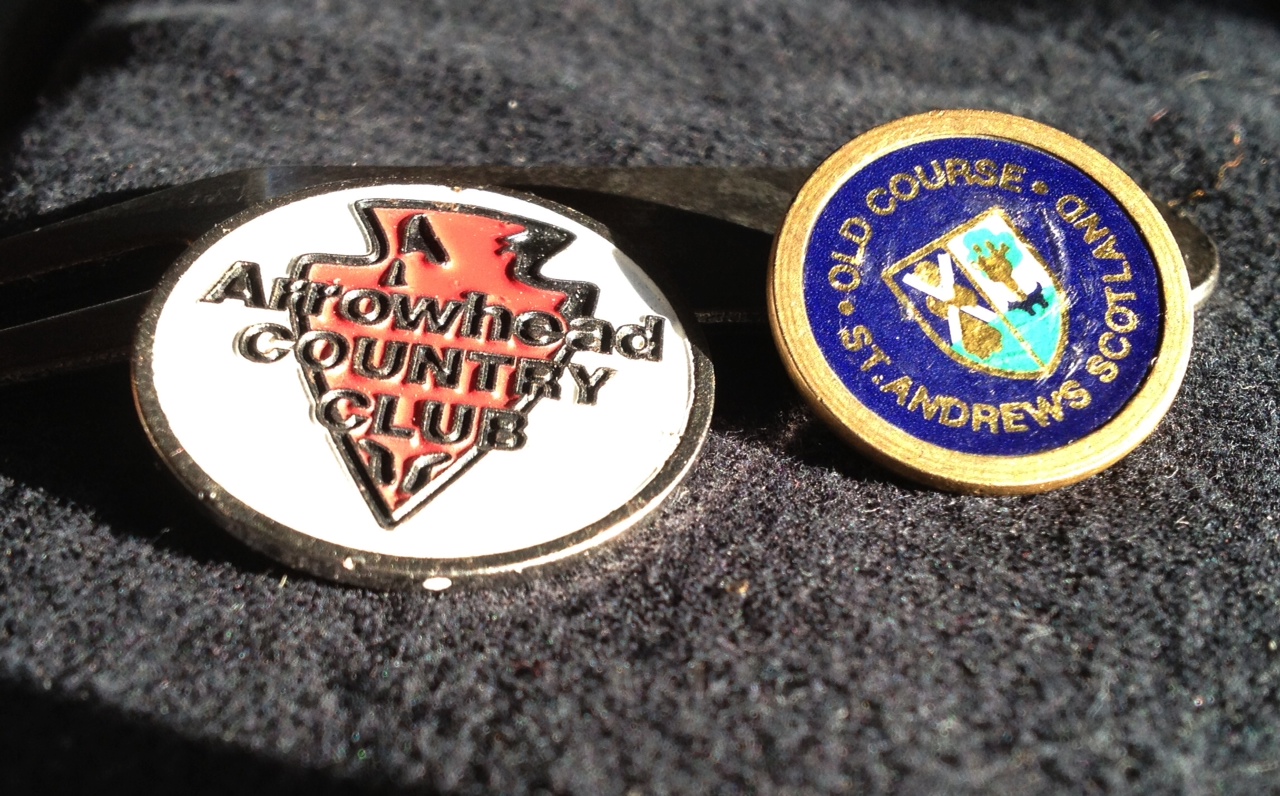
photoAs I do with all the markers I keep in my golf bag, I rotate the Arrowhead marker in and out of my game. The first three-putt sends it into time-out. But I never use the Old Course marker. I don’t want to lose it. Maybe I will find the owner or his/her son/daughter someday.

Before claiming that these are yours, be prepared to reveal some telling piece of information that only you and Chesnutt could possibly know. Meanwhile, here’s what Chesnutt has to say about his own game:

I caddied for my dad back in the early sixties, but a huge banana slice and indifferent putting convinced me that tennis was more my game. When I turned fifty, my brother-in-law the pilot-golfer (what else do they have to do when they are not driving a 737?)  persuaded me to play a round. I shot 99. I was hooked. My wife (hey, it was her brother who got me into this) made fun of my golf habit. “Why would any human being need more than ONE pair of golf shoes?” Luckily for me, she took up golf, became a 9-handicap, and soon bought her third pair of golf shoes. The trip to Bandon was our first big golf vacation together. The first round, at Pacific Dunes, was memorable not only for the stunning setting but also for finding the ball markers. It was so windy that my stand-bag blew over—twice. I’m now sixty-two years old, and my index is 4.5, and I keep about ten ball markers and three repair tools in the rotation. The repair tools don’t seem to have the same cosmic effect on my putting as the markers. I’m also up to four pair of golf shoes. 

I’ll put up more What’s In My Bag items as soon as I’m back in the States. I’ve got several in the hopper, but there’s room for more. Keep ’em coming—and include at least one photo and a golf-oriented description of yourself.


What’s In My Bag, Part Three: Let’s Have a Look Inside Those Pockets

Will, Brent, D.O., Ben, Liberty National Golf Course, Jersey City, New Jersey, May 5, 2013.

Famous building, Will, Brent, D.O., Ben, famous statue. Fourteenth tee, Liberty National Golf Course, Jersey City, New Jersey, May 5, 2013.

On Sunday, I had the tremendous good fortune to be invited to join a twelve-man outing at Liberty National Golf Course, in Jersey City, New Jersey, directly across the Hudson River from lower Manhattan. I employed a labor-saving technique I’ve often used during visits to other rich-guy golf clubs: I wore my sorriest-looking pair of shoes, knowing that the locker-room guy would fully resuscitate them while we were playing. During a multi-day trip Pine Valley ten or fifteen years ago, I took three sorry-looking pairs of shoes and left them outside my door sequentially. I went home feeling like a new man.

Cool clubhouse.

Cool clubhouse–and that statue again.

Liberty National was designed by Tom Kite and Bob Cupp, and it was built, in 2006, on a desolate industrial site. (I’ve seen a variety of cost estimates, all of which have nine digits.) The Barclays—which used to be known as the Westchester Classic, and then as the Buick Classic—was held there in 2009, and it will be held there again in August. Tour players grumbled about the course the first time. Since then, Kite and Cupp have made many changes, and either the changes have been effective or I don’t know what I’m talking about, because I liked the course a lot. And the clubhouse is the only starkly modernistical one I’ve ever been in that I fully approve of.

The bar, post-round.

The bar, post-round.

Partway through our round, I apologized to my caddie for having forgotten to remove a couple of nonessential items from my golf bag. (I’ve gotten a little lazy about on-course housekeeping in recent years, because at home I now almost always use a pushcart.) The bag can’t have been too bad, though, because I still occasionally carry it myself. Here is some of what was in it:

Ball markers

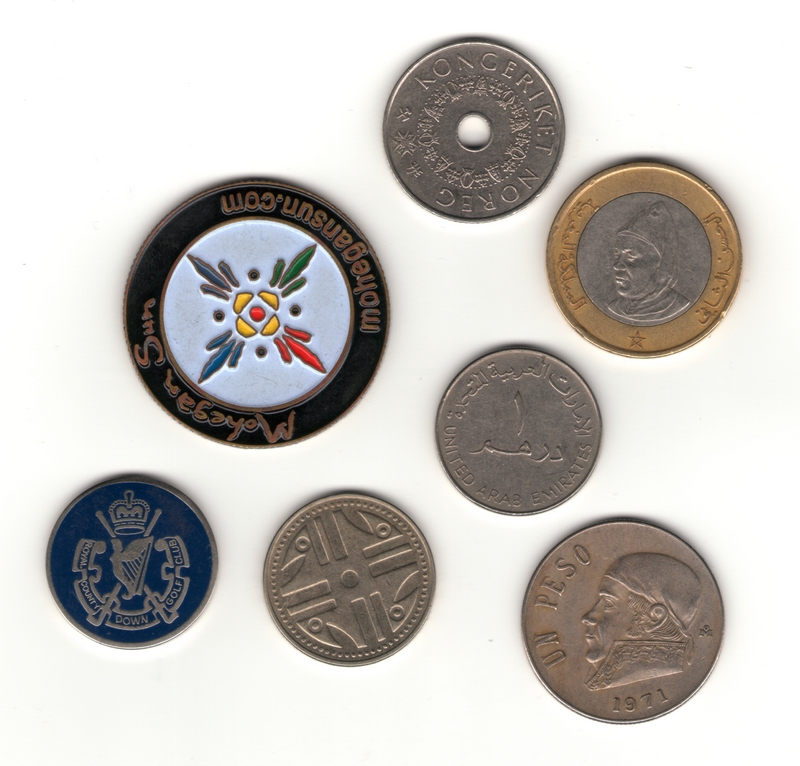
The photo above shows my selection of lucky ball markers for that day. Clockwise from lower left: a souvenir marker from Royal County Down, a necessity because of the sublimity, transcendence, immanence, etc., of that course; a souvenir marker from a casino in Connecticut, useful because it has four colored pointy things, any one of which can be aimed at the hole; a Norwegian coin with an actual hole in the middle of it; a Moroccan coin featuring King Hassan II, who loved golf, wore golf gloves on both hands, and was accompanied during golf rounds by a servant whose only job was to use a pair of silver tongs to hold the king’s cigarette while swung; a one-something coin from Dubai, which I often use when I absolutely have to one-putt; a big old Mexican coin with some guy on it; a Colombian coin featuring what appear to me to be balls, holes, and “aiming chutes.”

When I wrote about (a slightly different selection of) lucky ball markers, last year, I said that when I used a coin with a guy’s head on it I aimed the top the head at the hole. Michael Clark, a reader, wrote to say that, on the final day of a three-day-tournament at his club, he had discovered a better way. “The eyes of the coin had to be looking at the hole,” he wrote. “When the eyes lined up to the hole the putts were dropping! Also, it had to be the same coin. So, if the coin has eyes, line them up!” Since then, I have field-tested Clark’s method, and adopted it.

Morefar green repair tool

The photo above is of what is probably the luckiest green-repair tool I’ve ever owned. I got it at a super-secretive golf club called Morefar Back O’ Beyond, which straddles the border between Danbury, Connecticut, and Brewster, New York.

The course on the left is Morefar. The course on the right is Richter Park, which is owned by the city of Danbury, Connecticut, and is one of the best munys in the country.

The course on the left is Morefar. The course on the right is Richter Park, which is owned by the city of Danbury, Connecticut, and is one of the best munys in the country.

Morefar

Morefar used to be owned by the disgraced insurance company A.I.G. I played there a dozen years ago as the guest of one of the club’s handful of local members. Only a tiny number of golfers are allowed out each day, and the only other group on the course on the day we were there was that of the Sultan of Brunei, who teed off before we did. He and his retinue were almost comically slow, but, it turns out, you don’t play through the Sultan of Brunei. On an airplane recently, I saw a guy (in first class) who had a Morefar attaché case in his lap. I gave him the secret sign of brotherhood (by showing him my green-repair tool) as I walked past him on my way to the back of the plane, but he cut me dead.

coppertone

The item above is roll-on sunscreen, which I use as “lip balm.” The tube is at least half again as big as a ChapStick tube, and the stuff is waterproof. It’s especially handy in cold weather and in wind. I don’t carry ordinary sunscreen in my golf bag because I don’t believe in applying sunscreen in situ. I once told someone that if I ever ran for President my platform would have just three planks. I don’t recall what the first two were, but the third was that everyone would have to put on their sunscreen at home, before they went to the golf course, the swimming pool, or wherever. Sunscreen is much easier to apply when you aren’t wearing clothes, and it works better if it’s had some time to soak in. When I see young parents at the beach trying to squirt sunscreen onto squirming, uncooperative children, I think: “An hour ago, your children were naked and not covered with sand; why didn’t you think of doing this then? When I’m the President, we’ll have no more of this nonsense.”

Several readers have sent me descriptions of what’s in their own bag. As promised, I will soon create a new section and post several of them permanently. If you’d like to add your own bag to the pile, send an email to myusualgame@gmail.com. Include a golf-related description of yourself and at least one or two photos of your golf stuff.

(Read Part One and Part Two.)

What's In My Bag?

What’s In My Bag?

What’s In My Bag, Part Two: Why Two Drivers?

drivers

Ben Hogan, before teeing off at Riviera Country Club, was asked why he wasn’t carrying a 4-iron. “Because there are no 4-iron shots on this course,” he said.

Or maybe he didn’t say that. With sports anecdotes you can never be sure. Apocryphal or not, though, the point was a good one. No two golf courses are alike, so each one makes unique demands not only on golfers but also on golfers’ equipment. When Hogan benched his 4-iron at Riviera, assuming he really did, he made room in his bag for a club that he believed would be more useful on that particular course. Based on my own experience at Riviera, I would guess that the replacement was a sledge hammer, to be used for extracting wayward drives from the dense kikuyu rough.

I  often tinker, Hogan-style, with my club selection, in an effort to tailor my equipment to my surroundings and my shifting abilities. My home course is short and tight, and, therefore, it usually rewards finesse more than raw power. When I play at home, I carry a putter, three wedges (60°, 52°, 46°), two hybrid irons (9, 8), six old-man hybrids (34°, 30°, 25°, 23°, 18°, 17°), and two drivers (a 10.5-degree Ping K15 and a 16-degree Nike Sumo Sweet 16—both antiques). All shafts are stiff.

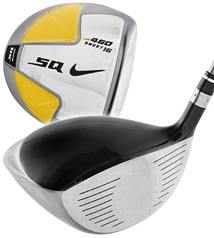
Nike Sumo Sweet 16.

Nike Sumo Sweet 16.

The 17-degree hybrid and the 18-degree hybrid are both made by Nike and are both called 2-hybrids—but they’re different models, and the 18-degree one actually goes farther, although I find it harder to hit. (As I mentioned in my previous post, I think of it as a fairway wood.) It and the 16-degree driver probably seem redundant, or almost redundant, but they’re not. My longer 2-hybrid is at least theoretically easy to hit off the ground, but its head is so small that, when my ball is sitting on a tee, it gives me the heebie-jeebies, especially in the heat of competition. My course has a several short, narrow par-4s on which it might be the perfect choice for tee shots if it didn’t have a head that appeared to have been designed to slide between the bottom of a teed ball and the ground. For those tee shots, I hit my 16-degree driver, which I call Baby Driver. It goes about the same distance as the hybrid—200 yards, plus or minus ten percent—but has a head the size of a battleship. (I also have a 13-degree Mama Driver, currently in Time Out.)

During the first, stroke-play round of the men's member-guest last year, Tony, Tony's son Tim, and I carried nine drivers between us. That's my bag on the left, Tony's on the right.

During the first, stroke-play round of the men’s member-guest last year, Tony, Tony’s son Tim, and I carried nine drivers between us. That’s my bag on the left, Tony’s on the right.

When I first bought Baby Driver, five or six years ago, I used it only on short par-4s and tight par-5s. But it’s so easy to hit that, since then, I’ve found more and more uses for it. Last year, Rick and I played in a senior tournament run by our state golf association. The course had five par-3s, all of which were fairly long. I hit Baby Driver on all five of them, and in two rounds it and I were cumulatively two over par on those ten holes. In Northern Ireland last year, I hit Baby Driver on a downhill 134-yard par-3 and was the only player in our group to put a ball on the green. And sometimes I hit it off the ground.

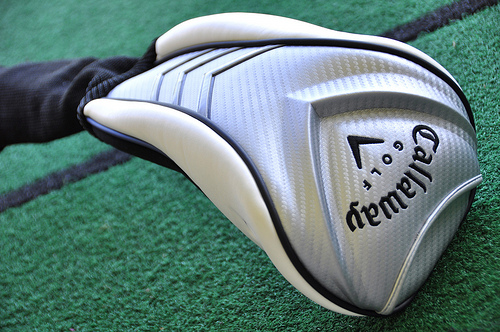
I'll address headcovers at surprising length later, but I can tell you now that I have just two of them: one for my putter, because if I don't use it the putter's saber teeth lock onto the shafts of my other clubs; and one for Baby Driver which I got from the lost-and-found box in the golf shop. Appropriately, I guess, it's for a women's driver, and it has a vaguely obstetric-seeming pouch on top. I use it to keep my two drivers from clanking annoyingly as I walk.

I’ll address head covers at surprising length later, but I can tell you now that I have just two of them: one for my putter, because if I don’t use it the putter’s saber teeth lock onto the shafts of my other clubs and are hard to pry loose; and one for Baby Driver (see photo). The Baby Driver one I got  from the lost-and-found box in the golf shop. Appropriately, I guess, it’s from a women’s driver, and it has a vaguely obstetric-seeming pouch on top. I use it only because without it my two drivers would clank annoyingly as I walked.

If at least two readers will send me descriptions (with one or more photos) of their own equipment, I will create a permanent What’s In My Bag department, and publish them there, along with any future contributions. Send all that stuff to myusualgame@gmail.com.

To be continued. (Read Part One.)

What's In My Bag?

What’s In My Bag.

What’s In My Bag, Part One: Where are the Irons?

wimbI’ve been asked by many readers—well, actually, by just one reader, but he asked twice—to publish a poor man’s version of my favorite regular feature in Golf Digest. I’ve been somewhat hesitant to do so, for who-asked-you reasons, but I also know that most golfers enjoy snooping in other golfers’ bags, and my own assortment may be peculiar enough to be of interest. So why not?  Furthermore, if at least two readers will send me descriptions (with one or more photos) of their own equipment, I will create a permanent What’s In My Bag department, and publish them there, along with any future contributions. Send all that stuff to myusualgame@gmail.com.

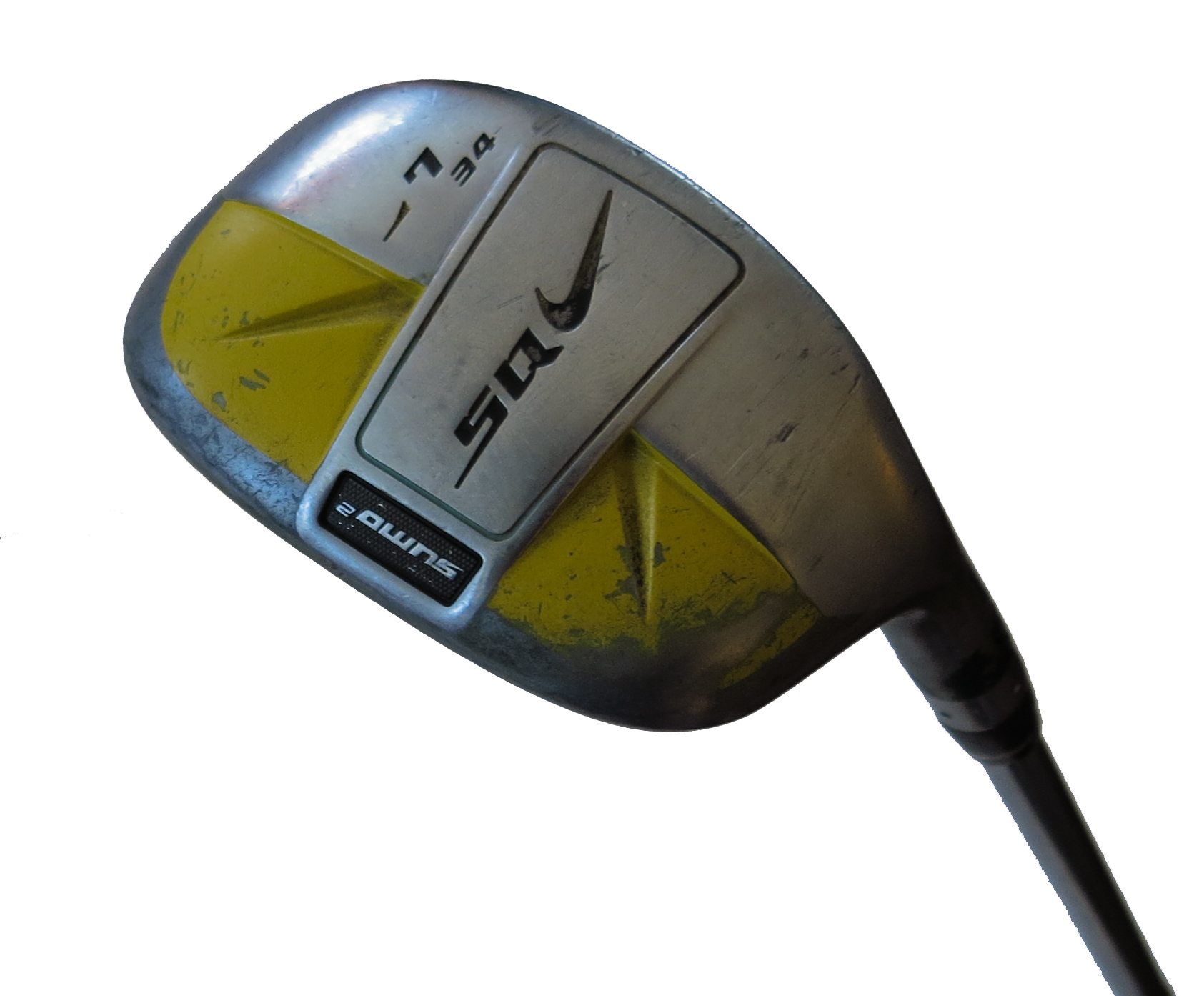
The first thing you will notice, if you have read this far, is that my bag doesn’t contain any conventional irons. My friend Tony and I now lead what we call the Hybrid Lifestyle. It consists of playing as much golf as possible while other people are at work, and not using normal equipment. It was Tony who introduced me, six or seven years ago, to what we both now think of as a magic golf club: a 34-degree 7-hybrid, made by Nike, which a single-digit friend of his had urged him to try. As Tony promised, I hit it longer, higher, straighter, and more consistently well than my 7-iron, which I’d had custom-fitted in Arizona a couple of years before, and as soon as I got home I ordered one just like Tony’s. Not long after that, Tony and I played a round with a visiting friend of his, and we used our magic clubs on a 150-yard par-3. We both hit high draws to within six feet of the hole, and the friend said, “Gee, you guys could play on the L.P.G.A. Tour.” He meant to be devastating, but I’ve adopted his remark as a swing thought.

This is the magic golf club. Nike not only doesn't make it now, but also, according to Nike, never made it the past. (Tony Dabbs told me the company had never made a 34-degree hybrid.) Tony and I know better.

This is the magic golf club. Nike not only doesn’t sell it now, but also, according to Nike, never sold it the past. (A Nike rep told me the company had never made a 34-degree hybrid.) My friend Tony and I know better.

Almost everyone now agrees that low-numbered hybrids are easier to hit than the corresponding long irons. That’s true even for pros, who stopped carrying 1-irons years ago, and now often don’t carry 2-irons or 3-irons, either. But Tony’s and my experience has convinced me that the hybrid advantage extends deep into the bag, and that hardly anybody carries enough. I would bet that’s true even of many tour players, but it’s definitely true of golfers who aren’t paid to play. Today, Tony’s longest iron is a 9. Mine—now that I’ve supplemented my six Nike hybrids with two Cleveland HB3 “hybrid irons”—is a pitching wedge. As a result, I’m convinced, we’re both now playing our best golf ever.

(I’m not sure I like the HB3s; they make a weird noise when you hit them, causing even pure shots to sound like chunks. But I like being able to say I don’t have any irons. Tony calls his 9-iron his 1-iron, because it’s his one iron—get it?)

The great Karsten Solheim.

The great Karsten Solheim.

Almost twenty years ago, I got to spend time with Karsten Solheim, the founder of Ping, who invented the modern, perimeter-weighted golf club. Solheim told me that hitting a ball with an old-fashioned club, in which the weight of the head was uniformly distributed along the blade, was “like hitting a tennis ball with a Ping-Pong paddle.” A similar principle applies to hybrids. Tony Dabbs, a Nike product line manager, told me, “With a hybrid you’ve got a lower and deeper center of gravity, so it gets your launch angle up—more than what an iron can possibly do. A hybrid is essentially a mini-fairway wood, or a small driver.” The weighting and the shape of the head also make a hybrid easier to hit well out of the rough, since the club is less likely to twist. Dabbs told me that the advantage is greatest for slower swing speeds, but I think stronger players gain, too, and that that benefit compounds over time because once you begin hitting decent shots with a comfortable swing you’re less likely to lash at the ball from over the top with any of your clubs.

Tragically, from my point of view, Nike no longer makes SQ Sumo2 hybrids, which I prefer to all subsequent models. (I do carry a second 2-hybrid, a Nike VR S model that Nike also doesn’t make anymore. It goes farther than my other Nike 2-hybrid, although I find it harder to hit well. I think of it as a fairway wood, which it resembles.) And Nike no longer makes even a 6 hybrid. (Dabbs told me there’s “a point of diminishing returns” as lofts get higher. Hmph.) If you’re a seller—right hand, steel, stiff—please speak up.

To be continued. (I’m going to stretch this out for quite a while. Next, I’ll explain why I’ve got two drivers.)