In Praise of Winter Rules

Gary, our superintendent, had to mow the fairways today (see above), but he and his crew also put the snow cover on the practice green (see below). The grass is still growing, but winter is coming.

This is the time of year when every round is a bonus round. It’s also the time of year when my friends and I permit ourselves to lift, clean, and creatively place our balls within a foot or two of where we find them, even in bunkers. I used to fret about this brazen violation of the game’s rules; golf’s most sacred imperative, after all, is “play the ball as it lies.” But I’ve stopped feeling bad about rolling them over. As Tim said once, “There’s a genuine art to improving a lie.”

Adopting so-called winter rules creates shot-making possibilities that few of us would experience otherwise. There’s a par-five on my course that I seldom reach in two—unless I’ve sliced my drive into the weedy wasteland to the right of the fairway and perched my ball on the crest of a tee-like tuft of desiccated scrub, so that I can smack it with my driver. Even I can produce backspin with my wedges if I’m hitting them from a patch of frost-burned turf. Fluffing up the rough on the edge of a greenside bunker enables me to hit parabolic flop shots, just like Phil’s.

Golf courses would be cheaper to maintain if we all played all the time by winter rules. Fairways wouldn’t have to be manicured; in fact, inconsistent playing conditions would be prized, because they would offer a spectrum of exploitable lies. Casual cheating would be neutralized, since the guys who now depend on foot-wedges would lose their competitive advantage. Divot holes and clumps of mud would cease to matter. Equipment manufacturers would thrive, as players rethought their choice of clubs. (How about a huge-headed wedge for plucking a ball from the peak of a carefully molded cone of bunker sand?)

Of course, we would lose something, too. Preferred lies are like wild cards: real royal flushes are devalued when threes and nines are wild. For most of us, though, the gain would more than offset the loss. There’s something thrilling about launching a big banana from the tee and shouting, “Get in the rough!”

We had the course virtually to ourselves, so we played as a sevensome and got around in three and a half hours.

My Close Personal Friend (a Different) Tom Watson

Nick and Hacker (real name), Dyker Beach Golf Course, Brooklyn New York, 2006. That’s the Verrazano-Narrows Bridge in the background.

As soon as our home course closes for the season, my friends and I pack up our clubs, say goodbye to our wives and children, and head south for a while, to a place where golf can be played on real grass even in the middle of the winter. Which is to say, we go to the Bronx.

Many people don’t realize that there is a golf course inside the New York City limits, but there are more than a dozen, and almost all of them are public courses that are open year-round. Our favorites are probably Pelham Bay and Split Rock, in the Bronx, and Dyker Beach, in Brooklyn, but there are others and, because there’s no such thing as a bad golf course, we sometimes play them, too. (You can read more about winter golf in New York here and here.)

The drive south takes us down I-684 and the Hutchinson River Parkway and past still more golf courses, most of which don’t stay open all winter. One of those is Saxon Woods, which is one of six public courses owned by Westchester County, New York. Saxon Woods is so close to Winged Foot and Quaker Ridge that some people figure A. W. Tillinghast must have designed at least part of it, too. The evidence for that isn’t strong, to say the least, but as we drive by I look at it longingly (which is how I look at all golf courses).

Not long ago, I received an email from Tom Watson, a Saxon Woods regular, who wanted me to know about a game he had invented. Here he is:

Tom Watson (real name) playing in a charity outing at Westchester Country Club, Rye, New York, 2012.

Tom wrote:

“I simply keep my best score for each hole for the entire season, and add them up for a season’s best net total. So it allows a 19-handicapper to post a ‘score’ that’s closer to the pros than to guys who put their shoes on in the parking lot. And it gives you some real rooting interest as the season wanes. I was sitting on 68 last week when I stepped up to one of the only two holes I haven’t parred all year. A good drive, a yanked three-wood, a big flop shot over a bunker, and an easy three-footer later, I was writing down par and dropping my Season’s Best to 67. It’s a number I’m not usually acquainted with—and it made the round. I didn’t quite go all Ian Poulter on the green, but there was a discreet fist pump involved. It’s the only golf game I know of where your score always goes down over time!”

Tom’s invention is actually a re-invention. A cumulative score like the one he compiled is called a ringer score, and there are lots of clubs and leagues and groups that run season-long ringer competitions. (One of them is Wethersfield Country Club, in Connecticut, where Rick and I played in a state senior four-ball tournament this year.) Ringer scores are also fun to use as a side bet on golf trips, over multiple courses. Ray, Tony, and I did that during ten rounds on three courses at Bandon Dunes, not quite six years ago. I’m pretty sure I won, although I don’t recall collecting any money.

The Late-Season-Golf Problem, in Diagram Form

Several years ago, I played a few rounds in northern Scotland in December. The sun began setting almost as soon as it had risen, and even at noon it practically sat on the horizon. The late-season golf window here in Connecticut isn’t as narrow, but you have to pay attention. Five of us teed off at 1:00 this afternoon. We played in just over three hours, but by the end I was having trouble following drives. Mornings are tough, too:

Rick, November sun, Sunday morning, seventeenth hole.

Last week, I spent a couple of days in Kansas City without my golf clubs. My mother told me about a local country club, which a few years ago assessed its members for major improvements to the golf course. The assessment was substantial, and quite a few members left the club rather than pay it. Four of my mother’s friends went to the club one day for their regular bridge game, and when lunch was over they discovered that none of them could sign the check. All four, it turned out, had dropped their membership without telling the others.

Stanley on the second tee last Sunday, with his Crocodile Dundee hat (bought on eBay) and late-season club-carrier thing.

Golf Carts: Fairway or Rough?

The winning team, by a record margin: Chic, Gary, and Doug. Second hole, November 4, 2012.

Beginning November 1, the Sunday Morning Group gives an extra handicap stroke to anyone who wears shorts. Chic and Doug both did this morning—and Doug didn’t wear a hat, and after a few holes he took off his jacket—even though it was 35 degrees when we started. We had three threesomes, and we played two best balls, net, off the low handicap, which was four. Chic and Doug ended up on the same team, along with Gary, our superintendent, but the extra strokes were meaningless because they shot 12 under, which was 16 shots better than the second-place team (mine). That’s a record, as far as anyone can remember. Incidentally, the Sunday Morning Group’s record worst round is 9 over par, net, on one best ball; it was set on October 22, 2001, by Frank D., Rick, and me.

November 1 is also the day the golf shop closes for the year, and that means no golf carts from now till spring. (The carts are stored for the winter in a building behind the ninth green which somehow survived Hurricane Sandy—see the photo below.) The course always looks great once the carts have been put away, because there aren’t tire tracks running everywhere.

Thinking about that made me think about an unresolved controversy at many clubs, including mine: do golf carts do more damage on fairways or in the rough? Gnarly old rough seems “stronger” than manicured fairways, but cart tracks are usually harder to see in short grass than in long. I’ve played courses where players were told to keep their carts off the fairways, and I’ve played others where they were told to keep them out of the rough.

Several years ago, I asked Stacy Bonos, an agronomist in the Turfgrass Breeding Project at Rutgers University, who was right. She hesitated, but when I pressed her she said that, all in all, carts probably probably did less damage to fairways than to rough.

No more carts till spring.

Hurricane Sandy Golf Update

The huge old oak tree near the fourth green, which was nearly destroyed in the Halloween storm a year ago, dropped one more branch yesterday, during Hurricane Sandy, creating a shortcut to the fifth tee.

Playing golf during the hurricane turned out to be impractical, but five of us did play an inspection round Tuesday afternoon, after the storm had passed. There was surprisingly little damage to the course, other than the busted fence in the photo above and a white pine that had fallen across the fifth tee, visible in the photo below. We decided to play the pine trunk “as it lies,” and, because it was lying between the white tee markers, that meant getting the ball up fairly quickly.

Adam teeing off on the fifth hole.

Thirteen years ago, on the first night of the Sunday Morning Group’s first annual October golf trip to Atlantic City, we ate dinner at a terrific Italian place downtown. We looked for it again a couple of times during the next few years, but no one could remember its name or exactly where it had been, and we eventually gave up, although we didn’t stop talking about it. (“Remember that great Italian place we ate dinner at in 2000?” etc.) Last night, during the storm, while I was watching the Weather Channel and searching the Web for frightening pictures of hurricane damage, I noticed a photo on the MSNBC site of a flooded street in Atlantic City, and scared my wife by shouting “That’s it!”

And that truly is it: Angelo’s Fairmount Tavern, on Fairmount Avenue. Someone please tell me that the hurricane didn’t sweep it away.

Hurricane Sandy Golf

On Sunday, two three-man teams tied at -10, so we held a playoff: wrong-handed overhand throw over the fence between the first tee and the putting green, closest to the pin. This was supposed to present a “perfect storm” of difficulty, but Corey (our new pro) and Nick (who works in the golf shop and plays three sports at a local high school) can throw better lefty than most of the rest of us can throw righty, and since the two of them were on the same team it wasn’t close. That’s Corey, throwing, in the photo above. At the far right is Stanley, nervously practicing.

While the burgers were grilling, Hacker (real name) suggested that we play golf during the hurricane “to monitor the storm and protect the course.” We’re going to try that on whichever day the weather seems worst, assuming that trees haven’t fallen across our driveways. Someone said that we might as well play naked, because if we didn’t the hundred-mile-an-hour winds would “blow our clothes off.”

This hurricane has made everyone think about the storm we had exactly a year ago, when we lost power for a week and I had to fly to Chicago to take a shower. Here’s what things looked like then:

And here’s what the golf course looked like a week later, when I got back from Chicago:

No one thought we’d play again that year, but, thanks to Gary and his crew, we were open again as soon as the snow had melted, and we stayed open through New Year’s Day—a record by almost a month.

Scary Icons Create Tee Times

Whenever rain is in the forecast, even if it’s only a 20 percent chance of showers, play at my club goes way down. Seeing a thunderstorm icon in their web browser apparently causes many members to make non-golf plans for the day. On Sunday, twenty guys showed up for our regular game—a good turnout—but we had the course to ourselves until noon, I think because the Weather Channel icon that morning had lightning bolts in it. There was enough drizzle at one point to make me put on rain gloves, but there was never any lightning or even real rain, and the sun was shining by the time we finished. Our club’s website has a weather app. Maybe someone could modify it to show lightning bolts all the time.

In honor of the Ryder Cup, we used scorecards from Medinah, which Hacker (real name) had downloaded from the club’s website. (We did the same thing during the PGA Championship with scorecards from the Ocean Course at Kiawah.) The only real effect was to shuffle the holes where the handicap strokes fell, but using the scorecard of a major venue is a respectful way to acknowledge the efforts of the big boys, and, besides, variety is interesting.

We also randomly divided into Ryder Cup teams—ten guys representing the United States and ten representing Europe—and played five four-ball matches, for one point each. I was on the U.S. team, which won, 4½ points to ½. We all assumed that the real U.S. team would win, too, by annihilating the Europeans in the singles matches, in the afternoon. Imagine our surprise. The Sunday Morning Group’s record in using golf to predict important events is now 2-1-0; matches of ours correctly called the outcome of the 2008 presidential election and the 2012 Super Bowl.

We’ll play our Presidential Special game again on Election Day. It was created by Tim, who is the inventor of several core concepts, including negative skins, “shooting your pants,” and the mathematical formula by which we predict the winning team score in our regular Sunday games (13 minus the lowest handicap in the field, times -1). Half the field will represent Obama and half Romney, and each hole will have an Electoral College value equal to the sum of its number and its handicap stroke index.(Our 16th hole has a stroke index of 17, so it’s worth 33 electoral votes—16 plus 17.) An entire golf course adds up to 342 electoral votes—172 needed to win.

Future trivia question: Who made the winning putt in the 2012 Ryder Cup Matches? Answer: It wasn’t Martin Kaymer, whose 1-up victory over Steve Stricker guaranteed only a 14-14 tie (and thus a European “retention” of the trophy). The winning putt was the short par putt that Tiger Woods conceded to Francesco Molinari on the eighteenth hole, because their halved match gave Europe a 14½ -13½ victory. If Tiger had made his putt, 2012 would have been the third tie in Ryder Cup history.

Huge Falling Tree Crushes Golf Carts

On the right-hand side of the photo above—which I took this past Saturday morning, at the beginning of an annual mixed event called the Fall Classic—you can see a huge, ancient, two-trunked oak tree just past the end of the golf shop. About three and a half hours later, toward the end of the tournament, the tree suddenly fell down. My foursome was on the far side of the course when it went, but even from that distance the sound was like an explosion. Here’s what I saw when when I got back to the first tee:

The course was full of golfers, but, amazingly, no one was standing near the tree when it fell, and no one was sitting in any of the golf carts parked beside it. Bob W. and Nick-who-works-in-the-golf-shop were playing a putting game on the practice green, and they watched it go down.

The roots picked up the water cooler near the first tee and flipped it over the split-rail fence, onto its roof:

That’s Margaret’s coffee mug. It was unharmed.

Within an hour, our favorite tree guy, who played with Gene B. in the member-guest this year, was on the job. He and his crew cleaned up everything but the two main trunks, which were too big for the chipper.

The next morning, my friends and I posed on the trunks before we teed off. We’re thinking about turning them into a bench. Or maybe we’ll just leave them where they are. That would definitely be easier. Maybe we’ll leave the squashed golf carts there, too, as a reminder that golf carts don’t last forever.


Hunting in Hazards

Two examples, from Monday afternoon. That’s a great blue heron in the photo above. It’s looking for dinner at the junction of two streams on the fifteenth hole. And that’s Rick in the photo below, looking for his drive in the lateral to the left of the thirteenth fairway. He, Adam K., Hacker (real name), and I teed off at 4:00, and we had just about run out of daylight by the time we finished, at 7:00. I missed my first opportunity in several months to play golf in a sweater. Oh, well. More opportunities ahead.

Back-Roads Scotland: Fraserburgh

Fifteenth green, Fraserburgh Golf Club, Scotland. Photo by Ian Stephen.

For the July issue of Golf Digest, which is on sale now, I wrote an article about Donald Trump and his newest golf course, Trump International Golf Links, in Scotland. The course is on the North Sea coast, a two-and-a-half-hour drive north from the Old Course at St. Andrews and about ten miles beyond the port city of Aberdeen. You should definitely play it if you have a chance—it will open July 10—and after you’ve done that you should get back on the A90 and drive another hour north, to the town of Fraserburgh, at the easternmost end of the Moray Firth. It’s the home not only of the Kinnaird Head Lighthouse and the Museum of Scottish Lighthouses, but also of Fraserburgh Golf Club, the seventh oldest in the world.

Fraserburgh foghorn, April, 2012. It was built in 1902. It's not still in use, but the museum keeps it painted.

I played Fraserburgh with two older members: Bill Maitland, who owns a furniture store in town, and Andrew Tait, a member of family of extremely successful fishermen. The morning was cold and the wind was blowing hard, and I wore two pairs of rain gloves, one on top of the other, in the hope of maintaining feeling in my fingers. Tait, in contrast, didn’t wear even one glove, and the explanation was what I guessed: after you’ve spent  a few decades fishing in the North Sea, it takes more than wind to make your hands feel cold on land.

Town of Fraserburgh, viewed from the golf course. April, 2012.

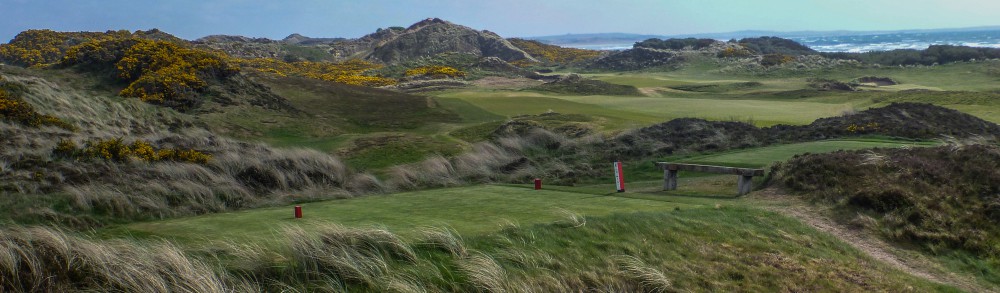
Fraserburgh’s first and eighteenth holes are flat and forgettable, but nearly everything in between is brilliant, beginning with the second, a par 4 that plays up what looks like the surface of the moon, on the flank of a mountainous dune called Corbie Hill:

Second Hole, Fraserburgh Golf Club. Photo by Ian Stephen.

Golf in the region goes back a long way. Local church records show that a parishioner named John Burnett was sent to the “maisters stool” for “playing gouff” on the links of Fraserburgh in 1613. The club was founded a century and a half later, in 1777, and it has the documents to prove it. At lunch after our round, Maitland showed me a copy of the original membership register. “These names are still well known to us,” he said—and by that point they were well known to me, too, because I had seen them on plaques and trophies in clubhouses along the coast:

"These names are still well known to us," Bill Maitland told me.

Fraserburgh’s original members got together for lunch after they played, just as they do nowadays, and they were required to pay their share of the bill whether they showed up or not—an excellent rule that my own gang ought to adopt. After we’d eaten, Tait took me to the wharf to see his family’s three fishing boats. He lives on a farm a few miles down the road and has his own five-hole golf course, which he plays when he’s too busy to get to the club.

Andrew Tait, Fraserburgh wharf, April, 2012. The boat is named for his parents.

Fraserburgh’s eighteenth hole is called Bridge, after a footbridge over some railroad tracks along the western edge of the course. The rail line connected Fraserburgh with Aberdeen and the villages and golf courses in between—a sort of Linksland Express. It closed in 1965, though, and the footbridge was demolished, so Fraserburgh’s eighteenth is now a golf hole with a ghost name. The course is still there, though, and it’s one of many worthy destinations along the coast for links-golf pilgrims who can be persuaded not to turn around after playing Carnoustie.