
Masters Countdown: Eighth Hole

Augusta National's eighth green, 1935.

When the eighth green was built, it looked very much the way it does today, with tall, steeply contoured mounds on either side. In 1956, though, Clifford Roberts, the club’s co-founder and chairman, had the mounds removed. “That’s the only time I can really remember Mr. Jones getting mad at Cliff,” Phil Harison, a longtime member, told me in the late 1990s. “But he removed the mounds for a reason. They blocked the view of the spectators at the tournament, and once they were gone the spectators could see a lot better. But Mr. Jones got awfully upset about that. He really did, because without the mounds the hole was much less interesting, and the green didn’t look like any other green on the golf course.”

Augusta National's eighth green in 1956, after the mounds had been removed to improve sight lines for spectators.

Roberts never thought that removing the mounds improved the hole—and, indeed, the new green was dreadful. It was featureless and vaguely hourglass-shaped, and it could be approached without trepidation from almost any angle. But Roberts felt strongly that spectators ought to be able to see. Not long before he died, though, he decided that the sacrifice had been too great and that the mounds should be restored. The change was finally made in 1979, not quite two years after his death. Byron Nelson led the project, along with Joseph S. Finger, an architect who, among other accomplishments, had played golf at Rice University in the thirties on a team that was coached by Jimmy Demaret. In restoring the mounds, Nelson and Finger relied heavily on photographs taken during the thirties and forties. Harison—who had grown up in a house that used to stand just beyond the first green—consulted on the project as well. During the Second World War, when the course was closed, he had often ridden a motor bike over the mounds, and he told me that he retained a sort of physical memory of their shape.

Jones and Roberts used to ask Harison to fill out groups in Augusta National’s main member-member event, the Jamboree, beginning when he was thirteen; he and a partner won the event in 1941, when he was sixteen. He didn’t officially become a member until 1946, when he turned twenty-one, but at that time, he told me, Jones and Roberts kidded him by saying, “Oh, you’ve been a member for years.” Harison attended every Masters, beginning with the first, and was the tournament’s official starter for more than sixty years: it was he who introduced each player on the first tee—everyone from Bobby Jones to Tiger Woods. He died 2008, at the age of 82.

During 2001, the tournament tee on the eighth hole was moved back and to the players’ right—part of a course-wide effort, supervised primarily by Tom Fazio, to lengthen the course and increase the premium on accuracy and controlled shot shape off the tee. The fairway bunker was doubled in size and stretched toward the green. (The old bunker ended roughly at the peninsula of turf near the left center of the new bunker. See the photo below.)

The eighth hole has had a fairway bunker in approximately the same position since the course opened. Changes in its size and in the location of the tournament tee—all of which were made, in part, to keep the bunker in play—provide a good indication of how much tournament players’ driving distance has increased since the early 1930s: the far edge of the bunker today is roughly a hundred yards farther from the tee than it was during the first Masters.
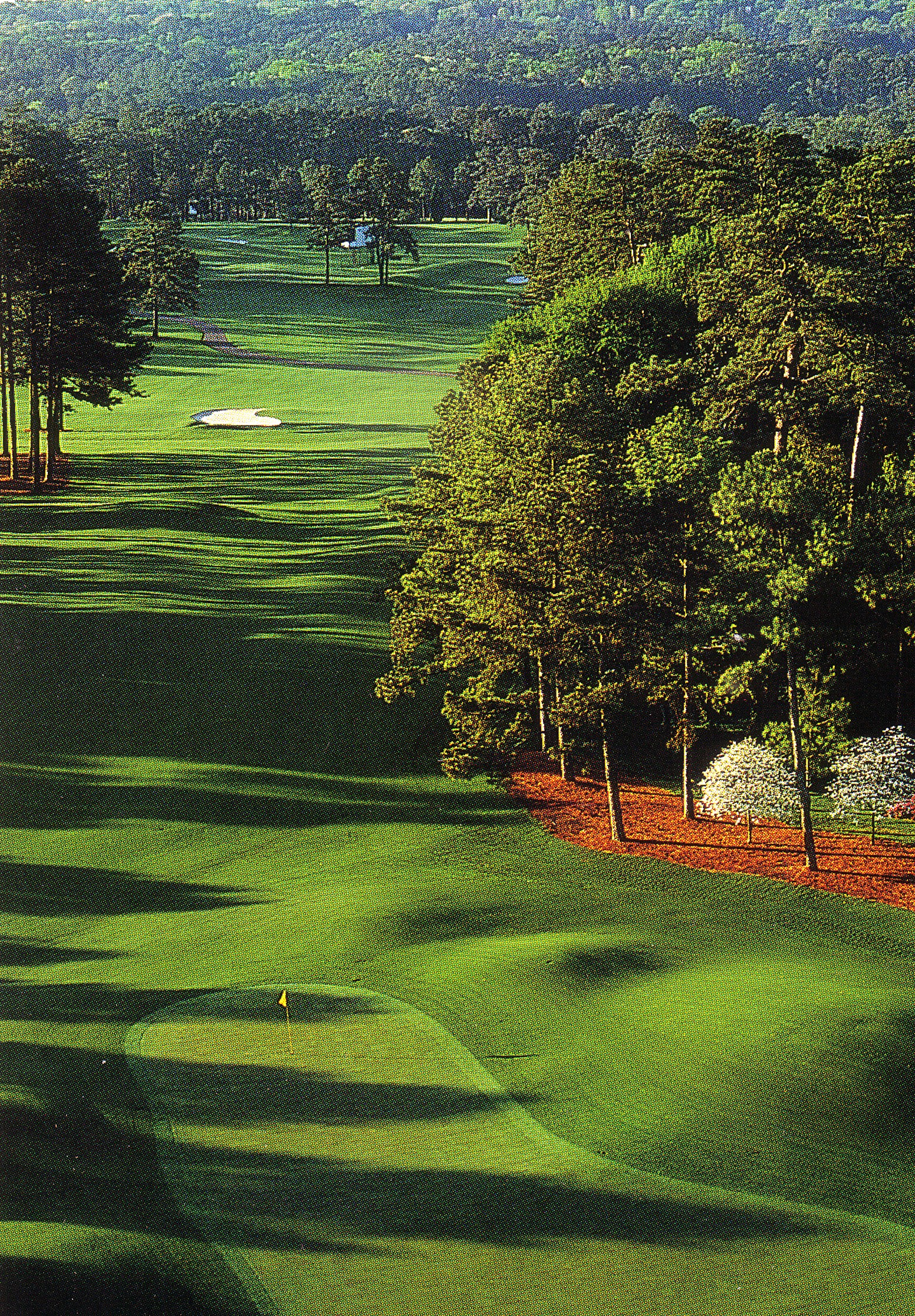
Looking back toward the tee from the eighth green. The hole's single bunker is on the left.

Masters Countdown: Third Hole

Augusta National's third green, 1935.

Augusta National’s third hole has probably undergone fewer changes than any other hole on the course. Its principal feature today, as was true in the beginning, is a treacherously shaped green, which sits on a tilted natural plateau. Dropping off from the shallow left end of the green is a deep bunker from which pars can be difficult to save. The green is hard to hit and harder to hold, and approaches to it are complicated by the fact that the putting surface is invisible from the fairway.

In 1933, Clifford Roberts, the club’s co-founder and chairman, wrote a letter to Alister MacKenzie, who had designed the course, in which he suggested adding a deep cross bunker in the face of the plateau directly in front of the green. “It was my understanding,” Roberts wrote, “that the deep-face trap located in about the center would make this a definite drive and pitch hole; that is to say, a well struck pitch would be required in order to hold the green and the trap would make it impossible to play a run-up shot.” MacKenzie was vehement in vetoing that idea—which Roberts had admitted Jones didn’t support—and his response contains so much of his thinking about design that it is worth quoting at length:

I am delighted that Bob agrees that the [third] with the one trap is all right. This confirms my impression that Bob knows more about golf and its sound principles than any man I have ever come across.

My own opinion is that a cross bunker would convert it into an ordinary stereotyped hole and would nullify all the subtleties of the undulations of the approach to which we gave so much time and thought.

Consider the many problems which face a golfer approaching the hole. In the first place he can play safely to the right and rely on a long putt going dead to get his four. If he elects to go straight at the flag he must play a perfect pitch or else his ball would hit the bank and come back or run over the green. On the other hand if he tries to run up from the right his shot must be played perfectly as a half hearted run up shot will inevitably run into the bunker on the left, which appears to me to be absolutely perfect both in regard to its position and its construction.

At this hole the super golfer, like Bob, has a most fascinating problem, as to have a reasonable chance of three he will have to attack the hole from the left, where all the slopes help him towards the hole. It is here that the tee-shot bunker comes in as he must make up his mind to play round it with a pulled shot from right to left or a fade from left to right, or, when a strong wind is in his favour, to play over it.

If the approach to this hole is maintained as hard and as true as the green it will make the most perfect hole of its length in the world of golf and any additional bunker would ruin it.

It is holes of this description that keep up one’s interest in golf year after year, stimulate players to improve their game and prevent golf becoming stale.

Jones didn’t think as highly of the third hole as MacKenzie did; his favorite par-fours almost all required long-iron or fairway-wood approaches—shots at which he excelled. But MacKenzie’s conviction has been borne out over the years. Of all the architects who have worked on the course, none has yet made a persuasive case for a major revision. (The single original fairway bunker became a cluster of four fairway bunkers in 1983, but the impact on tee shots didn’t change.) The third hole remains the shortest par-four on the course, yet it was one of the few holes that consistently gave Tiger Woods trouble during his record victory in 1997. (On Friday, he hit a bullet-like drive to within fifteen yards of the green, yet made a bogey.) In fact, the experience of Woods and other long-hitting players suggests that one effective way to “Tiger-proof” a golf hole may be to shorten it.


Tiger, Continued

In 2006, when I was working on the Men’s Vogue article about Tiger Woods that I mentioned yesterday, Woods showed me around the men’s grillroom in the clubhouse at Isleworth, the gated golf community where he lived. He pointed out its many man-friendly amenities, among them a pool table, a Ping-Pong table, numerous pinball machines and videogames, a true-rolling artificial putting green, a miniature basketball court, and a long row of leather easy chairs, which were lined up in front of a flat-screen TV that was hanging above a fireplace. “There are a lot of divorces here,” he said, and we both laughed.

Ha! Who knew? He was probably already fouling his nest, as my late father would have put it, but his public self-immolation was still a few years away. If there’s anyone other than Woods himself who might gain by meditating on his troubles, it’s parents who—inspired by his remarkable life, perhaps—entertain serious athletic ambitions for their own children. Ask any pushy sports dad whether he’d be happy for his son or daughter to achieve superstardom, and he’d undoubtedly say yes. But striving for supremacy, in any endeavor, is a morally treacherous proposition. Great athletes become great in part by learning to coldly exploit the weaknesses of others, and by treating their own desires as global priorities. What we usually refer to as an athlete’s “sacrifices”—the pre-dawn wake-up calls, the endless, lonely hours in the gym or on the driving range—are really acts of narcissism, carried to a sweaty extreme. One of Woods’s many appealing characteristics, pre-scandal, was that he seemed at least moderately concerned about the world beyond his own accomplishments. The mess he made of his family is a useful reminder that being a good person, no matter how many advantages you seem to have, is as difficult as it looks, especially if you’re in a position to take your sexual fantasies live—a temptation that famous athletes often seem to resist about as successfully as rock stars.

Nevertheless, as I wrote yesterday, I enjoyed hanging around with him—and I would guess that virtually all the other people present on those days did, too. He arrived by himself, in his own car, without an entourage, and he cheerfully did everything he was asked to do. A woman who worked for one of his corporate sponsors told me that he never complained, much less threw a celebrity tantrum. In Los Angeles, he spent much of the day shooting motion-capture footage for a video game. He had to lie still as two technicians from Electronic Arts, the video game’s publisher, affixed eighty-eight BB-size motion-capture reflectors, called markers, to his face, neck, and upper chest, and as they worked he chatted with them amiably. Then he spent almost two hours sitting in what looked like a dentist’s chair inside a pod-like enclosure, which was as brightly illuminated as an operating room, and had to keep his head motionless while saying things like “A bear bit me in the forest today” and “I never jump quickly off a truck”—sentences that contain phonemes which can be digitally reshuffled into custom dialogue.

Another of his professional commitments that day was to spend half an hour conversing with Edward Barry-Walsh, a seventeen-year-old English boy (and four-handicap at Sunningdale), who, as a result of winning a contest sponsored by Electronic Arts, was going to be included as a character in the game. Woods sat next to him on a couch, put his feet up on the coffee table, and gave no indication whatsoever that he was keeping track of the time. Barry-Walsh had written a number of questions on a sheet of paper. He seemed nervous at first, but Woods set him at ease and after a while he put the list away.

When Barry-Walsh couldn’t think of anything else to ask, Woods posed for photographs with him and his parents, discussed the proper technique for hitting lob shots over living-room furniture, and looked ahead to the day when Barry-Walsh would be “out there kicking my butt.”  Later, Barry-Walsh told me that the experience had far exceeded his expectations, and marveled, “He’s just such a down-to-earth bloke.” Not even close, we learned later.

Four and a half years after their conversation, Barry-Walsh made the cut and finished tied for forty-third in the 2010 Castle Dargan Irish Masters, a European mini-tour event. But, unless he subsequently enjoyed triumphs that Google knows nothing about, that was the zenith of his professional golf career—maybe not the unluckiest thing that could happen to a talented young man.

My Close Personal Friend Tiger Woods

In late 2005 and early 2006, on assignment for Men’s Vogue in Los Angeles and Orlando, I got to spend some time hanging around with Tiger Woods. (Woods wanted Vogue to pay attention to his clothing lines and so had agreed to be interviewed at some length by a print reporter, something he ordinarily hates and rarely does.) He buffaloed me on at least one issue—he described his marriage as one of the proudest achievements of his life—but I liked him a lot, and I enjoyed being with him, and I found him much more interesting to talk to than, for example, any of the handful of Major League Baseball players I had to interview, many years ago, on an assignment for the short-lived magazine Inside Sports. (Imagine the most annoying jock in your high school class permanently frozen at his moment of maximum annoyingness.) Woods gets close to zero credit for being forthcoming, but, actually, over the years he has intelligently explained a huge amount about what goes on in his mind as he competes—more than any other great athlete I can think of.

He has also been surprisingly nonchalant about the potential peril of getting out of the bed in the morning. He loves roller coasters. He races down double-black-diamond slopes despite not knowing all that much about skiing. He has taught himself to hold his breath underwater for four minutes, and he has dived to a hundred feet without scuba tanks. He has gone bungee jumping in New Zealand. And he drives his car too fast, in my middle-aged opinion. Also, of course, those cocktail waitresses.

In Florida, the idea was that Woods would put on a Prada suit and zip around Lake Butler on a jet ski while the photographer chased him in a power boat. But there was a problem. The sky had darkened steadily through the morning, and the wind had picked up to thirty miles an hour, and the National Weather Service had issued a small-craft advisory. The owner of the power boat said the water was so choppy that if he ventured onto the lake he might not be able to return to the same dock. Canceling the shoot would be the prudent thing to do, everyone agreed—except Woods. “It’s not that rough,” he said, like a ten-year-old making a case for visiting Disney World in a thunderstorm.

Woods eventually prevailed on the weather issue. After a few minutes on the water, though, he circled back toward the dock, and I and all the other people on shore assumed that the ugly conditions had brought him to his senses. But then he shouted, “How fast is this thing supposed to go?” It turned that he hadn’t been able to crank the jet ski to anything like its top speed, 60 m.p.h., and he couldn’t figure out what might be wrong. A neighbor of the jet ski’s owner removed several handfuls of weeds from under the hull, and Woods happily took off again, at full throttle.

Thirty minutes later he was back on land, very pleased. As he changed out of his wet clothes, he said, “Watch this,” and poured a half-cup of water from one of his Cole Haan oxfords

With a great deal of trepidation, I’m going to open this blog to comments. But I can always change my mind. Real names, please.