Masters Countdown: The First “Green Coats”

green jacket

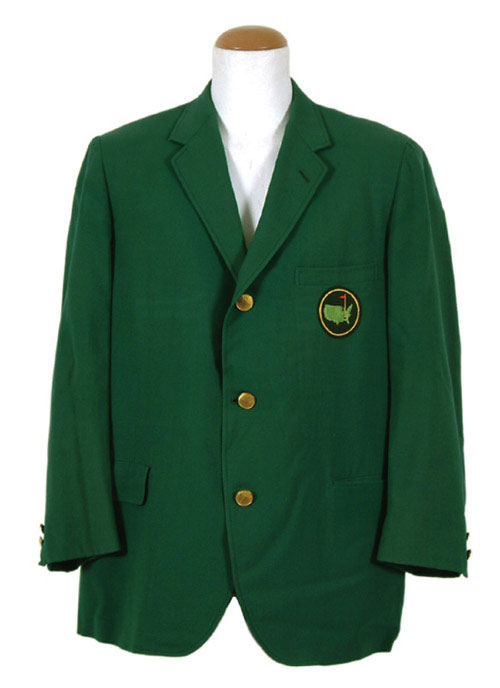
Green jackets were first worn at Augusta National in 1937, but they weren’t popular. “The members were not enthusiastic at first about wearing a conspicuous Kelly-green garment,” Clifford Roberts, the club’s co-founder and chairman, wrote in 1976. “Besides, the original coats were made of material that was too heavy, so that the wearer became uncomfortably warm.”

A few years later, the club offered an improved version, and on January 13, 1941, Helen Harris, who managed the club’s office, wrote a letter to the members informing them that “the Club’s Tailor is prepared to make the official Green Coats bearing the club’s Emblem for $18.50 and if you should wish to order one, please have your own tailor fill in the measurements on the enclosed blank and return it to me.”

The club had recently done some much-needed remodeling in the clubhouse, which had been a wreck when the club and tournament began. “With the improved Club facilities,” Harris continued, “most all our Members will likely spend more time here and these green coats come in handy for lounging. They are also quite serviceable during the Master’s [sic] Tournament as they make it unnecessary to wear a badge. Moreover, they identify the wearer as a member and thus give our gallery patrons a reliable means of securing information.”

The first Masters winner to be given a green jacket was Sam Snead, in 1949. A decade earlier, the club had photographed the first five winners in green jackets, but those had been borrowed from members—in a couple of cases, from members who had significantly different dimensions. The club keeps a selection of sizes on hand, and if a player who hasn’t won before is in contention the golf shop makes a few phone calls, to get an idea of likely measurements.

Horton Smith, Byron Nelson, Gene Sarazen, Henry Picard, and Ralph Guldahl, 1939. You can order a nice print of this swell photo from the Masters website.

Horton Smith, Byron Nelson, Gene Sarazen, Henry Picard, and Ralph Guldahl, 1939. You can order a nice print of this swell photo from the Masters website. No green jacket, though.

Masters Countdown: How Augusta National Almost Built a Golf Hall of Fame

Bobby Jones, 1941 Masters.

Bobby Jones, 1941 Masters.

The National Baseball Hall of Fame and Museum opened in Cooperstown, New York, on June 12, 1939, and the Professional Golfers Association responded by inducting several legendary golfers, among them Bobby Jones, into its own hall. But the P.G.A.’s hall as yet had neither a building nor a plan for one.

Clifford Roberts, who was Augusta National’s chairman and co-founder, embraced the idea and suggested several sites on the club’s property. His favorite, initially, was an elevated six-acre parcel roughly two hundred fifty yards to the east of the tenth green. This was one of the building lots that the club had been trying to sell for a decade. Among the advantages of the site, Roberts wrote to Jones, was that visitors to the hall “would have four good views of the course instead of one.” He also liked the idea that “members using the golf course would have a good view of an attractive building”—though from a distance.

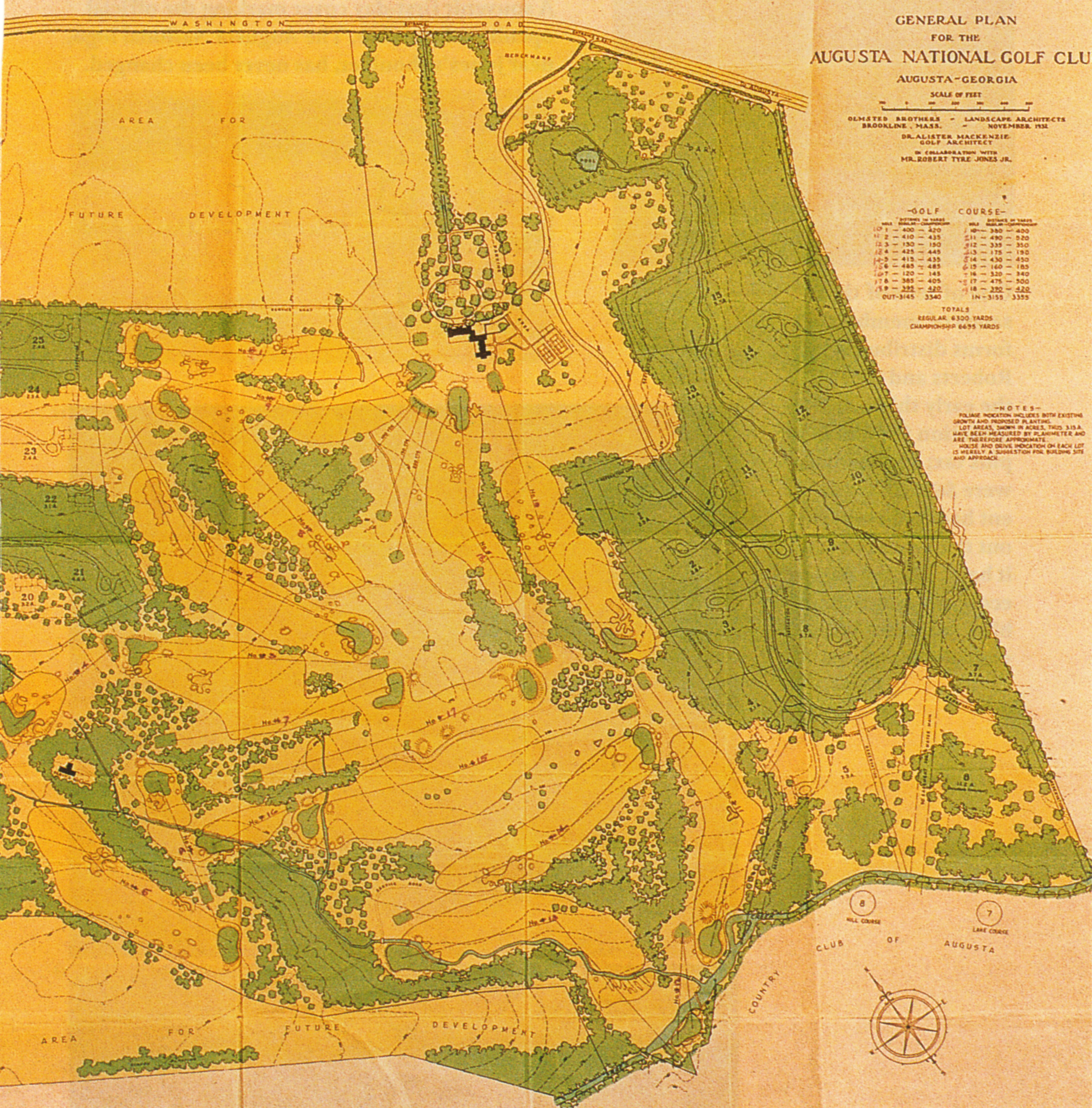
1932 Augusta National real-estate development plan, prepared for the club by Olmsted Bros.

1932 Augusta National real-estate development plan, prepared for the club by Olmsted Bros. Roberts’s initial choice for a hall of fame site was on the east side of the property, to the east of the modern eleventh tee–in the green stuff on the map above.

Roberts was especially concerned that golf’s hall of fame should be more compelling than baseball’s. A few days after the 1941 Masters, he wrote a lengthy letter to Olmsted Bros.—the club’s landscape architects at that time—in which he described a number of features that he thought ought to be included. “The more I think about it,” he wrote, “the more I feel that a building that houses a few plaques or a few bronze busts and that offers nothing else to the public, would prove to be a dull, worthless type of project, having no excuse for its existence except to attempt to glorify the leaders of golf. And I doubt that very much would be added to their fame.” One wing of the building, he continued, could contain “automatic movie machines,” which, for a quarter, would show instructional films by the game’s great teachers. Another wing could serve as both a comprehensive library and a bookstore. Visitors would be able to buy souvenir booklets, postcards depicting the Augusta National course, and “popular-priced copies” of some of the books in the library.

Roberts’s boldest suggestion was to construct “a miniature Augusta National course surrounding the Hall of Fame which would be a practical pitch and putt course and could be made a most attractive part of the landscaping scheme.” The holes would be scaled-down replicas of the holes on the big course. He proposed a fee of twenty-five cents per round. He also suggested building an “especially attractive” public driving range based on a plan that Jones had come across and thought highly of.

Despite Roberts’s enthusiasm, the project never came to anything, and there was no further discussion of building a miniature Augusta National. The two members that Roberts had been counting to pay for the project lost interest in it, and the club was not in a financial position to follow through on its own. And then news from Europe and the Pacific made other concerns more pressing.

Masters Countdown: Those Amazing Flowers

ANGC Circle 2

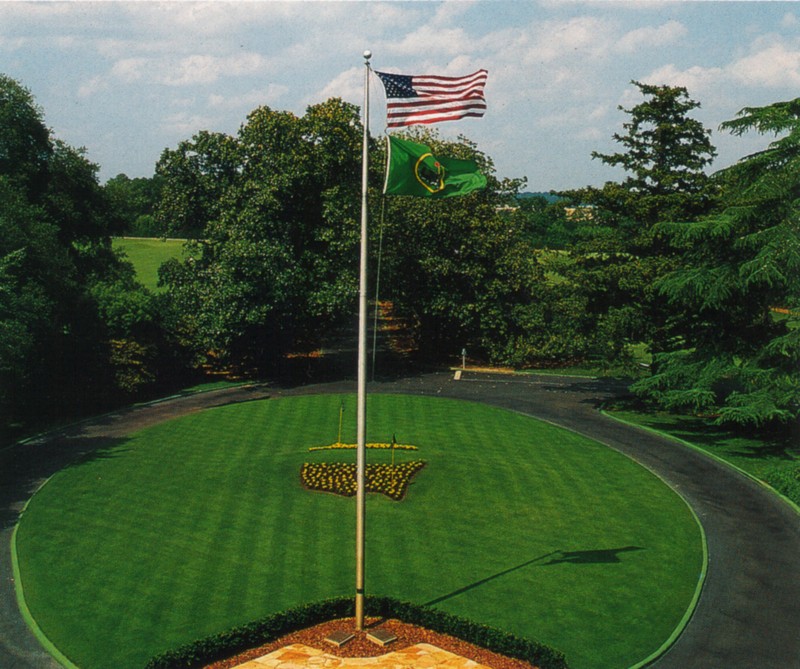
The photograph above shows the circle at the end of Magnolia Drive, in front of the Augusta National clubhouse. Everything is immaculate, including the green paint on the curbs—which is touched up frequently as the tournament approaches. The photograph below, which was taken in 1947, shows the same circle as it appeared during a period when the club was still strapped for money and couldn’t afford to pay the same attention to detail (or to pansies).

ANGC Circle 1

At the base of the flagpole in the photograph at the top of this post are plaques commemorating the co-founders of the club and the tournament: Clifford Roberts and Bobby Jones. The plaques are the only memorials to the men on the property. In 1941, two new Augusta National members—James Middleton Cox, a newspaper publisher, who years earlier had served three terms as the governor of Ohio, and his son, James, Jr.—proposed erecting a large statue of Jones near the clubhouse, not far from what would later become the site of the Eisenhower Cabin. Jones and Roberts were deeply unenthusiastic about the monument, and both were relieved when the Coxes, at Roberts’s suggestion, shifted their attention to the possibility of building a hall of fame on club property. I’ll have more to say about the hall of fame in a few days.

Masters Countdown: The 1967 Television Strike

U.S. Walker Cup team, 1957. Charles Coe, the captain, is squatting in the center. Billy Joe Patton, in glasses, is standing behind him.

U.S. Walker Cup team, 1957. Charles Coe, the captain, is squatting in the center. Billy Joe Patton is fifth from the left.

The American Federation of Television and Radio Artists declared its first national strike on March 29, 1967. That meant that CBS’s usual golf commentators, who were members of that union, could not participate in that year’s Masters broadcast, the following week. Clifford Roberts, Augusta National’s chairman, conducted auditions among the club’s membership, and settled on two distinguished amateur players, Charles Coe and Billy Joe Patton, to fill two of the vacant spots. Coe had won the U.S. Amateur twice and had been the runner-up to Jack Nicklaus in 1959, and in the 1961 Masters he had finished tied for second with Palmer. Patton had led the Masters after two rounds in 1954, then ended up in third place behind Snead and Hogan. Both men had played the course for years—Coe with a handicap that varied between plus-6 and plus-7.

Coe and Patton did creditable jobs as commentators, and their minimalist dialogue confirmed Roberts’s belief that less is more in golf broadcasting. CBS was pleased as well, and William MacPhail, who was the network’s director of sports, passed along a sampling of the large volume of complimentary mail the network had received. One viewer wrote, “[T]he quiet, sincere comments of your members, which were entirely adequate, were a refreshing change from the glib, and sometimes overly talkative, ‘pros’ we usually hear.” Another wrote, “What an absolute pleasure it was to watch a player, under severe pressure, walk up to a putt in silence—the silence any gallery always accords a player, but which the announcers feel impelled to fill with chatter. In this case, one truly felt present, with a real sense of actual participation.” The broadcast turned out so well, in fact, that CBS executives credited it with breaking the strike, which ended the day after the tournament.

Not much silence nowadays. Worth trying?

Masters Countdown: Bobby Jones in Color

Bobby Jones in Color

The photograph above was taken in 1947, during the next to last Masters that Bobby Jones competed in. His badge identifies him as Player No. 1. The photographer was apparently experimenting with an early color film. The negatives were discovered in an envelope in an old file cabinet at Augusta National almost fifty years later, around the time I began researching my book The Making of the Masters. No prints are known to have been made before that time.

There is a great deal of confusion about Jones and his status as a player. Augusta National, in tournament publications, lists him as an amateur, but by the rules of the U.S.G.A he became a professional in 1930, when Warner Bros. hired him to make instructional films, and when, a little later, he began designing and promoting golf clubs for A.G. Spalding & Bros.

Jones retired from competition not because he had no worlds left to conquer; he retired because he abhorred the idea of being labeled a professional. In a letter to Clifford Roberts many years later, he described the typical pro as “an uneducated club servant”—a prejudice that dated to the early days of his competitive career, when only amateurs were accorded the honorific Mr., professionals weren’t allowed inside clubhouses, and tournament organizers distinguished between “gentlemen” and “players.”

“So long as I played as an amateur, there could be no question of subterfuge or concealment,” he wrote in 1960—a statement that clearly shows what he thought of playing golf for money. Roberts secured Jones’s participation in the first Masters, in 1934, by cleverly dodging the issue: in the tournament’s program listings and pairing sheets, he made no distinction between amateurs and professionals.

But the distinction was invariably noted elsewhere. The Associated Press and all other news organizations, in their coverage of the tournaments Jones competed in, listed him with the pros. Even O.B. Keeler, who had built his sportswriting career by celebrating Jones’s amateur accomplishments, took it for granted that Jones was now a professional. And so did Augusta National, officially.That’s why Charles Yates, not Jones, was honored as the low amateur in the first Masters, even though Yates’s score was three strokes worse than Jones’s.

Would Jones have played in the Masters if the club had been compelled to label him explicitly as a professional? Roberts said in later years that he suspected he probably would have, in order to help the club. But Roberts was uncertain enough that he never raised the matter with him, either then or later.

In Golf is My Game, Jones wrote that to give up his amateur status would have been “like giving up part of myself.” But, in fact, he gave it up in 1930. And he had a powerful incentive for doing so. His golf-related income in 1933, when the first tournament was being planned, was over $100,000; in contrast, Paul Runyan, who won nine events that year and was the tour’s leading money-winner, had gross tournament earnings of less than $6,500.

Masters Countdown: Ninth Hole

Augusta National's ninth green, 1935.

Clifford Roberts, Augusta National’s co-founder and first chairman, liked to say that he made only one contribution to the original design of the course. During the construction of the ninth hole, he persuaded the contractor to create a level landing area in the steeply tilting fairway at the distance he normally drove the ball (about 180 yards). “The engineer was not at all enthusiastic about accommodating me,” Roberts wrote in his book about the club, “but finally agreed to bring back a tractor and do the job.” Roberts later told friends that he had requested the change because he didn’t want any of his matches with Bobby Jones to be decided by his luck at hitting a fairway wood to an elevated green from a downhill, sidehill lie. The current ninth hole was then the eighteenth, and Jones customarily either gave Roberts nine strokes or allowed him to begin their matches with a nine-up edge. Even so, Roberts needed all the help he could get.

(Augusta National doesn’t use the U.S.G.A.’s handicapping method. It has its own simple system, devised by Roberts, which is based on the number of pars a player ordinarily shoots, with a small adjustment for birdies. Essentially, if you make six pars, your handicap is twelve. The Roberts system works well, is easy to compute, and allows daily modification.)

Roberts’s difficulties with the second shot on the ninth hole were shared by most of the club’s other members, who, like him and unlike Jones, weren’t long enough off the tee to come close to the ideal driving area, at the bottom of the hill. And neither Jones nor Alister MacKenzie, who designed the course, was at all disapproving of Roberts’s modification. In consultations among the three, Roberts’s role was to supply the viewpoint of the average golfer, and Jones and MacKenzie both solicited his opinion. Roberts’s landing area is still visible in the ninth fairway, and it still receives plentiful use from members and guests, as well as from occasional Masters competitors.

Hord Hardin, who was the president of the U.S.G.A. from 1968-69 and was Augusta National’s third chairman, between 1980 and 1991, told me a story in 1996, shortly before he died, that I’ve heard in several versions. Augusta National had a few women associate members in the early years. (Most, if not all, were members’ wives—possibly including Roberts’s first wife, Mary Agnes Bishop, whom he married in 1937 and from whom he was divorced not long afterward.) In the clubhouse one day, one of the women told Roberts that she had just made a hole-in-one on the eighth—a 500-plus-yard uphill par 5—and Roberts asked how that was possible. Hardin told me, “She was playing the ninth, and flat missed her tee shot. The ball hit a something off to the right, flopped up in the air, and went in the hole on the eighth green, no more than fifty yards away. When he heard that, Mr. Roberts is supposed to have said, ‘That’s it. No more women members.'” Roberts and Jones’s original plan for the club had included a second course, intended mostly for women, and a large women’s locker room, which was to have been situated in the huge new clubhouse they intended to build as soon as they could afford to tear down the dilapidated old plantation house. The Great Depression forced them to scale back their ambitions, and prevented them from demolishing what today is probably the most recognizable building in golf.

As the photograph above shows, the ninth green’s famous false front, which contributed to Greg Norman’s spectacular final-round collapse in 1996, was originally more pronounced. (Look at the far right-hand edge of the photo.) The ninth hole is also seventy yards longer than it was during the first tournament. The most recent extension was during the summer of 2001, when the Masters tee was moved back thirty yards and a high stone wall was built to seclude it from a service road just beyond it. At the same time, additional trees were planted on the left between the new tee and the members’ tee, to eliminate the possibility of tournament players’ using the first fairway as an alternate driving area, and new pine trees were planted along the right side of the ninth fairway, to tighten the landing zone. Even though the hole today is 460 yards long from the tournament tee, Masters competitors often have as little as a nine-iron or a wedge for their second shot.

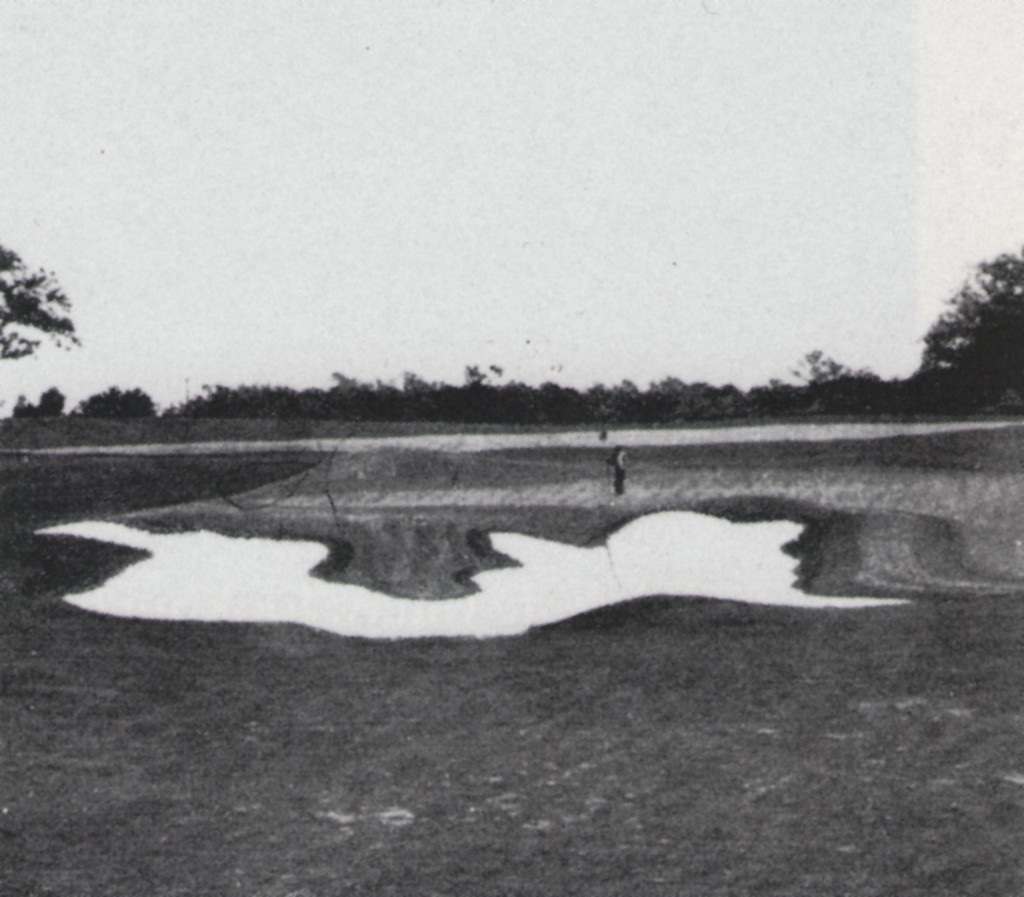
Players, fans, and television commentators who claim that Augusta National had no rough until Hootie Johnson added the “second cut,” in 1999, should study the photograph below, which was taken at the 1949 Masters. The rough in the foreground is several times the height of any grass on the course today. And note the greenside bunker configuration. MacKenzie’s original large bunker was later reconfigured and divided into three, and then at some point after 1949 the bunker nearest the tee was removed.

Ninth hole, Augusta National, 1949 Masters.

That’s the end of my hole-by-hole Masters Countdown for this year. I’ll take it up again next spring, beginning with the tenth hole—although I’ll have one or two more things to say about the Masters before this year’s tournament is over.
Masters Countdown: Eighth Hole

Augusta National's eighth green, 1935.

When the eighth green was built, it looked very much the way it does today, with tall, steeply contoured mounds on either side. In 1956, though, Clifford Roberts, the club’s co-founder and chairman, had the mounds removed. “That’s the only time I can really remember Mr. Jones getting mad at Cliff,” Phil Harison, a longtime member, told me in the late 1990s. “But he removed the mounds for a reason. They blocked the view of the spectators at the tournament, and once they were gone the spectators could see a lot better. But Mr. Jones got awfully upset about that. He really did, because without the mounds the hole was much less interesting, and the green didn’t look like any other green on the golf course.”

Augusta National's eighth green in 1956, after the mounds had been removed to improve sight lines for spectators.

Roberts never thought that removing the mounds improved the hole—and, indeed, the new green was dreadful. It was featureless and vaguely hourglass-shaped, and it could be approached without trepidation from almost any angle. But Roberts felt strongly that spectators ought to be able to see. Not long before he died, though, he decided that the sacrifice had been too great and that the mounds should be restored. The change was finally made in 1979, not quite two years after his death. Byron Nelson led the project, along with Joseph S. Finger, an architect who, among other accomplishments, had played golf at Rice University in the thirties on a team that was coached by Jimmy Demaret. In restoring the mounds, Nelson and Finger relied heavily on photographs taken during the thirties and forties. Harison—who had grown up in a house that used to stand just beyond the first green—consulted on the project as well. During the Second World War, when the course was closed, he had often ridden a motor bike over the mounds, and he told me that he retained a sort of physical memory of their shape.

Jones and Roberts used to ask Harison to fill out groups in Augusta National’s main member-member event, the Jamboree, beginning when he was thirteen; he and a partner won the event in 1941, when he was sixteen. He didn’t officially become a member until 1946, when he turned twenty-one, but at that time, he told me, Jones and Roberts kidded him by saying, “Oh, you’ve been a member for years.” Harison attended every Masters, beginning with the first, and was the tournament’s official starter for more than sixty years: it was he who introduced each player on the first tee—everyone from Bobby Jones to Tiger Woods. He died 2008, at the age of 82.

During 2001, the tournament tee on the eighth hole was moved back and to the players’ right—part of a course-wide effort, supervised primarily by Tom Fazio, to lengthen the course and increase the premium on accuracy and controlled shot shape off the tee. The fairway bunker was doubled in size and stretched toward the green. (The old bunker ended roughly at the peninsula of turf near the left center of the new bunker. See the photo below.)

The eighth hole has had a fairway bunker in approximately the same position since the course opened. Changes in its size and in the location of the tournament tee—all of which were made, in part, to keep the bunker in play—provide a good indication of how much tournament players’ driving distance has increased since the early 1930s: the far edge of the bunker today is roughly a hundred yards farther from the tee than it was during the first Masters.

Looking back toward the tee from the eighth green. The hole's single bunker is on the left.

Masters Countdown: Seventh Hole


A not especially intelligible drawing of Augusta National's seventh green, from the program for the first Masters, in 1934, when the seventh had no bunkers.

The seventh wasn’t much of a hole in the early days. (The consensus, as described by Clifford Roberts, the club’s co-founder and chairman, was that it was “the only weak hole out of the eighteen.”) Alister MacKenzie, who designed the course, likened it to the eighteenth at St. Andrews, but the resemblance was superficial. Both holes were short, and both had large greens and no bunkers, but in comparison with the venerable and surprisingly difficult closing hole of the Old Course, the seventh at Augusta was a pushover. Many players today would have been able to drive it.

In a letter to MacKenzie in 1933, Roberts wrote, “I think the real criticism . . . is that it lacks character. Ed Dudley [the club’s first professional] made a suggestion which appealed very much to me. He proposed putting a bunker in the middle of the face of the green and letting it wedge into the green. In other words, his thought is to partly develop this green into two sections, the same as is true of one of the greens at Lakeside, California. Bob [Bobby Jones] did not have very much to say about this proposal, but I do not think he was much impressed by it. I think, in truth, that Bob is really hesitant about making any alterations or incidental refinements till you can come here and see the layout.”

Perry Maxwell

Nothing significant happened until 1938, when Horton Smith—who had won the first and third tournaments—suggested elevating the green and fronting it with several deep bunkers. He also suggested moving the green twenty yards back and to the right. Jones and Roberts both approved. The design work was done by Perry
Maxwell, an Oklahoma banker-turned-architect, whose best-known course is probably Tulsa’s Southern Hills. Maxwell had been a partner of MacKenzie’s during the final years of MacKenzie’s life. (Their last joint project, completed in 1933, was Crystal Downs, in Frankfort, Michigan.) The transformation of the seventh green, which cost $2,500, was paid for by Lewis B. Maytag, who was one of the club’s earliest members and was the head of the Maytag Company. In addition, the driving area was tightened through the addition of a grove of pine trees on the left side of the fairway. (There were already trees on the right.)

Maxwell made several less dramatic changes in other greens—among them the first and the fourteenth, to which he added pronounced undulations. Such undulations were his trademark and were known as “Maxwell rolls.” MacKenzie was no longer alive at that time, but he undoubtedly would have approved: he loved dramatic contours. In The Spirit of St. Andrews, he wrote wistfully about the early greens at Machrihanish, a legendary links course, designed by Old Tom Morris, on the Kintyre peninsula in western Scotland: “Some of the natural greens were so undulating that at times one had to putt twenty or thirty yards round to lay dead at a hole only five yards away. These greens have all gone and today one loses all the joy of outwitting an opponent by making spectacular putts of this description.” For the disappearance of such features, MacKenzie blamed a preoccupation with the elimination of “unfairness”—a word that he scornfully placed in quotation marks.

Today, the seventh is 450 yards long—110 yards longer than it was for the first Masters—and the landing area is narrow. Just fifteen years ago, the seventh was considered a birdie hole, even by members. Now it’s a tough par for any player whose tee shot ends up in the pine straw.

Masters Countdown: Sixth Hole

Sixth hole, Augusta National, 1935.

Augusta National is viewed as sacred ground by many golfers, who sometimes assume that the holes have remained inviolate for decades, if not since the beginning of time. But the course has never been a museum. In fact, it has almost certainly undergone more significant changes, beginning in the 1930s, than any other important golf course in the world. Revenues from the Masters, along with substantial contributions from members, have financed numerous alterations, some of them monumental. Almost every summer, greens are regraded or rebuilt, tees are moved, hazards are added or eliminated, new trees are planted in strategic positions, and mounds are reshaped, raised, flattened, moved, created, or carted away. Since the very earliest years of the club, the only thing sacred about the course has been a belief that it must continually be modified and improved.

Changes to the course have had numerous designers. The club has been receptive to—and has steadily solicited—suggestions from players, members, guests, spectators, sportswriters, television viewers, television commentators, distinguished architects, and others. Even as early as the early fifties, Bobby Jones could say with accuracy that the course was “truly of national design.” He viewed that miscellaneous heritage as one of the course’s greatest strengths, and his assessment became still more apt in subsequent years, as increases in tournament revenues expanded the scope of what the club could afford to try.

The same tributary of Rae’s Creek that runs in front of the thirteenth green and along the left side of the thirteenth fairway used to run also between the sixth tee and sixth green. The stream ran so far short of the green, though, that it virtually never came into play. The club dammed the stream to create a more formidable hazard. But the new pond was still thirty yards from the front of the putting surface, making the water a nearly irrelevant hazard even for high-handicap players. (It couldn’t even be seen from the tournament tees.) In 1959, the pond was removed and the stream was buried. You can see part of the old pond in the photo below.

Masters Countdown: Fifth Hole

Augusta National's fifth green in 1935.

The fifth hole is the centerpiece of what has sometimes been called Augusta National’s other Amen Corner. It’s ranked by more than a few players as the second best par-four on the course (after the tenth), and television cameras don’t do justice to its dramatic topography. Alister MacKenzie, who designed the course, felt that the fifth was descended in spirit from the Road Hole—the much feared seventeenth hole on the Old Course at St. Andrews. The main similarity may be in the difficulty of the approach shot, since balls that land short invariably stay short, while balls that are hit long occasionally disappear for good in the trees and shrubbery beyond the green. The perils of the green make Jack Nicklaus’s achievement during the 1996 Masters seem all the more astonishing: he eagled the fifth twice, in consecutive rounds.

The pair of large, steep bunkers on the left side of the fairway are a characteristic MacKenzie hazard. (Equally characteristically, Bobby Jones initially felt that the bunkers were superfluous, and they were not added until after the course had opened.) As originally positioned, they were more of a visual hazard than an actual one, since even in the early years players didn’t have much trouble driving over them or playing safely to the right. (The bunkers often aided less skilled players, by stopping pulled or hooked drives that might otherwise have run down the steep hill and out of play—as Wendell Miller, the contractor, predicted they would, in May, 1933, while making an unsuccessful attempt to interest Jones in adding the bunkers then.) MacKenzie, throughout his career as an architect, made frequent use of course features that were essentially optical illusions: seemingly narrow fairways that were ampler than they appeared from the tee; seemingly ample fairways on which the ideal landing areas were narrow and precise; large greens that seemed to provide huge targets but were contoured so that reasonably simple putts could be earned only with brilliant approaches—and bunkers that looked threatening from a distance but were easy to carry. He felt that easily avoided fairway bunkers were good for a player’s self-confidence and sense of achievement.

By 2002, the bunkers had long since ceased to serve even as visual hazards for the vast majority of Masters competitors. Under the direction of Tom Fazio, the tournament tees were moved back, the fairway was reconfigured, and the bunkers were reshaped, deepened, and moved closer to the green. The carry over the farther bunker from the Masters tees is now more than 315 yards, uphill, and both bunkers are so deep that reaching the green from either one is impossible, or nearly so. Each bunker has an almost vertical forward face, on which a thin layer of sand is held in place by a fabric liner, which also prevents balls from becoming embedded.

The fifth fairway caused problems for many years. Buried stones continually worked their way to the surface, where they were a threat to golf swings and mower blades. Finally, in 1962, the club resurfaced the fairway (and also the seventh) with new topsoil. When the job was complete, Clifford Roberts, the club’s co-founder and chairman, devised a characteristically simple method of testing the results: he asked Phil Wahl, the club’s manager, to drive a golf cart up and down the fairway at full speed and report back on the smoothness of the ride.