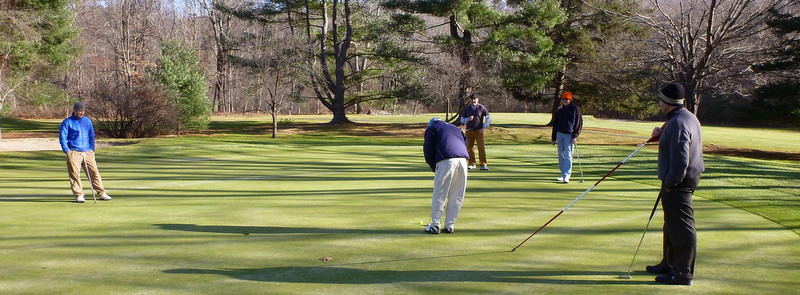
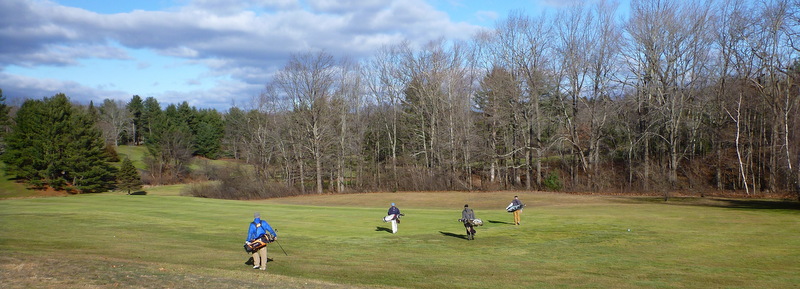
Tony and D.O., Royal Aberdeen Golf Club, Scotland, May, 2008.
Tony, who is a member of my Sunday Morning Group, lives in Atlanta for almost half the year. His golf buddies there are smarter, richer, and better-looking than his S.M.G. friends, and they hit the ball farther and have better short games. I’ve met several of them, though, and they’re not as bad as that makes them sound. They haven’t invented as many golf games as we have, but they do occasionally come up with something interesting, including a best-ball game that Tony told us about recently (by email, since he’s still down there). We played it Saturday, and decided to name it after him.
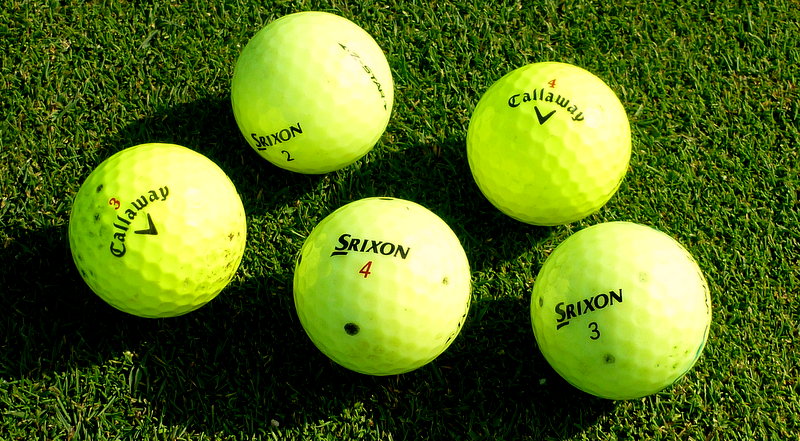
To play T-Bone (as we call both him and it), you need a group that’s evenly divisible into threesomes, foursomes, or fivesomes. Each group counts one best ball on the first six holes, two on the second, and three on the third. On Saturday, we had ten guys. We were going to pick two teams randomly, by pulling balls out of my hat, but once the balls were in the hat I noticed that there were five white ones and five yellow ones, so we just went by color. I was on the yellow team, and if you know anything about yellow balls you know that, technically, we had an overwhelming advantage. Somehow, though, we lost by six shots.
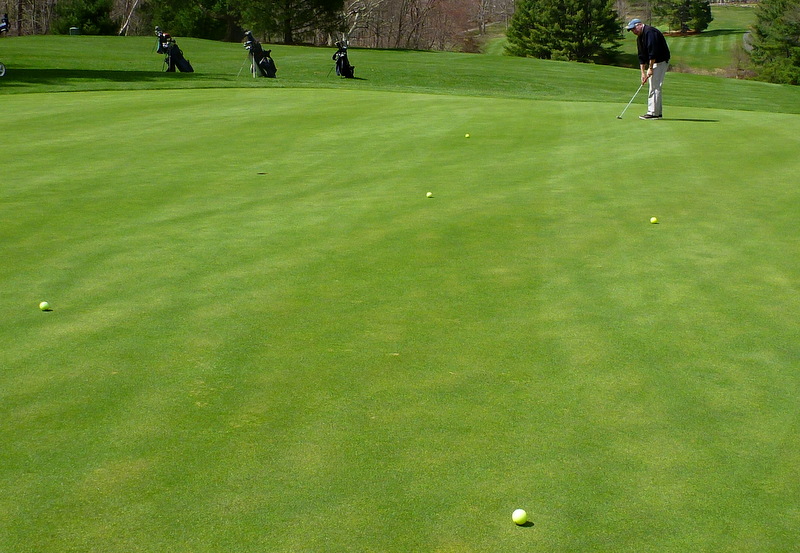
Five yellow balls plus Hacker (real name), eighth green.
Even when you have five guys on your team, counting three balls puts serious pressure on slicers, hookers, shankers, yippers, dubbers, flubbers, and choppers—in other words, on pretty much everyone. In an earlier test round, on Thursday, we tried T-Bone with two threesomes, and the trailing group came very close to making up a ten-shot deficit on the final six holes. There was quite a lot of pressure, too, because by that point we were all playing together, as a sixsome, on account of being stuck behind a slow group.
On Sunday, we played what might be thought of as modified T-Bone. We had eighteen guys, so we divided into six threesomes. The Committee realized that counting all three balls for the final third of the round would be too brutal and time-consuming, especially early in the season, so we decided to count two best balls on the first seventeen holes and all three on the eighteenth, which was also the Money Hole. That was brutal enough.
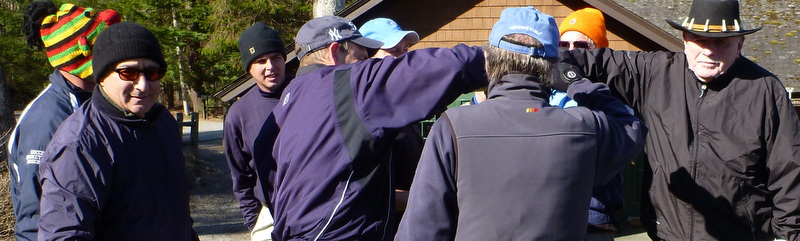
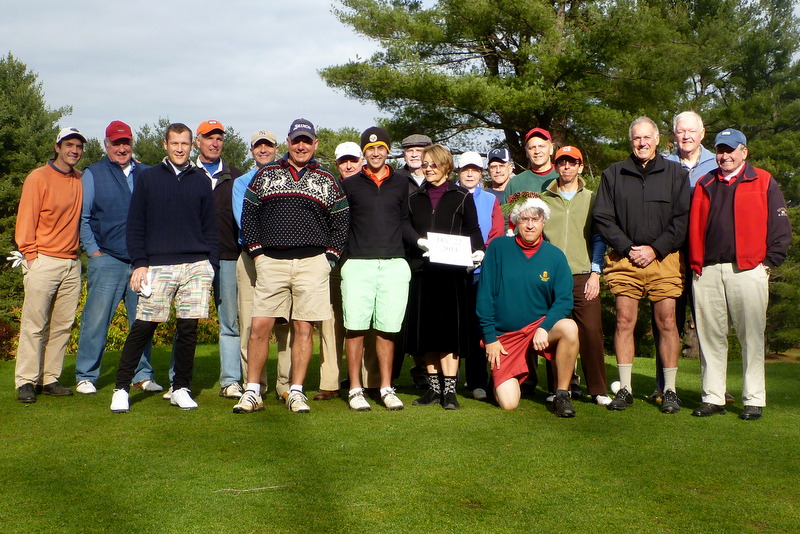
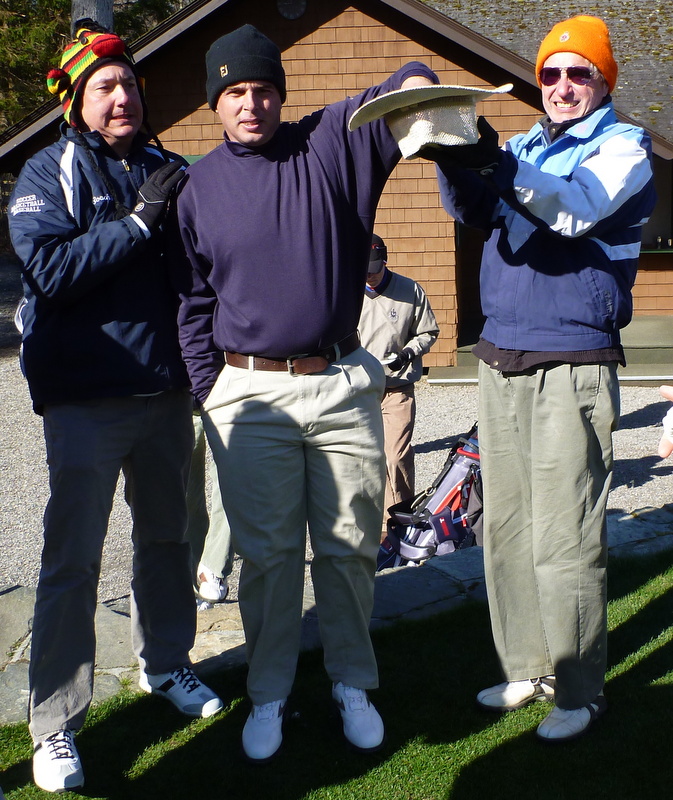
On Sundays, we pick teams by drawing numbered poker chips instead of balls—like this:
The guy in the middle is Corey, our pro. We’ve decided to call him a plus-2. Everybody gets excited when Corey plays, because we feel like we’re getting extra shots, but the advantage is an illusion because Corey, unlike the rest of us, can reliably play to his handicap, even when we have the kind of cold, windy weather that made Tony buy a place in Atlanta, as we did on Sunday.
It was a good day, though, as always. My team came in not-last, and Schoonie (whose hat Corey has his hand in in the photo above) brought lunch (although he forgot cheese for the cheeseburgers).
When we tried T-Bone for the first time, on Thursday, we shared the course with a nine-hole high-school tri-match. One of the teams was the boys’ varsity team from a boarding school in our town. The No. 2 player on that team is a girl (see photo below). She doesn’t hit the ball as far as Corey or Tony’s Atlanta friends, but she does hit it farther than any of us.They won, of course.
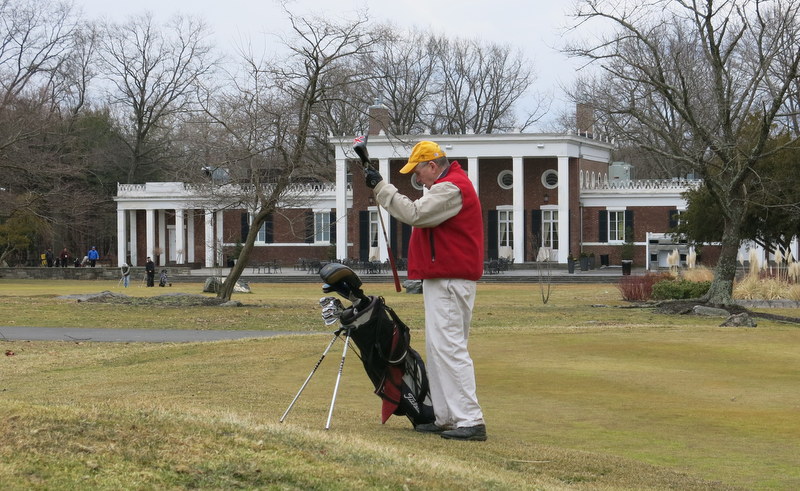
Hacker, Pelham Bay Golf Course, Bronx, New York, March 1, 2013.
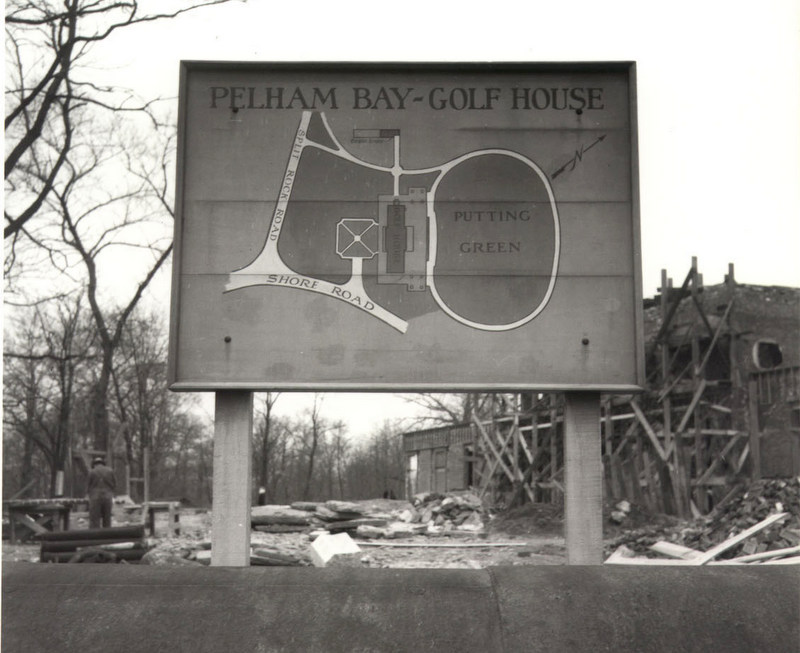
Hacker (real name), Rick, and I played in Pelham Bay Park, in the Bronx, on Friday. There are two golf courses, both owned by the City of New York—Pelham Bay and Split Rock—and they share a clubhouse, which you can see in the background in the photo above. It was built in 1936, and it has a cobblestoned driveway and front courtyard, and it has neoclassical columns made of white Tuckahoe marble. Here’s what the building looked like when it was under construction (beyond the sign):
Pelham Bay clubhouse, under construction, 1936.
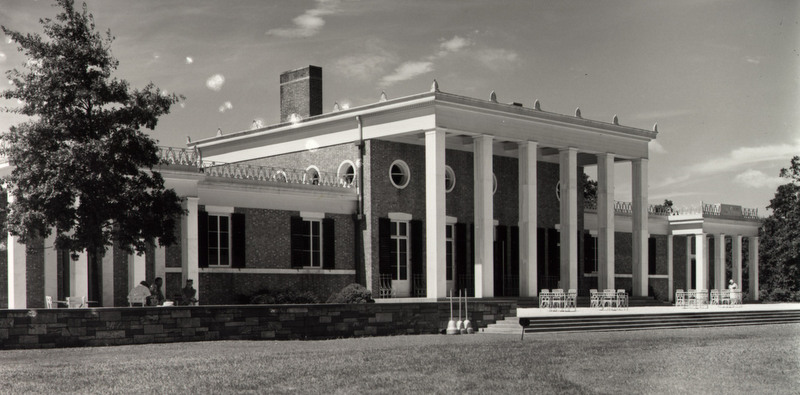
And here’s what it looked like when it was finished:
Pelham Bay clubhouse, 1930s.
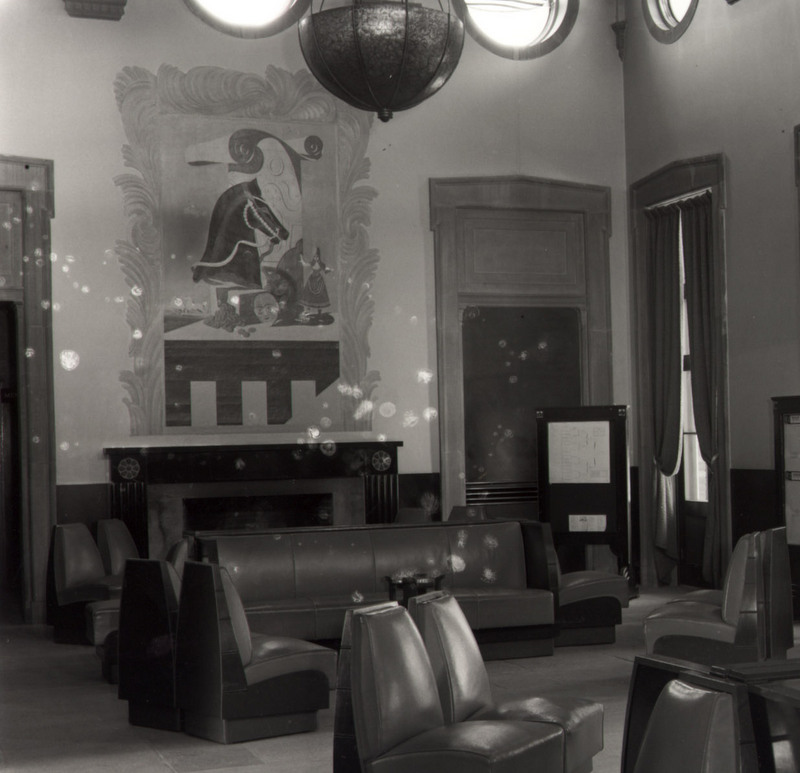
The first time my friends and I played Pelham and Split Rock, in 2004, the clubhouse was a mess. Glass was missing from many windows, and the front door had a hole that was big enough for rats to walk through on their hind legs. The Parks Department had bolted cheap outdoor floodlights to a pair of hemispherical hammered-bronze light fixtures in the Club Room, and it had installed an institutional drinking fountain in front of one of two basalt-and-marble fireplaces. The building was no longer heated, if it ever had been, and on one frosty winter morning we saw piles of construction debris burning in both fireplaces—Irish guys in front of one, Korean guys in front of the other. Here’s what the Club Room looked like in the 1930s:
Club Room, 1930s. The Parks Department later bolted flood lights to the Art Deco light fixture at the top of the picture, and installed a drinking fountain in front of the fireplace.
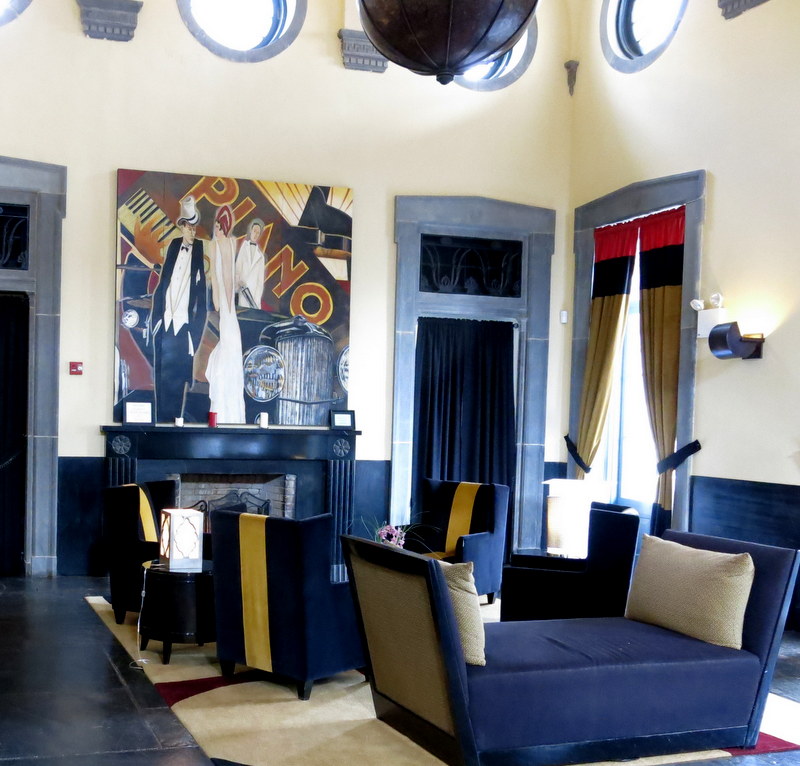
A year or two after we first played there, American Golf, which operates both courses on a twenty-year lease from the city, spent millions to restore the clubhouse. The architect was Page Ayres Cowley, and she and her colleagues did an extraordinary job. Here’s what the Club Room looked like on Friday:
Club Room, 2013. The floodlights have been removed from the hammered-bronze light fixtures. Why don’t you quit fooling around, and rent the clubhouse for your daughter’s wedding reception?
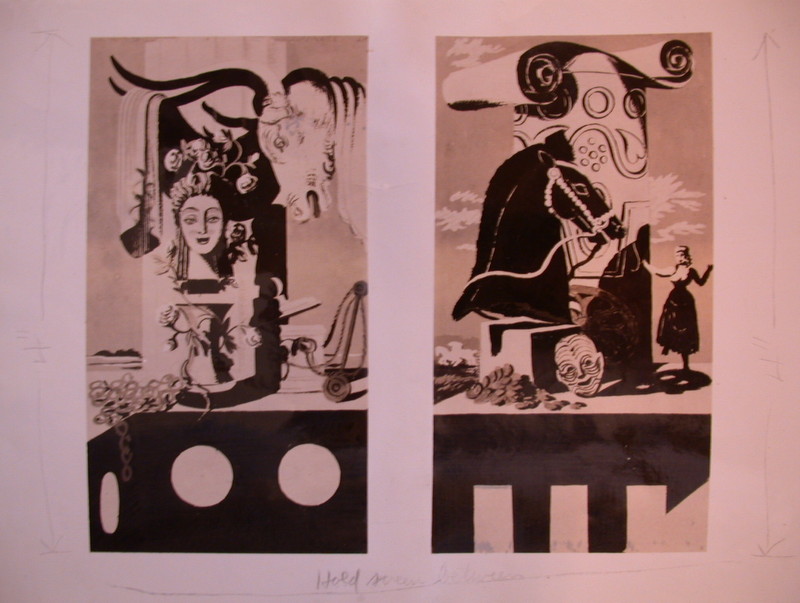
When the Pelham clubhouse was built, the artist Allen Saalburg created a Surrealist mural for the wall above each mantle. (Saalburg was a friend of Dorothy Parker, S.J. Perelman, Robert Benchley, and other early New Yorker contributors.) His murals—one of which is visible in the 1930s Club Room photograph—were still there when my friends and I first played the courses, but today the spaces they occupied are filled by a pair of hokey recent paintings, which depict what are supposed to be period scenes. The murals, Cowley told me, haven’t been destroyed, unlike similar ones that Saalburg painted, at around the same time, for the restaurant Tavern on the Green. But they need significant restoration work before they can go back up. Here is one of Saalburg’s sketches for the murals:
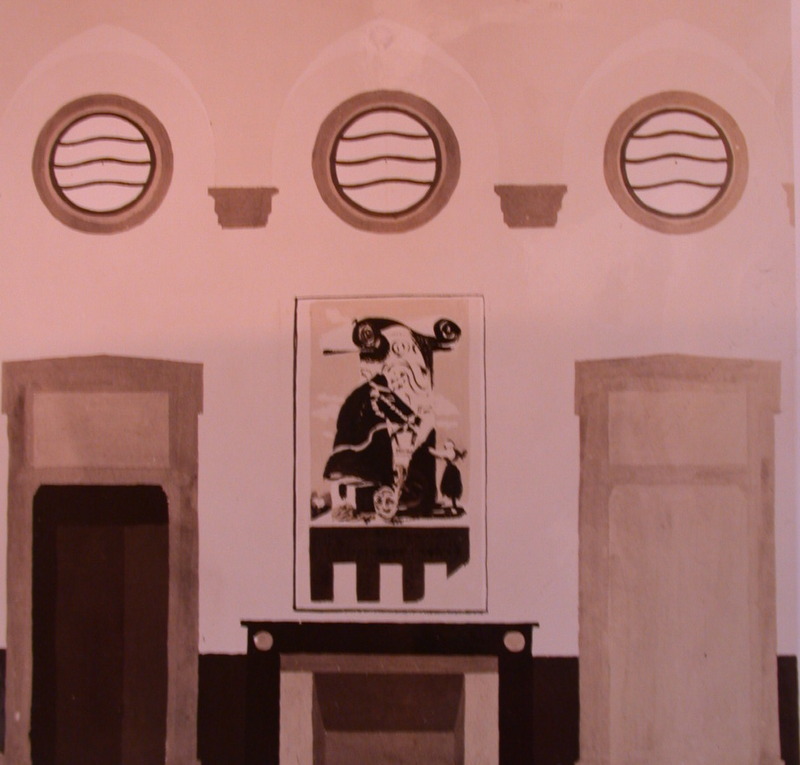
There’s not a lot of golf iconography in there, at least as far as I can see, but I hope somebody rich steps up and pays for their restoration. (Hey, Donald Trump!) And here’s how Saalburg visualized the fireplace wall you can see in the photos above:
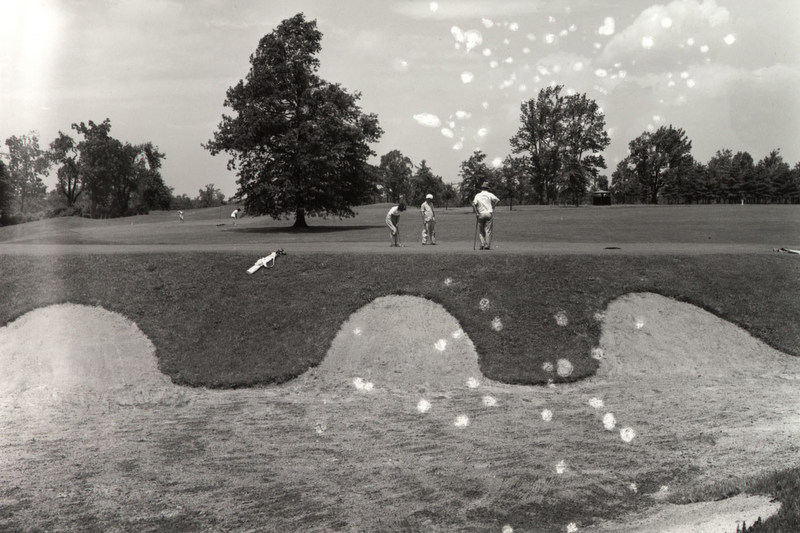
The round windows, and their wavy muntins, are still there—and they have glass in them now. Cowley told me she thinks some of the original bunkers on the course may have been designed to echo the shape of the windows, or vice versa. Here’s one of them, from the 1930s:
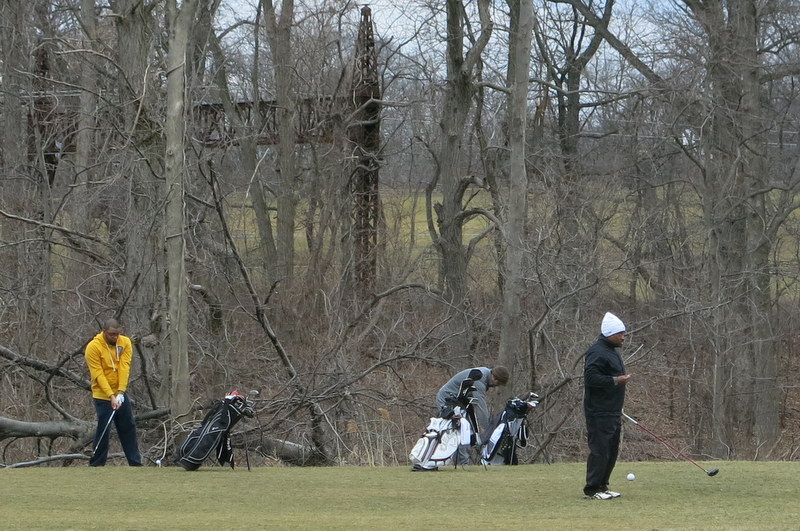
Maybe so. Anyway, Hacker, Rick, and I arrived at 10:30, and teed off almost immediately. (My greens fee was $39, walking; theirs, because they’re seniors, was $20.) There were pretty many other golfers, although we weren’t held up too seriously. We played skins and Ball Marker Stymies, and we finished in less than four hours. These guys were teeing off on the first hole as we putted out on the ninth:
The big rusty thing you see in the woods beyond them is part of a commuter rail line, which separates the two courses. And the grass you see through the trees is the eighteenth hole at Split Rock, which was closed—probably because it has more trees and takes longer to dry out than Pelham Bay does. I got home at 4:30 and took the dog for a nice long walk.
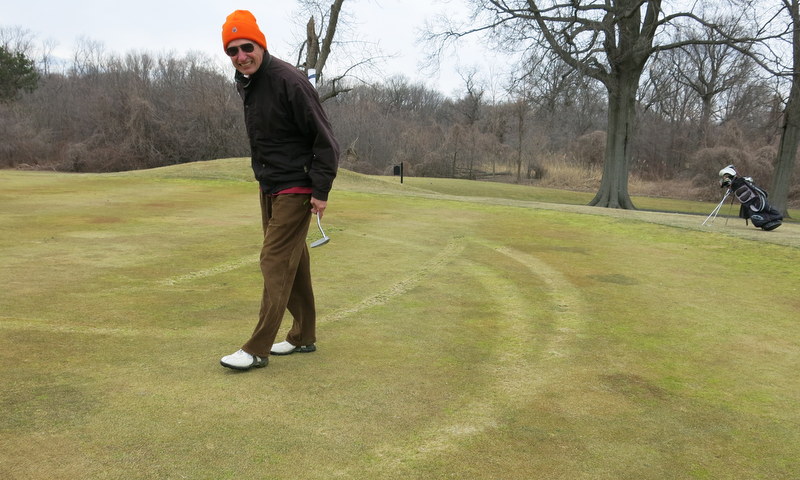
Some moron re-contoured several greens at Pelham by driving an R.V. over them. This one didn’t look too bad.
The blizzard that was supposed to pummel New England this weekend was a bust, at least as far as my town is concerned. We had a soft drizzle on Sunday morning, but that was as close as we came to getting buried under two feet of snow. The storm was still in the forecast when my friends and I made our weekend plans, though, so I ended up spending the day paying bills, doing the crossword, and obsessively touching up some old photographs that I borrowed from my mother last week, in Kansas City. The guy in the photograph above is my grandfather, in 1891, at the age of three. He never played golf, but he did join a country club, eventually. That’s the only connection I can think of. I like the picture, though.
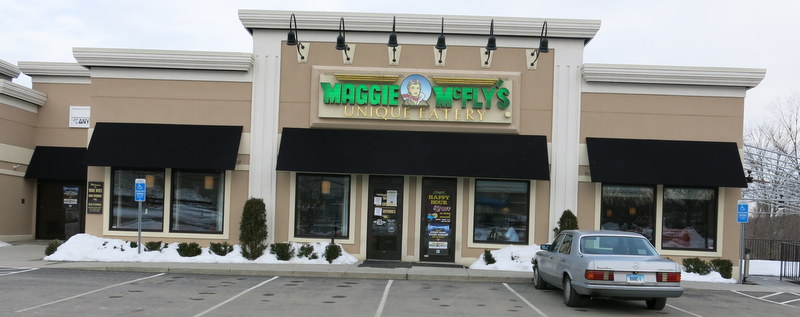
This doesn’t look like a golf course, but it is one. I don’t know who that fancy car belongs to. Some guy with head covers on his irons, probably.
Two weeks ago, Hacker (real name) reserved one of the three simulators at Maggie McFly’s, a restaurant and bar not far from where we live. We first played there three winters ago, when snow covered the ground for months and we couldn’t find anyplace to play on grass. Since then, the simulators have become so popular that the only tee time we could get was for Wednesday afternoon.
Simulator technology has improved tremendously since the first time I played indoors, in the early 1990s. As always, you hit shots toward a picture on a screen, and a computer takes over once the ball is in the air. What has changed is the sophistication of the imagery and the accuracy with which the sensors pick up your ball’s velocity, trajectory, and spin. The machine we played was manufactured by a company called aboutGolf and is endorsed by the PGA Tour. It’s what you see on the Golf Channel.
That’s Rick, getting ready to hit a lob over a bunker. It’s a shot he’s good at because–unfairly, some would say–he practices.
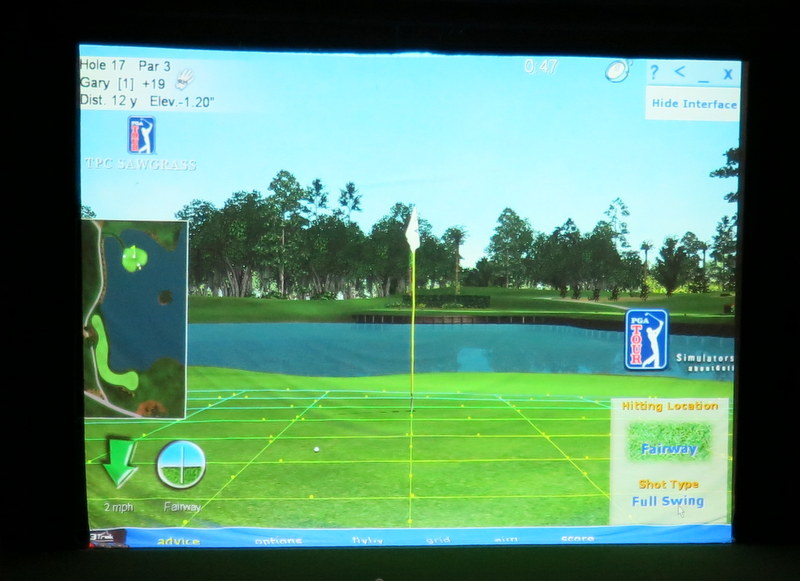
In the past, we’ve played Pebble Beach, Spyglass Hill, and the Old Course at St. Andrews, among other courses you may have heard of. This time we played the TPC at Sawgrass. Here’s what the famous 17th hole looks like when you’re standing on the fringe at the back of the green, looking toward the tee. I had a birdie putt, which I just missed:
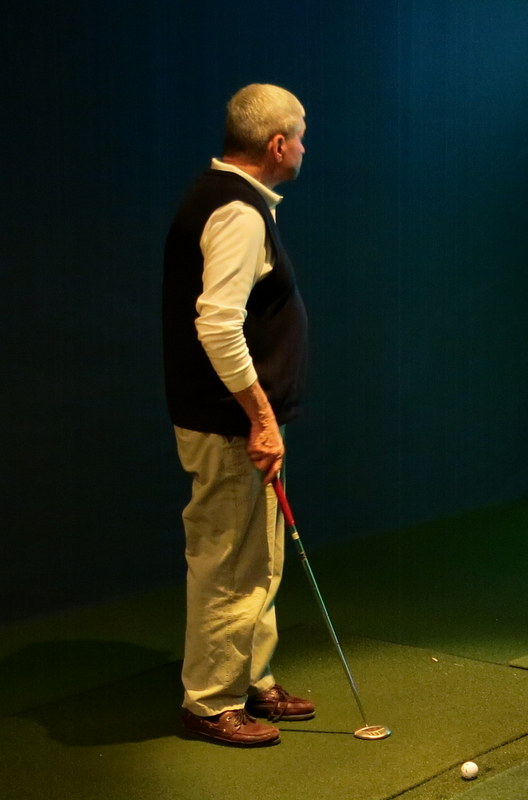
Simulator putting takes some getting used to: to read the breaks, you have to analyze the movements of dozens of virtual marbles rolling around on a projected grid that looks like a college-textbook illustration of the curvature of space-time. Once you get used to it, though, you begin to wish your home course had virtual marbles, too. Here’s Hacker—who was my partner—reading one of the many critical putts he drained:
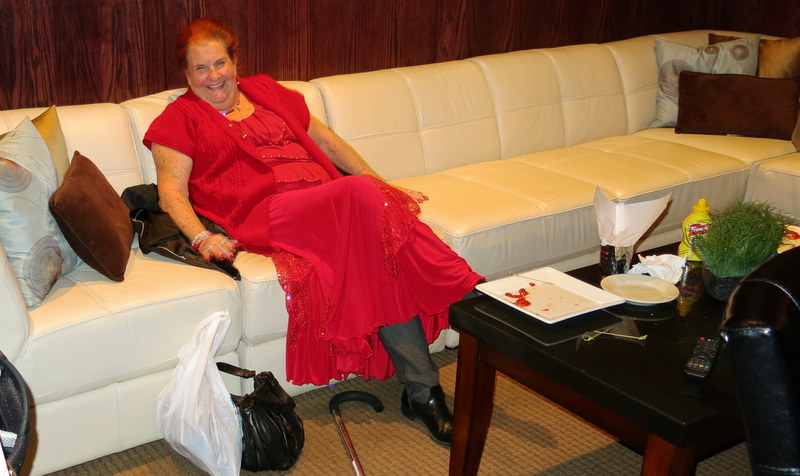
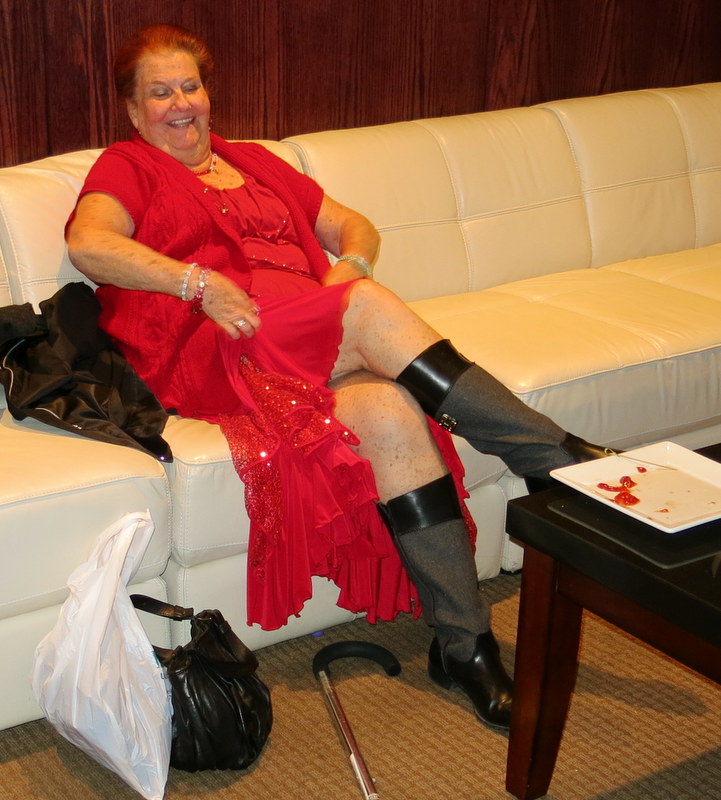
The simulators at Maggie McFly’s are great, because they’re in wood-paneled rooms that look like something you’d find in a fancy clubhouse. A waiter brought us beers and cheeseburgers, and there were four guys in the room next to ours who looked almost exactly like us, and if we had been able to figure out how to turn on the TV we would have been able to watch the football game. And about an hour into our round a woman with a cane walked in and sat down on our couch: our first gallery ever!
Her name is Linda, and she’s seventy-two years old. She said there was going to be karaoke at Maggie McFly’s that night, a favorite of hers, but that she would probably go home for a nap at some point, rather than hanging around for eight hours. Her husband, who died fifteen years ago, was an engineer. He worked on the Manhattan Project (though not on the bomb part) and on the Suez Canal, and he was a champion skeet shooter.
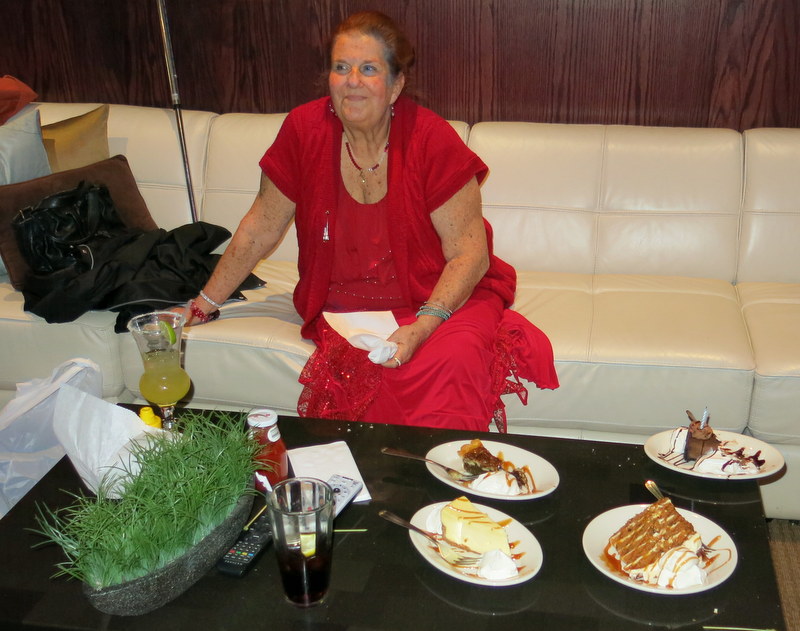
She said she had played a little golf when she was younger but hadn’t swung a club since sometime in the nineteen-seventies. She was very interested in how the simulator worked, and when we tried to explain it we sounded the way I did when my son, at the age of three or four, asked me what makes the car go. At one point, the manager came in to tell her to beat it, but we had already bought her a drink so we told him to beat it. I happened to mention that the following day was going to be my birthday, and when we weren’t paying attention she ordered dessert for all four of us. I got to pick the one I wanted, and then a waitress put a candle in it and lit it.
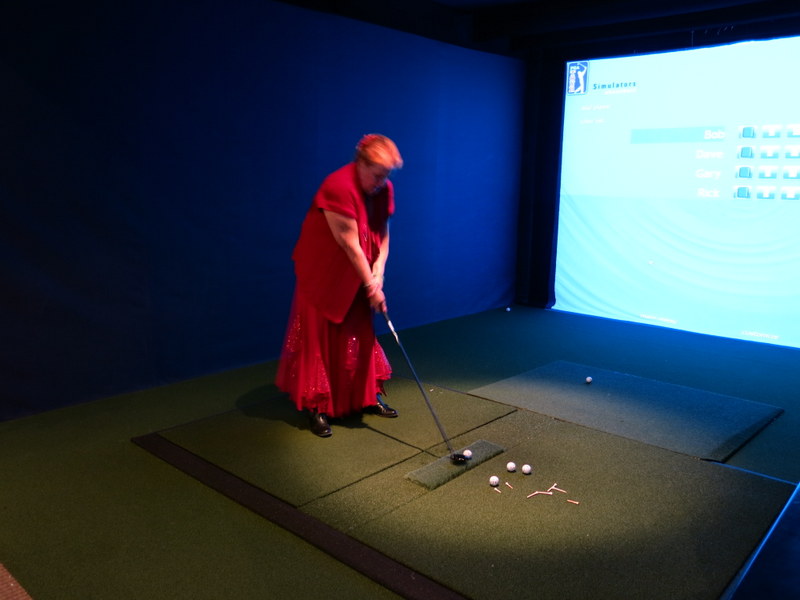
Linda wanted to try the simulator, so as soon as Hacker and I had wiped out Rick and Gary we gave her Hacker’s three-wood and let her rip a few. She went right under the first one, but after that she nailed it, repeatedly:
The only problem with simulator golf is that it’s the opposite of exercise, because between shots you don’t walk anywhere, or even climb in and out of a cart; you just plop down on the couch and steal a few more of Gary’s french fries.
My brother, John, used to play in a winter simulator league at a health club in Brooklyn. He said that it was embarrassing to stand around drinking beer and eating Doritos while beautiful women in butt-floss leotards trotted back and forth between the racquetball courts and the Nautilus machines. He suggested that the club install a treadmill next to the golf simulators, so that you could pick up your bag and pretend to walk to your ball while you waited for your turn to hit. That way, at least, you’d break a sweat.
This may be a direct reference to an early customer–a cop!–who took a whiz in a potted plant and was banished for life.
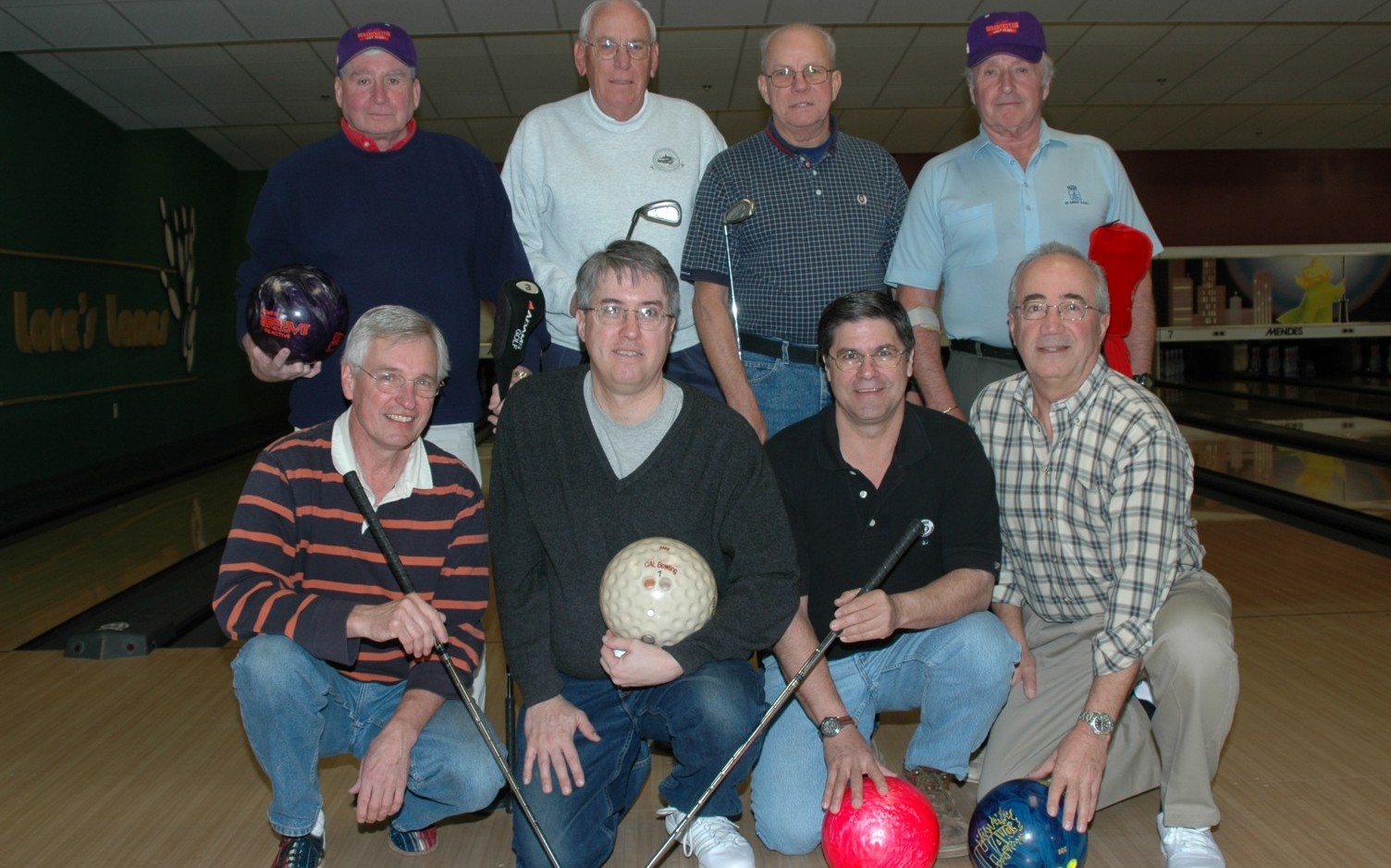
Eight years ago, my regular golf buddies and I decided that, instead of moping around all winter, as usual, we would go bowling. Eight guys showed up the first Sunday. Ferris, it turned out, had bowled in high school, and Billy had been a member of a hippie team in college. Nick and Gene already owned their own balls and shoes. Ray brought his old ball but couldn’t use it because his fingers no longer fit into the holes.
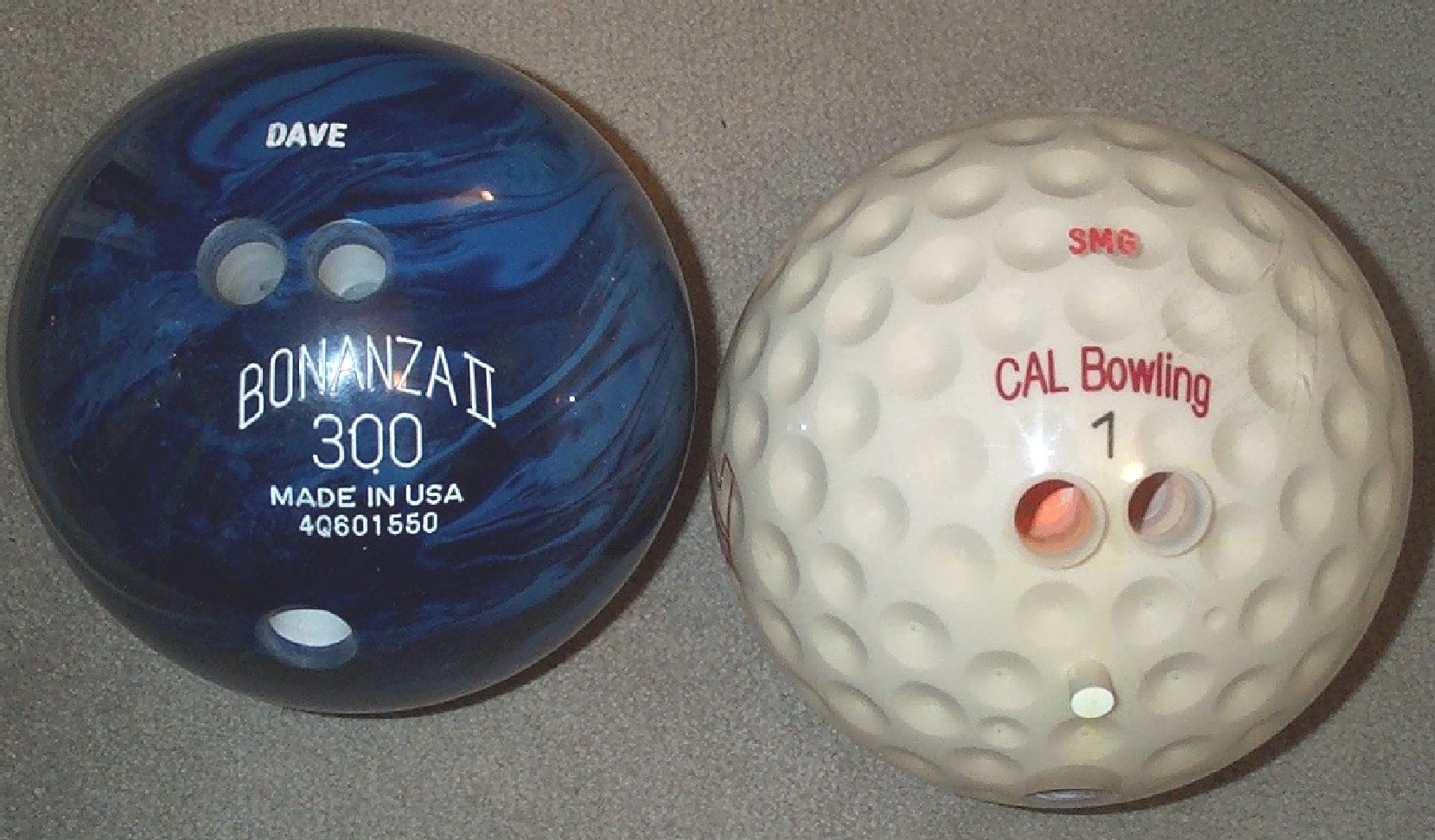
As soon as I got home, I went online and ordered bowling shoes, a bowling instruction book, and a bowling ball that looks like a giant golf ball. Two weeks later, I bought a second ball (with more spin) and a two-ball bag, to which I attached my golf-club bag tag. I had my name engraved on one of the balls, and “SMG” (for Sunday Morning Group) engraved on the other.
Taking up bowling was like discovering a previously unsuspected continent of things that you can buy. (Did you know that good bowling shoes have different right and left soles—one to grip and one to slide?) We transferred over all our regular junk, including skins, negative skins, nassaus, presses, and the money hole. We bowled in golf clothes and golf hats. We referred to frames as holes and to games as rounds. We used golf towels to wipe lane oil from our balls. I even managed to preserve most of my swing flaws: I came over the top in bowling, too.
I created an Excel spreadsheet that automatically updated everybody’s average and handicap whenever I entered new scores. In one of our earliest outings, after shooting a depressingly characteristic 82, I had six consecutive strikes, a spare, another strike, and two nines, for 226. Hacker (real name) said, “Aren’t you kind of sad that you’ve already shot the best round you’ll ever shoot?”
A bowling alley is one of the few sporting venues where a golfer can feel almost like an athlete. There were so many smokers at one of the ones we went to that even the parking lot smelled like cigarettes. Most of the regulars, who gave us dirty looks when we collapsed in hysterics over somebody’s double gutter ball, had very low centers of gravity—they were shaped like bowling pins—and their bowling bags had wheels on them. The specialty at the snack counter was panzarotti, which is made by combining all the things your doctor tells you never to eat and deep-frying them.
Bowling is fun, but it’s just golf methadone. We bowled for two winters, but then winters around here started seeming more like late fall or early spring. We found several open golf courses within an hour or two of where we live, and they made us forget all about our fancy bowling shoes. This winter, though, we’ve had a couple of big snowstorms, including a huge one this past weekend. We’re probably not going to see grass around here again for a while, even if it doesn’t snow this coming weekend, the way it’s supposed to. So who knows?
Doug, Gary, Mike A., Goodwin Park Golf Course, Hartford, Connecticut, Super Sunday, February 5, 2012.
On Super Sunday XLVI, last year, my golf buddies and I successfully predicted the outcome of that night’s football game by playing a golf match on the municipal course at Goodwin Park, in Hartford. The course was ideally situated for our match, because it’s pretty close to halfway between New York and Boston. And the park was designed, in the early nineteen hundreds, by the sons of Frederick Law Olmsted. Olmsted Sr. designed Central Park, in Manhattan, but lived in a suburb of Boston. (His sons’ firm, which by then was called Olmsted Bros., also created the original landscaping and real-estate plan for Augusta National Golf Club.)
Goodwin Park is somewhat flat and featureless, and—despite the enticing photograph on its website—there are no snow-capped mountains in the distance. But the areas around the greens were interesting, and playing cost less than a buck a hole. Also, we saw an aquatic mammal swimming across the pond you see in the lower right-hand cover of the photo above. Here’s the mammal:
Probably just a muskrat–rather than a beaver, as we originally hoped.
After the round, Hacker (real name) spoke the phrase “bacon cheeseburger” into the voice-search thing on his smartphone, and we ended up at a sports bar called Damon’s Tavern, which is the greatest sports bar we’ve ever been to because it has flat-screen TVs mounted above the urinals in the men’s room.
If we had thought to bring sleeping bags, we could have taken our naps at Damon’s, and hung on to our table for the football game that night. Instead, we drove home and slept in our own beds until just before kickoff. The game was slightly anticlimactic, however, because we already knew that the Giants were going to win.
Quite a while ago, Tom Reynolds, a reader in Atlanta, asked me to suggest a packing list for a golf trip to Ireland. I said I would, then forgot all about it, and recently he asked again. So here it is.
This packing list is the result of two and a half decades of thoughtful experimentation. In making it, I’ve assumed that no spouse or health-department official will be in your group, and that you will buy at least one souvenir golf shirt, one souvenir golf sweater, and one souvenir golf hat while you’re abroad. I’ve also assumed that you are not planning to do anything rash, like meeting a client or going to a play. My strong preference with rain pants (which are also useful as wind pants) is to wear them as pants, if possible, rather than over pants. If the weather is nippy, I wear them over long johns.
The reason for minimalist packing is not to avoid airline luggage charges; the reason is to reduce the tonnage of the gear you have to lug from place to place, and to make the most efficient use of the storage space in whatever vehicle you’re traveling in. Packing light also leaves space for all the overpriced golf stuff that you are almost certainly going to buy and lug home.
Because linksland weather is highly unpredictable but within a relatively narrow range—I’ve played in shirtsleeves in Northern Ireland in November and been hailed on in Scotland in June—my list doesn’t change a whole lot from month to month. Think in terms of layers, and be prepared to allow time for wet items to dry out—especially shoes. Mike B. took his plug-in ski-boot driers on our most recent trip to Ireland. He never needed them, because our shoes never really got wet, but taking them wasn’t a terrible idea. On a golf trip to eastern Ireland twenty years ago, I took two rainsuits and needed them both.
It’s possible to pack more than this, of course. It’s also possible to pack less. My friend Tony gets by with just his rain pants and one pair of chef pants, and some people believe that he never changes his shirt. A few years ago, Golf Digest sent me to play all fourteen courses where the British Open has ever been held, and I realized toward the end of the trip, which lasted two weeks, that although I’d brought two pairs of pants I could have gotten by with one. The great thing about microfiber is that you can launder it with a hotel wash cloth, even if you’ve gotten chocolate on it. I recommend black.
Tony in chef pants, North Berwick, Scotland, May, 2008.
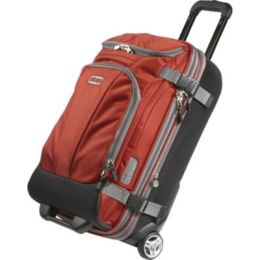
On my first golf trip to the British Isles, twenty years ago, I took a full-size suitcase. Now I take just a carry-on bag: a Mother Lode TLS Mini 21-inch rolling duffel, by eBags, which is currently selling for $190, shipping included (see photo at the top of this post). This is my favorite suitcase ever, even for non-golf trips. No matter what kind of suitcase you use, I recommend buying a selection of eBags Packing Cubes, which are soft, box-shaped modules that simplify intra-suitcase organization and make it easy to use your golf bag’s travel case for overflow packing.
Here’s what I take:
In the carry-on bag:
1 pair dark polyester microfiber pants (and a second pair worn on the plane—and I recommend black for both, because they never look dirty and you can remove stains, even chocolate, with a hotel wash cloth)
1 golf shirt (and a second one worn on the plane—and in cooler months I would make one or both of these shirts long-sleeved)
1 sweater (worn or packed, depending on the weather
1 pair of Under Armour-type long johns
1 long-sleeve Under Armour-type undershirt or turtleneck
1 tee shirt (to sleep in and serve in a pinch as an extra layer)
1 pair of “house pants”—fleece pants or nylon hiking pants or something similar (for lounging around, and for emergency duty under rain pants if the weather turns really foul, and for wearing on the trip home)
1 pair of shorts, maybe (something I’d never thought about before 2016, when sunburn was a bigger threat than rain in western Ireland)
Lots of cotton handkerchiefs (my new favorite golf accessory, useful for nose-wiping during wet, cold, windy, or allergen-dense rounds)
As many pairs of underpants and (wool) socks as I can cram into the remaining space
In the golf bag or golf-bag travel case (along with my golf clubs):
2 pairs of waterproof golf shoes
1 rain suit (the jacket of which, in combination with an undershirt, shirt, sweater, vest, etc., should be plenty of cold-weather protection, even for winter)
2 regular golf gloves and 2 pairs of rain gloves
1 Seattle Sombrero (or other truly good rain hat)
1 regular golf hat
1 knit cap
1 super-lightweight down vest, in its little stuff sack (weighs nothing, and is easy to cram into a golf bag; mine is by Uniqlo and is a recent addition to my packing)
As many golf balls as you think you’re going to need, because they’re cheaper here (a reasonable number is two balls a round; a couple of guys lost more, but some lost almost none)
A full box of Band-Aid or Compeed “blister cushions.” You won’t need them if you’re careful about the golf shoes you take, but if you have them in your bag you’ll be a hero to someone on your trip
Toiletry-type crap (if you put your toiletry kit in your checked bag you won’t need to worry about decanting your gels and liquids into tiny bottles and setting them aside in a Ziploc bag)
Other stuff:
1 or 2 twenty-four-inch bungee cords, for strapping your golf bag onto a pushcart (known abroad as a trolley), to keep the bag from falling off when you drag it into the dunes
1 water bottle (because on-course water isn’t common outside the United States; you can fill your bottle each day in your hotel room or in a golf-club locker room)
1 UK-and-Ireland-type plug adapter. Household current is 230 volts, but all your electronics will run on that with just the plug adapter—no need for a voltage converter. If all you’re going to need to charge is your phone, you can probably find a 110-volt shaver outlet (for an American-type plug) in the bathroom of your hotel room
1 mini-power strip (if, like me, you have a lot of stuff to plug in—mine’s made by Belkin—because no hotel room on earth has enough outlets, especially in other countries)
1 sleep mask (for creating darkness where there is none)
Earplugs (doubly useful if the locals are holding a Dallas-themed “Oil Barons’ Ball” in the main dining room—as happened to me in England a few years ago)
Travel clothes:
If you are going straight from the plane to a golf course—and that’s what you should be planning to do, in my opinion—you should wear golf clothes on the plane. For the trip home, it’s nice to have clean stuff. In my case, I flew home in a bought shirt, a bought sweater, and a pair of lightweight nylon pants that I hadn’t worn during golf.
If your golf shoes have nubs on the soles instead of spikes, you probably don’t need any other shoes—although you may be required to strip down to your socks in some parts of some golf clubs. On a recent trip to Ireland, I took a pair of “après-golf” shoes—which were actually just non-waterproof golf shoes—but wore them only a couple of times, because my two pairs of “working” golf shoes were just as comfortable and never really got wet. Tim brought two pairs of golf shoes plus a pair of Merrell Jungle Mocs, which he wore on the plane, on the bus, and when we weren’t playing golf—an idea I intend to steal next time
If you prefer to receive your packing instructions in video form, you can do so here:
For many years, I’ve accessorized my rain paints with farmer-type suspenders, my first pair of which I ordered from the Vermont Country Store. (I now use a different kind, which you can order here.) Suspenders eliminate the main problem of rain paints, which is that they creep down every time you put wet hands into the pockets. I also own, and sometimes use, a pair of Velcro bicycle clips, which are handy if the legs of your rain pants are so long they drag on the ground, as many are.
Vermont Country Store suspenders with rain pants, Scotland, 2004.
On a golf trip to England in 2010, my friends and I had to take sports coats so that we could eat dinner in the clubhouse at Royal Lytham & St. Annes. Hacker (real name) took a crummy old one, intending to abandon it there—a plan I foiled by spotting it in a closet on the day we left and returning it to him at the airport. But the concept is brilliant: clothes you can wear to extinction, then leave behind.
My bedroom in the Dormy House at Royal Lytham & St. Annes, May, 2010. My sports coat is in that pile somewhere.
On our trip to Scotland and Ireland in 2014, Peter A. brought many pairs of super-cheap socks, and threw away each pair after a single use. This seemed smart in the abstract, but he ended up being the only person on the trip who got blisters. For this most recent trip, he brought more expensive throwaway socks (roughly a dollar a pair versus roughly fifteen cents) and didn’t have a problem. My personal preference is to pack the best wool socks I feel I can afford, and lots of them.
I’ve always thought it was crazy to take shorts on a golf trip to the U.K. or Ireland, because indigenous golfers hardly ever wear them and some golf clubs have semi-ridiculous rules about them—like Hillside, in England, which allows shorts only if they’re worn with knee-height socks. (Dress codes abroad are kind of unpredictable. In 2016, the starter at Lahinch asked Matt to roll down the cuffs of his pants, which he had turned up maybe an inch, but let a local kid tee off in surfer shorts and an untucked tee shirt.)
It’s possible to pack more than this, of course. It’s also possible to pack less. On a non-golf trip to Europe a few years ago, my wife surprised me by packing lighter than I did. You don’t need to plan a lot of different “looks.”
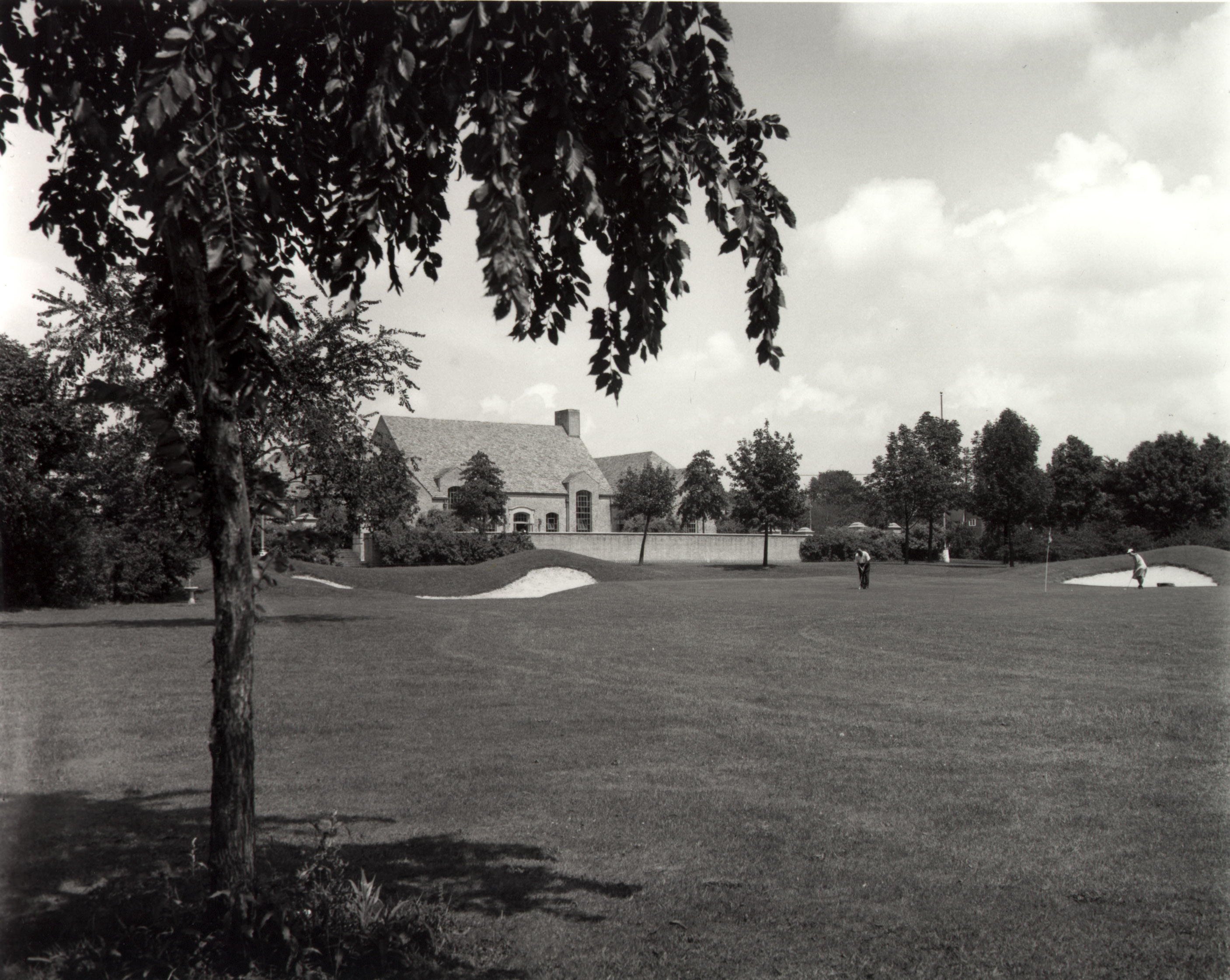
Clubhouse, Dyker Beach Golf Course, 1930s. At the right edge of the image is the old starter’s booth, near the first tee.
Dyker Beach Golf Course, where my friends and I played on New Year’s Day, was designed in the late 1890s by Thomas Bendelow and reworked in 1935 by John Van Kleek. Van Kleek was a prominent golf architect who fell on hard times after the Crash and was hired by Robert Moses to oversee a major citywide golf project, which was eventually funded by the Works Progress Administration. (Van Kleek is responsible for the three best courses inside the city limits: La Tourette, in Staten Island; Split Rock, in the Bronx; and Dyker. He also redesigned Split Rock’s sister course, Pelham Bay, in 1934.) The photo above shows Dyker’s clubhouse under construction, in the 1930s; the photo below shows it completed, not long afterward.
Clubhouse, Dyker Beach Golf Course, 1930s.
The green you see in the photo above is the second. The photo below shows what the same green and the clubhouse look like from a somewhat similar angle today. The tee on the right is the third:
Clubhouse, second green, and third tee, Dyker Beach Golf Course, 2013. The red-brick wing on the far right-hand side of the clubhouse, visible through the trees, was added a few years ago, during a major renovation. The slates on the main roof are mostly original.
On a crisp but snow-less Sunday morning in February, 2005, Hacker (real name) and I drove to Brooklyn for a bonus round at Dyker. We stopped in Westchester to buy gas and doughnuts, and as I was filling my tank I noticed a guy at another pump who was wearing golf shoes: a brother. Traffic was light, and we arrived long before our tee time. We drank coffee in Dyker’s clubhouse, most of which hadn’t been renovated since the 1930s, and ran into Terry Byrne, who was the president of the Shore View Golf Club, a group of a hundred and forty men who play most of their golf at Dyker. The club is six years older than the clubhouse. Its members include carpenters, cops, lawyers, firefighters, accountants, masons, city employees—a typical mix for a New York City golf course. (Byrne, whose parents were born in Ireland, was—and may still be—a plumbing supervisor for the New York City Housing Authority.) Shore View used to have a dark, dank, semi-secret meeting-and-card room in a back corner of the clubhouse, but it disappeared during the renovation.
Another view of the Dyker clubhouse in the 1930s. Page Ayres Cowley, the architect who designed the renovation and expansion of the building, described it to me, accurately, as “a French-inspired gentleman’s house.”
Just before nine o’clock, the starter put Hacker and me with a Manhattan structural engineer who had moved to this country from Italy twenty years before and took up golf in 2004, and a grumbling Brooklyn guy. There are linguistically distinct ancient tribes in the Kalahari Desert region whose members are known as the click-speaking people of southern Africa, and there are linguistically distinct ancient tribes in the Brooklyn region whose members could be known as the fuck-speaking people of New York—and this guy was one of those. “Where the fuck is my ball? I don’t mind losing a ball if I hit it in the fuckin’ woods, but that drive was right up the fuckin’ middle of the fuckin’ fairway. What the fuck!” We got along great, however. And two days later, Hacker and I played two more rounds in the city, at Van Cortlandt Golf Course, in the Bronx, and Clearview Park Golf Course, in Queens.
The Dyker clubhouse in the 1930s. Today, there’s a little dog park not far from the spot where the photographer was standing.
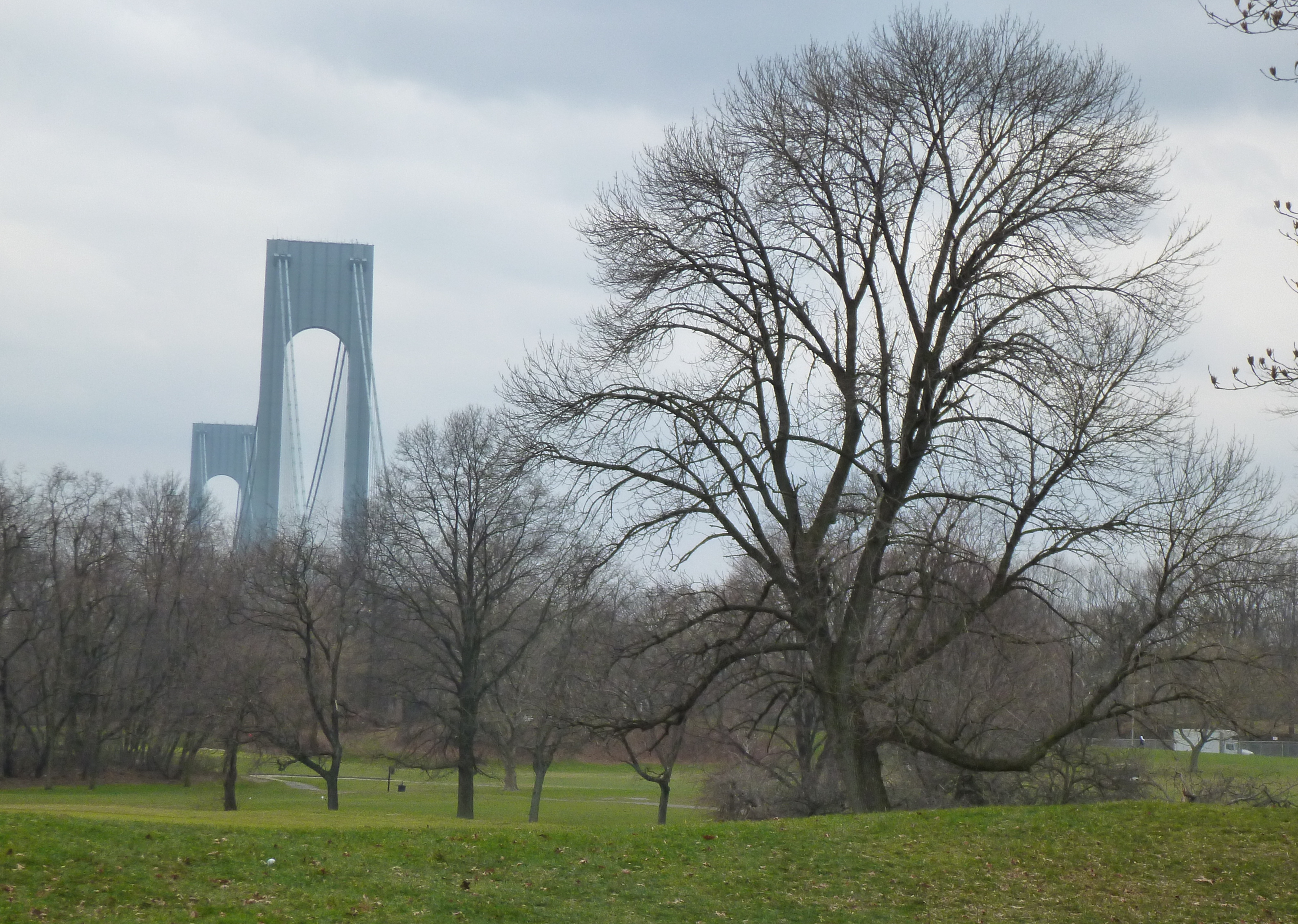
Dyker Beach Golf Course, Brooklyn, New York, January 1, 2013. That’s the Verrazano-Narrows Bridge in the background. There are good municipal golf courses on the other end of it, too (in Staten Island).
For the past six years, my friends and I have played golf on either New Year’s Day or New Year’s Eve—usually in New York City, which seldom gets much snow. On January 1, 2008, we played at Dyker Beach Golf Course, in Brooklyn. In 2009, we had to drive a couple of hours south of the city, to Galloway, New Jersey, to find a course where we could play on grass. One year, we played in the Bronx, on one of the two courses in Pelham Bay Park. In 2012, for the first time, we were able to play on our home course, which didn’t close for the season until the following day.
This year, our home course had closed on Christmas Eve Eve and Pelham Bay still had snow, so we returned to Dyker Beach. Other Gene drove us, in his wife’s car, which has millions of cool features that he doesn’t know how to use. The three guys who sat in the back seat didn’t bother to remove the dog seat cover, which was quilted and was actually sort of comfortable. We saw snow on the way down:
Rt. 7, in Connecticut, on our way to I-84.
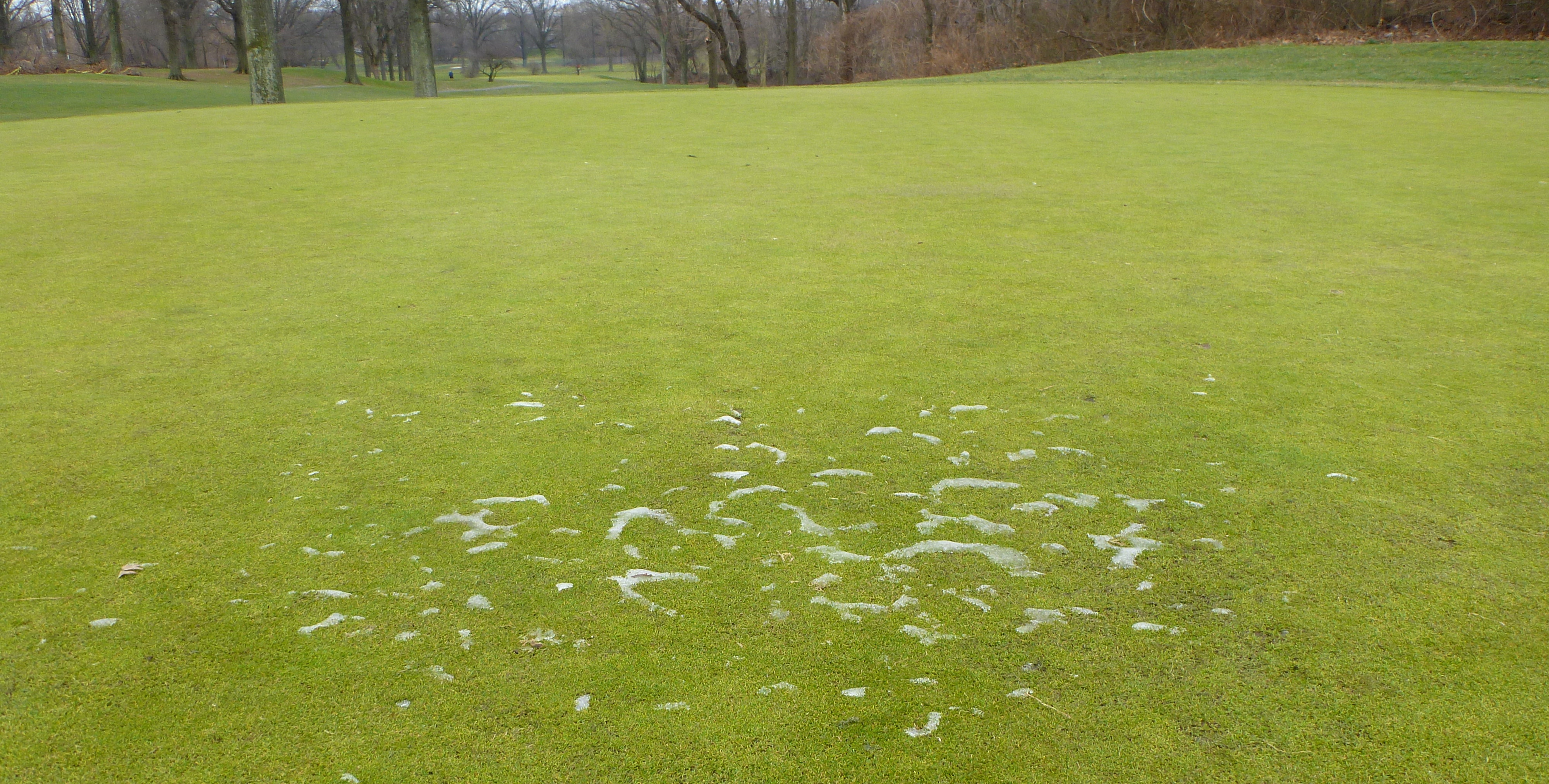
We made great time because everyone else in the tri-state area eitherwas still passed out or was trying to treat their hangover. And there was no snow at Dyker, except for this patch, on one of the greens:
The guy in the golf shop let us play as a fivesome—or, at any rate, he didn’t guess that we were planning to play as a fivesome and therefore didn’t specifically tell us not to. We saw some leftover damage from Hurricane Sandy, but it didn’t affect play:
Overall, the course was in terrific shape. Some of the grass was bright green and obviously still growing, and the greens were fast and unfrozen.
Dyker’s ninth fairway runs parallel, and quite close, to Seventh Avenue in Bay Ridge–a good reason not to park on that block. In fact, you probably shouldn’t walk on that sidewalk, or drive on that street.
Even though there were five of us, we kept pace with the single playing one hole ahead of us and stayed ahead of the single playing one hole behind us (in a cart). We finished in just under three hours.
Gene P., the night before, had warned us in an email that the forecast was for temperatures in the low teens, and he suggested that we consider rescheduling. But he must have been looking at the forecast for Alaska, because the temperature in Brooklyn never got below about 40.
Sixteenth green. We might be interested in buying one of those houses, across the street, and using it as our winter clubhouse.
We played Double Skins, with an added feature that I suddenly thought of on the third hole: Ball Marker Stymies—in which the old Stymie Rule is applied to ball markers rather than balls. That means that if somebody’s ball marker is in your line on a green you have to putt over it or around it. (And you can’t mark your ball with a hockey puck. Each marker—we decided—must be poker-chip-size or smaller.)
Stymied, on a breaking putt.
After golf, we had lunch at Pipin’s Pub, in Bay Ridge, the home of the famous Pipin Burger (bacon cheeseburger with American cheese). The fries at Pipin’s Pub need work, but we have nothing bad to say about the Pipin Burger. Our waiter took this photograph, despite making it clear that he believed he had better things to do:
Pipin’s Pub, January 1, 2013.
On New Year’s Day 2008, we had lunch at Pipin’s Pub, too—and at the same table. Here’s proof:
This isn’t the Sunday Morning Group, but it’s close. It’s a group of modern-day Druids celebrating the 2012 Winter Solstice at Stonehenge, an English archaeological site not far from the Salisbury & South Wilts Golf Club, which was founded in 1888, a year before my home club. (This photo is from the website of National Geographic.)
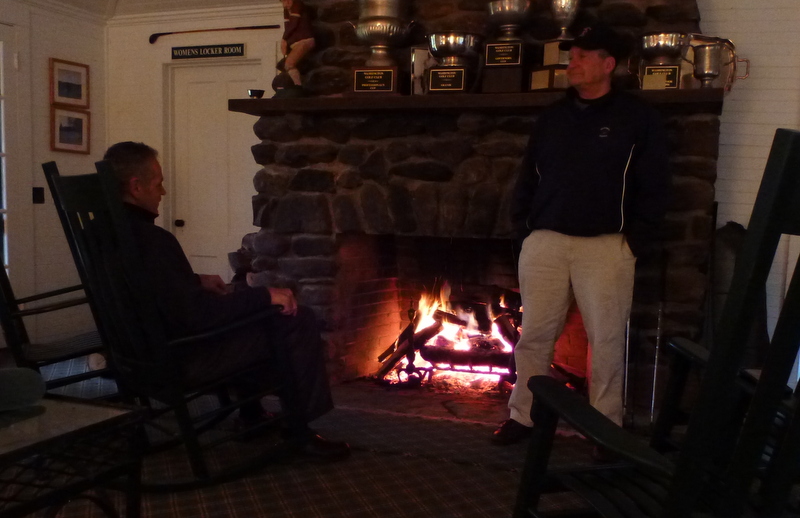
The world didn’t end on December 21, 2012, although we had so much rain during the night that I occasionally worried we were done for. The storm continued through most of the morning, and, as a consequence, just three of us showed up at 10:00 for the Sunday Morning Group’s second annual Winter Solstice Scramble and Holiday Party, With Gift Exchange. Gary, our superintendent, built a fire in the clubhouse fireplace, and he, Hacker (real name), and I sat in front of it and used our cell phones to send sarcastic emails to everyone else.
Gary and Hacker: where are Doug and Mrs. Doug, among other people?
The rain slackened after about an hour, and we could tell from Raindar that it was going to end soon. By 11:30, we had seven participants, including Mrs. Hacker, who had been delayed by a fallen tree.
We ordered four pizzas from Upper Crust Cucina, the official caterers not only of the Sunday Morning Group but also of the Men’s Member-Guest. Then we played a five-hole warm-up round with one club each while we waited for the pizzas to be delivered. (Upper Crust doesn’t deliver to anyone but us, so don’t bother asking.)
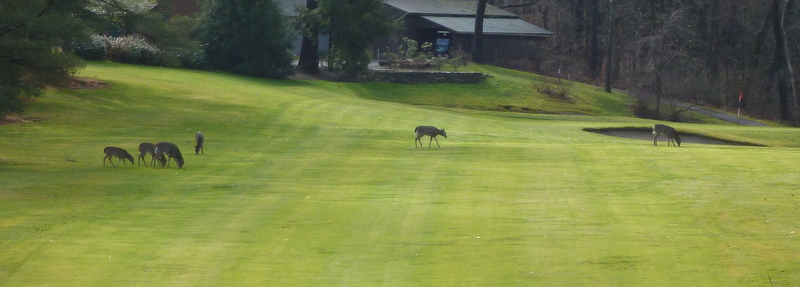
During the one-club, we saw six deer on the ninth fairway (photo below). When the pizzas arrived, we paid for them out of the Sunday Morning Group’s Slush Fund, which Hacker keeps in an envelope.
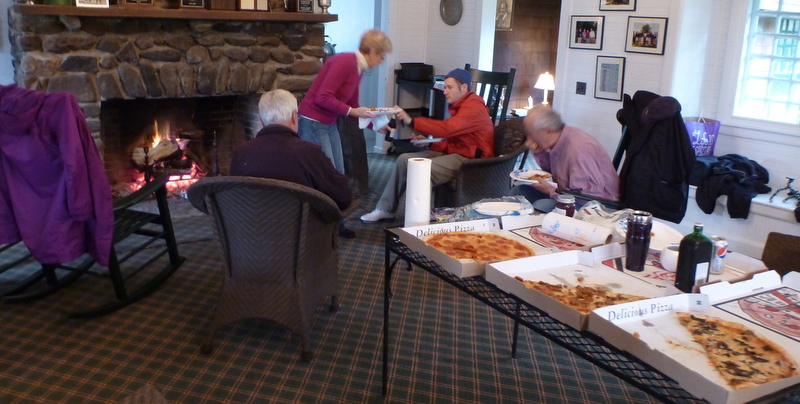
The pizza was terrific, as it always is, and during the gift exchange I received, from Hacker, a coffee cup that looks like a softball-size golf ball. He hadn’t bought it—he had just found it on a shelf—but I still like it. You can see part of it in the bottom right hand corner of the photo below, between my Thermos brand coffee travel mug and the communal bottle of Jägermeister, the official cold-weather intoxicant of the Sunday Morning Group. I poured my Diet Pepsi into it, as a gesture of gratitude and respect.
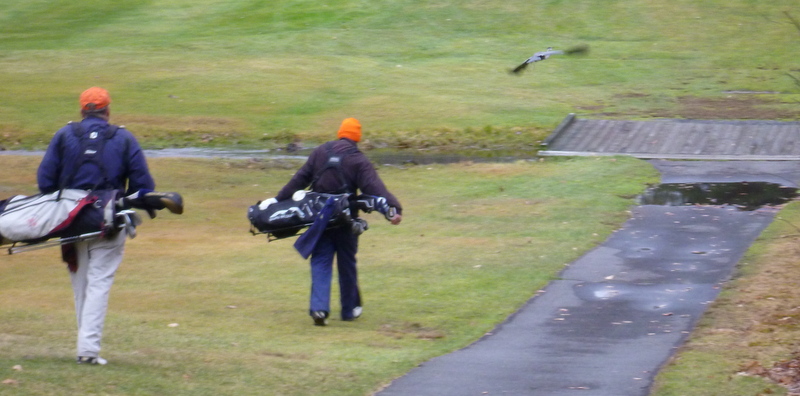
After lunch, four of us played eighteen holes with all our clubs, and I lost twelve dollars, on account of having forgotten how to play golf, apparently. We got pretty close to a great blue heron, which hangs out near the stream that runs across the lowest part of our course, between the out-of-bounds woods on the right side of the fifth hole and the pond on the fourth. You can see it taking off in the photo below. It’s the gray blur above the bridge:
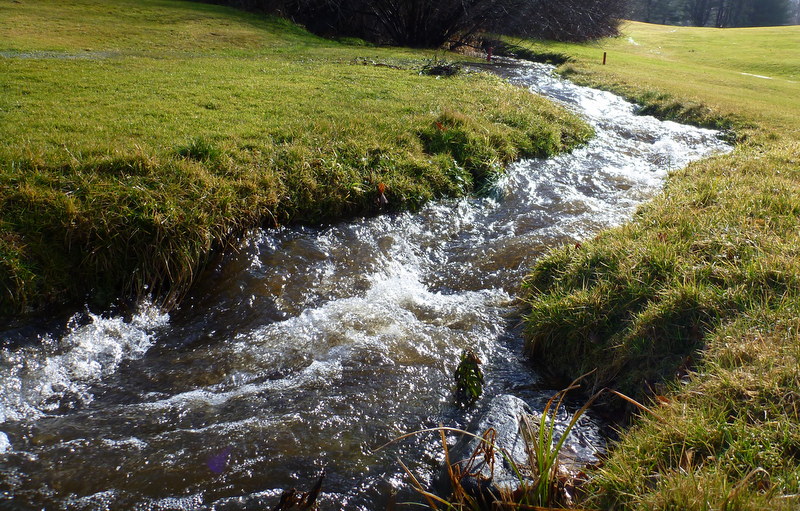
Here’s one of the places where the heron had been fishing. Ordinarily, this stream is about a foot wide.
We discussed holding a contest to name the heron. One possibility: “Uncle Frank,” after our dearly departed old friend Uncle Frank. It’s remotely conceivable that the heron actually is Uncle Frank, in bird form, although it doesn’t smoke or tell funny stories, and it doesn’t appear to be married to a retired soap-opera star.
We didn’t have as big a turnout for the 2012 Winter Solstice as we did for either the 2011 Winter Solstice (see photo immediately below) or the 2012 Summer Solstice (see photo below that). But seven is still pretty good for a day when nobody in their right mind played golf.
Austin had to leave after nine holes, so we needed a five-man game for the second nine. Hacker (real name) invented one on the spot: Double Skins, in which there can be as many as two skins on each hole. The easiest way to explain is with examples:
If, on any hole, two players tie for the low net score and everyone else does worse, those two players each win a skin. (If Players A and B make a net 3 and everyone else has a net 4 or worse, then Players A and B win one skin each.)
If, on any hole, one player makes the lowest net score and one player makes the second lowest net score and everyone else does worse, the two low players each win one skin. (This time, Player A has a net 3 and Player B has a net 4 and everyone else has a net 5 or worse, and,once again, Players A and B win one skin each.)
If, on any hole, one player makes the lowest net score and two or more players tie for the second lowest net score, only the player with the lowest net score wins a skin, because the maximum number of skins available on any hole is two.
If, on any hole, three players tie with the lowest net score, no one wins a skin.
Got it? One excellent feature of Double Skins is that it keeps more players interested longer. For example, on No. 12, a par-three, we all hit crummy tee shots, and then only Rick managed to chip close. He made a gimme par, which was good for a skin—but all the other balls still mattered, because a second skin was also at stake, potentially. And, as it happened, I made what turned out to be the only bogey, because everyone else was overly aggressive in trying to match Rick’s 3 and ended up three-putting . So I got a skin, too—through the back door, as it were.
We played one-dollar-per-skin, no carryovers and no Gillens, with the proviso that if anyone ended up owing more than five dollars the skin value would be cut until he owed less. Result: Gary got four skins, and the rest of us each got two, so the four losers each gave Gary two dollars.


 The guy in the middle is Corey, our pro. We’ve decided to call him a plus-2. Everybody gets excited when Corey plays, because we feel like we’re getting extra shots, but the advantage is an illusion because Corey, unlike the rest of us, can reliably play to his handicap, even when we have the kind of cold, windy weather that made Tony buy a place in Atlanta, as we did on Sunday.