Signs of Early Spring


Split Rock Golf Course, Bronx, New York, February 27, 2012

The Links at Union Vale was open today, but the manager said there was still snow on the second nine, so Hacker (real name) and I drove to the Bronx and played Split Rock. Hacker paid nineteen dollars and change (senior rate) and I paid thirty-eight. It was 55 degrees and sunny, and the grass was growing. The course-maintenance crew was back at work. They weren’t mowing, but they were blowing sweet-gum seed pods off the cart paths and changing the hole locations. The first time my friends and I played Split Rock this year, back in January, the fairways and greens were frozen hard and we couldn’t get the flags out of some of the cups. But this morning the guy with the hole-cutter didn’t even have to lean hard to get it into the ground. By the time Hacker and I were ready to drive back to Connecticut–after cheeseburgers in the Pelham clubhouse–the course and the parking lot were full.

Sometimes, when we’re traveling with a big group and trying to save time, the first foursome to finish will order lunch for everyone. “Sixteen bacon cheeseburgers, medium, American, fries.” Or, if there’s a vegetarian playing that day, maybe hold the bacon on one of them.


Clearview Park Golf Course

Clearview

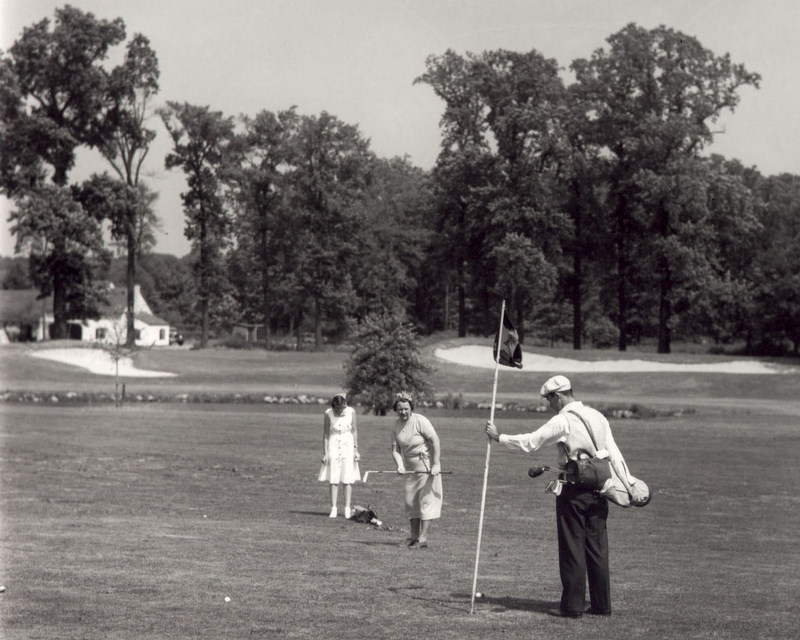
On a warm winter afternoon in 2005, Hacker (real name) and I met at Clearview Park Golf Course, in Queens, for my second round of the day. (I’d played that morning at Van Cortlandt Park, in the Bronx.) The temperature was close to fifty degrees, and the course was packed, mostly with Koreans, who are probably the second most golf-addled ethnic group in New York, after the Irish. The starter, who was also Korean, paired Hacker and me with two Korean men. One of them turned out to be the retired owner of a Manhattan wig shop. He told me that his clientele had included many famous actresses, among them Nancy Sinatra and Ann-Margret, but that actresses are undesirable wig customers because they don’t like to pay. The best customers, he said, are strippers, who favor huge blond wigs and don’t care what anything costs. We finished our round just as a very orange sun was setting beyond Manhattan, and we watched endless ribbons of white and red car lights unspooling across the Throgs Neck Bridge, which looms over the northern end of the course. Six days later, it snowed again. The photos above and below were taken at Clearview in the thirties or forties.

Clearview

Stroke Bank: A Refinement

Last night, we tried to reserve a tee time for today at the Links at Union Vale, but the course was fully booked into the afternoon—a February Wednesday in New England as busy as a summer Saturday. So we went back to Tunxis Plantation, which was still first-come-first-served. We teed off a little after 9:00, and again played Stroke Bank/Second Ball Decides—see earlier post—and thought of a further improvement: Stroke Deposits.

Let’s say you make a 4 and your partner makes a 5 on a par-four, while your opponents both slice their drives out of bounds and end up with 7s. You and your partner have the low gross score on the hole, so you have to commit first. If you keep your 4 and 5, your opponents, if they wish to halve the hole, will need to use a lot of strokes. In fact, one of them will have to use three strokes (to turn his 7 into a 4, tying your par) and the other will have to use two strokes (to turn his 7 into a 5, tying your partner’s bogey). Alternatively, your opponents could choose to win the hole outright—if either of them is able and willing to spend four strokes (to turn his 7 into a 3, thereby beating your 4, which is your team’s better ball).

If you don’t think they’re likely to do those things, or if you don’t care whether they do—maybe because you’re ahead in the match, or because they’re running out of strokes with hard holes still to play—you or your partner can choose to bank some or all of your surplus. For example, you yourself could deposit as many as three strokes, turning your 4 into a 7. Now your opponents can halve the hole if one of them spends just two strokes, turning his 7 into a 5 (thereby tying the other ball as well). But you’d have increased your stroke-bank balance by three, a trade-off that might be advantageous for you on the holes ahead.

This game, in practice, is nowhere near as complicated as it probably sounds. But there’s lots of psychological intrigue, and the four of us had many long, whispered strategy discussions as we walked from green to tee. Hacker (real name) and I lost three ways to Rick and our superintendent, but the match, as somehow always happens, came down to the final putt. And when we walked off the eighteenth green the sun was shining, and the Weather Underground app on my phone said the temperature was 56 degrees. We stopped at a barbecue place for lunch on the way home, and we’re all going to play again on Sunday.

These guys were warming up on the range at Tunxis when we finished.

Up Early

This morning, eight of us played at Tunxis Plantation. We arrived at 7:30 and stood around talking and drinking coffee for an hour and a half (first photo), as we waited for the frost to melt (second photo) and for the golf shop to open. When the all-clear sounded, we teed off first and, with no one ahead of us, played as fast as we do at home.

I had trouble sleeping last night, as I often do before I play golf. Even now, twenty years after I took up the game, waiting for golf still feels like waiting for Santa Claus. During the season, I set my alarm for 6:00 on Sunday mornings—unnecessarily, because I’m usually awake and squinting at the dial by 5:00 or 5:30, if not by 4:00: isn’t it time to put on my golf clothes yet? I click off the clock a few minutes before it would have buzzed, and tiptoe downstairs without waking my wife.

Six or seven years ago, during my Sunday Morning Group’s annual end-of-season trip to Atlantic City, Hacker (real name) got up, took a shower, woke up his roommate and told him to take a shower, went down to the lobby of the hotel where we were staying, sat in the dark in the empty coffee shop for a while, and then looked at his watch more closely and realized it was 3:30, not 6:30. Hacker has trained himself to wake up without an alarm clock, but he loves golf so much that his internal timekeeping mechanism sometimes jumps a few hours ahead. In Pinehurst once, he got up, took a shower, woke up his roommate and told him to take a shower, went downstairs in the house where they were staying, and found a couple of guys in the living room drinking beer and watching TV. “Kind of early for that, isn’t it, guys?” Actually, no: it was just a little past midnight, an hour after Hacker and his roommate had gone to bed. A street lamp near his window had fooled him into thinking the sun was coming up.

Order ahead from the Tunxis grill---service not available in February.

February Golf, Continued

Tunxis Plantation yesterday. We had some rain and snow a little later, but nothing golf-threatening.

Last week, Hacker (real name) and I had to travel an hour west to find an open golf course; yesterday, we had to travel an hour east, to Tunxis Plantation, in Farmington, Connecticut. We were joined by Mike A., whose company makes boxes, and by our home-course superintendent, who was taking a day off from cutting down trees.

We played Stroke Bank again (see yesterday’s post)—this time with two two-man teams. We combined it with our favorite version of two-man best ball, which is called Second Ball Decides. (If my partner makes a 3 and I make a 5 on a hole, and our opponents make a 3 and a 4, our opponents win the hole because, even though the better balls tied—3 and 3—their worse ball [4] was better than our worse ball [my 5]. The first ball was a tie, so we let the second ball decide.)

On one hole late in the match, my partner (our superintendent) used one of his strokes to force Hacker and Mike A. to spend three of theirs. Nevertheless, we lost both the back and the overall on the seventeenth—although we did win a consolation press on the final hole.

New Game: Stroke Bank

My friends and I have invented many golf games over the years: Perfect Skins, Boss, Election Day Special, Fathers and Sons, Shoot Your Pants, many others. (I’ll explain them all eventually.) Last week, at the Links at Union Vale, Hacker (real name) and I came up a new one, which we named Stroke Bank. It’s easiest to keep track of with two golfers, but if you don’t mind slightly complex on-course accounting you can play it with more. And it works extremely well in combination with two-man best ball, in which two players play a match against the other two players in the same foursome.

In Stroke Bank, each player begins the round with a bank account containing his full course handicap—six strokes in my case, sixteen in Hacker’s. And each player is allowed to spend those strokes in any way he wishes, in any quantity, on any hole, until his account is empty. On our first hole, for example, I made a par and Hacker made a bogey. Ordinarily, that would have been a win for me, but Hacker used one of his strokes to turn his five into a four, and we went to the second tee all square. Hacker’s bank account was one stroke lighter than it had been when our round started, but he figured that staying even was worth the cost. And if he’d wanted to he could have spent two strokes and gone one-up.

To keep every hole from turning into a bidding war, the player with the lower gross score on the hole has to commit first and there are no second chances. On the first hole, I was the low man. I said I would keep my par, and after Hacker had spent a stroke to turn my win into a half I couldn’t change my mind and spend a stroke to convert my par a birdie. (If both players shoot the same gross score on a hole, the order is determined by honors, as on the tee.)

Why would I even have considered spending a stroke to improve my score on a hole I’d already “won”? I might have done it to prevent Hacker from doing what he did, or to make him think twice. In fact, late in the round, I used one of my two remaining strokes to turn a natural birdie into a net eagle, even though Hacker had made a bogey on the same hole. I did it because I figured that, although he might be willing to spend two of his remaining three strokes to secure a half, he was unlikely to spend all three.

This feature turns Stroke Bank into a bluffing game, like Texas Hold ‘em. When your opponent has to commit first, you want him to think that if he doesn’t act preemptively you might do something drastic. And you have to keep an eye on your account balance. You shouldn’t be a spendthrift, squandering all your strokes early in the match, but you also have to remember that you won’t be able to spend leftover strokes in the bar.
Global Warming Invitational

January 1, 2009. Hacker (real name) and David Owen, Bay Course, Absecon, New Jersey.

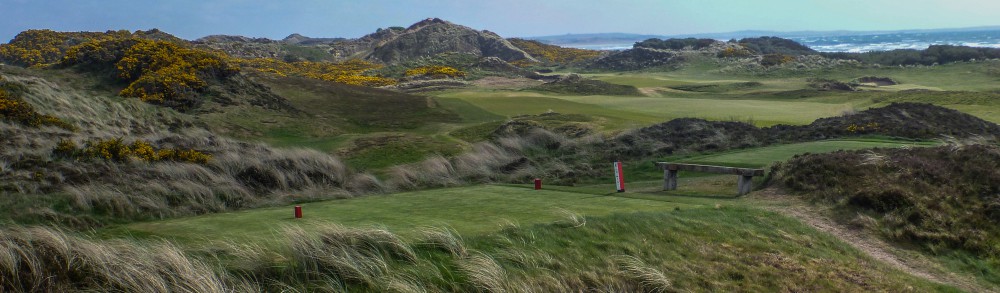
For six or seven years, my friends and I have managed to play golf on either New Year’s Day or New Year’s Eve. We’ve played at Dyker Beach Golf Course, in Brooklyn; Pelham Bay Golf Course, in the Bronx; and on the three AboutGolf simulators at Maggie McFly’s, in Brookfield, Connecticut. On New Year’s Day 2009, Hacker (real name), Other Gene, and I had to drive to Atlantic City, New Jersey, four hours to the south, to find grass. We stayed at the Seaview Resort & Spa, in Absecon, and had the Bay Course (which was designed by Donald Ross in 1914) to ourselves for two days. (Photo above.)

This year, for the first time in recorded history, we were able to play at home. My Sunday Morning Group gives one extra stroke to anyone who plays in shorts after November 1, and two extra strokes after December 1. Three of us got extra strokes on New Year’s Day.  (Photo below.)

David Owen, fourth from the right; Hacker (real name), seventh from the right, holding beer.

February Golf


The weather in the Northeast this winter has been unusually warm, creating unexpected golf opportunities. My home club stayed open until New Year’s Day, a record, and a few courses in our area haven’t closed at all, or have reopened. The other day, my friend Hacker (real name) and I played a round at the Links at Union Vale, in Dutchess County, New York.

The Links was founded in the late 1990s by a group of Irish golfers from the New York metropolitan area. They were fed up with the summer crowds on the city’s public courses (of which there are a dozen) and decided to build a place of their own within weekend commuting distance. Roughly eighty of them bought shares, at ten thousand dollars apiece. They found two hundred acres of cattle-grazing farmland seventy-five miles north of Manhattan, and they hired Stephen Kay and Doug Smith to design a course for them. The investors knew of Kay because he had done some work on the bunkers at Van Cortlandt Park, in the Bronx—the first public golf course in the United States, founded in 1895—and because he had designed an Irish-style course, called the Links of North Dakota, that they liked very much.

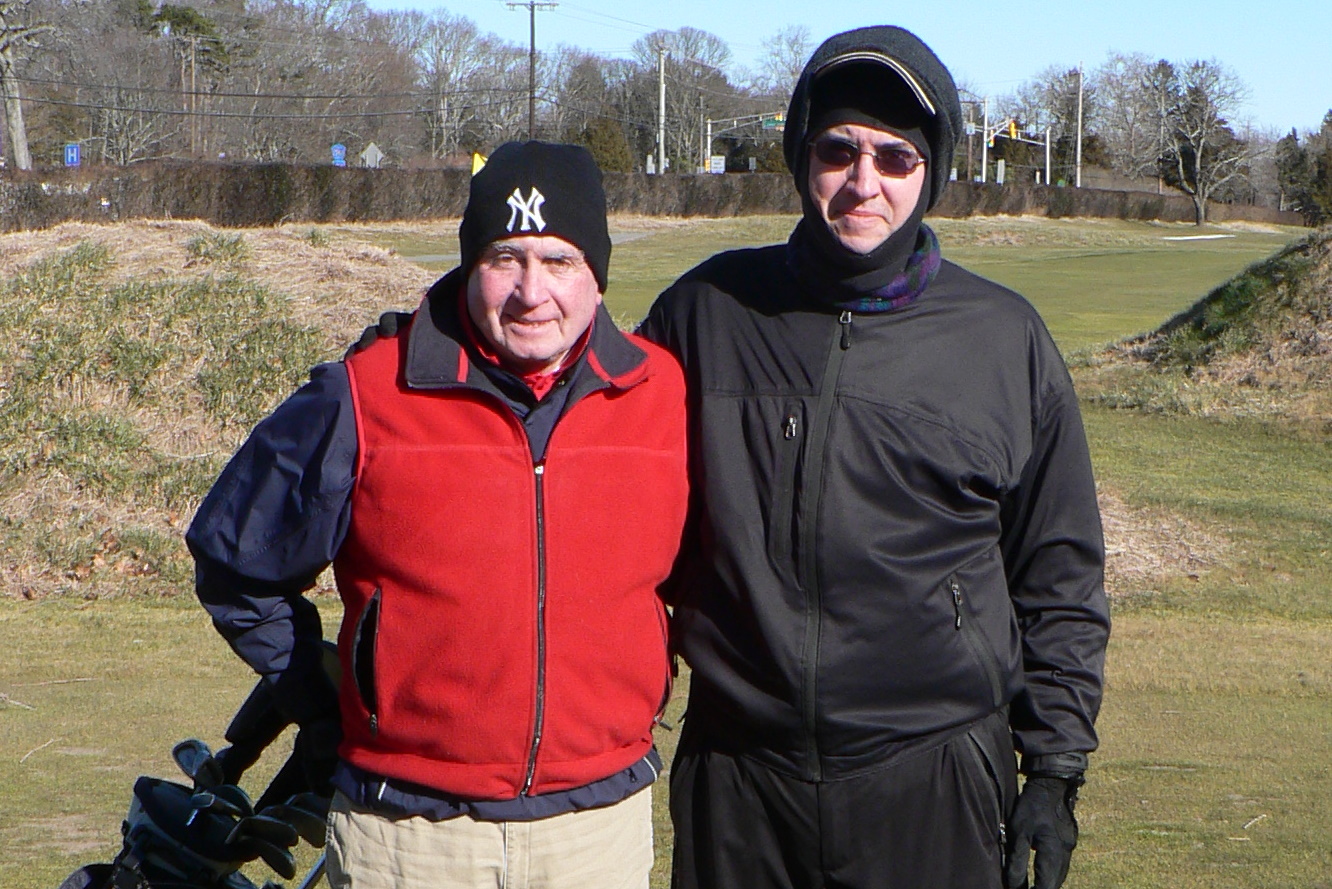
For the Union Vale investors, Kay and Smith built a very passable imitation of an Irish links course, and they did it for just $2.5 million—a pittance nowadays. Bull’s Bridge Golf Club, a private course that Hacker and I passed on the way to and from Union Vale, was founded at about the same time. It cost more than $20 million; has been threatened with bankruptcy on a couple of occasions; had a $1.4-million lien placed on it by its architect, Tom Fazio; is still making do with a temporary clubhouse; and costs more than a hundred thousand dollars to join. The original investors in the Links, who represent various Irish golf associations in and around New York City, allow themselves preferential tee times and charge themselves reduced fees, but their club is open to everyone and their clubhouse is well stocked with Guinness. That’s Hacker in the photo above, stuck behind an old grain silo on the fifteenth hole.