Hunting in Hazards

Two examples, from Monday afternoon. That’s a great blue heron in the photo above. It’s looking for dinner at the junction of two streams on the fifteenth hole. And that’s Rick in the photo below, looking for his drive in the lateral to the left of the thirteenth fairway. He, Adam K., Hacker (real name), and I teed off at 4:00, and we had just about run out of daylight by the time we finished, at 7:00. I missed my first opportunity in several months to play golf in a sweater. Oh, well. More opportunities ahead.

British Open Countdown: St. Annes Old Links Golf Club

Airplane, roller coaster, Yankees headcover, Other Gene, out of bounds: St. Annes Old Links has it all.

Just a few blocks from Royal Lytham & St. Annes, where this year’s Open is being held, is St. Annes Old Links Golf Club. From the parking lot, it looks like a down-at-heels muni, and it’s usually ignored by non-locals. You can see the whole course without turning your head, there’s an airfield over the fence, and the northern vista is dominated by the roller coaster at Blackpool, a seaside holiday spot whose nearest American analogs are Coney Island and some of the tawdrier parts of the New Jersey coast. (Prosperous Britons view Blackpool as beneath them, but your children wouldn’t.) Still, the course is far better than it looks, and it’s worth a visit (as is the roller coaster).

The roller coaster in Blackpool in 1983, when I rode it twice.

St. Annes is of historical interest as well, because it occupies part of Royal Lytham’s original site: the tenth and eighteenth holes are direct descendants of the earliest layout, and their greens are said to be the oldest in the region. The course has more than a few undistinguished holes, but it also has some tremendous ones. Maybe the best is the 450-yard, par-4 seventh, called Penance. Its left side is flanked by grassy ditches, which serve the same depraved purpose as the church-pew bunkers at Oakmont. Shots to the green generally play into a fierce wind, and they tend to end up at the bottom of a trench, in one of the numerous bunkers, under a spavined bush on a bank that hugs the rear left corner of the green, or against a shed just beyond the bushes. Another superb hole is the ninth, a claustrophobia-inducing par 3, which Bobby Jones liked well enough to measure, in 1926, for possible reproduction elsewhere.

Ninth green, St. Annes Old Links. That’s the clubhouse beyond it.

You might also see a helicopter. That’s Brendan on the left, walking toward the roller coaster.

British Open Countdown: A Great Golf Trip

Tony, Rick, Hacker (real name), David O., Brendan, David W., Tim, Other Gene, Ray, Hillside Golf Club, England, May, 2010.

My friends and I have taken some terrific golf trips over the past dozen years, including one to Scotland and two to Ireland. Our best trip ever, though, may have been the one we took in the spring of 2010 to the part of England where the Open Championship will be played this week. England’s Lancashire coast—which is also known as the Golf Coast—contains one of the world’s densest concentrations of superb links courses, including three on the Open Rota (Royal Liverpool, Royal Birkdale, and this week’s venue, Royal Lytham & St. Annes.) My friends and I played fourteen rounds on eleven courses in eight days, and over dinner on the final night we went around the table and each named the one course we’d most like to play again. There were nine of us, and we picked eight different courses.

The do-over course I named at dinner on the final night: Southport & Ainsdale, which I hadn’t even expected to like. That’s Birkdale Cemetery in the distance.

One reason the trip worked so well is that we did very little driving. The distance by air between Royal Liverpool (at the southern end) and Royal Lytham (at the northern end) is less than thirty miles, and we rented three three-bedroom apartments in Southport, a resort town roughly halfway between them. The rent worked out to something like $30 per man per day. We had views of the Irish Sea, and we could walk into town.

Extremely light housekeeping: my bedroom in our apartment in Southport. Note the necktie, which was required for dinner in the clubhouse at Royal Lytham & St. Annes.

We spent just one night away from our apartments, in nine single rooms in the Dormy House at Royal Lytham. That club offers several package deals, and they’re a bargain. We got two rounds of golf on the championship course, three meals in the clubhouse, and a night in the Dormy House for less than the à-la-carte price of two rounds of golf.

The Dormy House at Royal Lytham & St. Annes.

My bedroom window looked out on the practice putting green, the eighteenth green, and the clubhouse (the building on the left).

The view from my room in the Dormy House.

Lytham is the only Open course that begins with a par 3, a 200-plus-yarder with a circular green surrounded by ravenous bunkers. My favorite hole on the course is another par 3, the ninth, which looks like a golf hole in a dream: the green is elevated and undulating, like a graduate-level problem in topology. It’s tucked into the farthest corner of the course, and a cluster of red-brick buildings rises directly behind it, and if you flub your tee shot, an assistant pro told me, you can easily make 10.

Ninth green: don’t be long; don’t be short; don’t go right; don’t go left.

Within the city limits of Southport are three excellent courses—Royal Birkdale, Hillside, and Southport & Ainsdale—and one quite good one: Hesketh, which is the home of the Hitler TreeThe first three are laid out almost continuously along the coast to the south of town; they are so close together that if you miss the driveway for Birkdale, heading south, the handiest place to turn around is the side street that leads to Hillside. And at Hillside it’s entirely possible to hook a ball onto Southport & Ainsdale. I’ll have more to say about all those courses, and the others we played, later this week.

David O., Gene P., Royal Lytham.

More About Coping With Rain

Tony, Dave, Ray, Bandon Dunes, February, 2007

Everyone agrees that you can’t change the weather by worrying about it. Shouldn’t it follow, then, that you can change the weather by not worrying about it? I tested this concept on a Saturday six years ago. The sky was growing dark, so, in the hope of diverting the approaching thunderstorm, I purposely didn’t check the Weather Channel or become agitated before heading to the golf course.

Well, it didn’t work. As Hacker (real name), Ray, Tony, and I were getting ready to tee off, Fran, our pro, came out of the golf shop and said, “When I blow the horn, come straight in. There’s a huge cell heading for us.”

The thunder began as we were putting out on five, and moderately heavy rain was falling by the time we got back to the clubhouse. Ray went inside to estimate how quickly the angry green-and-orange amoeba was moving across the radar screen.

“About an hour,” he said when he came back. Hacker and I keep decks of cards in our glove compartments. The four of us sat at a table on the clubhouse porch and played setback, while water overflowed the gutters. I used to belong to a golf club where the old guys played setback all winter. The pro would knock on the card-room door in early April, to let them know it was spring.

We could still hear thunder after an hour, so we all went home. I stomped around the house for a while—“Hey, look! I’m not playing golf!”—then took a nap, which I had been planning to do anyway. When I woke up, I checked my computer: the last of the angry amoeba was almost east of us. I started e-mailing people.

E-mail is the most important golf-related discovery since the sand wedge, because, unlike the telephone, it lets you set up a golf game without anybody’s wife catching on until it’s too late. Tony and I met on the first tee at 4:00, and we had the place to ourselves for five or six holes. The sun came out. We watched swallows skimming the fairways, gorging on mosquitoes. We listened to the trees shaking themselves dry in the breeze: rain’s echo.

And then it was just like the hour after a rainstorm when you were a kid: in ones and twos and threes, our friends came back out to play. As Tony and I walked to the eighth tee, we passed Gillen and Tim, on the second green. Tim was saying, “We putted pretty well, but we didn’t sink anything over ten or twelve feet, and to do well in a scramble you have to sink long ones”—today’s version of the permanent conversation, resuming after a lightning delay. Gene and Nick and Frank were a hole behind them. Mike joined Tony and me on fourteen, by way of the range.

I ended up playing twenty-seven holes—nine more than I would have played if it hadn’t rained. Maybe not worrying works, after all.


Tour Players Lead Lives of Quiet Desperation

In 2003, I played in the pro-am at the Western Open, at Cog Hill, near Chicago. The pro on my team was J. P. Hayes, whom I wouldn’t necessarily have recognized if his name hadn’t been printed in huge letters on his golf bag. Nevertheless, I was excited. For a golf fan, playing in a pro-am is a fantasy come true. It’s a chance to spend five hours getting on the nerves of a real tour player, and it provides numerous opportunities to obtain personalized mementoes that can later be sold on eBay.

The excitement felt by the amateurs in any pro-am is almost exactly offset by the dread felt by the professionals, most of whom would prefer to be mowing their lawn, if not their neighbor’s lawn. But the tour requires even the top pros to take part, mainly because pro-ams generate favorable p.r. and make tournament sponsors happy.

My team, without even one useful contribution from me, finished sort of in the middle of the pack. The next day—the first day of the real tournament—I decided to lend comradely support to Hayes by following him in his round. His tee time was 1:09, exactly the same as Tiger Woods’s, although Hayes was assigned to the first tee (along with Justin Leonard and Stuart Appleby) while Woods was assigned to the tenth (along with Chris Smith and Cameron Beckman). Woods, who ended up winning the tournament, influences golf spectators the way a black hole influences cosmic dust: when he emerged from the driving range, at about 12:45, what appeared to be the entire human population of northeastern Illinois began to drift inexorably toward him.

Over on hole No. 1, in contrast, the crowd of spectators quickly reduced itself to a handful of friends, relatives, and stubborn contrarians. I walked with Hayes’s completely charming wife, Laura, who was pregnant with their second child; Amanda Leonard (also pregnant); Ashley Appleby; and a few of Hayes’s relatives, who were visiting from Wisconsin—about the same turnout you would expect for the final round of a club championship.

Non-golfers joke about how boring golf looks on television, but TV actually makes tournaments seem more exciting than they are, because it focuses on leaders and stars, and because the camera doesn’t linger once a shot has been hit. If you’ve ever attended a Tour event in person, you know that most of it consists of absolutely nothing—like a fireworks display at which the rockets go off ten minutes apart. Even if you’re following one of the superstars, you have more than enough time between strokes to read the newspaper, get caught up on your bills, or work out any lingering difficulties in your marriage.

It’s the pros who lead lives of quiet desperation—not regular golfers like us. If a pro hits a ball out of bounds, the other guys in his foursome never say, “Aw, forget it, just drop one up by the tree.” And nobody ever hooks them in the crotch from behind with a two-iron as they’re getting ready to play a shot. They have to hit practice balls and lift weights and take vitamins and live in hotels and worry about telling their wives they’ve been demoted to the Hooters Tour.They sacrifice the best years of their lives to entertain and inspire us, and how do we repay them? By hounding them for autographs, and calling them chokers when they lose, and nodding smugly when Johnny Miller says their swing looks a little laid-off. Then, to top it off, we ruin their Wednesdays with pro-ams.

We have a lot to atone for. And as I walked along with Laura Hayes I thought of a way to do that: by inaugurating a national program of amateur-professional events—“am-pros”—which will be just like pro-ams, except opposite. Rather than imposing ourselves on the pros at the very moment they’re trying to pull themselves together to compete, we’ll invite them to join us at our own clubs, and let them see, for a change, how real golf is played. Any pro who misses the cut at any tournament can simply show up that weekend at any participating club and play for free. We’ll give him a handicap of plus-five or plus-six, and we’ll choose teams the way we usually do, by throwing balls or pulling numbered poker chips out of a hat, and we’ll work him into our regular Saturday or Sunday games. Lunch, too. Want in?

Hacker (real name) counting the skins money at my club this past Sunday. J. P. Hayes and Tiger Woods: this life could be yours.

Sunday Morning on Friday Afternoon

The Friday-afternoon version of my regular Sunday Morning Group met the other day. Seven players showed up: three retirees, one semi-retiree, two self-employees, and one college student home for the weekend. We picked teams by drawing balls from my hat, three vs. four. As always, the threesome started two under par (an adjustment we borrowed from Augusta National) and no one got two strokes on any hole. The wager was twelve dollars a man: five dollars for best-ball, five dollars for skins, and two dollars for the Money Hole (which, because there were seven of us, was the seventh). Because it was Friday, not Sunday, we allowed strokes on par-threes. 

The course had been open for more than a week and the weather was flawless, but our cars were the only ones in the parking lot so we played as a sevensome. Later,  we picked up an eighth player: a self-employee, but one who runs a real company and has young children and so sometimes runs late. Even as an eightsome, we played faster than most foursomes, perhaps partly because Ray, over the winter, had eliminated a few redundant elements from his pre-shot routine. He’s just about the last member of the group who still believes in practice swings, although he now limits himself to one, plus waggles.

My team went a stroke ahead on the seventeenth, with a net birdie by Jim. He is recently divorced and hadn’t played in two years, except for a single round during an otherwise golf-free trip to Ireland a couple of weeks ago. On the eighteenth, Ray, on the enemy team, made a natural eagle, retaking the lead—but Jim answered him with a second consecutive net birdie, and we finished in a tie. Rick, as always, suggested giving everyone their money back, but Hacker (real name) reminded him that, in our group, “money doesn’t flow backward,” and told him to forget it. We held a playoff on the practice green—putting to the second hole from the top of one of the teak side tables on the patio, closest to the pin—and my team won.

Hacker, on the seventeenth tee, proving that intact rotator cuffs are overrated.

How to Take a Golf Trip With Friends


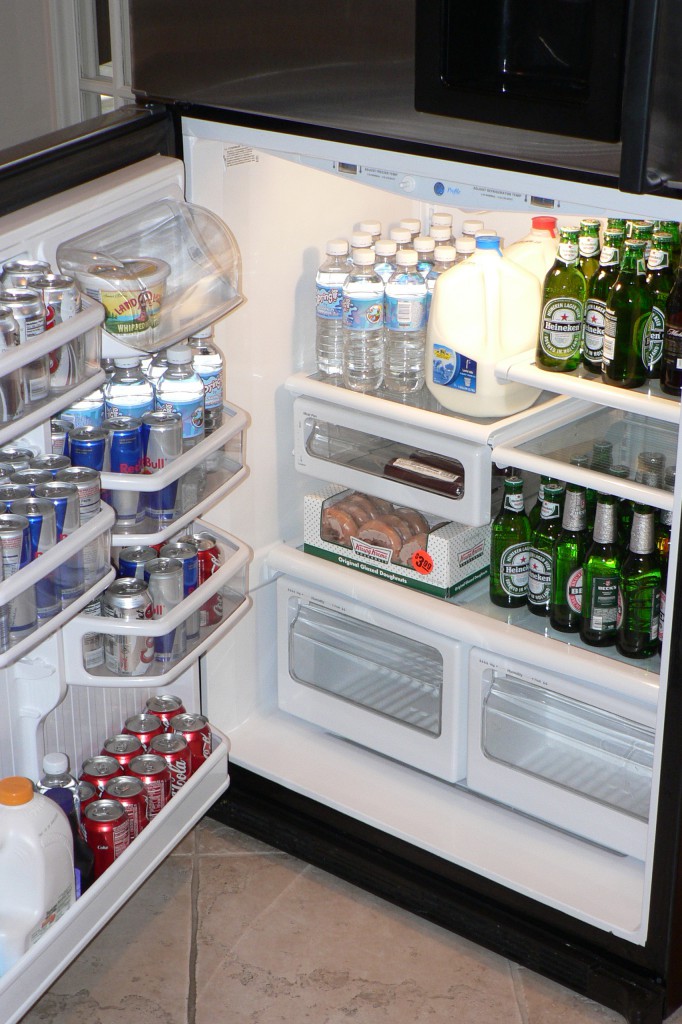
How to stock a golf-trip refrigerator. (Ferris's house, Pinehurst, 2006)

My regular golf buddies and I have taken many trips together, and, by trial and error, we’ve learned a lot about what works and what doesn’t. Here are some tips:

Do give one person the overall responsibility for managing the itinerary, keeping track of reservation deadlines, reminding laggards to make their deposits, and deciding which minor tasks can safely be delegated. Having a single, reliable leader makes it less likely that critical details (such as tee times) will be forgotten, and creates a clear blame path if things go wrong.

Don’t automatically assume that nobody will be up for more than eighteen holes a day or (equally important) that everybody will. During a buddies trip that eight friends and I took to Scotland in 2008, we designated one round as the official eighteen for each day, so that oldsters could flake out in the afternoon without losing their place in the standings. On the final day of an earlier, ten-day trip to Ireland, when even the golf obsessives had begun to fade, we revived everyone’s spirits by playing a scramble in the afternoon.

Do establish a centralized rule-making authority with the power to silence whiners, naysayers, and independent thinkers. Among my friends, this authority is called the Committee, and it typically consists of Hacker (real name) plus one or two people who, over the years, have satisfied Hacker that they are likely to agree with him. The Committee has many responsibilities, including picking the games, choosing the stakes, deciding whether or not Gene will be allowed to play from the senior tees, and settling minor but potentially divisive issues as they arise, such as do we get a first-tee do-over or not, and what about handicap strokes on par-threes? The Committee’s decision is always final—a relief to most people, who go on golf trips to escape their current responsibilities, not to acquire new ones.
The Committee.

Don’t allow trip-threatening behavior to go unpunished. On the second morning of our annual Atlantic City trip a few years ago, one foursome drove to the wrong golf course (with Hacker, of all people, at the wheel), even though all five cars had left our hotel at the same time and everybody had been given printed driving directions. The resulting confusion came close to ruining the whole trip, or so we said. When the round was over, we restored order by conducting a trial in the clubhouse—taking advantage of the fact that two of the participants that year were lawyers—and sentenced the offenders to pay for everybody’s lunch.

Do collect all wagers before anyone tees off. Losers always outnumber winners, and on a large golf trip that means that if the prize money isn’t in hand when the scores are tabulated the victors will have to collect from a sullen mob. We handle this on our golf trips by collecting a single buy-in on the first morning of the whole trip—currently, a hundred bucks a man—and paying all prizes for the trip out of that fund.

Don’t let the stakes get out of hand. The purpose of playing for money is to make three-foot putts seem important, not to let anyone get rich. We try to spread the prize money around by having lots of complicated side bets, all paid off from the same hundred bucks. The big winner, furthermore, is expected to buy lunch on the last day.

Do establish community-building trip traditions, such as our rule that recovering alcoholics drink free.

Don’t feel you have to do everything as a group. We often split up for dinner, primarily to eliminate tedious late-afternoon arguments about who is willing to pay how much to eat what. Doing this also occasionally generates interesting demographic data, as it did on the night when (as someone realized later) all the Democrats went to a sushi bar while all the Republicans went to Outback. (Figuring out that this had happened took some deductive work, because in our group, as in all successful golf groups, we almost never mention politics, even with people we agree with.)

Do be careful about the guest list. We usually open up our trips to friends from outside our club, and even to friends of friends. This has beneficially expanded our acquaintance with overweight middle-aged men from outside our immediate geographical area, but it has occasionally led to problems. One year, one guy invited an old high-school friend of his, whom he hadn’t seen in years. The old friend, who began drinking as soon as he got into Hacker’s car, bought a dozen condoms at a convenience store during the first refueling stop, then stashed the box under his seat and forgot all about it. A week after we got back, Hacker’s wife discovered the condoms and—here’s the problem—didn’t believe, even for a minute, that they belonged to any of us.

Don’t let a buddies trip end without establishing a Committee to pick the next destination.

How to load a rental car. (Cruden Bay, Scotland, 2008)
Important Rule Change Regarding Legs

Hacker (real name) and Tony: what's the rule?

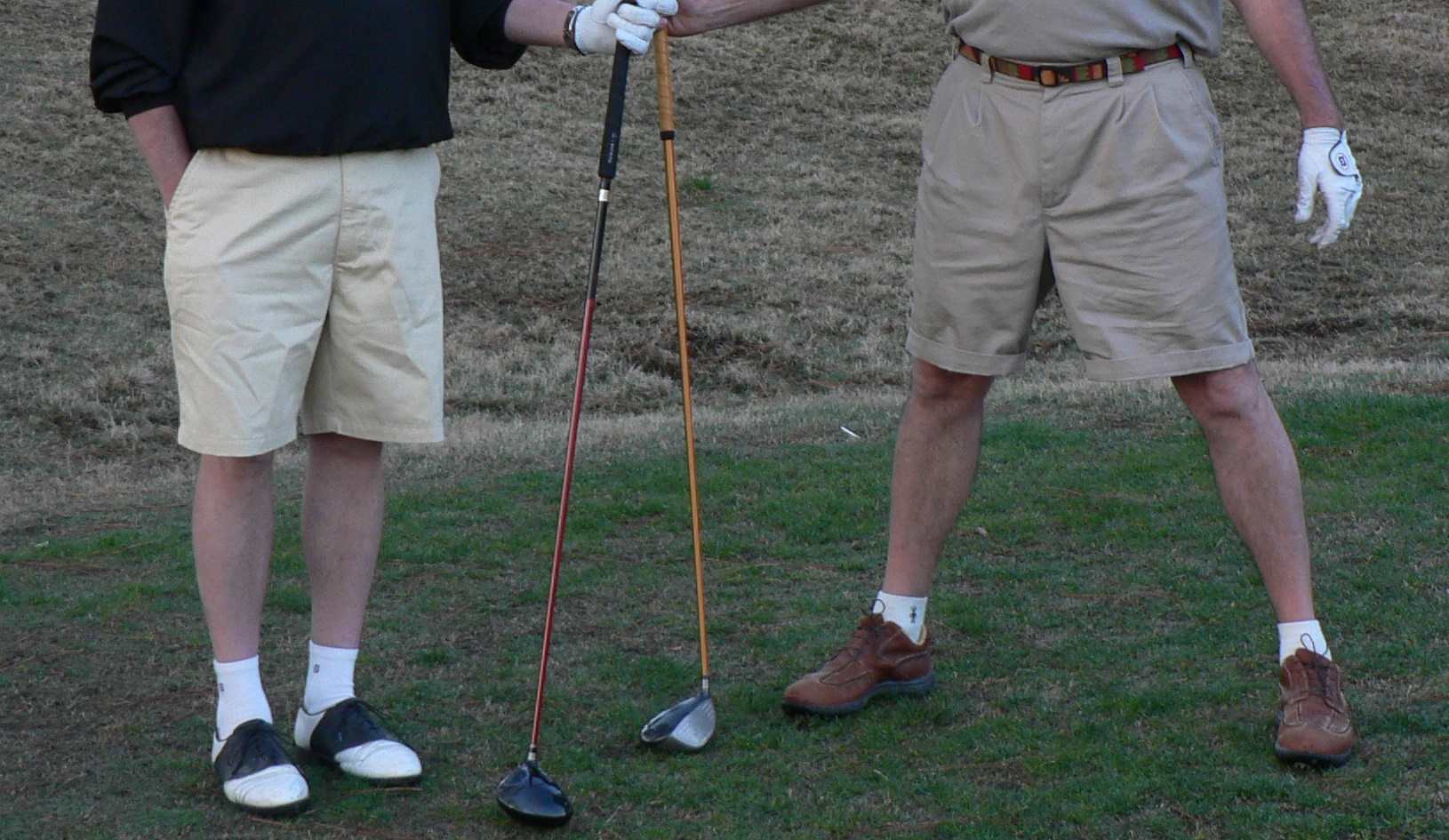
My regular Sunday Morning Group has its own rules, which are printed on the back of our scorecard. The most important ones: nobody gets a stroke on a par-3; nobody gets more than one stroke on any hole; you can’t win a skin if you aren’t present when we go over the scorecards; and “money doesn’t flow backward” (i.e., no refunds on wagers or anything else, even if somebody screwed up). We also give an extra stroke to anyone who wears shorts after November 1.

Our course stayed open so long last year—until New Year’s Day—that we added a new rule: anyone who wears shorts after December 1 gets two extra strokes. I was a beneficiary on our home course in December and on courses we visited in January, February, and early March, after our home course had closed. On one of those days, in the Bronx, I just about froze. But having two extra chances at skins is a powerful inducement—even though, when we’re on the road, we usually just throw the whole pot toward lunch.

Now that our home course is open again—six weeks earlier than normal—we face a dilemma. It’s still technically winter (since at this time last year most of the course was covered with snow), but yesterday the temperature was in the eighties. So do we give strokes for shorts, or not?

Luckily, Hacker (real name) thought of a solution: tomorrow, when our Sunday Morning Group plays its first official round at home since January 1, anyone who doesn’t wear shorts will lose a stroke. Deservedly.

Sunday Golf in Brooklyn

Marine Park Golf Course; Brooklyn, NY; March 4, 2012; 46 degrees.

There are a dozen public courses in New York City, and they stay open all winter, as long as the ground is snow-free—as it usually is, thanks to the urban heat island effect and the proximity of the Atlantic Ocean. On Sunday, as Rory McIlroy was moving to the top of the world ranking, six members of my regular Sunday Morning Group and I drove to Brooklyn for a round at Marine Park. (Several of our favorite city courses have enticingly warm-sounding names: Marine Park, Pelham Bay, Dyker Beach.)

Marine Park is situated a few miles from J.F.K. International and a few hundred yards from Floyd Bennett Field, which was the city’s first official airport. (When Howard Hughes set a record by flying around the world in ninety-one hours, in 1938, his trip began and ended at Floyd Bennett. The old runway area is now a somewhat dystopian-looking public park and a New York Police Department helicopter base.) The golf course covers a little over two hundred acres inside the elbow formed by Flatbush Avenue and the Belt Parkway. It was designed by Robert Trent Jones and was completed in 1963—just in time for the World’s Fair, which was held virtually next door, in Queens, the following year. The holes have a genuinely linksy feel: few trees, subtly undulating topography, exasperating wind off Jamaica Bay (another warm-sounding name). There’s more broken glass in the bunkers than you’d find at Troon or Carnoustie, and the views from some of the fairways include more barges and giant dump trucks. But the greens on Sunday were fast and terrific, even though nobody had mowed them in months.

Hacker (real name), Marine Park.

In 2007, New York City accused the company that was operating Marine Park of having ties to organized crime, and revoked its lease. The new lessee is investing millions in the course, and has renovated the club house and added a driving range. We saw huge piles of topsoil alongside a number of  the fairways—raw material for improvements to come. The guy manning the cash register in the golf shop, who was also the starter, told us that the days when old car parts and toilet seats would sometimes pop up through the turf are gone.

When we’d finished our round (after playing the last few holes as a sevensome, since there were slowpokes ahead of us and no one behind), we caravaned to Pipin’s Pub, in Bay Ridge. We’ eaten lunch there before—on New Year’s Day 2008, after playing a cold, wet round at Dyker Beach—and ever since then we’d been meaning to go back, partly because almost the entire first page of the menu is devoted to various kinds of cheeseburger. The day’s winners threw all their winnings into the lunch pot, as we almost always do during the off-season, and we ended up leaving a huge tip because with seven people the arithmetic was just impossible.

Pipin's Pub. Photo taken by nice waitress with Irish accent.

City Island

Connecticut is supposed to get snow later today, so on Sunday my friends and I will probably have to go back to New York City to play golf on grass. Among our possible destinations are the two golf courses in the upper left-hand corner of the image above, from Google Earth. That’s Split Rock Golf Course on the left and Pelham Bay Golf Course on the right. (Split Rock, as you can see, has more trees and narrower fairways.) The two courses are divided by a Metro North commuter rail line, and to get from the clubhouse to Split Rock you have to walk under a rusty old train trestle–shown in the photo below, which was taken the first time we played in the Bronx, six or seven years ago.

Gene, D.O., Nick, Split Rock G.C.

When we play in the Bronx, we sometimes have lunch on City Island, which is in the lower right-hand corner of the Google Earth image at the top of this post. To get there from the golf courses, you cross City Island Bridge, the first version of which was built in 1873. City Island looks like the unacknowledged illegitimate child of Nantucket and Hunts Point Avenue. A Connecticut shipbuilder named Orrin Fordham invented oyster farming there, in the eighteen-thirties. Later, the local economy was dominated by boat-building and sail-making.(Five victorious America’s Cup yachts were built on the island.) Today, City Island contains what is almost certainly New York’s densest concentration of yacht clubs (six of them) and seafood restaurants (Johnny’s Reef, Tony’s Pier, Sammy’s Fish Box, and Sammy’s Shrimp Box, among many others), yet the restaurants’ parking lots tend to be enclosed by tall, barbed-wired-topped chain-link fences, like the exercise yards of medium-security prisons, and knowledgeable seafood-loving locals often order lamb chops or steaks.

At the bottom of Fordham Street, on the east side of the island, is a tiny ferry that runs between City Island and Hart Island, a half mile to the east. Hart Island served as a prisoner-of-war camp toward the end of the Civil War and currently contains a vast city-owned cemetery, a potter’s field, which is used for the interment of stillborn infants, unclaimed and indigent people of all ages, and amputated limbs. The deceased—among them the novelist Dawn Powell, who died penniless, in 1965—are buried in long trenches, in stacked pine boxes. The burials are conducted by prisoners from Rikers Island, who travel to and from the ferry landing in blue-and-white buses operated by the Department of Correction. That’s the landing in the photo below. Hacker (real name) and I saw it one Sunday, when we decided to splurge on a post-round, mid-afternoon feast at the Lobster Box.