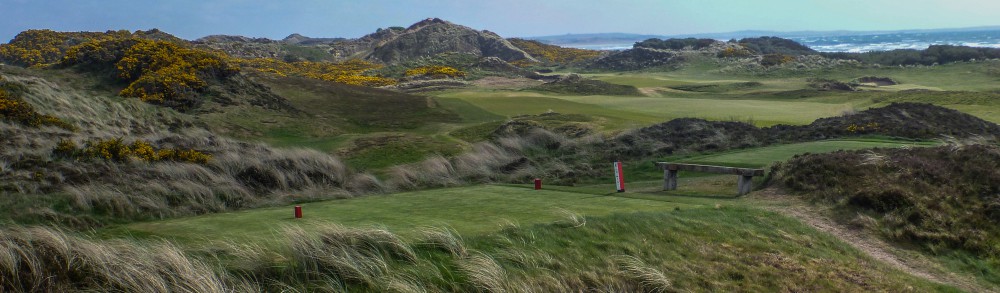
Reader’s Trip Report: Bandon Dunes in a Hurricane

Mike Goldman, a reader, recently spent several days at Bandon Dunes with seven friends. Here’s the local forecast from part of their trip:

bandonforecast-001

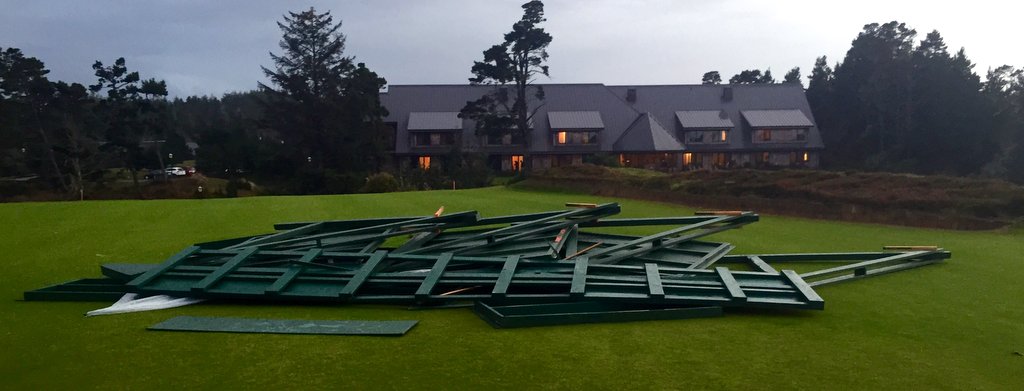
They played every day, naturally, even though the Speed Golf World Championship, which was supposed to be held on Old MacDonald while they were there, was canceled because of the weather. Here’s what the wind did to the speed-golf scoreboards:
bandonscoreboards

From Goldman’s report:
While the entire trip was a home run (mainly because my team won), the lasting memory will be our trudge through the hurricane on Saturday, on Bandon Dunes. What started as a light mist and a stiff breeze quickly regressed into a wind and rainstorm so dramatic that one member of our group said, on the second tee, “We’ve already passed the point of bringing all the animals inside and duct-taping the windows.” 
 
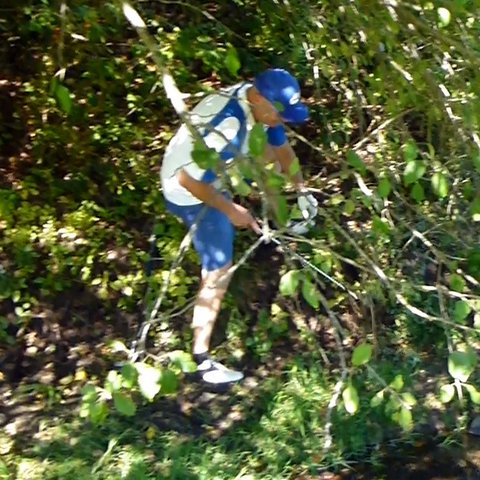
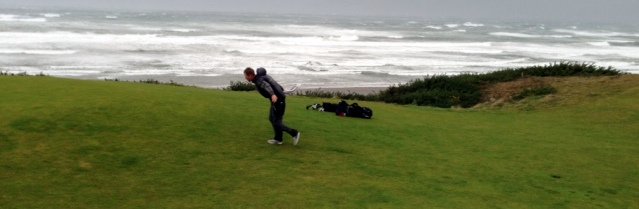
I’m not an agronomist, but my understanding is that gorse is a hearty plant and that it’s unusual to see it rolling down fairways like tumbleweeds. At one point, on the sixth green, we suspended play and hunkered down in a catcher’s stance, and leaned into the wind to keep from blowing off the cliff. We were a little nervous, but, mainly, we were laughing hysterically at what we were going to have to do to complete the match. Here’s one of our caddies climbing uphill into the wind:
bandoncaddiewind
On the seventh green, as we were trying unsuccessfully to mark our balls, one of the caddies said, “Whatever you do, do not get within 10 feet of that cliff.” No. 9 at Bandon is a straightforward par 5. On a normal day, it’s two good shots and a little pitch, and then you’re putting for birdie. Playing dead into he storm, I hit driver (hard), 3-wood, 3-wood (again), and then a torched 8-iron to the front fringe, 50 feet from the hole. I’m more pleased with that result than hitting it in two on a normal day.
 
At the end of nine holes, much to the relief of our caddies, we suspended play for a burger and a beer, and strategized about how best to complete the matches. We settled on the Preserve, Bandon’s new 13-hole par-3 course. The longest hole is only about 160 yards, but many holes turned out to be unreachable. On others, you’d hit a simple pitch shot and watch the wind whisk your ball over the green and into the gorse. At the end of the day, we were tattered, wind-damaged, and in possession of a golf experience we’ll all remember for a lifetime.  
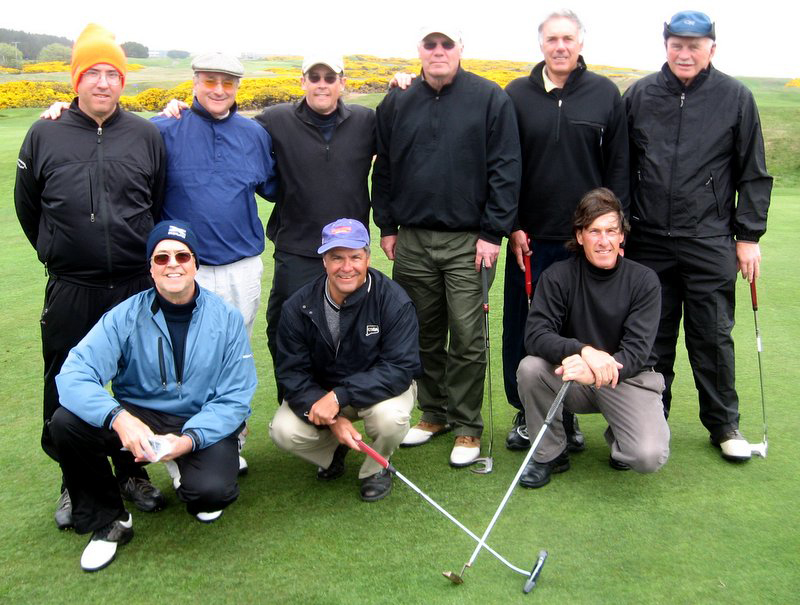
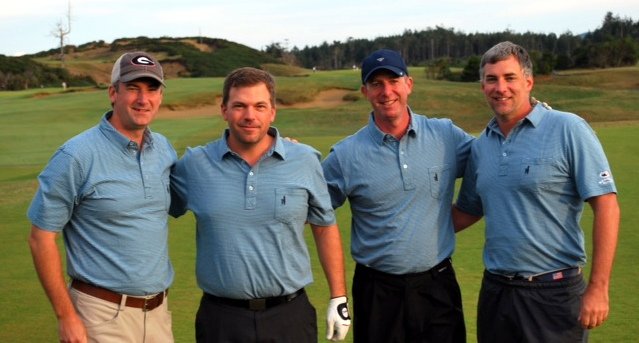
Here’s the winning team. (Marty Hackel: note the wardrobe.) From left to right, they are Mike Kemmet, Trevor Dyer, Mike Goldman, and Steve Harry. Dyer (a.k.a. The Captain) organized the trip, and kept everyone up to date with a website he created for that purpose —an excellent idea.
bandonwinningteam-001
Here’s Dyer during the hurricane. It looks like he’s swinging, but he’s actually just being bent into a pretzel by the wind:
dyer.jpg
And here’s a picture of Goldman during a round once the storm had passed:
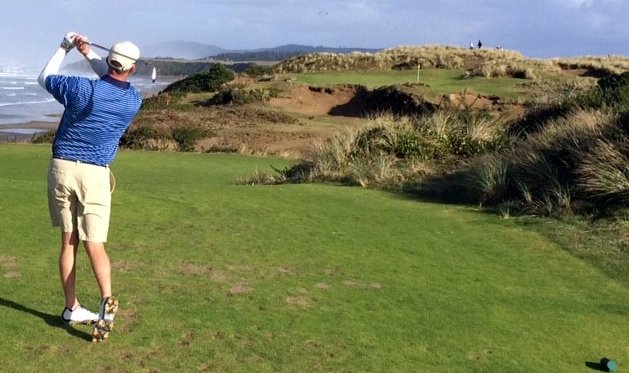
bandongoldman-001
And here’s a golf quiz: when you read Goldman’s account of their Saturday rounds, did you wish you’d been there, too? I did. (That means I passed the quiz.) I visited Bandon back in February 2007 with Tony and Ray. We played ten rounds in five days, all in the rain. During lunch between eighteens each day, we parked our rainsuits in some industrial-strength dryers in the clubhouse. Here are Ray and Tony with our caddies:
bandonrain2007
During that trip, a starter told me that, several winters before, on a day when the wind blew hard and Bandon received almost seven inches of rain, all eighty-five golfers on the tee sheet played—and so did two walk-ons, who were passing through and thought the day looked reasonable for golf. They were right!
pacificdunes2007

Two Ryder Cup Shots You Didn’t See on TV

You didn’t see them because they happened in a different Ryder Cup, the one the Sunday Morning Group held while the American tour stars were getting whupped in Scotland.

upthecreek
Twenty-four guys signed up in advance, and Corey, our terrific pro, divided us into two teams, one red and one blue. The youngest guy in the field didn’t show, apparently because he had met someone interesting in a bar the night before. Corey took his place, after persuading his mother, our club’s immediate past president, to watch the golf shop for him. (The guy who didn’t show made a big mistake, in my opinion. The time to establish golf in a romantic relationship is at the beginning, before the non-playing party has had time to develop a case.)
smgrydercolors
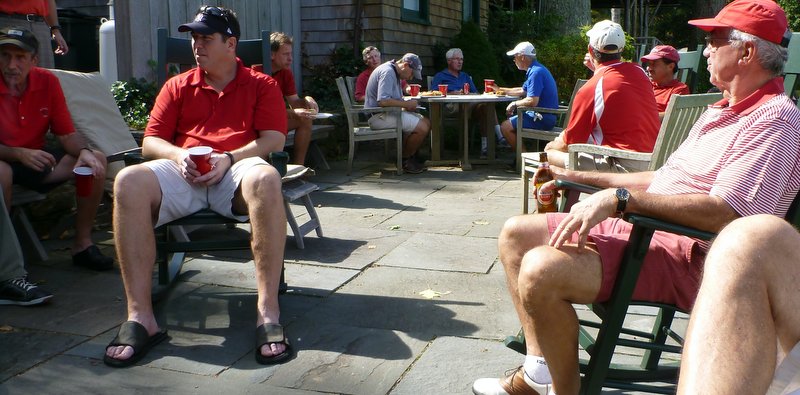
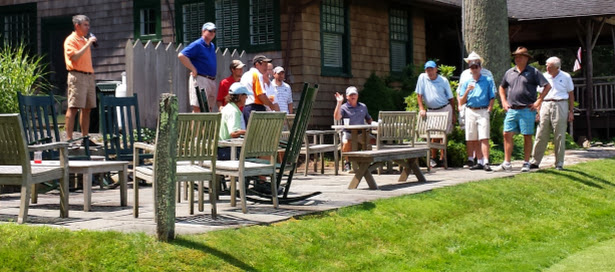
And after everyone had finished we had our usual lunch of cheeseburgers, hot dogs, and beer, on the patio near the practice green:
smgryderlunch
Before I get to the two shots that weren’t shown on TV, I’d like to make two general observations about the other Ryder Cup:
1. What is the source of Ryder Cup Europe’s pathological golf-course selections? In the sixties and seventies, the trans-Atlantic side of the contest was held exclusively on Open courses: Royal Lytham & St. Annes, Royal Birkdale, and Muirfield—an over-reliance on England, granted, but otherwise impeccable. Since then, the thinking has apparently been that crummy venues deserve international exposure, too. The worst is the Belfry, also in England, which has hosted the matches four times—more than any other course in history. The Belfry has just two good holes, the ninth and the eighteenth, and most matches don’t reach the eighteenth. This year’s course, at Gleneagles, was in the works when I first played golf in Scotland, in the early 1990s. At that time, the Scots had seemingly decided that the way to attract American golfers to Scotland was to hire Jack Nicklaus to build something that would remind them of Florida, cart paths included. Somebody, please, wake up the people in charge. The PGA Centenary Course, as Nicklaus’s creation is now known, isn’t even the best course at Gleneagles.
furykryder
2. There’s been lots of angry speculation about the reasons for this year’s American defeat, but no one, so far as I know, has hit on the real explanation: the extraordinarily annoying pre-shot routines of Jim Furyk and Keegan Bradley. In TV broadcasts of regular tour events, producers have become adept at keeping the cameras away from those two until they’re almost ready to make a real stroke. During the Ryder Cup, though, so little actual golf is under way at any moment that they had no choice but to make us watch full sequences—all the tics and twirls and feints and bird peeks and pocket scrunches and everything else. True, we were spared Furyk’s 5-Hour Energy wardrobe, and thank goodness for that. But the other stuff was increasingly infuriating, and by Saturday afternoon (I’m guessing) so many U.S. TV watchers were mentally rooting against Furyk and Bradley that the cosmic tide irretrievably turned. Those two golfers, between them, won two points and lost four; turn those Ls to Ws, and it’s a blowout the other way.
Now, back to the other Ryder Cup. The two shots you haven’t seen were both hit by Doug, who was my partner. In each case, he went on to triple- or even quadruple-bogey the hole. But that was OK because I had him covered.

Naked Putting With Jennifer Lawrence! (I Mean, a Poet Laureate for Golf)
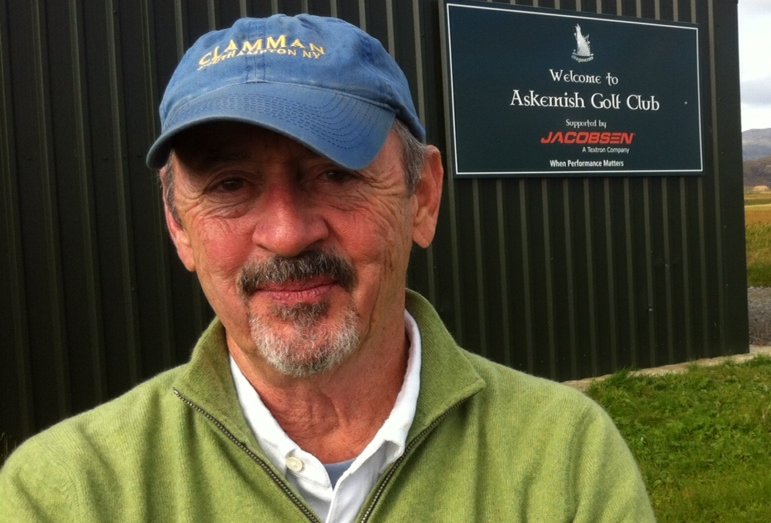
Billy Collins was the Poet Laureate of the United States from 2001 to 2003. He has taught at Lehman College, in the Bronx, since 1968, and he is a senior distinguished fellow of the Winter Park Institute, at Rollins College, in Winter Park, Florida. He’s also a golfer. This summer, he wrote to ask for advice about playing golf at Askernish, a restored Old Tom Morris course on the island of South Uist, off the northwestern coast of Scotland. I put him in touch with Ralph Thompson, the club’s chairman, and Collins visited with his fiancee, whose name is Suzannah.

bcaskernish

From Collins’s report:

Just back from the Western Isles to report a near transcendent golf experience at Askernish. When Ralph initially wrote back to me, he mentioned the upcoming Askernish Open, and after reading that sentence my heart sank with the assumption that I couldn’t play. But, as you might guess, his next sentence said he was entering me in the tournament.
Suzannah and I took the Oban car ferry (five-plus hours, two of gin rummy) and we drove to our hotel in the dark: the Orasay Inn, on the north end of the island. Next day was spent in churches and cemeteries doing some very unprofessional genealogical work (“Hey, here’s another MacIsaac!”) but not before a stop at the clubhouse, where Ralph said we could tee off straightaway, if we liked. But we had MacIsaacs to find. Next day, in the Open, I was paired with David Currie, a Toronto guy and an Askernish life member, who holds the golf club cack-handed — i.e., right one on top. Try that at the range.
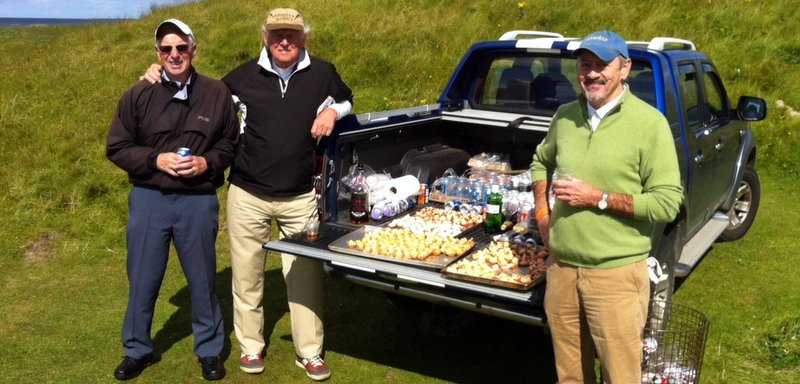
All I can say about the course is that it is pure links, and therefore the purest golf experience I have ever had, never mind my 103, partially the fault of rented, steel-shafted clubs. Glorious weather. And between the eighth and sixteenth greens stood a truck, tailgate down, whose bed was filled with drinks (whisky) and little bite-size salmon things with tiny wedges of lemon on them. I wolfed down about six.

bctruckbuffet

Here’s one of my favorite of Collins’s poems. It’s the second best poem ever written about golf:

Night Golf
I remember the night I discovered,
lying in bed in the dark,
that a few imagined holes of golf
worked much better than a thousand sheep,
that the local links,
not the cloudy pasture with its easy fence,
was the greener path to sleep.
How soothing to stroll the shadowy fairways,
to skirt the moon-blanched bunkers
and hear the night owl in the woods.
Who cared about the score
when the club swung with the ease of air
and I glided from shot to shot
over the mown and rolling ground,
alone and drowsy with my weightless bag?
Eighteen small cups punched into the
bristling grass,
eighteen flags limp on their sticks
in the silent, windless dark,
but in the bedroom with its luminous clock
and propped-open windows,
I got only as far as the seventh hole
before I drifted easily away—
the difficult seventh, “The Tester” they called it,
where, just as on the earlier holes,
I tapped in, dreamily, for birdie.

The best poem ever written about golf was written by me. Well, I did have a co-author—Emily Dickinson—and on a percentage basis she wrote more of it than I did. But I did contribute the crucial word:

Golf is the thing with feathers—
That perches on the soul—
And sings the tune without the words—
And never stops—at all—
I’ve heard it in the chillest land—
And on the strangest Sea—
Yet, never, in Extremity,
It asked a crumb—of Me.
Collins gave a terrific TED talk about poetry in 2012. You can watch it right here:

And you can read a poem he wrote about Askernish on the front page of the club’s website.

Two Golf Dreams, Featuring St. Andrews and Stevie Wonder

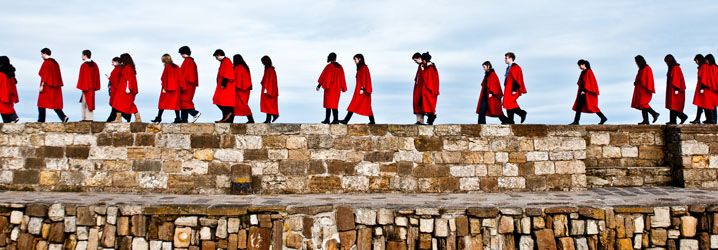
I’ve often wished that I’d taken up golf twenty years earlier, not only so that I could havekatieredgown wasted my physical prime on golf courses instead of in classrooms, libraries, and bars, but also so that I could have attended the University of St. Andrews instead of the college I did. I’d have bought a student golf ticket, which would have enabled me to play virtually free rounds on the Old Course and all the other Links Trust courses until I flunked out—and I still could have ended up in my current profession, since writing about golf requires no education at all. Instead, I’m forced to live vicariously through Slade, whose granddaughter Katie (in the sharp red gown in the photo at right) just matriculated at St. Andrews. As far as I’m concerned, she’s living the dream. And I know that the rest of the Sunday Morning Group shares my conviction that no one ought to pass her college career without frequent visits from her grandfather and his friends, who will be happy to camp out on the floor in her truly awesome-looking dormitory, which is barely a thousand yards from the first tee:

wardlaw

Closer to home, my friend Ellis recently had a golf-related dream, which had nothing to do with the Old Course but is of special interest because Ellis doesn’t play golf. Here’s his account:
My wife or girlfriend is Naomi, who is a real person I dated in the 1970s. She’s present when I’m approached to take part in some kind of TV event during which I’m to pretend to be Stevie Wonder. No singing, no makeup or disguise, just regular white old me, saying I’m Stevie Wonder. I say OK. We go to this big motel room, where there are a lot of TV tech people and others, plus broadcast equipment. I am given two golf clubs (a putter and an iron), and there is talk of a saxophone. Everyone behaves like this is an ordinary event, and nobody says, Hey, wait, you’re not Stevie Wonder.
There aren’t even any formal questions, or even a host. I kind of stand around, with the golf clubs, chatting with people. And that’s it. I realize that the event is over, and the crew starts packing up. One tech guy complains to me about his device and I nod as if I know what he’s talking about. I have a general sense that nobody really knows what they’re doing. Finally, Naomi and I leave, traverse some distance to “go home,” and end up at a wall covered with fabric. At the base of the wall is some sort of concealed hatch. She goes through it, I push down on it with whatever object I’ve been carrying, and prepare to go through it myself. And then I wake up.
And I hadn’t known Stevie Wonder was a golfer. The things we learn from dreams.


redgownsstandrews


The Sunday Morning Group Conquers All

trophythumb

Yale University has an undistinguished student body and a miserable football team, but it does have a tremendous golf course , which the U.S.G.A.—mysteriously but somehow characteristically—lists under “T,” for “The Course at Yale.” I’ve played two rounds there this year: one with Richard (a college classmate, who for two years lived within two doors of my own dormitory room but whom I didn’t meet until our thirty-fifth reunion), and one with Shep (an honorary member of the Sunday Morning Group) and his dad, Dick. Before I teed off with Shep and Dick, I visited the men’s locker room and discovered that the shelf above the sinks—mysteriously but somehow characteristically —held just a single toiletry item, a hair preparation I’d never heard of:

20140820_090031

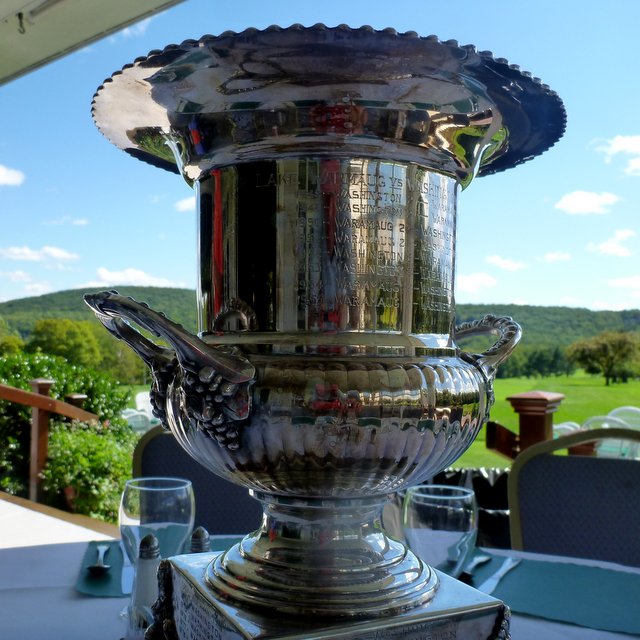
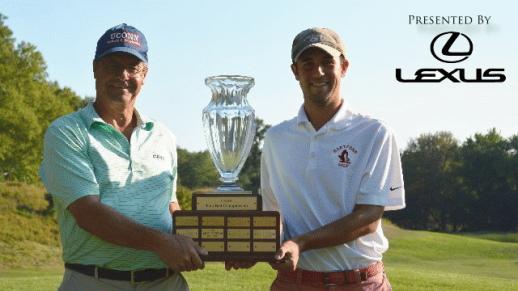
My two rounds at Yale, I’m pretty sure, “softened up” the course for Ray and Addison, who played there not long afterward, in our state golf association’s annual four-ball tournament, and won it by two shots, at seven under par. (They had no bogeys, and were one shot from tying the all-time tournament record.) They didn’t win a car, contrary to the clear suggestion in the photo below, but they did get their names engraved on a big trophy:

rayaddison

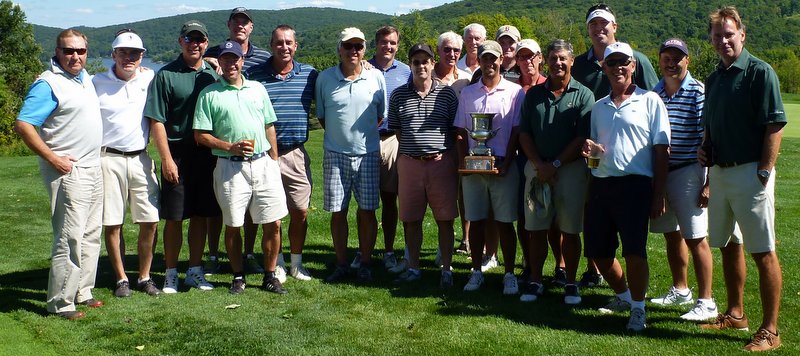
A few days later, our club beat our Enemy Club in our annual two-day home-and-home grudge match, which has been held every year since 1948. Each club’s team has ten players—in our case, all from S.M.G. Todd and I were partners the first day, and Ray and I were partners the second day, and when it was over the two teams posed together for a photo:

annualmatch

The very next day, Todd and Addison played in our state’s qualifier for the U.S.G.A.’s new national four-ball championship—and were the medalists, at five under par. (One stroke behind them were Ben D., an honorary member of the Sunday Morning Group, and his brother, Daniel—and just a week before that Ben had won another state event, the Tournament of Champions.) Because of their victory, Todd and Addison will be going to the Olympic Club, in San Francisco, in the spring, raising the possibility of a cross-country S.M.G. road trip.

One explanation for S.M.G.’s remarkable success in these things is that our locker room —despite being small, and equipped with just a single toilet, urinal, and shower—offers a rich selection of useful toiletries, plus a clock:

P1120121

Another is that hardly anybody went to Yale.

cathytattoo

The U.S.G.A. and R&A Should Adopt This Playoff Format (Among Other Things)

smgplayoff

Hacker (real name) came up fifteen dollars short on Sunday—something that hardly ever happens. He doesn’t count the money when he collects it before the Sunday Morning Group tees off, and he doesn’t keep track of who has paid and who hasn’t, yet the total is almost always exactly right. I know that I wasn’t the one who forgot to pay, because I’ve been on Martha’s Vineyard with my family. I’ve played golf just once, at Farm Neck Golf Club, the course I shared last summer with my close personal friend the President of the United States: 

president

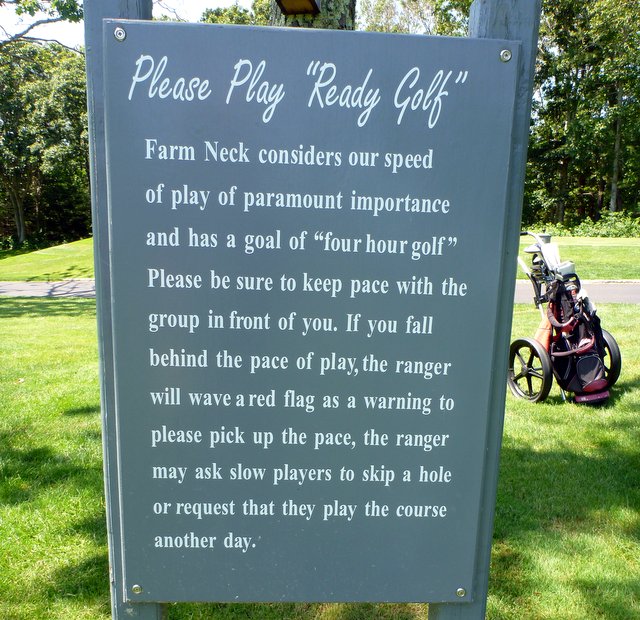
There’s a new sign near the first green:

P1130640

They used to ask people to play in four hours and fifteen minutes; four hours is better, although three and a half would be better still. I went as a single, and was grouped with a retired guy and two of his grandsons, who were in high school. They hadn’t played much golf before, but both of them were baseball players, and every so often they really clobbered the ball.

playingpartners

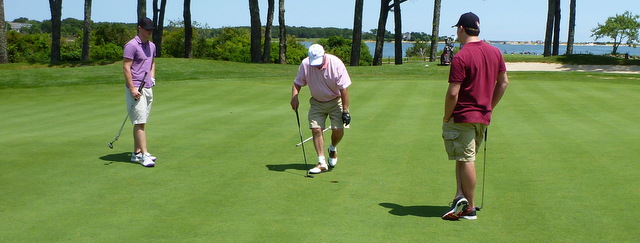
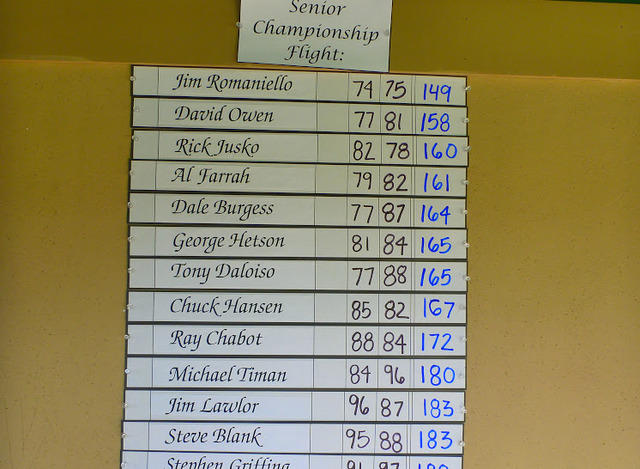
I had missed the previous Sunday at home, too, because I was playing in a two-day amateur tournament at Richter Park Golf Course, a terrific muny about forty minutes from where I live. Three S.M.G. guys—Rick, Tony, and I—played in the senior division, and we did pretty well:

seniorscoreboard

After 25 holes, I was tied, for about five seconds, with the guy who eventually won, but then I had some problems, including a quadruple bogey (from the middle of the fairway) on the eleventh hole. Still, the tournament was fun. And the guys who didn’t play at Richter had fun, too, because on Sunday S.M.G. had its first playoff of the year, after three teams tied at 16 under par. I’m kind of sorry I wasn’t there, because our playoff formats are the best in golf. On Sunday, the guys came up with a new one, in which the tied players had to sit in a chair on the patio and throw a ball onto the practice green by bouncing it off a picnic-table bench, closest to the hole:

20140720_115530

Hacker (who took the photo above, and the one at the top of this post) sent me a report:
Barney chose the bench to bounce the ball off of, and we made the guys sit on the far side of the round table, about nine feet from the bench. The stymie rule was in effect, as always, and we decided that any ball would count, even if it was off the green. We were worried at first that no one would be able to hit the bench, but that turned out not to be an issue, because Stan was the only one who missed it.
I’ll be back home soon—too late for that playoff, but just in time for the Men’s Member-Guest.

Up the Road From the Open: Ordeal by Asparagus, Death by Bacon, and the Formby Hippo

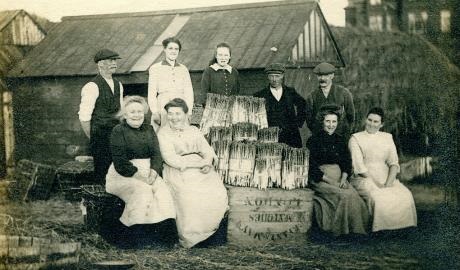
formbyasparagus Less than an hour up the Lancashire coast from Royal Liverpool Golf Club, where the 2014 Open was held, is the village of Formby, which is the home of two terrific courses, Formby Golf Club and Formby Ladies Golf Club. (It’s also the home of a forgettable Florida-style golf course, called Formby Hall.) Formby Golf Club abuts the Ainsdale Sand Dunes National Nature Reserve, one whose attractions is a small plot on which farmers grow asparagus, a once significant local crop. A man I met during a trip to the region last year told me that banquets for area golf-club captains held at Formby Golf Club had once been “ordeals by asparagus,” because diners had to be careful not to drip butter onto their red-silk tailcoats. I visited the Ainsdale dunes one afternoon between rounds, and, among other things, studied an informative historical display.

asparagusdisplay

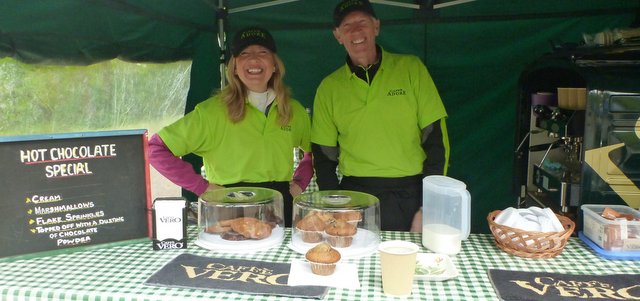
I also bought a cup of coffee at a mobile stand, which was operated by a middle-aged couple.

coffeestand

The man, whose name was Phil, noticed my golf cap and invited me to play golf with him and his son, Sean, at Southport & Ainsdale, a few miles farther up the road, where he was a member. We played a day or two later. The course is one of my many favorites in the area.

philsean

Phil is a retired Merseyside policeman. At lunch after our round, I asked him what his toughest case as a cop had been, and he told me about a forty-three-year-old woman who had died under mysterious circumstances. “I attended her autopsy,” he said, “because she was from a tough neighborhood and there was a presumption of foul play.” The pathologist was baffled, but then, as he was finishing up, he noticed something odd in her throat and gripped it with a clamp—like that scene in “Twin Peaks” in which Special Agent Dale Cooper finds a typed letter “R” under Laura Palmer’s fingernail. Phil said, “It was a piece of bacon rind, six or seven inches long. She had choked to death on a bacon sandwich”—an unsettling thought, since that’s what I was having for lunch, and since bacon is pretty much the No. 1 nutrient of the Sunday Morning Group.

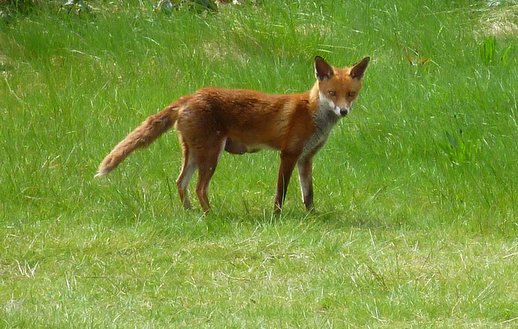
Incidentally, Formby has foxes in addition to asparagus:

formbyfox

And Southport & Ainsdale has rabbits:

rabbitwarren

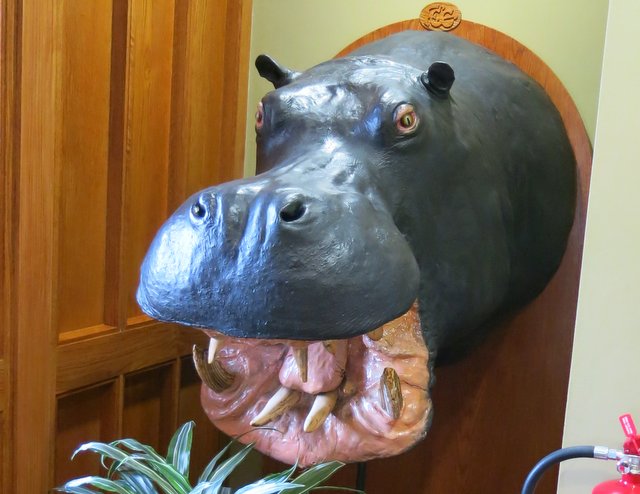
And Formby also has the Formby Hippo—about which I may have more to say later.

IMG_1348-001

Up the Road from the Open: The Hitler Trophy and the Hitler Tree

cockledick

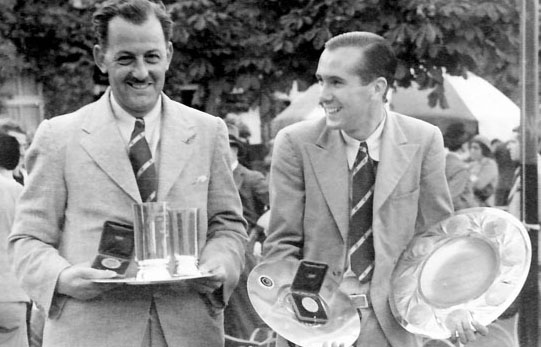
Hesketh Golf Club is an hour’s drive up the Lancashire coast from Royal Liverpool, where the Open is being played. It’s near the northern end of the resort town of Southport, and it has an enviable street address (see photo above). In 1936, the president of the German Golf Union was a brother-in-law of Joachim von Ribbentrop, who later became the foreign minister of the Third Reich. (Ribbentrop was executed for war crimes in Nuremberg in 1946.) In August, ten days after the close of the Summer Olympics, in Berlin, the golf union held an international tournament at Baden-Baden, in the Black Forest. According to English golf lore, Hitler believed that a German golf victory would soften the multiple humiliations that Jesse Owens had delivered during the Games. Seven countries participated, each represented by a pair of golfers. The format was seventy-two holes of stroke play over two days; each team’s score was the aggregate score of both its players. The English competitors were Tommy Thirsk, from Ganton Golf Club, and Arnold Bentley, from Hesketh:

thirskandbentley

After thirty-six holes, the Germans led by three strokes. According to a recent history by Derek Holden, Hesketh’s president, “Ribbentrop rashly notified Hitler that there would be a German victory. Elated, the Fuhrer set out for Baden-Baden to present the trophy to two members of his ‘master race.’” But Thirsk and Bentley dominated the final two rounds, and in the end they beat the Germans by twelve strokes and the French by four. Holden continues: “Ribbentrop then raced off by car to intercept Hitler and break the bad tidings. Hitler was furious, ordering his chauffeur to turn the car round.”

HitlerTrophy

The tournament trophy—a silver-gilt salver inlaid with faceted amber disks that from a distance look like egg yolks—eventually ended up in private hands, but was put up for auction in 2012. Hesketh acquired it for roughly £20,000, raised from members, after outbidding a German golf organization. Last year, Holden told me that he had been worried, initially, that Hesketh would have to compete in the auction with the Royal & Ancient Golf Club, which had sent a representative, and with collectors of Nazi memorabilia. But Hesketh prevailed, and the trophy is now displayed in the main grillroom.

trophycase

Bentley’s winnings at Baden-Baden included a small potted fir tree. He gave it to the club, which planted it on a small rise in front of the clubhouse. During the Second World War, members named it the Hitler Tree and used it as a urinal. You can still see it, if you visit Hesketh. (It’s now quite large, and is seldom—but not never—used as it was during the war.) The course isn’t one of the Liverpool area’s greatest, but its fourteenth and fifteenth holes are two of my favorites anywhere. Here’s the fourteenth, looking back from just beyond the green (with the clubhouse in the middle of the picture and the golf shop on the right, under the flagpole):

Fourteenth hole, Hesketh Golf Club, May, 2013.

Fourteenth hole, Hesketh Golf Club, May, 2013.

Sunday on TV: Two Great U.K. Links Courses, Two Great Golf Trips

P1040778

The Scottish Open—that is to say, the Aberdeen Asset Management Scottish Open—is being played at Royal Aberdeen Golf Club, in northeastern Scotland. My friends and I played two rounds there in 2008. The photo above is of some of the guys on the first tee. St. Andrews is just eighty miles to the south, but you could skip it and still put together a terrific golf trip, playing only courses within bicycling distance of Aberdeen. Maybe start at Carnoustie, on the northern side of the Firth of Tay. Then Forfar, a heathland course, definitely worth the twelve-mile trip inland:

forfarbridge

Then Royal Aberdeen, which you can study on TV on Sunday (the Golf Channel in the morning; NBC in the afternoon):

aberdeen2008

Then Murcar, which is so close to Royal Aberdeen that players on one course sometimes accidentally play onto the other. Here you are looking toward Murcar from Royal Aberdeen:

aberdeenmurcar

And here you are looking toward Royal Aberdeen from Murcar:

P1010917

Then Trump International, which I haven’t played yet but which I walked when it was nearing completion. Then maybe Newburgh-on-Ythan, where I played with two other guys named Dave. The course isn’t the greatest, but if you like to walk you can drive a couple of miles up the road and hike into a nature preserve whose many fascinating features include some enormous sand dunes, which are also visible from the course:

forviedune

You can also explore the remains of the village of Forvie, which was swallowed by blowing sand in the 1400s. All that’s left are some piles of stones and part of the village church, which was built on high ground:

forviekirk

Then Cruden Bay, which is one of my favorite courses anywhere:

crudenbay

Then maybe Peterhead (where I played with the pro), Inverallochy (where I accidentally set off the clubhouse alarm), and Fraserburgh, whose first and last holes could use some work but is otherwise terrific:

Fraserburgh15

There you go: a great golf trip, and you’ve put barely a hundred miles on your rental car. And if there are non-playing spouses along you can stop for occasional sightseeing without driving more than a mile or two out of your way:

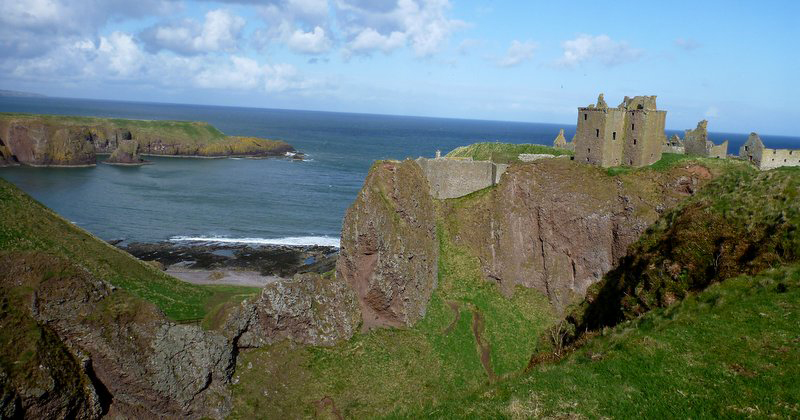
dunnottarcastle

Meanwhile, in England, the Women’s British Open—that is to say, the Ricoh Women’s British Open—is being held at Royal Birkdale, in northwestern England. (You can study the course on ESPN2.) My friends and I visited Birkdale in 2010 and I returned in 2013. Here’s Ray in 2010:

Ray at Royal Birkdale, May, 2010.

Ray at Royal Birkdale, May, 2010.

Birkdale lies near the center of what may be my favorite golf trip, the route for which runs along the Lancashire coast from Royal Liverpool, where the British Open will be played next week, about an hour to the south of Birkdale, to Royal Lytham & St. Annes, where the Open was played in 2012, about an hour to the north. I have an article about that trip coming up in a future issue of Golf Digest. In the meantime, I can tell you that in 2010 nine of us played fifteen rounds in eight days on eleven of the courses between Liverpool and Lytham, and at dinner on our last night in England the nine of us named eight of them as the one we’d most like to play again.

smgaberdeen2008

Reader’s Trip Report: Askernish Golf Club, South Uist, Scotland

Askernish satellite view

Askernish is on the island of South Uist, in the Outer Hebrides, off the coast of northwestern Scotland. 

grazing

I first visited in 2007, on assignment for Golf Digest, and I went back late the following year on assignment for The New Yorker. Getting to South Uist requires determination. In 2007, I flew from Inverness to Benbecula, which is one island to the north and is connected to South Uist by a half-mile-long causeway: 

causeway

In the air, I looked down, through breaks in the clouds, on the fjord-like creases that rumple Scotland’s west coast and on the waters of the Minch, the stormy channel that separates the Outer Hebrides from the Scottish mainland. The only other passengers were the day’s newspapers and two guys accompanying a load of cash for ATMs in Stornoway, on the Isle of Lewis, where we stopped first. Here are the newspapers, in containers belted into the seats:

newspapers on plane

In 2008, I took a ferry from Oban, which is a two-and-a-half-hour drive from Glasgow. The ferry sails three or four times a week and makes a brief stop at Barra, another island. I actually could have flown to Barra, although the flight schedule depends on the tides, because Barra’s runway is a beach:

Barra runway

The South Uist ferry trip takes about six and a half hours in good weather. We passed the islands of Mull, Coll, Muck, Eigg, Rum, Sanday, Sundray, Vatersay, Hellisay, Gighay, and Stack, among others. We also passed this lighthouse, on a tiny island called Eilean Musdile. It’s just off the shore of a larger island, called Lismore, which has a population of 146. The lighthouse was built in 1833:

lighthouse from ferry

Until 1974, cars on the South Uist ferry had to be loaded and unloaded with a crane, like freight; nowadays, you drive on and drive off. The ferry docks in Lochboisdale, a few miles from Askernish:

Lochboisdale harbor

The original course at Askernish was laid out in 1891 by Old Tom Morris. At some point, probably during the Second World War, most of Morris’s holes were abandoned, and until roughly a decade ago they were essentially forgotten. Since then, a plausible version of the old course has been restored, by a group that included Gordon Irvine, a Scottish golf-course consultant; Martin Ebert, an English golf architect and links-course specialist; Mike Keiser, the founder of Bandon Dunes; and Ralph Thompson, who used to be the manager of the island’s main agricultural supply store and now works full-time as the golf club’s chairman and principal promoter. Here are Irvine and Ebert, discussing the routing in 2008:

Irvine & Ebert

My New Yorker article about Askernish caught the attention David Currie, a reader and retired investment banker who lives on a small farm outside Toronto. (He’s front-row-center in the photo below.)  He first visited Askernish in 2010, and has since joined the club and returned two more times—most recently in June, for the first annual gathering of its “life members.” (I’m one, too, but couldn’t make it.)

OLYMPUS DIGITAL CAMERA

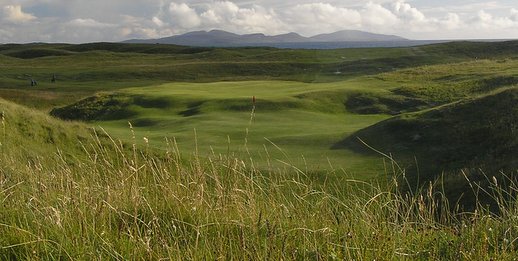
Currie also sent two photos of the course. Here’s the eighth hole:

OLYMPUS DIGITAL CAMERA

And here’s the sixteenth, Old Tom’s Pulpit, which is one of my favorite holes anywhere:]

OLYMPUS DIGITAL CAMERA

Currie writes:

I had always known that my roots were in the west coast of Scotland. Although my paternal grandparents came from the Glasgow area, I was aware that the Currie DNA was scattered along the coastal shores north of Glasgow. (Apparently, my ancestors slept around.) Other than that, I had little family history to go by. In 2011, Ralph Thompson mentioned that a Robert Currie had traveled to South Uist from New York to meet with the local council about erecting a memorial cairn acknowledging the contribution of Clan Currie to the cultural development of the island. I was present at the dedication of the cairn, in 2012:

OLYMPUS DIGITAL CAMERA

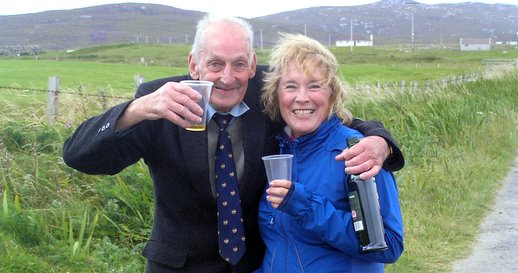
MacMhuirich was our original name centuries ago. And here’s a shot of my opportunistic wife, Liz, who never could resist a handsome man with his own whiskey bottle. Actually, the handsome man is Alasdair Macdonald, the owner of the croft where the cairn was erected:

OLYMPUS DIGITAL CAMERA

The Life Members Challenge was a Stableford. Currie came in second, one point behind Eric Iverson, an associate of the architect Tom Doak (who also played).

currie beer

Currie continues:
The initial six holes at Askernish can cause one to question what the fuss is all about. They are certainly quite nice, but nothing unusual or special. However, the WOW factor kicks in as you climb the dunes from sixth green to seventh tee and you stand there gazing out over the Atlantic Ocean. I thought I had died and gone to heaven, but I wasn’t about to allow that to happen, at least until I finished my round!

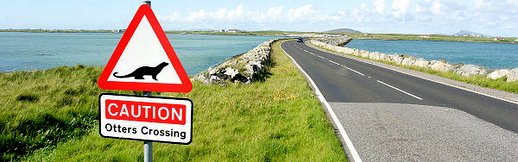
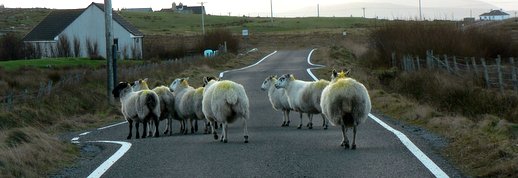
If you visit South Uist, drive carefully. Most of the roads are single-lane, and you have to share them.

sheep