Back-Roads Scotland: Forfar Golf Club

Forfar Golf Club, Scotland, May, 2007.

Forfar, Scotland, is a small town about dozen miles northwest of Carnoustie. Its most famous resident may be Bon Scott, the lead singer of the rock band AC/DC, who was born there in 1949 and died, of acute alcohol poisoning, in 1980.

Brian.

Forfar—prounouced FOR-fer—has a golf course, which was designed by James Braid. I pulled in one evening in 2007, to make sure I’d be able to find it the following morning. It was almost time for dinner, and I wasn’t really planning to play, but suddenly I found myself in the golf shop handing my credit card to the wife of the head pro. On the course, I soon caught up to and joined three members: Brian, a local builder, who sounded a little like Sean Connery and carried his golf bag by the handle, like a suitcase; Gavin, a retired local cultural administrator; and Michael, a jeweler. Here’s the sort of golfers they were: all three, despite having played the course regularly for many years, were surprised to learn that the round blue marker in the center of each fairway was 150 yards from the green. Gavin told me that the three of them played together almost every Monday evening because “then there’s no one in front and no one behind.” They took lots and lots and lots of swings, although we still finished in just about exactly three hours.

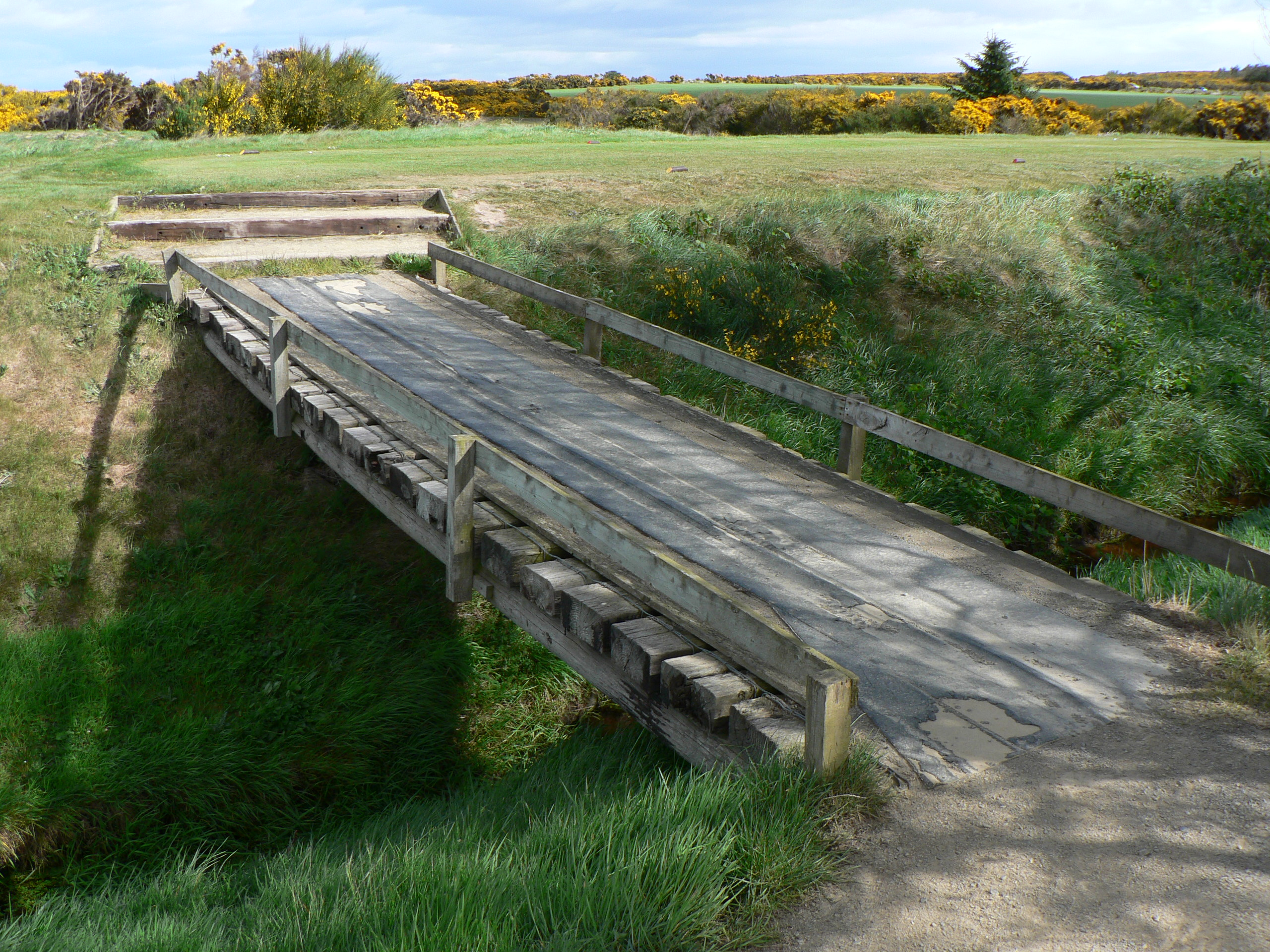
The next morning (after breakfast and a bucket of balls at the local driving range, on the other side of town), I played a second round at Forfar. A ladies’ medal competition was going on just ahead of me, so I had plenty of time to admire the course, which is well inland and is surrounded by farms but feels very much like a links course, in part because most of the fairways have distinctive undulations, like gentle ocean rollers—remnants of ancient flax furrows, Brian had told me. (You can see the furrows, sort of, in the photo at the top of this post.) And when I finished I still had time to kill, so I went around again. And the following year I came back, with friends from home.

If I were sure I’d return to Forfar as often as I’d like to, I’d accept an email solicitation I received a few days ago:

15 months membership for the price of 12!

New members can join straight away for the 2012 price of £485 (£460 + £25 bar credit) and receive membership of the Club through until 31st December 2013!

To join call now on 01307 463773.

The 2013 subscriptions for the remainder of the year are as follows:

Full Membership: £485*

5 Day: waiting list in operation
Under 25: £260
Family: £970** (2 adults & unlimited children)
Junior: £100 (17 & 18)
            £75 (12-16)
            £50 (8-11)
Country: £310
*includes £25 bar credit
**includes £50 bar credit

You will be assured of a warm welcome so please don’t hesitate to contact us by telephoning or sending an enquiry to our email address.

For more information on the benefits of membership at Forfar Golf Club please see below.

  • Excellent layout for all ability of golfers to enjoy.
  • Comfortable clubhouse with refurbished lounge & dining room
  • Driving Range facilities
  • Competitions every Thursday, Saturday and Sundays
  • Online tee time booking & Members Website
  • Unlimited Members guest tickets
  • Reciprocal arrangements with other Clubs for reduced greenfees and a member of the Association of James Braid Courses
  • Membership categories to meet your needs
  • Monthly Newsletter
  • SKY tv
  • Free WiFi
  • Excellent Catering facilities 7 days a week
  • PGA Pro with fully stocked golf shop
  • Discounted rate for FGC members on the Angus Council ‘Be Active’ scheme

Payment can be made by all the usual methods and the Club offers a Direct Debit scheme through Premium Credit Ltd.

Critical Golf Accessory: Pocket Handkerchief

There are several New Yorker writers and at least one award-winning novelist in this group. Lido Golf Club, Lido Beach, New York, September 21, 2012.

On Friday, at Lido Golf Club, three members of my foursome had an odd thing in common: we were carrying little packs of Kleenex, in response to a tenacious cold that’s been burning its way through the Northeast. Kleenex isn’t an ideal golf accessory, because it goes airborne in a breeze and doesn’t hold up to rain or even dew. On Saturday, back at home, I remembered to carry a handkerchief. As a result, I never did what I have often done when my nose was running on a golf course: find the least disgusting square inch of my golf towel and blow my nose into it.

Handkerchiefs have fallen out of use in the general population, but they’re good for golfers, especially in high winds, or during cold or allergy season. I paid fourteen dollars for a thirteen-pack of Van Heusen cotton handkerchiefs—just right for a week-long golf trip to Scotland or Ireland. If I had any sense, I’d keep at least one clean handkerchief in my golf bag all the time.

Incidentally, Kleenex facial tissues were introduced in 1924 as a “sanitary cold cream remover,” but sales remained modest until six years later, when Kimberly-Clark re-positioned them as disposable handkerchiefs. Times change.  In 2003, one of my nieces, who was eleven, saw her grandfather using a handkerchief and asked, with astonishment, “Is that a cloth Kleenex?” I had handkerchiefs when I was a kid—some with monograms—but I would bet that neither of my children, who are in their twenties, has ever used one.

Daniel Wexler, in his terrific book The Missing Links, devotes a chapter to the original Lido, which was designed by Charles Blair Macdonald and Seth Raynor. Bernard Darwin called it “the finest course in the world,” and Claude Harmon called it “the greatest golf course ever.” Part of the current course—which was designed by Robert Trent Jones in 1965—occupies part of the original property, but suburban tract houses cover much of the old layout, and Jones’s course is nothing special. Anyone interested in golf history should own a copy of The Missing Links—and not only because Wexler was a college roommate of my brother’s.

The modern Lido, with smoke stacks and a landfill on the far shore. JFK International Airport is about nine miles to the left.

Why a Golf Course is Not a “Links”

Rosapenna, Ireland, 2011.

Most people think of the word “links” as a synonym for golf course, but it’s actually a geological term. Linksland is a specific type of sandy, wind-sculpted coastal terrain—the word comes from the Old English hlinc, “rising ground”—and in its authentic form it exists in only a few places on earth, the most famous of which are in Great Britain and Ireland. Linksland arose at the end of the most recent ice age, when the retreat of the northern glacial sheet, accompanied by changes in sea level, exposed sand deposits and what had once been coastal shelves. Wind pushed the sand into dunes and rippling plains; ocean storms added more sand; and coarse grasses covered everything. Early Britons used linksland mainly for livestock grazing, since the ground closest to the sea was usually too starved and too exposed for growing crops. When significant numbers of Scotsmen became interested in smacking small balls with curved wooden sticks, as they first did in 1400 or so, the links was where they went (or were sent), perhaps because there they were in no one’s way. In some parts of Scotland, linksland is called machair, a Gaelic word. It’s pronounced “mocker,” more or less, but with the two central consonants represented by what sounds like a clearing of the throat. (Machair is the root of Machrihanish, a legendary links course on the Kintyre Peninsula, in western Scotland.)

Askernish, South Uist, Scotland, 2007.

The major design elements of a modern golf course are the synthetic analogues of various existing features of those early Scottish playing fields, and the fact that golf arose so directly from a particular landscape helps explain why, more than any other mainstream sport, it remains a game with a Jerusalem: it was permanently shaped by the ground on which it was invented. Groomed fairways are the descendants of the well-grazed valleys between the old linksland dunes; bunkers began as sandy depressions worn through thin turf by livestock huddling against coastal gales; the first greens and teeing grounds were flattish, elevated areas whose relatively short grass—closely grazed by rabbits and other animals, and stunted by brutal weather—made them the logical places to begin and end holes. (“A rabbit’s jawbone allows it to graze grass lower than a sheep,” the Scottish links consultant Gordon Irvine told me, “and both those animals can graze grass lower than a cow.”)

Askernish, South Uist, Scotland, 2007.

On the great old courses in the British Isles, the most celebrated holes often owe more to serendipity and to the vicissitudes of animal husbandry than they do to picks and shovels, since in the early years course design was more nearly an act of imagination and discovery than of physical construction. One of Old Tom Morris’s best-known holes, the fifth at Lahinch, in southwestern Ireland, is a short par 3 whose green is concealed behind a tall dune, so that the golfer’s target is invisible from the tee—a feature that almost any modern architect would have eliminated with a bulldozer. The greatest hole on the Old Course is often said to be the seventeenth, a long par 4 called the Road Hole, which violates a long list of modern design rules: the tee shot not only is blind but must be hit over the top of a tall wooden structure that reproduces the silhouette of a cluster of nineteenth-century coal sheds; the green repels approach shots from every direction and is fronted by a vortex-like circular bunker, from which the most prudent escape is often backward; a paved road runs directly alongside the green and is treated as a part of the course, meaning that golfers who play their way onto it must also play their way off.

The Road Hole, 2008.

Over the centuries, every idiosyncratic inch of the Old Course has acquired, for the faithful, an almost numinous aura. Alister MacKenzie once wrote, “I believe the real reason St. Andrews Old Course is infinitely superior to anything else is owing to the fact that it was constructed when no-one knew anything about the subject at all, and since then it has been considered too sacred to be touched.”

Royal Aberdeen, Scotland, 2008.

Masters Countdown: Ninth Hole

Augusta National's ninth green, 1935.

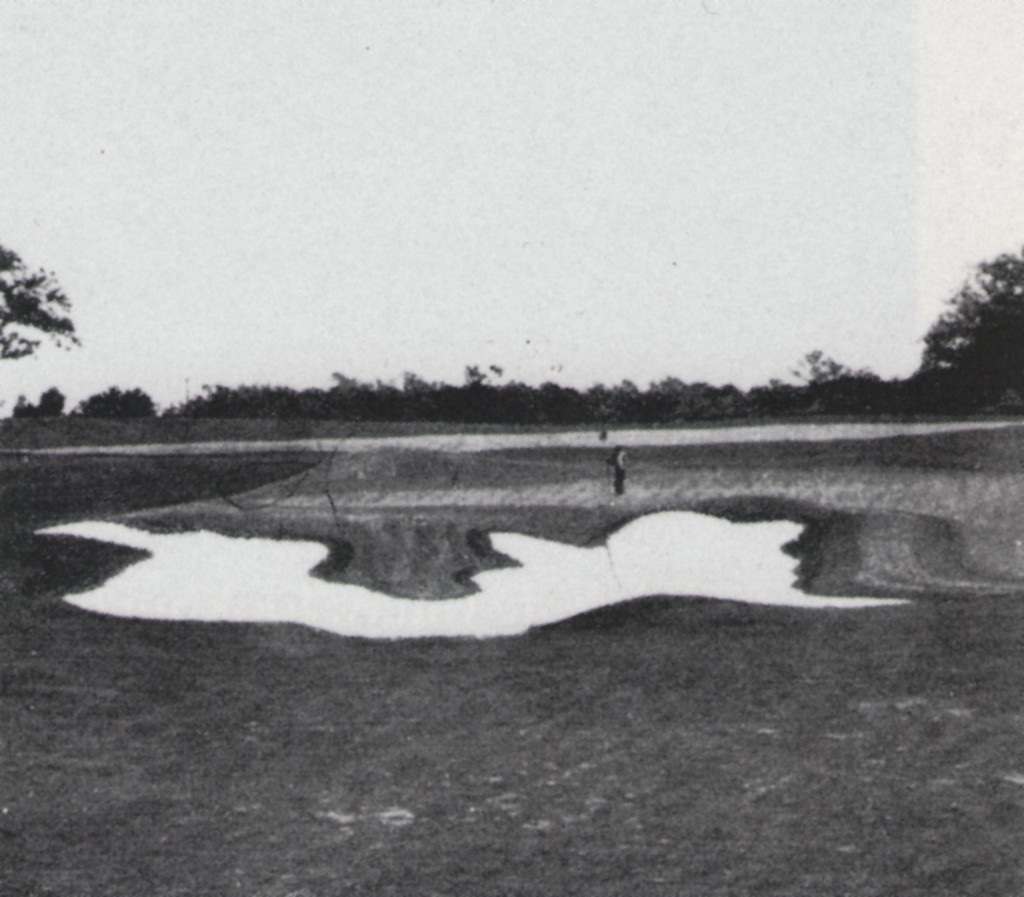
Clifford Roberts, Augusta National’s co-founder and first chairman, liked to say that he made only one contribution to the original design of the course. During the construction of the ninth hole, he persuaded the contractor to create a level landing area in the steeply tilting fairway at the distance he normally drove the ball (about 180 yards). “The engineer was not at all enthusiastic about accommodating me,” Roberts wrote in his book about the club, “but finally agreed to bring back a tractor and do the job.” Roberts later told friends that he had requested the change because he didn’t want any of his matches with Bobby Jones to be decided by his luck at hitting a fairway wood to an elevated green from a downhill, sidehill lie. The current ninth hole was then the eighteenth, and Jones customarily either gave Roberts nine strokes or allowed him to begin their matches with a nine-up edge. Even so, Roberts needed all the help he could get.

(Augusta National doesn’t use the U.S.G.A.’s handicapping method. It has its own simple system, devised by Roberts, which is based on the number of pars a player ordinarily shoots, with a small adjustment for birdies. Essentially, if you make six pars, your handicap is twelve. The Roberts system works well, is easy to compute, and allows daily modification.)

Roberts’s difficulties with the second shot on the ninth hole were shared by most of the club’s other members, who, like him and unlike Jones, weren’t long enough off the tee to come close to the ideal driving area, at the bottom of the hill. And neither Jones nor Alister MacKenzie, who designed the course, was at all disapproving of Roberts’s modification. In consultations among the three, Roberts’s role was to supply the viewpoint of the average golfer, and Jones and MacKenzie both solicited his opinion. Roberts’s landing area is still visible in the ninth fairway, and it still receives plentiful use from members and guests, as well as from occasional Masters competitors.

Hord Hardin, who was the president of the U.S.G.A. from 1968-69 and was Augusta National’s third chairman, between 1980 and 1991, told me a story in 1996, shortly before he died, that I’ve heard in several versions. Augusta National had a few women associate members in the early years. (Most, if not all, were members’ wives—possibly including Roberts’s first wife, Mary Agnes Bishop, whom he married in 1937 and from whom he was divorced not long afterward.) In the clubhouse one day, one of the women told Roberts that she had just made a hole-in-one on the eighth—a 500-plus-yard uphill par 5—and Roberts asked how that was possible. Hardin told me, “She was playing the ninth, and flat missed her tee shot. The ball hit a something off to the right, flopped up in the air, and went in the hole on the eighth green, no more than fifty yards away. When he heard that, Mr. Roberts is supposed to have said, ‘That’s it. No more women members.'” Roberts and Jones’s original plan for the club had included a second course, intended mostly for women, and a large women’s locker room, which was to have been situated in the huge new clubhouse they intended to build as soon as they could afford to tear down the dilapidated old plantation house. The Great Depression forced them to scale back their ambitions, and prevented them from demolishing what today is probably the most recognizable building in golf.

As the photograph above shows, the ninth green’s famous false front, which contributed to Greg Norman’s spectacular final-round collapse in 1996, was originally more pronounced. (Look at the far right-hand edge of the photo.) The ninth hole is also seventy yards longer than it was during the first tournament. The most recent extension was during the summer of 2001, when the Masters tee was moved back thirty yards and a high stone wall was built to seclude it from a service road just beyond it. At the same time, additional trees were planted on the left between the new tee and the members’ tee, to eliminate the possibility of tournament players’ using the first fairway as an alternate driving area, and new pine trees were planted along the right side of the ninth fairway, to tighten the landing zone. Even though the hole today is 460 yards long from the tournament tee, Masters competitors often have as little as a nine-iron or a wedge for their second shot.

Players, fans, and television commentators who claim that Augusta National had no rough until Hootie Johnson added the “second cut,” in 1999, should study the photograph below, which was taken at the 1949 Masters. The rough in the foreground is several times the height of any grass on the course today. And note the greenside bunker configuration. MacKenzie’s original large bunker was later reconfigured and divided into three, and then at some point after 1949 the bunker nearest the tee was removed.

Ninth hole, Augusta National, 1949 Masters.

That’s the end of my hole-by-hole Masters Countdown for this year. I’ll take it up again next spring, beginning with the tenth hole—although I’ll have one or two more things to say about the Masters before this year’s tournament is over.
Back-Roads Scotland: Moray Coast

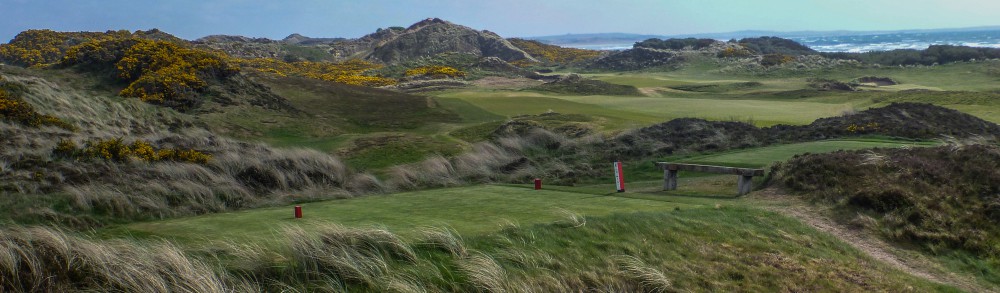
Lossiemouth, Scotland, March 26, 2012. Photo by John Thomson.

The photo above was taken this past Monday evening in Lossiemouth, Scotland, about two hours’ drive northwest of Aberdeen. You are looking across a corner of the North Sea toward the Moray Golf Club, the Lossiemouth Lighthouse, and both the waxing crescent moon and Venus. The photo was taken by John Thomson, a Moray member, whose Uncle Alistair was the club’s professional for thirty-one years and whose father was responsible for the construction of the club’s second eighteen. I haven’t played Moray, but I’ve gazed longingly at both the course and the clubhouse from the Stotfield Hotel, across the street. Here’s what I saw from the hotel’s front door during a trip in 2007:

Moray Golf Club, Lossiemouth, Scotland, 2007.

Moray is one of a number of fine links courses along on the Moray Firth’s southern edge, a hundred-mile stretch of golf-friendly coastline that runs between Inverness and Fraserburgh. Traveling golfers are probably most familiar with two courses at the western end, Castle Stuart and Nairn, which are popular stops for Americans on their way to Royal Dornoch. But those aren’t the only worthy courses on the Moray coast. Others: Nairn DunbarHopeman, Spey Bay, Buckpool, Strathlene, my beloved Cullen, Duff House Royal (not a links course, but significant because it was redesigned, in 1923, by Alister MacKenzie), Royal Tarlair, Rosehearty, and Fraserburgh. And there are many good inland courses nearby as well.

Lossiemouth would make a convenient base camp for any golf trip to the Moray coast. John Thomson, who took the photograph at the top of this post, owns the Links Lodge, a guest house next to the Stotfield; he also owns an adjacent three-bedroom self-catering apartment, the Beach View, which sleeps six. (If there are four golfers in your group, you can do what three Golf Digest editors and I did during a trip to southwestern Ireland in 2006: play a match to determine who will have to double up.) The Links Lodge served as Moray’s clubhouse for the first three years of the club’s existence, between 1889 and 1892; it was then replaced by the building in the photograph below. (The building has been enlarged considerably since then.)

Moray Golf Club, first dedicated clubhouse, 1892.

Thomson told me, “We only found out the Links Lodge was the original clubhouse while replacing a window: we took out a piece of frame with the carpenters’ delivery note still stuck to it.” The first owner, Thomson said, must have been one of the gentlemen in this photograph:

Founding members, Moray Golf Club, 1893.

He continued, “We boast not one but two prime ministers as members—and expelled one of them. We have one of the longest associations of any club in the world with our own labeled malt whiskey (since among the founders were some distillers). Dai Rees, Max Faulkner, and Fred Daly played exhibition matches here, and regular visitors included Ted Ray, Harry Vardon, J. H. Taylor, and James Braid.”

I’ll be in northeastern Scotland next month. My itinerary won’t take me to Lossiemouth, I’m sorry to say, although it will take me to Fraserburgh. I’ll report, eventually. In the meantime, here are a few photos of Hopeman, about four miles west of Moray. I took them in 2007. As you can see from the first, a breeze was blowing the day I played.


Masters Countdown: Eighth Hole

Augusta National's eighth green, 1935.

When the eighth green was built, it looked very much the way it does today, with tall, steeply contoured mounds on either side. In 1956, though, Clifford Roberts, the club’s co-founder and chairman, had the mounds removed. “That’s the only time I can really remember Mr. Jones getting mad at Cliff,” Phil Harison, a longtime member, told me in the late 1990s. “But he removed the mounds for a reason. They blocked the view of the spectators at the tournament, and once they were gone the spectators could see a lot better. But Mr. Jones got awfully upset about that. He really did, because without the mounds the hole was much less interesting, and the green didn’t look like any other green on the golf course.”

Augusta National's eighth green in 1956, after the mounds had been removed to improve sight lines for spectators.

Roberts never thought that removing the mounds improved the hole—and, indeed, the new green was dreadful. It was featureless and vaguely hourglass-shaped, and it could be approached without trepidation from almost any angle. But Roberts felt strongly that spectators ought to be able to see. Not long before he died, though, he decided that the sacrifice had been too great and that the mounds should be restored. The change was finally made in 1979, not quite two years after his death. Byron Nelson led the project, along with Joseph S. Finger, an architect who, among other accomplishments, had played golf at Rice University in the thirties on a team that was coached by Jimmy Demaret. In restoring the mounds, Nelson and Finger relied heavily on photographs taken during the thirties and forties. Harison—who had grown up in a house that used to stand just beyond the first green—consulted on the project as well. During the Second World War, when the course was closed, he had often ridden a motor bike over the mounds, and he told me that he retained a sort of physical memory of their shape.

Jones and Roberts used to ask Harison to fill out groups in Augusta National’s main member-member event, the Jamboree, beginning when he was thirteen; he and a partner won the event in 1941, when he was sixteen. He didn’t officially become a member until 1946, when he turned twenty-one, but at that time, he told me, Jones and Roberts kidded him by saying, “Oh, you’ve been a member for years.” Harison attended every Masters, beginning with the first, and was the tournament’s official starter for more than sixty years: it was he who introduced each player on the first tee—everyone from Bobby Jones to Tiger Woods. He died 2008, at the age of 82.

During 2001, the tournament tee on the eighth hole was moved back and to the players’ right—part of a course-wide effort, supervised primarily by Tom Fazio, to lengthen the course and increase the premium on accuracy and controlled shot shape off the tee. The fairway bunker was doubled in size and stretched toward the green. (The old bunker ended roughly at the peninsula of turf near the left center of the new bunker. See the photo below.)

The eighth hole has had a fairway bunker in approximately the same position since the course opened. Changes in its size and in the location of the tournament tee—all of which were made, in part, to keep the bunker in play—provide a good indication of how much tournament players’ driving distance has increased since the early 1930s: the far edge of the bunker today is roughly a hundred yards farther from the tee than it was during the first Masters.

Looking back toward the tee from the eighth green. The hole's single bunker is on the left.

Masters Countdown: Seventh Hole


A not especially intelligible drawing of Augusta National's seventh green, from the program for the first Masters, in 1934, when the seventh had no bunkers.

The seventh wasn’t much of a hole in the early days. (The consensus, as described by Clifford Roberts, the club’s co-founder and chairman, was that it was “the only weak hole out of the eighteen.”) Alister MacKenzie, who designed the course, likened it to the eighteenth at St. Andrews, but the resemblance was superficial. Both holes were short, and both had large greens and no bunkers, but in comparison with the venerable and surprisingly difficult closing hole of the Old Course, the seventh at Augusta was a pushover. Many players today would have been able to drive it.

In a letter to MacKenzie in 1933, Roberts wrote, “I think the real criticism . . . is that it lacks character. Ed Dudley [the club’s first professional] made a suggestion which appealed very much to me. He proposed putting a bunker in the middle of the face of the green and letting it wedge into the green. In other words, his thought is to partly develop this green into two sections, the same as is true of one of the greens at Lakeside, California. Bob [Bobby Jones] did not have very much to say about this proposal, but I do not think he was much impressed by it. I think, in truth, that Bob is really hesitant about making any alterations or incidental refinements till you can come here and see the layout.”

Perry Maxwell

Nothing significant happened until 1938, when Horton Smith—who had won the first and third tournaments—suggested elevating the green and fronting it with several deep bunkers. He also suggested moving the green twenty yards back and to the right. Jones and Roberts both approved. The design work was done by Perry
Maxwell, an Oklahoma banker-turned-architect, whose best-known course is probably Tulsa’s Southern Hills. Maxwell had been a partner of MacKenzie’s during the final years of MacKenzie’s life. (Their last joint project, completed in 1933, was Crystal Downs, in Frankfort, Michigan.) The transformation of the seventh green, which cost $2,500, was paid for by Lewis B. Maytag, who was one of the club’s earliest members and was the head of the Maytag Company. In addition, the driving area was tightened through the addition of a grove of pine trees on the left side of the fairway. (There were already trees on the right.)

Maxwell made several less dramatic changes in other greens—among them the first and the fourteenth, to which he added pronounced undulations. Such undulations were his trademark and were known as “Maxwell rolls.” MacKenzie was no longer alive at that time, but he undoubtedly would have approved: he loved dramatic contours. In The Spirit of St. Andrews, he wrote wistfully about the early greens at Machrihanish, a legendary links course, designed by Old Tom Morris, on the Kintyre peninsula in western Scotland: “Some of the natural greens were so undulating that at times one had to putt twenty or thirty yards round to lay dead at a hole only five yards away. These greens have all gone and today one loses all the joy of outwitting an opponent by making spectacular putts of this description.” For the disappearance of such features, MacKenzie blamed a preoccupation with the elimination of “unfairness”—a word that he scornfully placed in quotation marks.

Today, the seventh is 450 yards long—110 yards longer than it was for the first Masters—and the landing area is narrow. Just fifteen years ago, the seventh was considered a birdie hole, even by members. Now it’s a tough par for any player whose tee shot ends up in the pine straw.

Masters Countdown: Fifth Hole

Augusta National's fifth green in 1935.

The fifth hole is the centerpiece of what has sometimes been called Augusta National’s other Amen Corner. It’s ranked by more than a few players as the second best par-four on the course (after the tenth), and television cameras don’t do justice to its dramatic topography. Alister MacKenzie, who designed the course, felt that the fifth was descended in spirit from the Road Hole—the much feared seventeenth hole on the Old Course at St. Andrews. The main similarity may be in the difficulty of the approach shot, since balls that land short invariably stay short, while balls that are hit long occasionally disappear for good in the trees and shrubbery beyond the green. The perils of the green make Jack Nicklaus’s achievement during the 1996 Masters seem all the more astonishing: he eagled the fifth twice, in consecutive rounds.

The pair of large, steep bunkers on the left side of the fairway are a characteristic MacKenzie hazard. (Equally characteristically, Bobby Jones initially felt that the bunkers were superfluous, and they were not added until after the course had opened.) As originally positioned, they were more of a visual hazard than an actual one, since even in the early years players didn’t have much trouble driving over them or playing safely to the right. (The bunkers often aided less skilled players, by stopping pulled or hooked drives that might otherwise have run down the steep hill and out of play—as Wendell Miller, the contractor, predicted they would, in May, 1933, while making an unsuccessful attempt to interest Jones in adding the bunkers then.) MacKenzie, throughout his career as an architect, made frequent use of course features that were essentially optical illusions: seemingly narrow fairways that were ampler than they appeared from the tee; seemingly ample fairways on which the ideal landing areas were narrow and precise; large greens that seemed to provide huge targets but were contoured so that reasonably simple putts could be earned only with brilliant approaches—and bunkers that looked threatening from a distance but were easy to carry. He felt that easily avoided fairway bunkers were good for a player’s self-confidence and sense of achievement.

By 2002, the bunkers had long since ceased to serve even as visual hazards for the vast majority of Masters competitors. Under the direction of Tom Fazio, the tournament tees were moved back, the fairway was reconfigured, and the bunkers were reshaped, deepened, and moved closer to the green. The carry over the farther bunker from the Masters tees is now more than 315 yards, uphill, and both bunkers are so deep that reaching the green from either one is impossible, or nearly so. Each bunker has an almost vertical forward face, on which a thin layer of sand is held in place by a fabric liner, which also prevents balls from becoming embedded.

The fifth fairway caused problems for many years. Buried stones continually worked their way to the surface, where they were a threat to golf swings and mower blades. Finally, in 1962, the club resurfaced the fairway (and also the seventh) with new topsoil. When the job was complete, Clifford Roberts, the club’s co-founder and chairman, devised a characteristically simple method of testing the results: he asked Phil Wahl, the club’s manager, to drive a golf cart up and down the fairway at full speed and report back on the smoothness of the ride.

Back-Roads Scotland: Cullen

In 2007, I traveled to Scotland on an unusual Golf Digest assignment. I landed in Glasgow without tee times or an itinerary, and I rented a car and set out in a more or less random direction, with the goal of playing only courses I’d never heard of before. You can read my article about that trip here or here.

One of my favorite stops was a quirky course called Cullen, in Aberdeenshire, on the southern coast of the Moray Firth. The original nine holes were laid out by Old Tom Morris, and the course has blind shots, crossing fairways, otherworldly topography, and a cool tee shot that you hit from the top of a cliff. Partway through my round, I joined (as the fifth player) a group of older golfers from a club called Hopeman, about thirty miles to the west. They were on a golf outing, and this was their second round of the day, and they were playing a scramble, in competition with three other groups from their club. Most of them were carrying flasks, from which they were sipping a mixture of something and Drambuie—I couldn’t quite make out the recipe—and their golf bags were so full of empty beer bottles that they clanked when the wind, which was fierce, knocked them over.

They urged me to have a swig from one of their flasks. I declined, because I’d quit drinking about a year before, but they were so relentless that I eventually decided it would be better to risk falling off the wagon than to come to blows. As soon as I’d drunk a capful, though, they began to worry about their supply. “Are you driving?” one asked. His brow was furrowed with concern. When I said I was, he and the others concluded that offering me another swig or a beer would be unwise. Toward the end of the round, one of them asked, in a slurry brogue, “Wha hoe wah noo?” and only I could understand him: “What hole are we on now?” (It was the seventeenth.) Photo below. That’s the eighteenth green in the distance. I went back a year later with friends from home.

The boys from Hopeman: "Wha hoe wah noo?"

The specialty in the clubhouse—at left in the photo above, behind the big rock—is Cullen Skink, a fish soup that has its own Wikipedia entry.

The bent flag shows how hard the wind was blowing.

Looking back toward the clubhouse and the town.

The boys from Hopeman and some of their beverages.

Here’s where my friends and I stayed in Cullen when we went back the following year:

Masters Countdown: Third Hole

Augusta National's third green, 1935.

Augusta National’s third hole has probably undergone fewer changes than any other hole on the course. Its principal feature today, as was true in the beginning, is a treacherously shaped green, which sits on a tilted natural plateau. Dropping off from the shallow left end of the green is a deep bunker from which pars can be difficult to save. The green is hard to hit and harder to hold, and approaches to it are complicated by the fact that the putting surface is invisible from the fairway.

In 1933, Clifford Roberts, the club’s co-founder and chairman, wrote a letter to Alister MacKenzie, who had designed the course, in which he suggested adding a deep cross bunker in the face of the plateau directly in front of the green. “It was my understanding,” Roberts wrote, “that the deep-face trap located in about the center would make this a definite drive and pitch hole; that is to say, a well struck pitch would be required in order to hold the green and the trap would make it impossible to play a run-up shot.” MacKenzie was vehement in vetoing that idea—which Roberts had admitted Jones didn’t support—and his response contains so much of his thinking about design that it is worth quoting at length:

I am delighted that Bob agrees that the [third] with the one trap is all right. This confirms my impression that Bob knows more about golf and its sound principles than any man I have ever come across.

My own opinion is that a cross bunker would convert it into an ordinary stereotyped hole and would nullify all the subtleties of the undulations of the approach to which we gave so much time and thought.

Consider the many problems which face a golfer approaching the hole. In the first place he can play safely to the right and rely on a long putt going dead to get his four. If he elects to go straight at the flag he must play a perfect pitch or else his ball would hit the bank and come back or run over the green. On the other hand if he tries to run up from the right his shot must be played perfectly as a half hearted run up shot will inevitably run into the bunker on the left, which appears to me to be absolutely perfect both in regard to its position and its construction.

At this hole the super golfer, like Bob, has a most fascinating problem, as to have a reasonable chance of three he will have to attack the hole from the left, where all the slopes help him towards the hole. It is here that the tee-shot bunker comes in as he must make up his mind to play round it with a pulled shot from right to left or a fade from left to right, or, when a strong wind is in his favour, to play over it.

If the approach to this hole is maintained as hard and as true as the green it will make the most perfect hole of its length in the world of golf and any additional bunker would ruin it.

It is holes of this description that keep up one’s interest in golf year after year, stimulate players to improve their game and prevent golf becoming stale.

Jones didn’t think as highly of the third hole as MacKenzie did; his favorite par-fours almost all required long-iron or fairway-wood approaches—shots at which he excelled. But MacKenzie’s conviction has been borne out over the years. Of all the architects who have worked on the course, none has yet made a persuasive case for a major revision. (The single original fairway bunker became a cluster of four fairway bunkers in 1983, but the impact on tee shots didn’t change.) The third hole remains the shortest par-four on the course, yet it was one of the few holes that consistently gave Tiger Woods trouble during his record victory in 1997. (On Friday, he hit a bullet-like drive to within fifteen yards of the green, yet made a bogey.) In fact, the experience of Woods and other long-hitting players suggests that one effective way to “Tiger-proof” a golf hole may be to shorten it.