Another Beef About My Golf Bag

The annoying part in question, lower right-hand corner.

While we’re on the subject of golf-bag design, I’d like to raise the topic of legs. My first Sun Mountain bag (which had the Titleist name on it) worked great, and I liked it so much that I wore it out. My second, third, and fourth Sun Mountain bags, however, had a problem that it took me some time to diagnose. After a while, the bag stand on each would become noticeably harder to use, and eventually I found that I had to really slam the bag on the ground to get the legs to extend far enough to make it stand up.
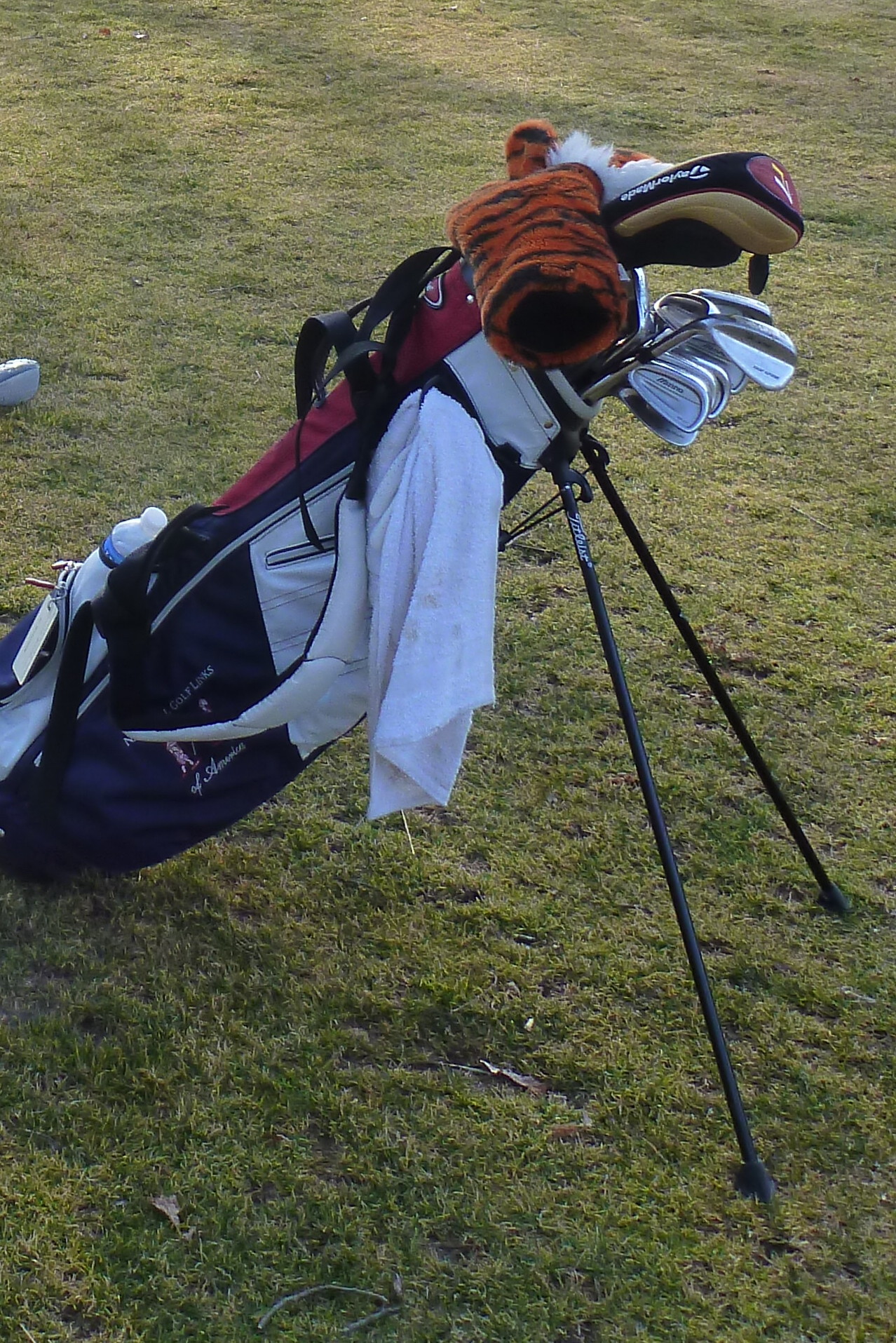
Titleist bag (made by Sun Mountain) with the same problematic leg joint.

The problem, I finally realized, was that that the plastic joint connecting the leg to the bag had twisted, from the stress of repeated use, and no longer pushed the legs out as far or as easily as it had originally. That couldn’t happen with the original design, because on those bags the joint was super-sturdy—a solid hunk of plastic that couldn’t be torqued out of alignment.

Bag with original, untwistable leg joint.

I solved this problem for myself by performing a radical legectomy on my first Sun Mountain bag (which I still had in my garage because I never throw away golf stuff) and transplanting those legs onto my current Sun Mountain bag—which now works great. I mentioned this to Rick Reimers, the C.E.O. of Sun Mountain (whom we should all bow down to for his long record of fearless innovation), at the P.G.A. Golf Merchandise Show, in Orlando, back in January. He wrote down my gripe on an index card but said he’d never heard of it before. I know I’m not making this up, because other guys I play golf with have noticed it, too. Or maybe we just play insanely many rounds and therefore have difficulties that normal people don’t. Thoughts?

Sun Mountain, Please Fix This Problem

Sharpie inserted all the way into the pen holder on Tony’s Sun Mountain golf bag.

I own pretty many Sun Mountain products—golf bag, push cart, rain suit, travel case—and I’m generally satisfied with all of them. I even defended Sun Mountain’s rain suits after all that trouble at the Ryder Cup. But Sun Mountain golf bags (and golf bags that Sun Mountain makes for Titleist) have an annoying defect that I first pointed out to the company, to no avail, eight or ten years ago: the pen holder on the bag (see photo above) is too shallow to engage the pocket clip on the cap of a Sharpie, which is the de facto official indelible ball-marking pen of the game of golf. As a result, the pen holder cannot be used for the only thing it’s meant to be used for. If you put a Sharpie in the pen holder on a Sun Mountain golf bag, the Sharpie will fall out, either during your golf round or, later, when you throw your bag into the trunk of your car. Making the pen holder a half-inch deeper would cost nothing but would solve the problem. Why hasn’t this been done?

18 Good Things About Golf: No. 10

Stanley, with a golf accessory designed to speed up play.

10.  Although golf is expensive in absolute terms, on an hourly basis it isn’t much costlier than bowling. A perfectly serviceable set of used clubs can be had for a couple of hundred dollars—or less, if you know an obsessive with a garage full of equipment he can no longer stand to look at. An hour or two spent poking through the bushes on virtually any course will turn up a month’s supply of balls. Sneakers can usually be worn instead of golf shoes, especially now that golf shoes increasingly look like sneakers. Even relatively fancy courses now offer recession-inspired discounts on greens fees and memberships. I know hunters and fishermen who spend more.

The truly oppressive cost of golf is the cost in time: dawdling choppers make life miserable for everyone stuck behind them. They transform what ought to be a pleasurable diversion into an all-day slog, and they hurt the game itself, by increasing the national supply of player frustration and spousal resentment. The ideal solution would be for everyone to play faster, but since that’s unlikely to happen the best remedy is to bypass the slowpokes, by avoiding, whenever possible, the most popular times, days, weeks, and months. My friends and I often go out late in the afternoon for what we call a Two-Hour Eighteen™: a full round, on foot, faster than most Americans play nine holes in a cart. We pick times when our course is likely to be empty or nearly so, and we don’t take practice swings, agonize about where to aim putts we weren’t going to make anyway, or stand still while other people hit. When you can comfortably play eighteen holes in two hours or two hours and fifteen minutes, you can put in a reasonable day’s work, get in a full round, enjoy a beer with your pals, and still be home in time to ask, “Hey, Honey, what’s for dinner?”

When I took up golf, twenty years ago, I worried that I was too horrible to swing in public. But I soon realized that, bad though I was, I wasn’t much worse than most of the other golfers I saw, and that even the good ones didn’t mind playing with me as long as I kept up. In fact, they scarcely noticed me at all, so absorbed were they in their own struggles. As my friend Jim explained, “Nobody ever gave a shit about how anybody else played golf.

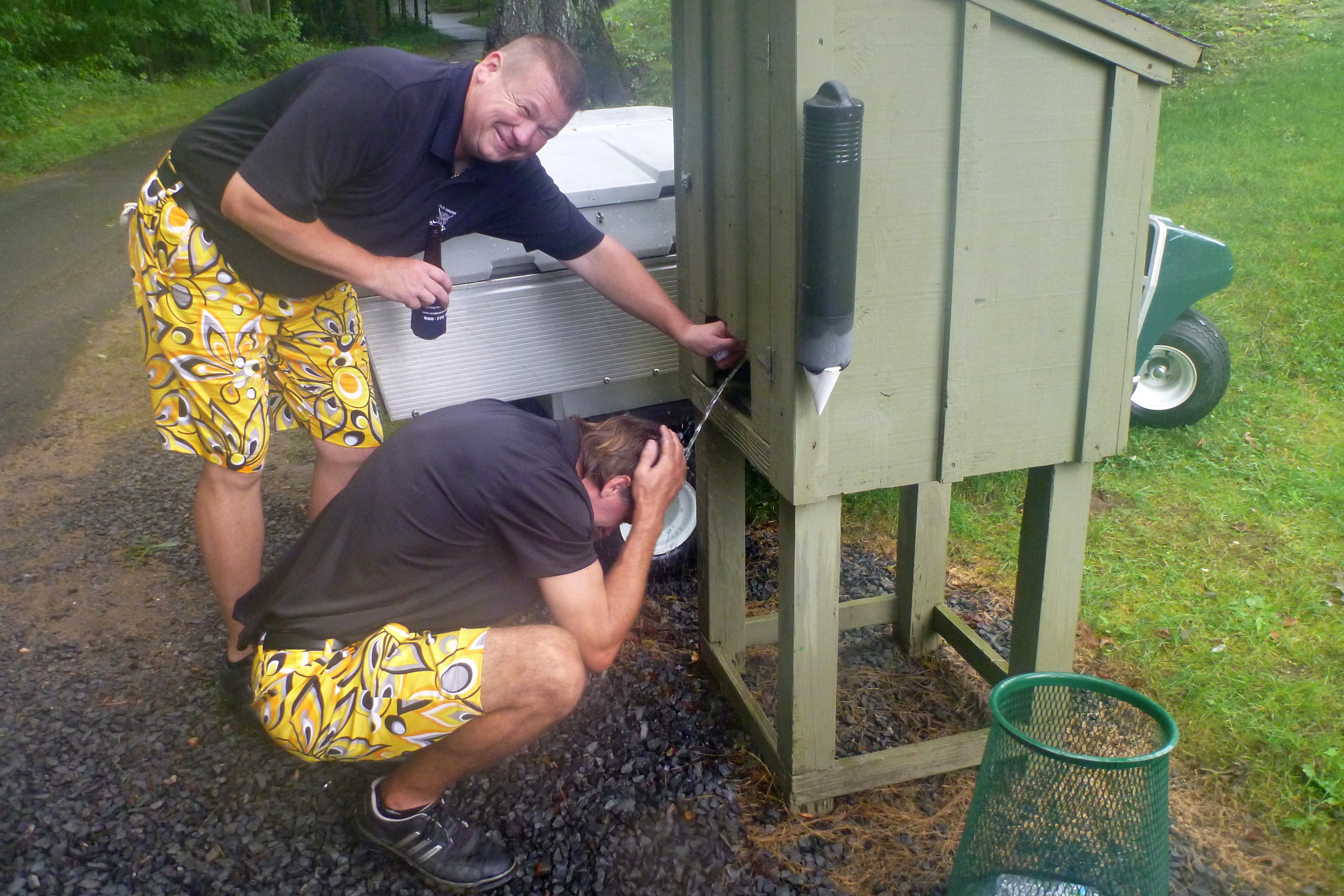
Save time by showering at the course. Member-Guest 2011.

For Memorial Day: How to Remember Deceased Golfers

The Amerman Tree (right), Memorial Day weekend, 2012.

During a tournament one year, I used a very bad word to curse a former member of my club. It was nothing personal. I’d hit a weak banana from the tee, and my line to the green was now blocked by the Amerman Tree, which memorializes a deceased past president of the board of governors. I never knew Mr. Amerman, but I curse him every time I slice a drive into the steadily expanding circumference of his memory.

As I punched my ball sideways into the fairway that day, it occurred to me that planting a tree in the line of play is a terrible way to honor a dearly departed member. Golfers don’t really even like trees, except in the abstract. A memorial maple may seem like a fitting monument on the day it’s planted, but once its trunk has grown thick enough to stand straight without being staked it begins to grate on the nerves of the survivors.

Golfers don't really even like trees, except in the abstract. That's Howard behind the first green.

There’s a better way: Instead of honoring the dead by creating annoyances in their behalf, why not remember them with golf balls? Most golf shops sell thousands every season. What if each one were imprinted with the name of a member who had died the year before?

Your guest in the member-guest would need an explanation. “His name’s on all the balls,” you’d say. “Nice old guy. Died last year. Played the course in eight different decades. Used a three-wood when he played in the snow.”

You’d think of him every time you played. If his name was long enough, you’d use it to line up putts. On your trip to Scotland in July, you’d launch a few into the whins in his honor.

As each summer slipped away, your club’s supply of memorial balls would gradually disperse itself: into the weeds, into the trees, over the walls, around the world. The following spring, your golf shop would be stocked again, with balls bearing new names—but the previous year’s batch would keep turning up for decades, the way old golf balls always do. They’d materialize in shag bags. Caddies would find them in the woods. Old-timers would retrieve them from the pond. A new member would step on one in the fescue near the pump house and ask about the name.

“Nice old guy. Died a few years ago. Caddied for Titanic Thompson once. Runner-up in the club championship. Navy in the Pacific in World War Two. And he never walked past the Amerman Tree without breaking off a branch.”

4 Things You Need to Know About Golf Hats

The photo above shows how to “fold” a golf cap, by bringing the rear band underneath and sliding it over the bill. The band preserves the curve of the bill, and  you can easily slip the whole thing into a golf bag or a suitcase. If you own more golf caps than you will conceivably be able to wear out during the years remaining to you, as you probably do, you can fold your excess inventory and store it in gym bags, like this:

You can keep one of these bags in the trunk of your car and store the others in the attic of your house, rotating every season or so. (When you take off your cap upon entering a clubhouse or a grill room, you don’t need to fold it. Just tuck the bill into the back of your pants, the way a waiter does with an order pad. That way, many beers later, you won’t leave your cap lying on the table.)

To keep your favorite golf caps clean, you need one of these:

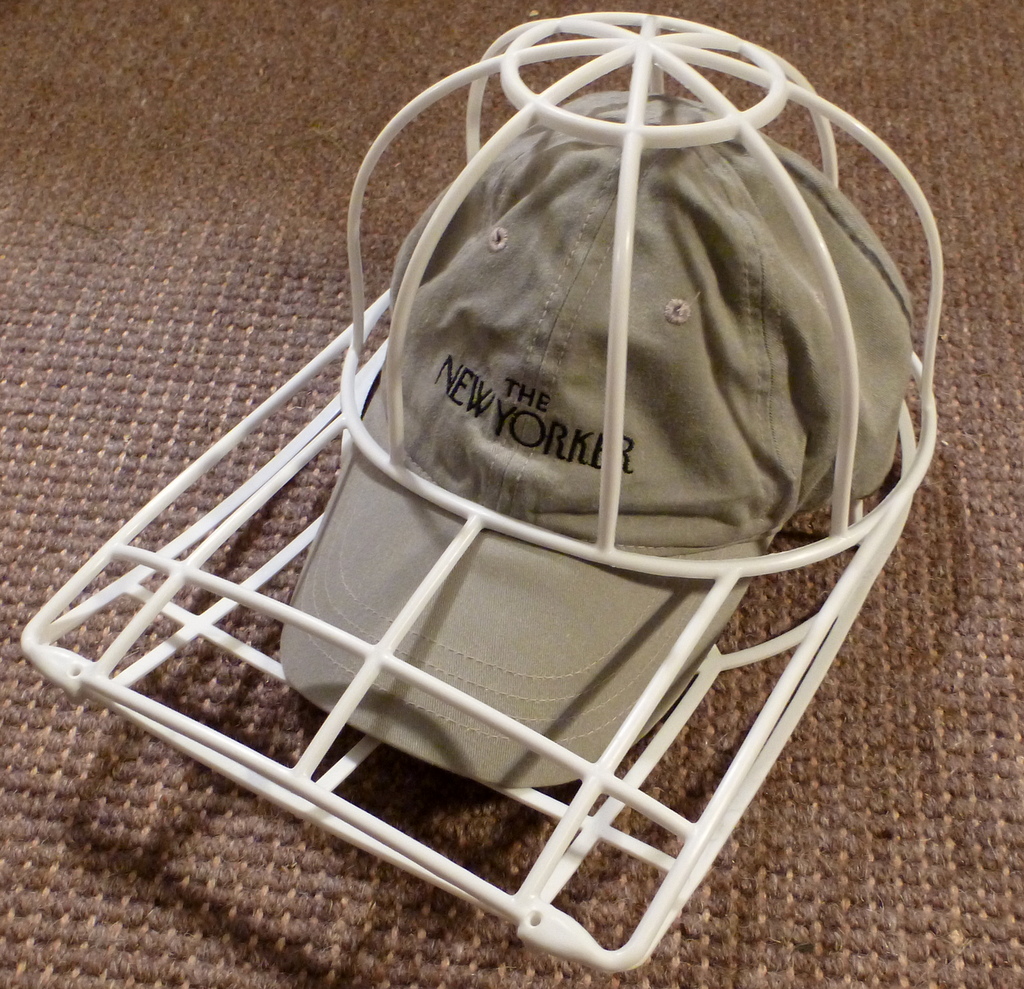
It’s a plastic frame that lets you wash your caps in the dishwasher, one at a time. You snap the cap inside it and run it through a complete washing cycle, then allow it to air dry. (No heat.) Amazon sells several versions. Here’s what a cap looks like when it’s in the frame:

The frame does a good job of preserving the cap’s shape, and the dishwasher kills cooties.

If you play golf in the rain, as you should, you need a good rain hat. Unfortunately, no golf-equipment company makes a really great one. Fortunately, Outdoor Research does. It’s called a Seattle Sombrero, and although it’s intended mainly for kayakers, hikers, and fishermen it’s perfect for golfers. It comes in real sizes and is adjustable; it has a chinstrap, which is useful in high winds; it has a brim that is broad enough to keep water from spattering your glasses or running down your neck; it has Velcro strips that let you stick the sides of the brim to the crown when you don’t need them. You can also throw it in the washing machine, if you need to. It’s a great hat:


These are the Best Golf Shoes, and I’m Not Kidding

The True Linkswear golf shoes of Tony, David O., Tim-o, & Tim. Royal Portrush Golf Club, Northern Ireland, April, 2012.

Among the hits of last year’s PGA Golf Merchandise Show were some unusual golf shoes, made by True Linkswear. They look a little like Earth Shoes and a little like Crocs: the front end is wide, allowing your toes to spread out the way they do when you walk barefoot, and there’s almost no heel. A teaching pro who now works for the company told me, “It took me a week to get over it, visually.” But golfers learn to love the look, he said, and are often able to throw away their orthotics, like crutches at a revival meeting. (It’s also possible that True Linkswear shoes promote a slightly better swing, by making it harder for you to lean over your toes.) The company’s reps brought 300 pairs to Orlando but had to stop selling them after just a few hours because they were running out of samples. By the time I got to the booth, they no longer had a pair in my size, but the ones I tried on—which were half a size too small—were still the most comfortable golf shoes I’d ever worn. I now own four pairs.

I took two of those pairs to Ireland this month, along with some New Balance walking shoes. I figured that the walking shoes would be good for après-golf—but I was wrong about that, because by comparison with my golf shoes they felt like army boots. I wore the walking shoes when we went out to dinner our first evening in Ireland but left them in the car after that, and wore only my golf shoes. And I never felt even a twinge, despite the fact that, according to Tim-o’s Fitbit Ultra, we walked between eighteen and twenty-two miles a day (while playing 36 holes and searching for balls among the dunes). And I wore my Trues on the flight home, too.

I wasn’t the only True believer on the trip: Tony, Tim-o, Tim, and I all wore them, in various models and colors—as you can see in the photo above.That’s four of the seven golfers on the group. And Jack wore FootJoy Contour Casuals, which look and feel like sneakers and which he also didn’t bother to take off. It’s now hard for me to believe that golfers ever played in shoes that had stiff soles and metal spikes and had to be broken in.

I’ve retired my original pair of Trues from active golf duty, but I wear them when I work in the yard, walk the dog, and wander through the woods. I’d wear them in the house, too, if I ever wore shoes in the house. And a day will come, I predict, when I will own no other shoes.

Brendan icing a foot rubbed raw by a week of links golf in conventional golf shoes. Cullen Golf Club, Scotland, May, 2008.

Improved Golf Transit

Trolleys, Portstewart Golf Club, Northern Ireland, April, 2012.

At home, my friends and I have almost always walked and carried our bags. In Scotland four years ago, though, we became semi-converted to pull carts–which are called trolleys in the U.K. and Ireland (and are called buggies in Australia). At first, we weren’t very good at handling them and were constantly tipping them over and crashing them into one other, as you can see in the photo below, from Cruden Bay in 2008. (Those are the steps that connect the first tee and the clubhouse. A trolley ramp is built into them, but we still managed to screw everything up.)

Trolley accident, Cruden Bay Golf Club, Scotland, 2008.

Unfortunately, the standard rental trolley is ill-designed for the only job it has to do. An easy way to make up for its major defect is to travel with your own bungee cord, as I do, and use it to secure your bag to the frame, as in this photo, from Enniscrone, where we played yesterday:

Golf bag secured to rental trolley with bungee cord, Enniscrone Golf Club, Ireland, April, 2012.

I still overturn my trolley fairly often, but when I do my bag doesn’t usually fall completely off. The only time I got into serious trouble yesterday was as I was leaving the fourteenth green. I took a path that was meant not for trolleys but for mountain goats, and eventually had to pick up the trolley itself (with the bag securely attached) and carry it.

Cell Phones and Golf Courses

For a long time, I refused to own a cell phone. I hated those guys who tie up golf courses by talking at full volume to their secretary or their stockbroker when it’s their turn to hit, and I hated the thought of losing my ability to tell people, “Sorry, for the next four hours I’m going to be absolutely impossible to reach.” One of the great things about playing golf is that it takes up virtually your entire brain, and prevents you from thinking about the stuff that keeps you awake at night. A ringing cell phone breaks that spell—and not just for the phone’s owner but for everyone within earshot.

Well, I still hate all that, but, like everyone else in the world, I have a cool phone now, and I’ve discovered that it has a golf-related redeeming feature: When you use a cell phone to tell your wife that you may be just a teensy bit late for dinner with her parents, the Caller ID on the kitchen phone displays your cell number, not the name of the golf course you’re calling from. In exchange for surrendering one of the last remaining vestiges of your privacy, you gain the time you need to create and rehearse a more convincing explanation. Isn’t that all we can ask of technology?  To incrementally improve our quality of life?

E-mail and the World Wide Web have made even deeper encroachments into personal privacy, but they, too, offer compensations to golfers. In the old days, arranging a game with friends could involve an hour or more of high-risk telephone use, during which all the participants were nakedly vulnerable to discovery by their wife, kids, or boss. Now, thanks to the Internet, you can handle it all quickly, silently, and privately—and you get in trouble only for the rounds you actually play, not for the rounds you were unsuccessful in setting up. The only guys in my circle who are problematic are Nick, whose wife, Mary Anne, handles the email for both of them, and Gene, who doesn’t have a computer. But, luckily, Mary Anne likes having Nick out of the house, and Gene always gets the word eventually—usually via telephone from Nick.

Want a $12,000 Bulletproof Golf Shirt?

On my first day in Colombia, two women in an old Toyota drove me to an industrial park on the outskirts of Bogota. There, in a building that from the outside looked like a warehouse, the man I’d come to interview—early forties, black hair, not tall—shot me in the abdomen with a .38-calibre revolver. I felt a thump in the gut, then nothing. The man was Miguel Caballero. He’s the founder and chief executive of a company that makes “specialized personal protection,” and when he shot me I was wearing one of his products, a black suede jacket with lightweight bulletproof panels in the lining. The company, which is called Miguel Caballero, makes fashion-oriented body armor, and sells it mainly to executives, celebrities, political figures, and others who have security concerns but don’t want to dress like members of a SWAT team. Popular items include a three-button blazer, a V-necked wool sweater, a Nehru vest (for customers in the subcontinent and, conceivably, for anxious idolizers of Sammy Davis, Jr.), and a polo shirt, which, because of its extra bulk, may usefully promote a compact golf swing. Caballero also makes bulletproof camouflaged hunting clothes,to protect hunters from misdirected shots fired by their companions—an eventuality that he referred to as “a Dick Cheney accident.”

Before shooting me, Caballero hollered across the main manufacturing area to warn the several dozen workers there—most of them women sitting at sewing machines-to put on ear protection. They complied without apparent curiosity. Carolina Ballesteros, who is the company’s design director and Caballero’s fiancée, told me that being shot by her boyfriend is “very normal”: he has more than two hundred employees and has shot most of them (including Ballesteros) at least once, a practice that encourages team loyalty and close attention to quality control. Caballero, nevertheless, is aware of the dramatic possibilities, especially when the target is a visiting journalist. After removing his revolver from its case, he held out an open box of Colombian military ammunition, and—saying, “We respect the human rights”—invited me to select my bullet. He positioned me at a slight angle to himself, near a tabletop shrine to the Virgin Mary. (“This is a Catholic country,” he’d explained earlier, when he noticed me looking at the shrine.) He told me that he was going to count to three, and that when he began counting I should take a big breath and hold it. He asked me to point to my belly button, then held the pistol’s barrel a few inches from my descending colon and closed his eyes, as if praying or collecting his thoughts, while one of his suppliers took photographs with my camera. The jacket felt a bit heavy, but pleasantly so—like a dentist’s X-ray apron. After firing, Caballero lifted my shirt to check my abdomen for bruising, and found none. Then he used a pair of long-nosed pliers to extract the bullet from inside the suede. It was flattened and rounded like a mushroom cap, and it was still hot.

I wrote about Caballero and his company in The New Yorker. He has a retail boutique at Harrods, in London, where some of the golf shirts sell for the equivalent of about twelve thousand dollars.There’s no further mention of golf in my article, but  bulletproof technology is pretty interesting. Below is a brief video of me being shot. The video was made by Caballero’s public-relations assistant, on her iPhone:

Pimp My Ride

A year and a half ago, I bought a Sun Mountain Micro-Cart–a compact four-wheel push cart. It has made a big difference to my back, shoulders, and knees, and it folds up so small that I can easily stow it in my car or take it with me when my friends and I drive around the Northeast looking for golf courses that aren’t closed for the winter. My Micro-Cart worked very well right out of the box, but during the past eighteen months I’ve made certain modifications. A few were necessitated by my apparently unbreakable habit of letting my Micro-Cart go at the tops of hills–to find out, for example, whether it will roll all the way across a bridge at the bottom. Sometimes it makes it across; sometimes it doesn’t. (On one run, I accidentally broke off one of the two arms that hold the bag on the cart. My workaround: use the bag’s umbrella loop to secure the bag to the remaining arm.) I also used epoxy glue to reattach the little metal plate that the magnetic score-card holder sticks to. (The plate had popped off in a crash.)

Most of my modifications, though, have been improvements to the original design. For example, the Micro-Cart has a useful plastic-lidded waterproof storage compartment near the handle. However, the lid wouldn’t close over my Bushnell PinSeeker 1500 laser rangefinder, which is somewhat bulky. (The lid is angled, and the narrow end hit the fat bottom of the rangefinder.) My solution was to use some of my son’s old Lego bricks to create a shim, which lifts the rangefinder into the deeper part of the compartment. I also used Lego bricks (and epoxy glue) to create a rim at the edge of the smaller, upper compartment, where I like to keep pencils. The Lego rim keeps pencils from sneaking into the lower compartment and hiding behind my rangefinder:

An especially useful modification was invented by my friend Tony, who also owns a Micro-Cart. He attached the cylindrical umbrella holder to the handle and then covered it with a putter head cover that he’d selected from our club’s extensive lost-and-found collection. This turned his umbrella holder into a sort of padded pommel horn–very useful for one-handed cart-pushing and occasional stunt steering. I’ve done the same. (The umbrella holder is problematic for in-motion umbrella-holding, unless you’re well under six feet tall. But in my opinion umbrellas are more trouble than they’re worth anyway.)

Sun Mountain has introduced a new version of the Micro-Cart, for 2012. After another crash or two, I’ll be ready to upgrade. And I’ll save my current cart for parts.