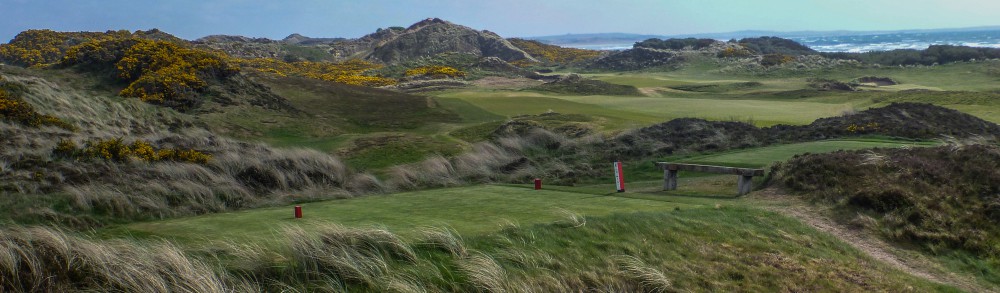
 If you play golf in cold weather, you have to do something about your ears. A knit cap is nice and warm, but it doesn’t have a bill, and you need a bill to shade your eyes when the sun is low in the sky. The traditional solution is to wear a knit cap on top of a regular golf cap. That’s not ideal, though, because unless you pull the knit cap down almost all the way to your shoulders it will try to pinch-lift the regular golf cap off your head. Recently, I found a solution: the Ball Cap Ear Band, from the Duluth Trading Co., currently on sale for $7.99. It keeps your ears well covered, and it has a slit for the bill of your golf cap, and the part that goes across your forehead helps to keep your face warm. And if you’re still cold you can wear a regular knit cap on top of it, or add one of those whole-head things that skiers sometimes wear–as I had to do on New Year’s Day in Atlantic City in 2009 (see alarming photo in previous post).
Author Archives: David Owen
Global Warming Invitational
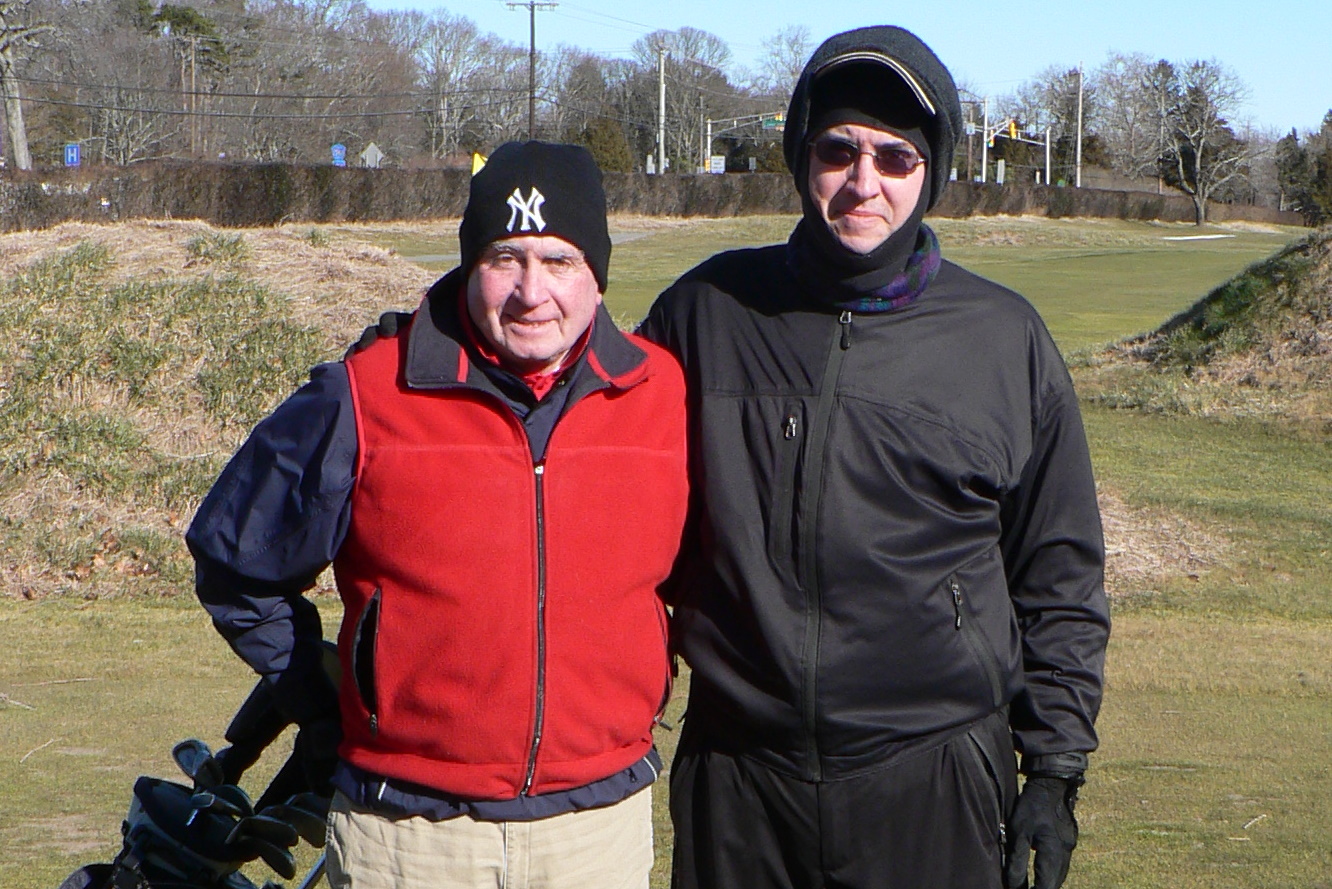
January 1, 2009. Hacker (real name) and David Owen, Bay Course, Absecon, New Jersey.
For six or seven years, my friends and I have managed to play golf on either New Year’s Day or New Year’s Eve. We’ve played at Dyker Beach Golf Course, in Brooklyn; Pelham Bay Golf Course, in the Bronx; and on the three AboutGolf simulators at Maggie McFly’s, in Brookfield, Connecticut. On New Year’s Day 2009, Hacker (real name), Other Gene, and I had to drive to Atlantic City, New Jersey, four hours to the south, to find grass. We stayed at the Seaview Resort & Spa, in Absecon, and had the Bay Course (which was designed by Donald Ross in 1914) to ourselves for two days. (Photo above.)
This year, for the first time in recorded history, we were able to play at home. My Sunday Morning Group gives one extra stroke to anyone who plays in shorts after November 1, and two extra strokes after December 1. Three of us got extra strokes on New Year’s Day. (Photo below.)

David Owen, fourth from the right; Hacker (real name), seventh from the right, holding beer.
February Golf

The weather in the Northeast this winter has been unusually warm, creating unexpected golf opportunities. My home club stayed open until New Year’s Day, a record, and a few courses in our area haven’t closed at all, or have reopened. The other day, my friend Hacker (real name) and I played a round at the Links at Union Vale, in Dutchess County, New York.
The Links was founded in the late 1990s by a group of Irish golfers from the New York metropolitan area. They were fed up with the summer crowds on the city’s public courses (of which there are a dozen) and decided to build a place of their own within weekend commuting distance. Roughly eighty of them bought shares, at ten thousand dollars apiece. They found two hundred acres of cattle-grazing farmland seventy-five miles north of Manhattan, and they hired Stephen Kay and Doug Smith to design a course for them. The investors knew of Kay because he had done some work on the bunkers at Van Cortlandt Park, in the Bronx—the first public golf course in the United States, founded in 1895—and because he had designed an Irish-style course, called the Links of North Dakota, that they liked very much.
For the Union Vale investors, Kay and Smith built a very passable imitation of an Irish links course, and they did it for just $2.5 million—a pittance nowadays. Bull’s Bridge Golf Club, a private course that Hacker and I passed on the way to and from Union Vale, was founded at about the same time. It cost more than $20 million; has been threatened with bankruptcy on a couple of occasions; had a $1.4-million lien placed on it by its architect, Tom Fazio; is still making do with a temporary clubhouse; and costs more than a hundred thousand dollars to join. The original investors in the Links, who represent various Irish golf associations in and around New York City, allow themselves preferential tee times and charge themselves reduced fees, but their club is open to everyone and their clubhouse is well stocked with Guinness. That’s Hacker in the photo above, stuck behind an old grain silo on the fifteenth hole.