The Man Who Invented the Yardage Book

Deane Beman won the U.S. Amateur twice and the British Amateur once, and between 1969 and 1973 he won four times on the PGA Tour.

UNITED STATES - SEPTEMBER 13: Golf: US Amateur Open, Closeup of Deane Beman victorious with trophy at Wakonda Club, Des Moines, IA 9/13/1963 (Photo by Lee Balterman/Sports Illustrated/Getty Images) (SetNumber: X17644)

Beman and the trophy for the 1963 U.S. Amateur. Photo by Lee Balterman/Sports Illustrated/Getty Images)

He became the tour’s commissioner in 1974, and he built the Stadium Course at TPC Sawgrass—where the Players Championship, the fifth major, will be held next month, and which you can read about in my column in the current issue of Golf Digest—and he is largely responsible for transforming the tour into a robust modern enterprise. He was also the first player to methodically measure and record key yardages on the golf courses he played, beginning in 1954, when he was still a junior:

IMG_1372

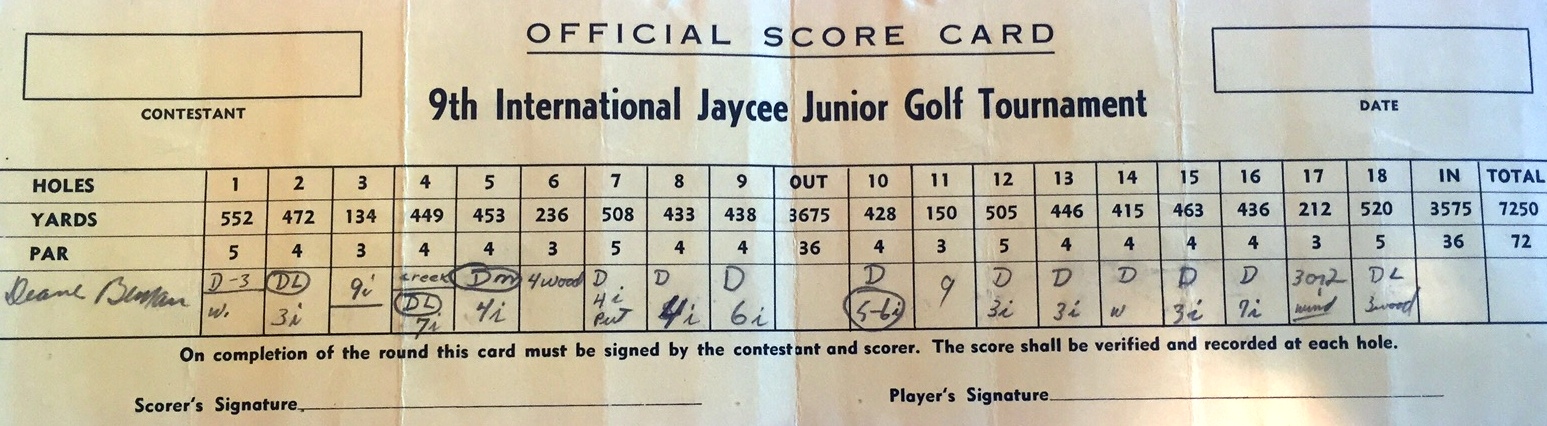
Beman’s homemade yardage guide for the 1954 U. S. Jaycee Junior Tournament, which was held on the golf course of the University of New Mexico.

“I’d pace off the golf course during a practice round, and make notes on a scorecard,” he told me recently. “It was quite unsophisticated, but pretty effective. Doing that was a little more difficult back then, because golf courses had single-row irrigation, so there weren’t as many sprinkler heads as you have today. I used trees and bunkers and things like that. A championship course usually had bunkering in the landing areas, and I could use either the front or the back of a bunker as my mark to the front of the green. And then I’d measure the green.”

Beman's front-nine notes from the 1958 U. S. Open, at Southern Hills. The circled numbers are green depths.

Beman’s front-nine notes from the 1958 U. S. Open, at Southern Hills. The circled numbers are green depths.

“I played a lot of golf with Jack Nicklaus when we were amateurs, and he would laugh when I pulled out my card,” Beman continued. “But then he got married to the idea. The first time Jack copied what I did was at Pebble Beach, for the 1961 U. S. Amateur.” Nicklaus himself said later, “I was playing a practice round with Deane in 1961 and he said, ‘Why don’t you try it one time, just walk off the golf course?'” He did, and blew away Dudley Wysong in the final. “After that,” Beman continued, “I don’t think Jack ever played a round without having the ability to really, really know the length of any shot he was facing.”

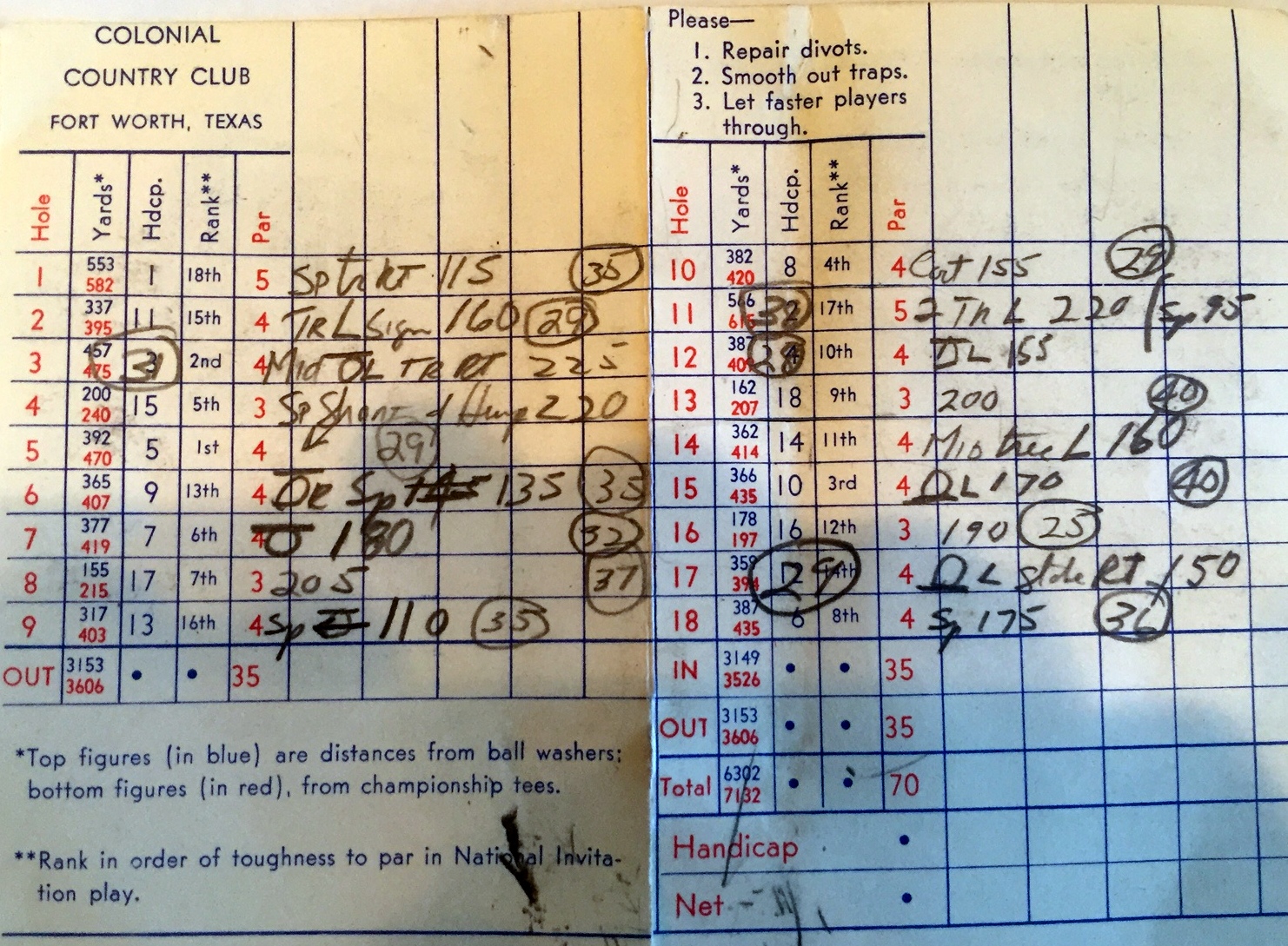
Beman's notes from Colonial, in 1960.

Beman’s notes from Colonial, in 1960.

“Now, I will say this,” Beman went on. “I was not a popular guy with caddies, because I required them to go walk the golf course before every round, and pace off every pin position. I had my yardages to the front of the green, and I knew how deep the green was, so I would give my caddie a pad on which I had marked the dimensions. I wanted to know how deep the pin was that day, and he would pace that off. Nobody had any pin sheets in those days—but I did.”

Beman's notes for the 1959 Masters.

Beman’s notes for the 1959 Masters.

Nowadays, tour players and their caddies carry extraordinarily sophisticated yardage books, which contain not just distances but also topographical details, and even lousy golfers can determine the length of just about any shot within a few feet, if they own a laser rangefinder. But players at all levels were skeptical at first, and Beman’s idea didn’t really catch on until the 1970s. Arnold Palmer, among many others, though it was dumb. Ha!

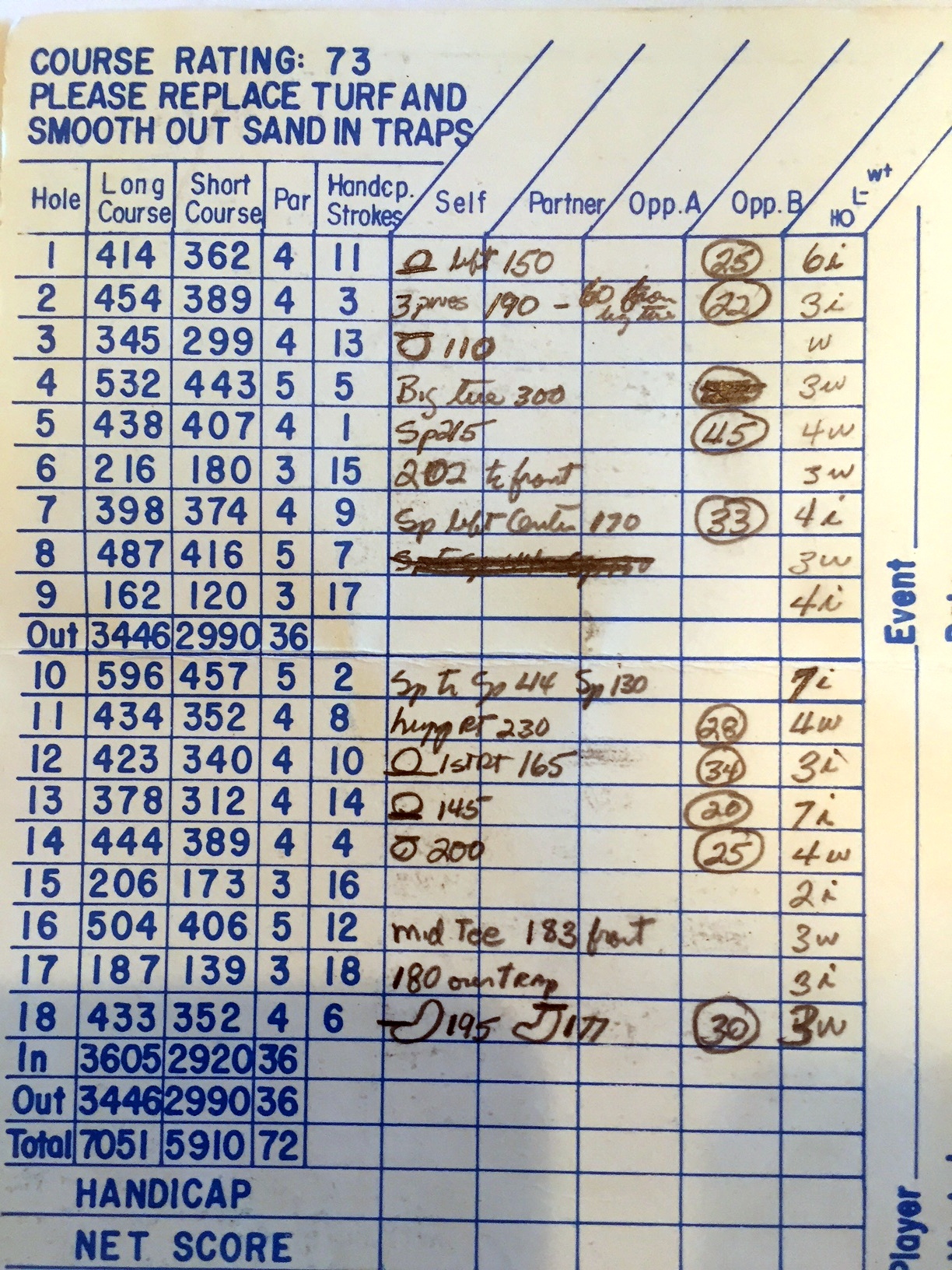
Beman's notes for Pinehurst No. 2.

Beman’s notes for Pinehurst No. 2.

“My notes became much more sophisticated once I turned professional,” Beman said. He saved those scorecards, too — but the ones in the photos above show how it all began.

IMG_1379

Golf Clothing Tip Inspired by March Madness

sox-compression

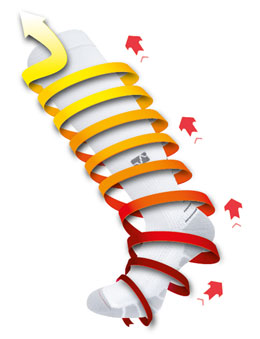
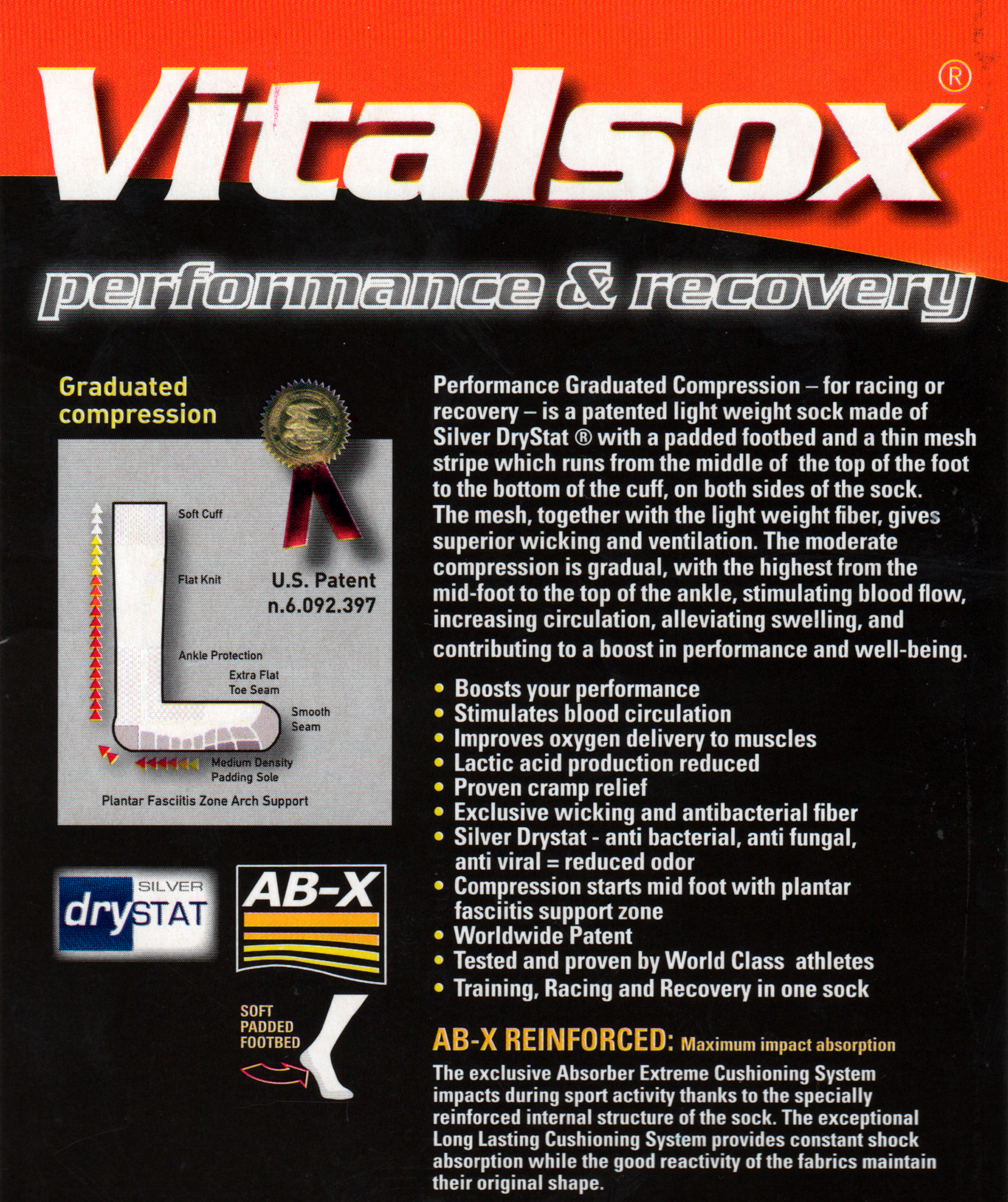
ankles started bothering me shortly after the end of the past golf season. Various possible explanations occurred to me: tendonitis, arthritis, my father’s legs (poor circulation), my mother’s legs (peripheral neuropathy), too much deskwork (ha!), advancing age, incipient varicose veins (leading current theory). I read something somewhere about compression socks, and bought a version intended for runners, from a company called Vitalsox. They’re knee-height and they’re a little tricky to put on, but they immediately made my ankles feel 80-95 percent better.

vitalsox-performancerecovery-royal-blue.jpg

So what the hell? All sorts of athletes wear them, including college basketball players, and they’re supposed to be good for people who are stuck in too-small seats on long flights, like the one that eleven golf buddies and I are about to take to Ireland. I’ve now got four long pairs and four quarter-height pairs (meant for tennis players), and I’m about to order more. The only bad thing about them is that I can’t (that is to say, I won’t) wear them with shorts. But who knows? Maybe I’ll change my mind about that, too.

Socks package-001

I’m not crazy about revealing what they look like on my actual legs, so you’ll have to use your imagination.

Better Golf, in Bar Form

P1170809

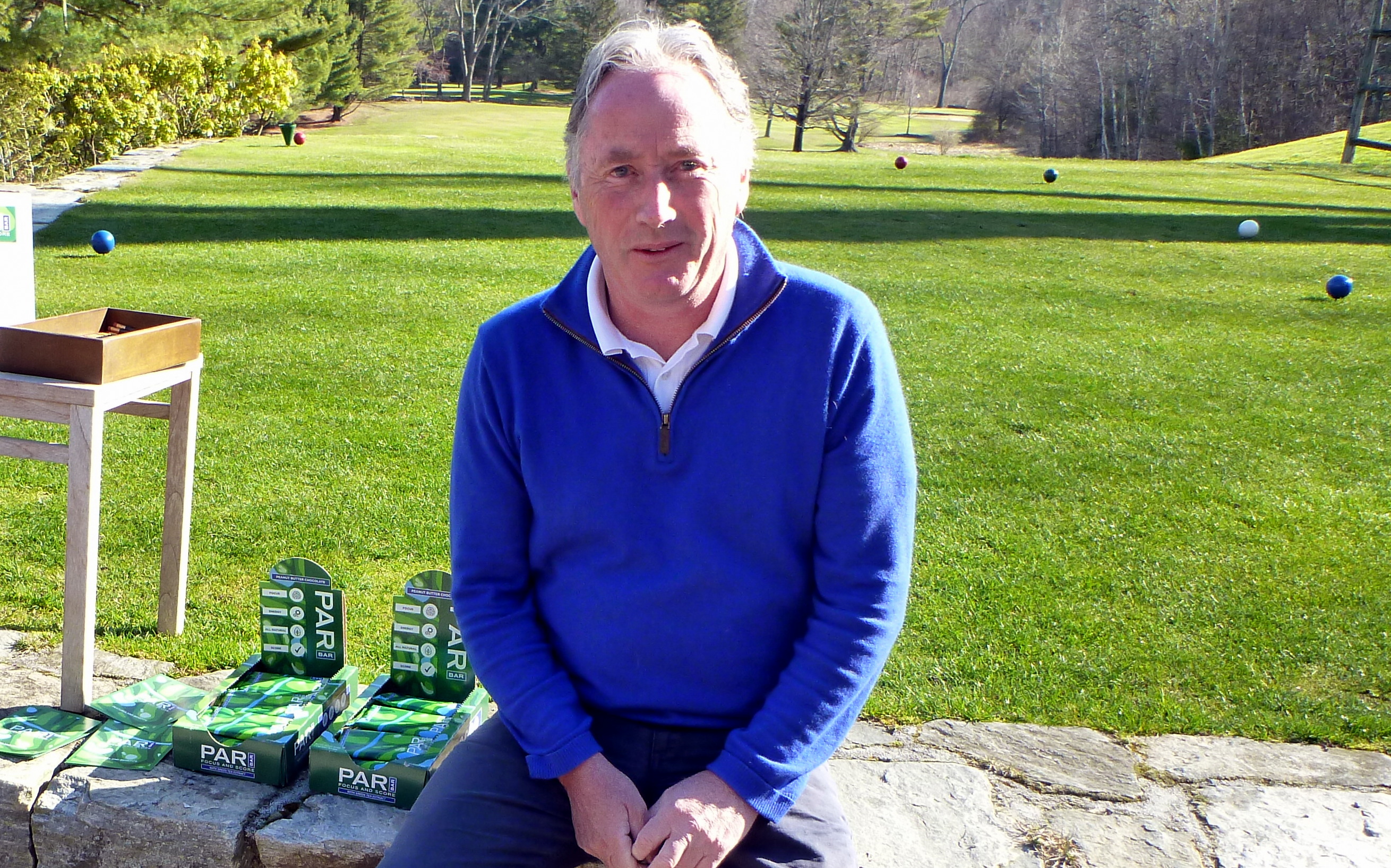
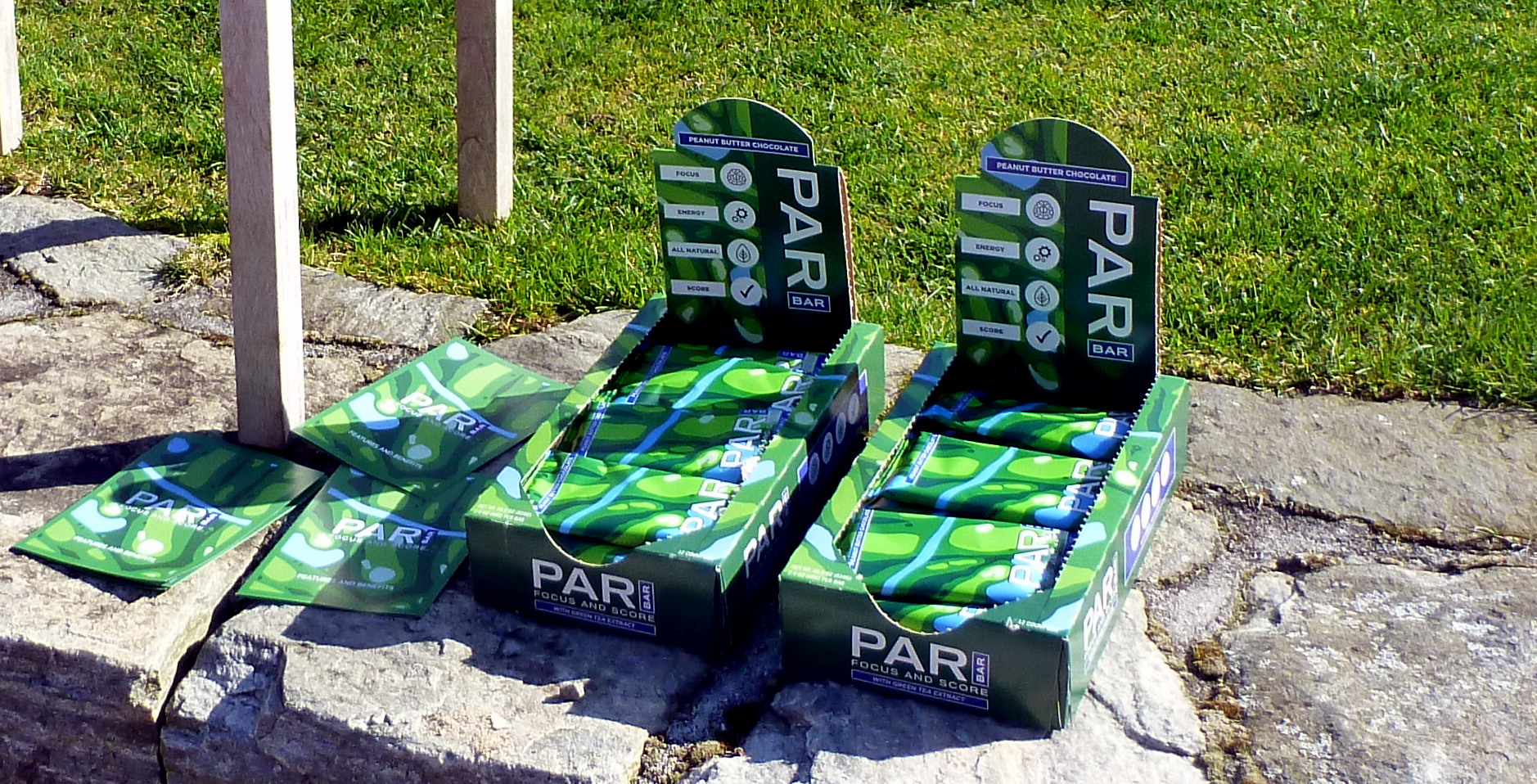
Gerry Mullally grew up in Belfast, Northern Ireland. In the early 1970s, his father sent him to the United States to get him away from the Troubles. His first job here was as a caddie at Maidstone, where, among other things, he was stiffed by Juan Trippe, the cheapskate founder of Pan American Airways. Mullally became a food scientist, and worked for several major corporations, and retired last year. In January, he began manufacturing a post-career invention of his: the Par Bar, a nutrition bar formulated specifically for golfers. I learned about him from a friend who belongs to the same golf club he does, and invited him to play with the Sunday Morning Group. He brought treats:

P1170806-001

“I created a must-have list of features and benefits and set that as the development goal,” he explains on his website. “It needed to taste really good, it should be made with only natural and healthy ingredients, and it would have to provide sufficient energy for the whole round.” The idea is to eat about a third of a bar roughly 15 minutes before you tee off, then take another bite or two every couple of holes. “The bar I set out to develop was high in protein, high in slow-release carbohydrates and high in dietary fiber,” he continues. “I had become aware of a recently approved food ingredient from green tea leaves called L-Theanine. Its properties seemed tailor-made for the challenges of golf, and clinical studies had already confirmed its ability to increase mental alertness and focus.”

par bar open

I followed Mullally’s instructions and had my best round of the season so far. Does Par Bar get the credit? I can’t say for sure, but I’ve noticed this sort of thing before. Many years ago, I covered a multilevel-marketing convention for another publication, and one of the exhibitors gave me some bee-pollen tablets. I swallowed one, and a couple of hours later I was stung by a bee. On Sunday, just about everybody played with exceptional mental alertness and focus, except for three guys who had recently watched videotapes of their swings. In the photo below, Mullally and I are on the fourth tee. You’ll notice that there’s still some advertising space available on my jacket:

P1170811

The Par Bar solves a perennial mid-round problem, to which my solution, heretofore, has usually been either a Snickers or a hot dog. And it tastes good!

P1170814


18 Good Things About Golf: No. 15

P1110831-001

15. Many of golf’s best moments occur off the course. There are the beers on the patio when your round is over. There is the midnight inspiration that sends you tiptoeing into the backyard in your pajamas with a pitching wedge and a sleeve of balls. There are the equipment catalogs that make you feel like a kid with an inside track to Santa Claus. There is that first glimpse of Amen Corner on TV each April—official proof that winter is gone. And there is the pile of golf books and magazines that teeters next to your chair, ready to return you to your favorite frame of mind whenever it’s too cold, too dark, or too wet to play.

For most of us, golf improves in retrospect. That triple-bogey on 17 reveals itself, upon reflection, to have been a double-bogey derailed by an unrepaired ball mark. And if your playing partner hadn’t coughed at the top of your backswing on the tee your drive most likely would have stayed to the left of the water: bogey. And if somebody’s dog hadn’t dug up that greenside bunker during the night your sand shot surely would have landed on grass instead of sand, and you’d have had your par. In fact, you once sank a birdie putt from almost as far away. You can still remember every inch of that curling 40-footer, which broke left instead of right but, because you pushed it, still tumbled in. And today, but for a handful of flukes, you damn near made birdie again.

P1140394

Masters Countdown: Great Moments in the History of Slow Play

Ed Furgol, 1957 Masters. (Photo by John G. Zimmerman /Sports Illustrated/Getty Images)

Ed Furgol, 1957 Masters. (Photo by John G. Zimmerman /Sports Illustrated/Getty Images)

Not all that long ago, Masters competitors, playing in twosomes, were expected to finish 18 holes in about three hours, even during the tournament’s final round. After the 1956 Masters, a competitor wrote to Clifford Roberts, the club’s co-founder and chairman, to complain that, after playing the first nine in an hour and a half, he had been told by an official to hurry up. You can read more at this blog’s official home, on the Golf Digest website. And if you “subscribe” to myusualgame.com, by filling in your email address in the blank on the right side of this page, you’ll be notified every time I post something new. And, if you’re willing to wait a month or so, you can find complete versions of all my old posts on this site, too, by paging down until you reach them.

Doug Ford and Clifford Roberts, 1957 Masters. (Photo by Augusta National/Getty Images)

Doug Ford and Clifford Roberts, 1957 Masters. (Photo by Augusta National/Getty Images)

Masters Countdown: Clifford Roberts and the Range Balls

spaldingdot

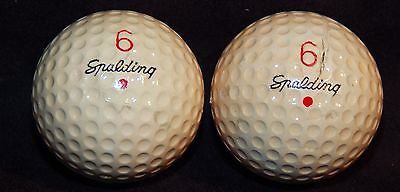
Clifford Roberts was the co-founder, with Bobby Jones, of Augusta National Golf Club, and he served as its chairman from the club’s founding until his death, in 1977. For many years, the only golf balls Roberts used were Spalding Dots, which had balata covers and were used by many tour pros. The golf shop would order six dozen before each season—all with Roberts’s name printed on them—and he would send his caddie to the shop whenever he needed a new sleeve. The first balls with Surlyn covers were introduced in the mid-nineteen-sixties, and at some point Roberts played a round with a member who was using one of them. “They’re longer than the old balls,” the member said, “and you can’t cut them.”

Augusta National/Getty Images

Augusta National/Getty Images

Roberts told his caddie to go back to the shop and return immediately with one of the club’s two head pros. “These balls I’ve got are no goddamned good,” he said when the pro had hurried over to see what was the matter. Roberts switched to the new balls, and liked them — a change that left the golf shop with six dozen Spalding Dots that had CLIFFORD ROBERTS printed on them. “There was nothing else to do with them,” Bob Kletcke, one of the pros, told me years later, “so I put them in my shag bag.” A short time later, Roberts borrowed Kletcke’s shag balls to practice with. (He always said that using striped range balls made him dizzy.) “Well, I’ll be goddamned,” he said as he teed one up. “These balls have my name on them.” And he loaded them all into his golf bag.

Arnold Palmer And Chairman Clifford Roberts (Photo by Augusta National/Getty Images)

Arnold Palmer And Chairman Clifford Roberts (Photo by Augusta National/Getty Images)

Masters Week Weather: WTF!

IMG_1415

Oh, relax—I didn’t take that photo in Augusta. I took it here in Connecticut, where we just finished the mildest winter since the dinosaurs went extinct. (The nearest muny was closed for all of eight weeks; my home course re-opened earlier than it ever has before.) But then, early Sunday morning, the world looked like this:

image1

We called off Sunday Morning Group, and I hung around the house and “did chores.” Around lunchtime, though, Addison pointed out, by email, that most of the snow was gone from his yard, so he, Tim D., Mike A., and I met on the first tee at 3:00. It was cold, and the wind was blowing hard, but we had the course to ourselves:

P1170777

Here’s what the bulletin-board thing near the clubhouse looked like when we finished, a bit less than three hours later:

P1170789

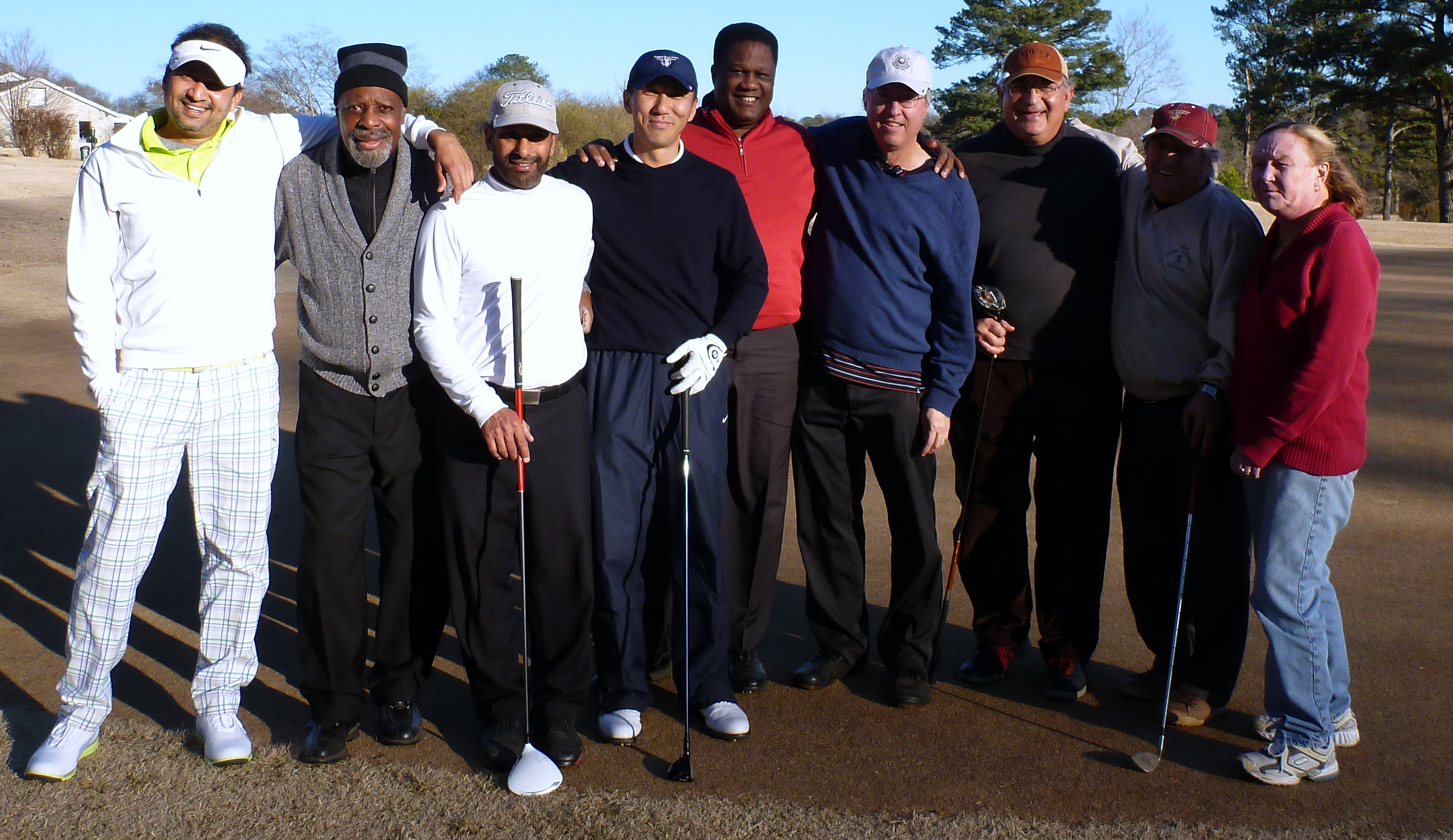
And here’s what we looked like:

This isn't an art shot. The image is crooked because I had to prop the camera on the head of my driver.

This isn’t an art shot. The image is crooked because I had to prop the camera on the head of my driver.

We’ve had several opportunities recently to make our storm gear seem like a good investment. Here’s Barney on Saturday, when we played in rain:

P1170768

And, because only three guys showed up on both Friday and Saturday, we invented a new three-man game: three six-hole matches, in each of which one of us played against the better ball of the other two. The bet was two dollars per man per match, with automatic presses. It was fun, and the money came out virtually even, but we won’t be able to try it again for a while, because more snow fell overnight—and it’s still falling right now. I’m doing laundry!

IMG_1394

Reader’s Trip Report: 2016 Connecticut Golf Show

Mark Beebe, in "visor wig."

Mark Beebe, in “visor wig.”

The forecast for two Sundays ago included “up to” a foot of snow. We got about three quarters of an inch, so I guess the forecast was accurate. The day before the big storm, Mark Beebe, an out-of-town member of the Sunday Morning Group, visited the Connecticut Golf Show, at the convention center in Hartford, with his golf buddy Tom. Mark’s report:

“Tom’s wife is recovering from a serious illness, and he’s also been helping another old golf buddy, ‘Lefty’ Bob, who’s in failing health. So it was good to see him and get him out doing something we both like: wasting time doing golf stuff.”

ctgolfshow16

“Pretty much all the major equipment guys were there. I didn’t try any of the clubs, because my March swing is not of club-fitting quality and if I wait until my July swing shows up the same equipment will be available at a higher price—the same strategy I use for investing in stocks.”

ctgolfshowbags

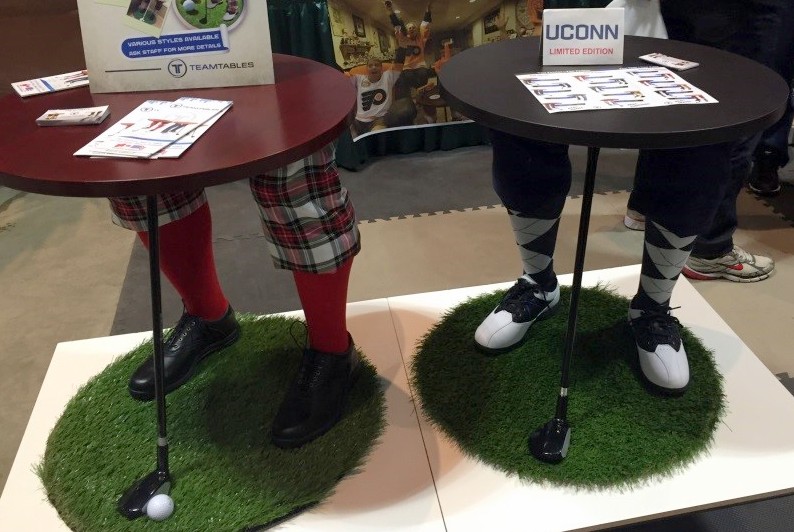
“Nevertheless, I did buy a few things. I broke my No. 1 rule, as always, by buying a club without swinging it, a TaylorMade M1 3-wood. I also bought a ball marker with the insignia of Michigan State, my alma mater—which was nice because the Spartans had just gotten bounced from the NCAA tournament, in the first round, the day before. There were no Middle Tennessee State ball markers, but I did pick up a dozen of last year’s Titleist NXT Tours. I went through racks and tables of remnants and leftovers, and noticed that they had great prices for small and medium golf shirts, but hardly anything in XL. There was also a guy selling coffee tables:”

table legs

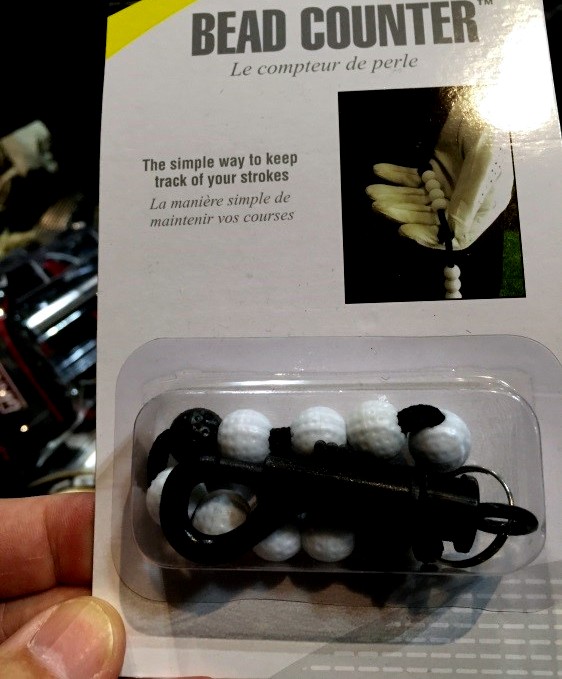
“Does anyone actually keep score with these things?”

bead counter

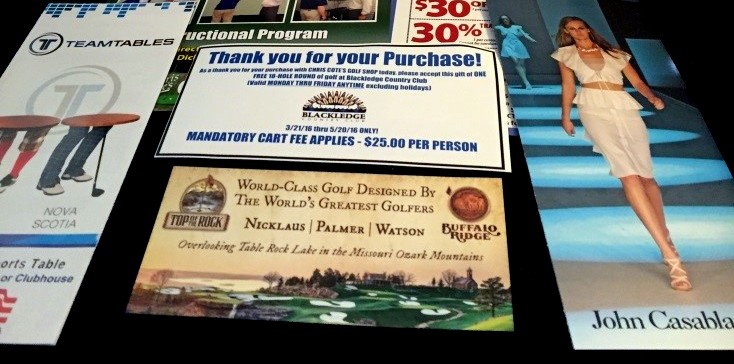
“I picked up lots of brochures from golf resorts, and one from the John Casablanca modeling and talent agency, which had a booth. I asked the Casablanca people why they had come to a golf expo, and they said, ‘Because that’s where the people are.’ I took their brochure to give to my daughter, who is studying theater in college.”

casablanca brochure

“Tom and I stopped for lunch on our way home and got caught up. That was the best part. We’re hoping to tee it up in the next couple weeks, weather and health issues permitting. And when I got home I found a good place to put my NCAA bracket:”

beebe ncaa bracket

Masters Countdown: Why Does Augusta National Have Two Head Pros?

Augusta National has two head professionals, Tony Sessa and J.J. Weaver. They started as assistants under the club’s previous co-professionals, Bob Kletcke and David Spencer, and they moved up when Kletcke and Spencer retired. But how did Augusta National end up with two head professionals in the first place?

J.J. Weaver and Christine Wang, who won the girls' 12-13 division of a regional round of the Drive, Chip and Putt in 2013. (Bob Levey/Getty Images)

J.J. Weaver and Christine Wang, who won the girls’ 12-13 division of a regional round of the Drive, Chip and Putt in 2013. (Bob Levey/Getty Images)

The club’s original pro was Ed Dudley, who was Bobby Jones’s first choice for the job. (His second and third choices were Macdonald Smith and Willie MacFarlane.) Jones explained his criteria to Clifford Roberts, the club’s co-founder and chairman, before the two of them approached Dudley: “First of all I want a gentleman. Next, I feel we should select a pro who likes to teach. And, finally, I believe we want someone who is a good player.”

Robert P. Jones (Bobby's father), Jerry Franklin (an important early member), Clifford Roberts, Bobby Jones, and Ed Dudley, the club's first pro, 1931. (Augusta National/Getty Images)

Col. Robert P. Jones (Bobby’s father), Jerry Franklin (an important early member), Clifford Roberts, Bobby Jones, and Ed Dudley, the club’s first pro, 1931, three years before the first Masters. (Augusta National/Getty Images)

A fourth requirement was that the new pro be willing to work without a salary, since there was no money to pay him. Dudley at first had to get by on what he could earn from lessons and his minimally stocked golf shop—a tough proposition, considering how few golfers played the course in the early years.

Augusta National/Getty Images Clifford Roberts and Ed Dudley, 1940s.

Augusta National/Getty Images
Clifford Roberts and Ed Dudley, 1940s.

Beginning in 1934, he supplemented his income with earnings from his souvenir tent at the Masters and from the tournament itself, which he played in fourteen times. He finished in the top ten seven times during the first eight tournaments, and he came close to winning in 1937, when he finished third, behind Byron Nelson and Ralph Guldahl.

Augusta National/Getty Images Dudley's "golf shop" at the 1940 Masters. That's Lloyd Mangrum on the right.

Augusta National/Getty Images
Dudley’s “golf shop” at the 1940 Masters. That’s Lloyd Mangrum on the right.

Dudley retired from Augusta National in 1957 and was succeeded by his assistant, Gene Stout, who had also been his assistant at the Broadmoor, in Colorado Springs, where the two men worked during the summers, when Augusta National was closed.

Augusta National/Getty Images Gene Stout showing off samples of his tournament merchandise at the 1962 Masters.

Augusta National/Getty Images
Gene Stout showing off samples of his tournament merchandise at the 1962 Masters.

Stout was replaced in August, 1966, by his assistant, Robert Kletcke.
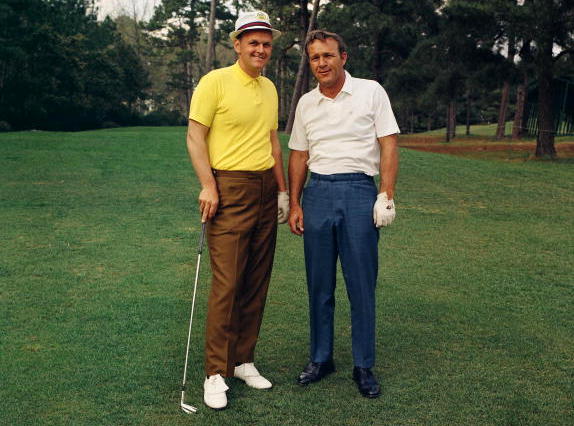
Augusta National/Getty Images Bob Kletcke and Arnold Palmer in the ninth fairway, in the 1960s.

Augusta National/Getty Images
Bob Kletcke and Arnold Palmer in the ninth fairway, in the 1960s.

And that same year Kletcke hired David Spencer to serve as his own assistant.

In the spring of 1967, at the end of Kletcke’s first season as the club’s head pro, he and Spencer were called to a meeting with Roberts. They were both nervous, because they figured they must have done something to displease their boss. When they arrived, though, they found Roberts in a good mood, and he told them they had done a good job. He said, furthermore, that he and the other members were tired of getting to know and like the club’s assistant professionals, only to have them move on to other jobs after just a few years. He said that he would like for both Kletcke and Spencer to remain at the club, and that if they continued to do a good job they could stay for as long as they liked.

“But I don’t want Bob eating steak and Dave eating hamburger,” Roberts went on. He said that he had arrived at a solution, which was for the club to have two head professionals, or co-professionals. He had had the club’s general manager draw up a partnership agreement, and he said that if they would sign it the jobs would be theirs. He said he realized that such an arrangement could lead to tensions, and that he did not want the two men to think of themselves as rivals. As a result, he said, if a situation ever arose in which he felt compelled to fire one of them, he would fire them both.
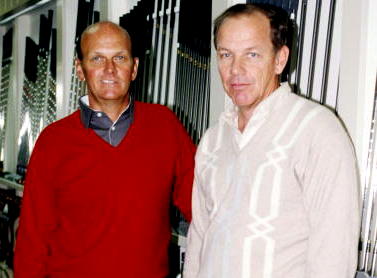
Augusta National/Getty Images Bob Kletcke and David Spencer.

Augusta National/Getty Images
Bob Kletcke and David Spencer.

Kletcke and Spencer were surprised by Roberts’ offer, and they asked if they could take the proposed agreement back to the golf shop to talk it over. On their way past the clubhouse, Spencer said, “Gee, Bob, I don’t know about this.” He had planned to stay at Augusta National for a few years, as was customary for assistants, then seek a head professional’s position at another club, probably in the Midwest.

“I don’t know either,” Kletcke said. “I’m not sure it’s a good idea.” Kletcke had been thinking he would like to try to play on tour. (He later did so briefly, with Roberts’ encouragement and with financial backing from several Augusta members.) Neither man was enthusiastic about sharing a job. They weren’t sure they would be compatible partners, and they weren’t excited by the thought that a misstep by either one of them, in Roberts’ eyes, could put both of them out of work. They talked about the proposal for some time, and came to the conclusion that it didn’t make sense for them. It had been considerate of Roberts to make the offer, but the arrangement was clearly unworkable. The only matter to be decided was which of them would tell Roberts.

“I’ve been here longer,” Kletcke said. “Why don’t you go back and tell him?”

“You know him better than I do,” Spencer said. “I think you ought to go.”

There was a long silence. Each man imagined knocking on Roberts’ door and explaining that neither of them liked his plan. They looked at the ground.

“Maybe we could both go.”

There was another long silence.

At last, Spencer held out his hand and said, “Well, how do you do, partner?” And the two men worked together, at adjacent desks, for the next four decades. If either of them had had the nerve to return to Roberts’ room after their meeting in 1967, both almost certainly would have left Augusta to do something else.
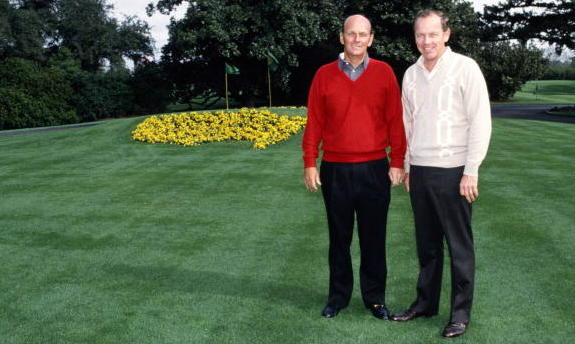
Bob Kletcke and David Spencer. (Augusta National/Getty Images)

Bob Kletcke and David Spencer. (Augusta National/Getty Images)