18 Good Things About Golf: No. 9

Looking at clubhouses counts as sightseeing. Royal & Ancient Golf Club, Old Course, St. Andrews, Scotland, May, 2008.

9. Golf provides an organizing principle for travel. Mere idle globe-trotting doesn’t appeal to me; I like a trip to have a purpose. For that reason, I enjoy traveling with children. Having kids along forces you to do things you really enjoy (buying ice cream, visiting a dungeon museum, taste-testing foreign candy) and to skip things you really don’t (going to plays, touring the wine country, looking at statues). Keeping your kids from slitting each other’s throat compels you to find activities that actually are interesting, as opposed to merely sounding like the kinds of activities that people engage in when they go on vacation. When children are not available, golf can serve a similar function. Rather than tramping aimlessly around Scotland in the hope of being moved by the differences between it and America, you tramp around Scotland checking off names on your life list of Open Rota courses.

On a golf trip, every day has the same unimprovable agenda: wake up, take shower, drink coffee, eat bacon, play eighteen holes, eat lunch, play eighteen holes, drink beer, take shower, eat dinner, go to sleep. The best golf trips, unlike the vacations that wives plan, never leave you wondering what to do next, and there is never an empty three-hour time block in which you might suddenly be expected to look at a cathedral. You don’t have to wait between lunch and golf, or between golf and beer, or between beer and shower, or between shower and dinner. When one agreeable activity ends, another begins. And on the last day, during the long drive back to the airport, you can pass the time by planning the next trip.

I did actually have a look at a Scottish castle in April, but it was on the road between golf courses and I needed to take a whiz.

Golfer’s Cure for Jet Lag

The cure for jet lag is golf. You take the overnight nonstop to Scotland from Newark, arrive bleary-eyed in Glasgow at 8:00 in the morning, drag your clubs past the bomb-sniffing dogs in customs, stumble into a men’s room designated “loo of the year,” change a tall stack of American dollars into a short stack of British pounds, drive 55 miles through Robert Burns country while trying to remember to admire the sheep-dotted hillsides, reach Turnberry in a daze—and tee it up on the Ailsa course, where Tom Watson and Jack Nicklaus fought their legendary Duel in the Sun, at the British Open in 1977. You haven’t slept since what seems like the day before yesterday, but your tee shot somehow finds the fairway, and a little mental arithmetic reveals that your colleagues back home are arriving, just now, at their desks. Suddenly, you feel happier than you’ve felt since the birth of your first child, or since the time you and your brother nearly won the member-guest. (Not to worry: The cure for excessive cheerfulness is also golf.)

Or so I’ve decided over the years, during a number of golf trips abroad: Hit the ground running, and keep running until dinner. I was gratified recently when a doctor who treats sleep disorders, whom I was interviewing for an article, recommended the same thing. To beat jet lag, he said, don’t take a nap upon arrival (my wife’s approach); keep your eyes open until the locals call it a day, or at least until the sun has gone down. That’s what I did this past week, in Scotland, and it’s what I did again yesterday, when I got back home. And I’ll do it again tomorrow, when six of my friends and I take off for a week of golf in Northern Ireland and northwestern Ireland.

Yesterday, my last day in Scotland, I had to interview someone in downtown Edinburgh, and I took a taxi from my hotel, which was at the airport. A guy up ahead of us did something stupid, but the taxi driver anticipated it—he told me he could read the guy’s mind—and he honked and said “What an idiot!” almost before the guy himself knew what a stupid thing he was about to do.

The taxi driver doesn’t own a car, he told me; when he and his wife need to go somewhere far away, they rent one. Usually, they pick it up at 11:00 a.m. and return it the next day at 11:00 a.m. Sometimes, 10:00. He rents from Arnold Clark, and gets a medium-size car, like a Corsa or a Focus. Once, he got upgraded to a really big car because they were out of medium-size cars, and some of his relatives felt initially that he was putting on airs. Occasionally, when he and his wife go to visit his wife’s mother, who lives near the English border, they will use his taxi, an old-fashioned English black cab, and his wife will ride in the back, “regally.” In fact, when he retires, a few years from now, he may keep his taxi, because he enjoys driving it, and sell just the “plate,” which is their equivalent of a medallion. He and his wife go on holiday every September; last year, they spent two weeks in Greece. That cost £3,000, for the two of them, including air fare. He likes to stay in four-star hotels, but in Greece they stayed in a five-star hotel. He likes to take “all-inclusive” trips—self-catering is too much trouble on vacation—but the Greek trip included only breakfast and dinner. That didn’t bother him too much, because when he’s traveling he eats a lot at breakfast—orange juice, corn flakes, yogurt, porridge, eggs, sausage, bacon, black pudding, haggis, beans, you name it—so much that has to let out his belt when he leaves the dining room. His wife, by contrast, eats nothing but toast and sometimes has trouble making it even till lunch. Keeping the weight off is harder than it used to be, even though he goes to the gym, but what choice do you have? The places he and his wife like to go are: Spain, the Canary Islands, Greece, Majorca. They usually go away in September, after the schools have started up again, because then you can get bargains, but just yesterday he looked into going away in July, too. The best the travel agent could do, though, was £1,000 apiece, all-inclusive, for a week—even in Greece! He thinks it might be possible to do better online, but hasn’t checked yet. At any rate, the travel agent said to come back in July or August and have a look at September then. Next year, for his sixtieth birthday, his wife wants to take him to New York City, where he (unlike her) has never been. He wants to go, but four hours is the limit for him, air-travel-wise. Two hours, two and a half hours? Fine. He doesn’t start to panic if he’s in the air longer, but he doesn’t like it. The best way to fly to New York might be with a stop somewhere on the way—maybe in Iceland—to break up the flight. That might make the ticket cheaper, too, since the flight wouldn’t be direct. He thinks that four days should be enough for New York, and he has been told that the part of New York that he and his wife should visit is midtown Manhattan. He was very glad to hear that I agreed with that recommendation.
The Capital of Left-Handed Golf (No, Bubba, It’s Not Augusta, GA)

Clubhouse, Kingussie Golf Club, Scotland.

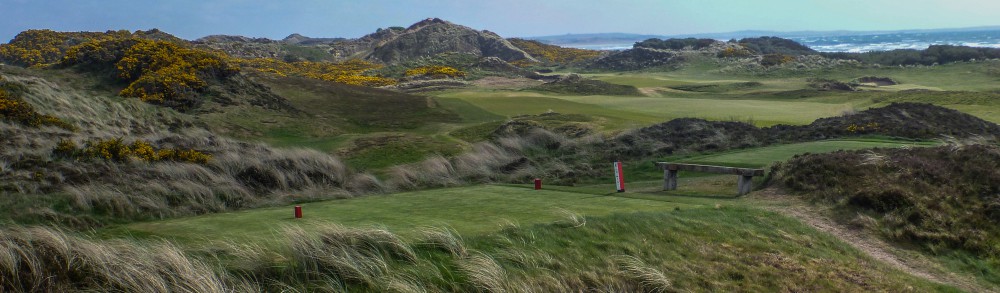
In 1992, when I was new to the game, I took my first golf trip to Scotland. You can probably guess at least part of the itinerary. I played at Turnberry, Gleneagles, St. Andrews, Carnoustie, and Dornoch, and I finished at Tain, an Old Tom Morris course at the inland end of Dornoch Firth. That last round went by so fast that it left me with most of a day to fill, so I asked my playing partners, who were Tain regulars, if they could recommend a course on the long road to the airport—any course at all. They suggested Kingussie, just off the A9, about a third of the way between Dornoch and Glasgow, in what is now Cairngorms National Park. So that’s where I went.

My expectations were neither high nor low; I just wanted one more chance to swing my clubs. But during the decade and a half since then I’ve probably thought about Kingussie as often as Carnoustie. You could never hold a British Open there—among other reasons, the course is almost 2,000 yards too short—and golf-tour operators almost never send American travelers to play it. Nevertheless, it stuck in my mind. The course (which was expanded and redesigned by Harry Vardon in 1908) is set in and around the elevated valley of the River Gynack, in the rocky hills above the village. The first hole is a long, semi-blind par-three, and the sixth is a short par-4 that plays past the ruin of an old shieling, or shepherd’s hut, and the fourteenth, called the Dyke, runs along an old stone wall. It was a memorable finish to a memorable trip.

The Shepherd's Hut, Sixth Hole, Kingussie.

I returned to Kingussie in 2007 and played with three Scots, two of whom were on holiday from the Orkneys, a cluster of small islands north of the Scottish mainland. When we had finished, we had a drink with a group of regulars sitting at two picnic tables outside the clubhouse. One of them told me, “Kingussie has more left-handed and cross-handed players than any other golf club in the world”—a consequence, he said, of the town’s intense devotion to shinty, a bruising Highlands stick game that is similar to the Irish sport hurling (from which it evolved) and to field hockey, and in which there is apparently a tactical advantage to playing from the wrong side of the ball. No, no, another member insisted: there are more left-handed golfers in Newtonmore, Kingussie’s principal shinty rival, three miles to the west. The conversation then veered into a discussion of Newtonmore’s golf course, which my new friends unanimously dismissed as too flat to bother with.

One of my new friends from the Orkneys.

That evening (after a second eighteen), I drove over to Newtonmore and watched a youth shiny practice, the only form of the game available locally that evening. I stood with a group of shinty moms in a parking lot filled with Scottish minivans, and saw that grade-school shinty players, unlike the adult shinty players in the stories I had heard at the picnic table at Kingussie, wear helmets and still have their teeth.

Shinty practice, Newtonmore, Scotland, 2007.

Tom Watson, Seventh Grader

Wheezer, 1962

Tom Watson and I had the same seventh-grade math teacher. Watson is six years older than I am, but we attended the same school, in Kansas City. It was called Pembroke-Country Day then and is called Pembroke Hill now. It was boys-only in our day; it began to go co-ed when I was a senior.

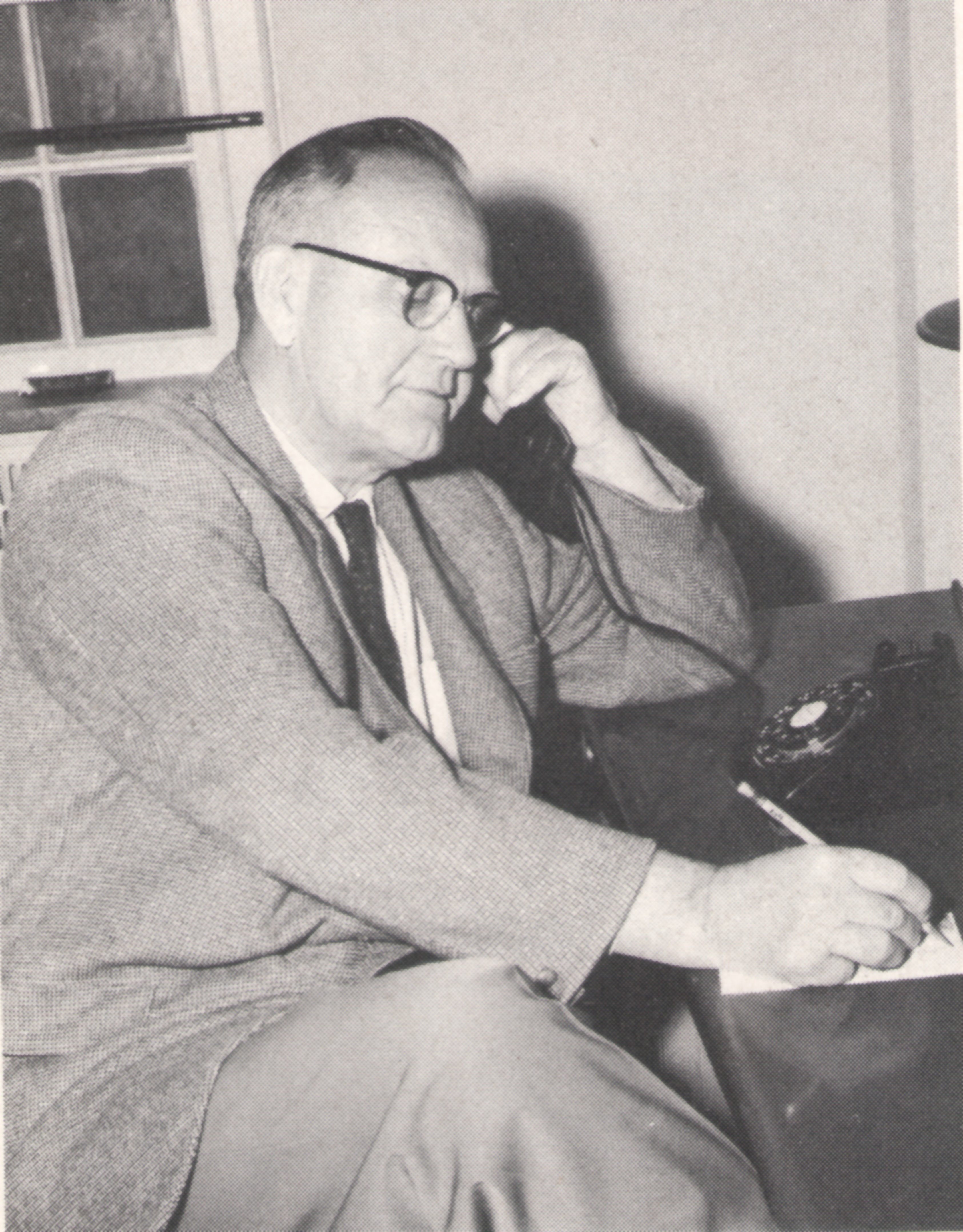
My father had had the same math teacher, too, many years before. In my father’s day, the math teacher’s nickname was Tarz, short for Tarzan, because he was built like Johnny Weissmuller; by the time Watson and I had him, his nickname was Wheezer. He looked like Lyndon Johnson, with tremendous gravity-stretched jowls and ear lobes. Age must have lengthened his scrotum, too, because he was always careful to lift his testicles out of the way before sitting in a chair or leaning back against the front of his desk. Sometimes, my friends and I, as we took our seats for math, would pretend to lift our testicles out of the way, too.

Wheezer supervised one of my study halls. One day, an eighth-grader hid a running tape recorder inside a locker in the back of the room, and every five or ten minutes the tape would scream, “WHEEEEEEE-ZER!” There would be pandemonium; then, gradually, everyone would settle down; then it would happen again.

When Watson was in high school, in the mid-sixties, he was the captain of the golf team, of course, but he was also an outstanding shooting guard on a very good basketball team, and he was the quarterback (and leading rusher) on the football team, which won a conference championship. He would put his golf clubs away every August, when two-a-day football practices began, and he wouldn’t touch them again until February, when basketball season was over—a mentally and physically healthy approach to sports that athletic prodigies don’t follow anymore.

I never saw Watson play golf, but I did cheer for him at basketball and football games. Then, in 1967, he went off to Stanford without a scholarship, figuring he’d end up in the insurance business.

Watson was the subject of one of my first magazine articles, a profile for Esquire, which ran in 1982. I had to revise the ending over the summer, as it went to press, because he suddenly won the U.S. Open, at Pebble Beach, after making his famous chip-in birdie on the seventeenth. And then, in July, after the issue could no longer be updated, he won the British Open, too.

These photographs are from Pembroke-Country Day’s yearbook for 1967, when Watson was a senior and I was in sixth grade. I’m pretty sure I was in the bleachers at the football game below, because my friends and I didn’t miss many. Watson is at the far left.