

I had an article in last week’s New Yorker about fancy airplane seats. Here’s something about air travel I’ll bet you didn’t know: the rule of thumb for in-flight entertainment systems is “$1,000 an inch”—meaning that the small screen in the back of each economy seat can cost an airline $10,000, plus a few thousand for its handheld controller.

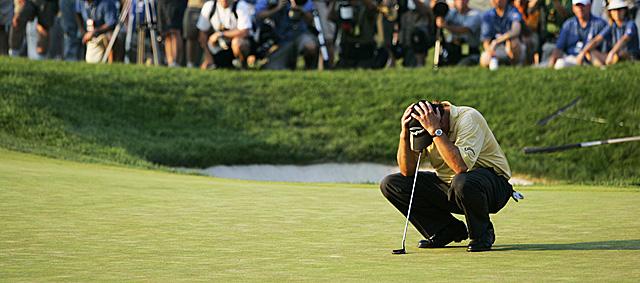
On June 18, 2006, I flew to Las Vegas on JetBlue with my wife and our two kids, and the flight was great because I got to watch almost the entire final round of the U.S. Open, at Winged Foot, on the screen in the back of the seat in front of me. The broadcast broke up as we were landing. Phil Mickelson had just hit a terrible drive into trouble on the left on the final hole, but he had a one-stroke lead and was about to win his third major in a row—good for him! I thought nothing more about it until the next morning, when I turned on ESPN. They were talking about Geoff Ogilvy and his victory at the U.S. Open, and at first I thought that the tournament I’d watched on the plane must have been a recording of the Open from some other year. Eventually, though, I learned what had happened.
Two weeks ago, I traveled to Calgary to give a talk (not about golf), and as a result I didn’t get to watch any of the first three rounds of the Masters, even on the plane. I went out to dinner with some of the people who had sponsored the conference I spoke at, and the husband of one of them, a lawyer, told a story about an airplane trip he took in the late 1960s, when he was about twenty.
Here’s the story: This lawyer fellow (whom I’ll refer to as Fellow) goes with a friend of his to the Toronto airport, where Friend (ditto) is catching a cheap charter flight to London. There’s construction going on at the airport, and the gate area is a mess, and everyone is sort of milling around. Fellow stands with the other non-passengers, waiting to wave farewell, but at some point Friend says, “Come on—let’s see how far you can get.” Fellow says, “No, no, I’ll get in trouble.” They go back and forth like that, but Friend eventually talks him into it, and, when the passengers are taken onto the tarmac to board a shuttle to take them to the plane, Fellow goes with them.
On the shuttle, Fellow says, “I don’t have anything!” and Friend says, “Here, take this,” and gives him his ticket envelope (while keeping the ticket). When Fellow gets to the plane, he sort of waves the envelope at the stewardess in the doorway and says “22C,” and boards the plane. He has no ticket and no passport and no luggage, and he’s wearing shorts. He sits down in 22C, and Friend slips into one of the restrooms and closes but does not lock the door.
The stewardesses count the passengers. The plane takes off. There are one or two empty seats on the plane, and Friend comes out of the bathroom and sits down. The plane lands at Gatwick, and all the passengers get off. There is enough confusion at the airport that Fellow is able to slip through customs, perhaps aided by the fact that he is maybe the only person in England who is wearing shorts. He calls his mother, back in Canada, and asks her to mail him his passport and some money. She sends him $100. He figures he’ll get a job of some kind, but mostly he just hangs out in pubs with Friend.
After about a month, Fellow gets some part-time work helping a guy who handles travel for University of Toronto students studying in England. One day, the guy hands him the unused return portion of a round-trip ticket that belonged to some student, and says, “Here. You owe me.” (This was in the era when half a round-trip ticket was often cheaper than a one-way ticket, and airlines didn’t penalize you for using it.)
The ticket has someone else’s name on it, but Fellow successfully uses it, along with his actual passport, to fly back to Toronto. When he lands, has just 50 cents—enough to take a bus only partway to the city, so he figures he’ll go as far as he can and then walk. While he’s waiting for the bus, he looks down and sees two bus tickets lying on the ground. He goes to the place he worked before he went to England, to get his last paycheck, which he had never collected. While he’s doing that, the boss comes out asks him what he’s doing, and re-hires him, and he goes to work the next day.
This new format sucks.
It does take a little getting used to. . . .
i xan’t figure out how to comment on the new style blog at g digest site. ugh.
I know it’s possible. I’ll investigate
I think I see now. I think you have to register with the GD site–which you can do down in the comment section at the bottom of each post. At any rate, my plan at the moment is to “archive” copies of all GD posts on this site, too, a couple of weeks or a month after they appear on golfdigest.com, because I like having everything all nice and neat in one big pile.
Don’t want to support Golf Digest. Sorry. Will I be able to read your stuff here, still?
Well, to the Web gods there’s no difference between this site and the Golf Digest site. That’s what “in association with Golf Digest” means. Plus, I like Golf Digest, since they send me to interesting places. Still, I am planning to place copies of all my new Loop posts on this site, too, after some decent interval, because I like the idea of having everything intact in one place.
No difference? Really?
I presume that the Golf Digest advertisers see a very big difference between my clicking here and my clicking at golfdigest.com.
Clicks here are counted as clicks on golfdigest.com. Everything goes to the same stomach.
I presume you did not miss my point: that if GD advertisers are paying for clicks here, they are not getting their money’s worth, since you don’t show their ads.
Btw: great piece on the airline seats. Just read it on my NYer iPad ap.
I understand your point. And thank you!
You’re most welcome.
I’ve been enjoying your work for 30 years or so. I must be one of the few who have a copy of “The Man Who Invented Saturday Morning” — and “My Usual Game” is one of my favorite golf books.
Thank *you* for being responsive. I have attempted dialogue with numerous national media figures, over the years (including one of your higher-ups at Golf Digest, with whom I used to work), and only three of you have been willing to engage at all: James Taranto of the Wall Street Journal; Bill Falk of The Week; and now you. Much appreciated.
If you’re ever in Minneapolis-St. Paul (during the non-winter months), give me a holler and we’ll tee it up.
Just try to shut me up. And thank you AGAIN.